

Партнерка на США и Канаду по недвижимости, выплаты в крипто
- 30% recurring commission
- Выплаты в USDT
- Вывод каждую неделю
- Комиссия до 5 лет за каждого referral
When moving along the chord of force  the variable force in the truss bar is given by:
| (19) |
 ,
,where 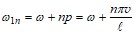 ;
;
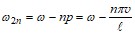 .
.
In this case the value of the coefficient  in equation (6):
| (20) |

where,  .
.
Frequencies  and
and  are modulated at carrier frequency
 .
.
In the first approximation, the critical frequencies corresponding to single-frequency parametric resonances are given by:
| (21) |
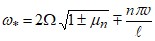 .
.The carrier frequencies are proportional to the speed of the load only if the source of the disturbance is the inertia forces of the unbalanced rotating masses associated with the object moving by the lattice truss (train).
I. e.  , where
  – radius of wheels.
In this case:
| (22) |
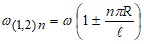 ,
,and
| (23) |
 .
.Usually  . For example, when the train is moving (
 =0.525 m), the estimated span of the trusses
  =33…110 m value
  is 0.005…0.015.
In this case, the regions of dynamic instability are concentrated around the region 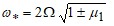 , width of these regions decreases with increasing n as the value of
  increases, since the Fourier coefficients
  decrease substantially.
With the help of expression (23), it is possible to determine the critical speeds of load movement along the truss:
| (24) |
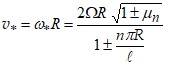 .
. Since the oscillations of the bar of the higher trusses are high-frequency, the critical speeds of the load motion along the railway bridge are realized only in the high-speed mode [4].
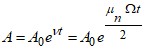
The increase in the time of the amplitudes of the resonance parametric vibrations occurs, without allowance for the resistance, according to the exponential law with the exponent :
:
| (25) |
 .
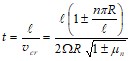
.Time of movement of load on the span of the truss is limited:
| (26) |
 .
.Consequently, the value of the exponent in this case:
| (27) |
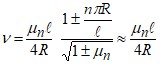 .
.For a span structure with lattice trusses of a large railway bridge with parameter values  =0.03, ℓ=110 m, R=0.525 m values of the parameters
  is 1.7 and
  =4.806.
In this case, there is a significant increase in the vibration amplitudes even with a relatively small excitation coefficient .
.
It should be noted that the parametric resonances of the bar elements of trusses can be realized only in higher forms of vibrations (oscillations), since they are high-frequency.
In this case, there is no significant superposition of parametric and forced oscillations of the bars, since the critical frequencies are twice the vibration frequencies of the bar at which ordinary resonance can take place . Forced oscillations in this case occur in the supercritical region where the dynamic coefficient is less than unity (in the considered case it is 0.33).
When studying forced oscillations, one can neglect the effect of the variable frequency of free oscillations and use equation (1) with the value  =0. The values of the kinematic perturbations of the bar ends can be determined from an analysis of the general vibrations of the truss for the investigation of which it is necessary to apply known methods of structural dynamics or to use the corresponding computational complexes (for example, COSMOS/M).
In the domains of stable solutions we obtain the following asymptotic solution of the homogeneous equation (1) [5]:
| (28) |
 ,
,Investigation of oscillations of bars in regions of dynamic stability
In the general case, the integrals in the right-hand side of equation (28) cannot be expressed in terms of elementary functions.
Taking this into account, we represent the equation  in the form of a uniformly convergent series:
| (29) |
 ,
,where, 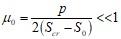 – small parameter.
Substituting equation (29) into (28), we obtain:
| (30) |
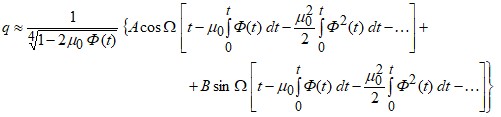
Integrals of the form  in practically important cases are expressed in terms of elementary functions.
In the case where the function  can be represented as a polyharmonic process
 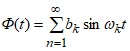 , then the solution of equation (30) will be represented in the complex form of writing.
| (31) |
 ,
,where  .
.
Using relation 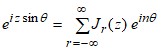 , where
  Bessel functions with a whole icon we obtain the following equation:
| (32) |
 .
.The analysis of expression (31) indicates the presence in the total vibration of harmonic components with frequencies of the  and amplitudes proportional to the product of Bessel functions
 .
.
The oscillation spectrum is practically limited due to the properties of Bessel functions and because of negligible values provided that their argument is much smaller than the index. For example, under the  condition for a fixed index r, we get:
| (33) |
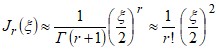 ,
,where  – gamma function of an integer argument with parameter values
  ,
,  ,
,  .
.

|
Из за большого объема этот материал размещен на нескольких страницах:
1 2 3 4 |
