


Партнерка на США и Канаду по недвижимости, выплаты в крипто
- 30% recurring commission
- Выплаты в USDT
- Вывод каждую неделю
- Комиссия до 5 лет за каждого referral
Respiratory System
1. The exchange of gases between blood and cells is called
a) pulmonary ventilation.
b) internal respiration.
c) external repiration.
d) cellular respiration.
2. Which of the following does NOT belong to the conducting prtion of the respiratory system?
a) alveoli
b) bronchioles
c) nose
d) pharynx
3. The structure which closes off the larynx is the
a) glottis.
b) Adam's apple.
c) epiglottis.
d) vocal cords.
4. Which of the following describes a correct order of structures in the respiratory passeways?
a) pharynx, trachea, larynx, bronchi, bronchioles
b) larynx, pharynx, trachea, bronchiles, bronchi
c) trachea, pharynx, larynx, bronchi, bronchioles
d) pharynx, larynx, trachea, bronchi, bronchioles
5. The exchange of gases occurs in the
a) trachea.
b) bronchioles.
c) alveoli.
d) bronchus.
6. The volume of air that can be exhaled after normal exhaltation is the
a) tidal volume.
b) residual volume.
c) inspiratory reserve volume.
d) expiratory reserve volume.
7. The volume of air in a normal breath is called
a) total lung capacity.
b) vital capacity.
c) tidal volume.
d) residual volume.
8. Gas exchange in the lungs happens by the process of
a) osmosis.
b) diffusion.
c) exocytosis.
d) active transport.
9. Most oxygen in the blood is transported
a) as gas dissolved in plasma.
b) as oxyhemoglobin.
c) as carboxyhemoglobin.
d) as bicarbonate.
10. The primary chemical stimulus for breathing is the concentration of
a) carbon monoxide in the blood.
b) carbon dioxide in the blood.
c) oxygen in the blood.
d) carbonic acid in the blood.
Test #5
Respiratory system
Answers
1. b
2. a
3. c
4. d
5. c
6. d
7. c
8. b
9. b
10. b
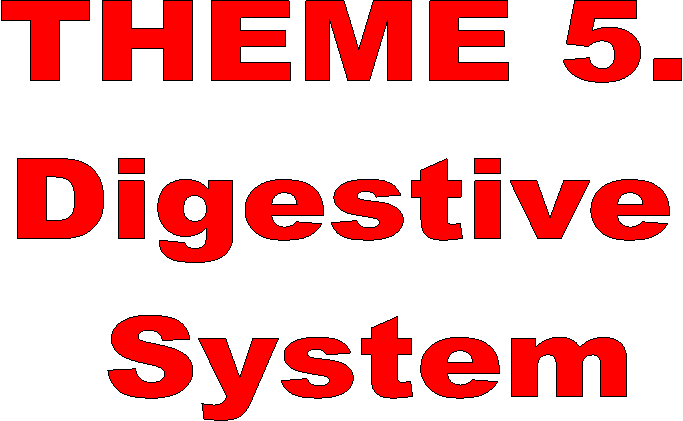
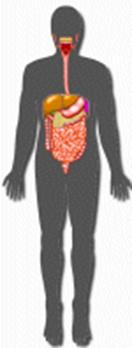
The Digestive System
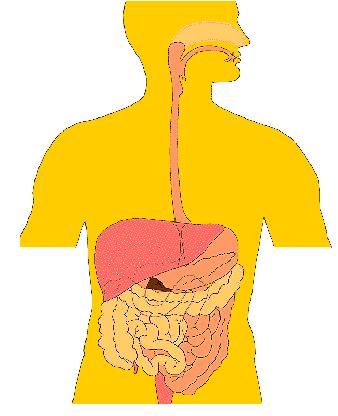
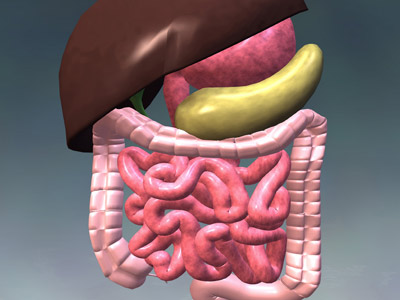
The human body needs fuel to live. We eat food for fuel. But just getting the food into the body is only a small part of the process. The food must be broken down into chemicals that the body can use. This whole process is called digestion. Some of the organs involved in digestion are the mouth, esophagus, stomach, small and large intestines, gallbladder, pancreas and liver.
Vocabulary
1. fuel – топливо
2. digestion – пищеварение
3. to involve – вовлекать
4. esophagus – пищевод
5. pancreas – поджелудочная железа
Mouth and Teeth
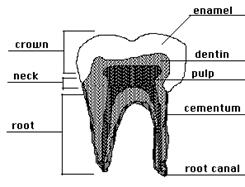 The mouth and teeth are the first step in breaking food down. During the process of chewing, food is shredded and ground. Powerful muscles move the mandible, or lower jaw, while the food is chewed. The front teeth cut the food and the back teeth grind the food.
There are three main parts to the tooth: the root, the neck and the crown. The root is the part inside the jaw. The neck is a narrow connection between the root and the crown. The crown of the tooth is above the gum.
First teeth come in between 6 and 8 age 6, baby teeth are gradually replaced by permanent teeth. There are 32 permanent teeth.
When food is being chewed, saliva is squirted into the mouth. Saliva helps to soften the food. It contains an enzyme that helps break down the starch in the food.
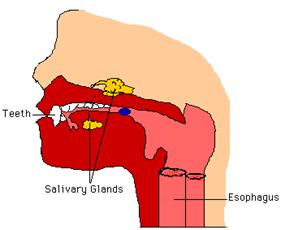
After chewing, the food is swallowed and passes down the esophagus to the stomach. The esophagus is about ten inches long. The tongue helps push the food to the back of the mouth, and the muscles in the esophagus move the food down the tube.
Traveling Food
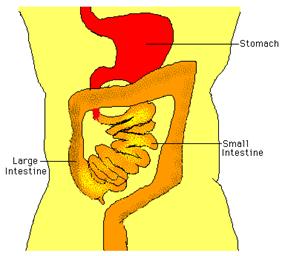 The stomach is a sac shaped like a "j" and is about eight inches long. In the stomach, food is mixed with acids. The muscles in the stomach move, which helps break down the food. The stomach is protected from the acid by a lining. From the stomach, the food pulp is sent to the small intestine. Food leaves the stomach a little bit at a time.
The small intestine is the final place for digestion. Measuring about twenty feet in length, the small intestine is one inch in diameter. Digestive juices released in the small intestine finish breaking down the food.
The food is moved along the small intestine in a squeezing motion known as peristalsis. This motion is much the same as squeezing a tube of toothpaste. All of this movement causes the noise when we say our stomach is "growling."
Lining the small intestine are millions of fingers called villi. These absorb the chemicals that we need from the food into the body. It is at this point the food is actually in the body.
Waste products and food that are not absorbed in the small intestine pass into the large intestine. This waste material is called feces. The large intestine is only five feet long but is larger in diameter than the small intestine. The large intestine includes the colon.
In the large intestine, feces are formed from water, undigested food and bacteria. Water is absorbed back into the body so the waste material becomes more solid as it travels through the colon. It may take as long as twenty hours for food to pass completely through the large intestine.
Gall Bladder Pancreas and Liver
The pancreas is an elongated gland that is below the stomach. It produces pancreatic juice that contains digestive enzymes. The pancreas also secrets insulin into the blood. Insulin is needed to allow glucose or sugar from food to get into the bloodstream. People who cannot produce insulin are diabetics.
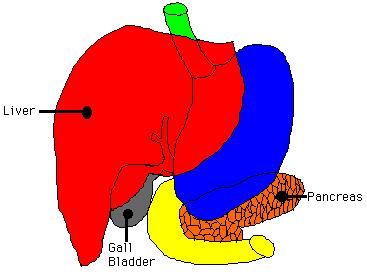
The largest gland in the body is the liver. It is on the right side of the body underneath the ribs. It weighs about three pounds and is eight inches long. The liver stores a form of glucose called glycogen. Vitamin A is manufactured in the liver. Bile which is needed to breakdown fat, is made in the liver. This organ is also where alcohol, drugs, bacteria and old blood cells are broken down and removed from the body. Damage to the liver can be serious because this organ is extremely necessary to life.
The gallbladder is a small sac on the underside of the right lobe of the liver. It stores bile that is made by the liver. Bile travels from the liver through the hepatic ducts to the gallbladder. It holds about two ounces of bile. Bile is needed to breakdown the fat that is in food.
Vocabulary
1. mandible – нижняя челюсть
2. to grind – молоть
3. root – корень
4. crown – корона
5. jaw – челюсть
6. narrow – узкий
7. gum – десна
8. gradually – постепенно
9. permanent teeth – постоянные зубы
10. saliva – слюна
11. to squirt – бить струей
12. starch – крахмал
13. to swallow – глотать
14. sac – мешок
15. acid – кислота
16. lining – внутренне покрытие
17. squeezing – сжатие
18. peristalsis –перистальтика
19. growling – рычание
20. villi – ворсинки
21. absorb – всасывать
22. feces – фекалии
23. colon – толстая кишка
24. elongated – удлиненный
25. to store – запасать
26. lobe – доля
27. bile – желч
Questions
1. What is the structure of digestive system?
2. How many permanent teeth has an adult person?
3. What is the function of stomach, liver?
4. What is the largest gland of the body?
5. Where is liver situated?
Crossword | |
|
|
Across 2. A long folded tube inside the body attached to the stomach where nutrients in the food are absorbed. 6. A part of your throat that acts like a gateway sending air into the lungs and food down into the stomach. 7. The place where waste is stored before it leaves the body. 8. The part of the food that is not digested. 11. The tube that connects the stomach to the mouth. 12. A verb that means to push food through your pharynx. 14. Crush food with your teeth. 15. Muscle in your mouth that is used for pushing food around. | Down 1. After being swallowed, food goes to this place where it is mixed with acid. 3. The tube after the small intestine where liquid is absorbed. 4. These are used to chew food. 5. The good things in food. 9. A slippery liquid that makes food easy to swallow and helps to break the food down. 10. The process of breaking down food for use as energy and building materials for your body. 13. This produces juices (called bile) that go into the small intestine and help digest the food. |

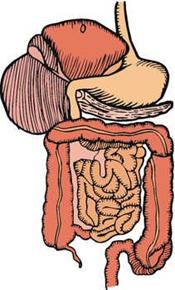
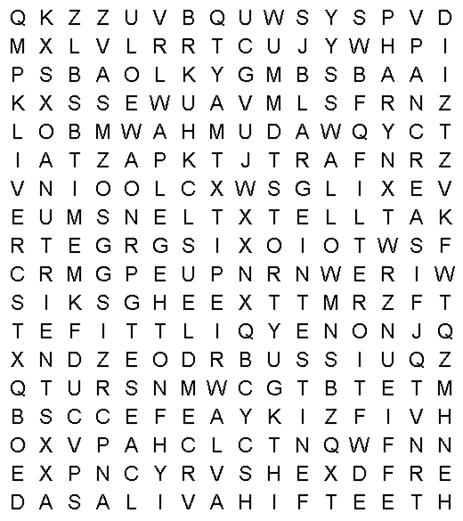
Word Reaserch | |||
|
| ||
absorb appendix chew digest esophagus | excrete filter large intestine liver mouth | nutrients pancreas pharynx rectum saliva | small intestine stomach swallow teeth tongue |
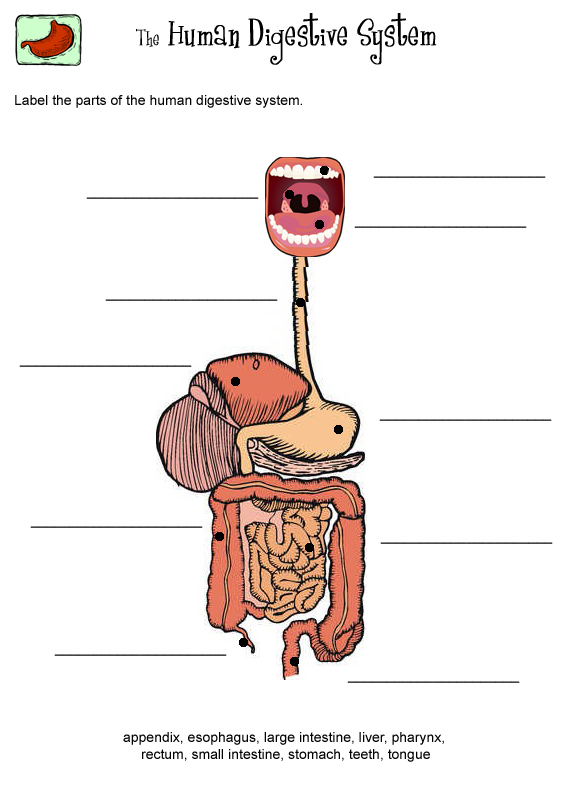
Quiz Instruction: Use the words in the box to fill in the blanks. | |||
stomach rectum waste system acid | chewed liver saliva swallow absorbed | food mouth large intestine tongue liquids | energy small intestine digestion pharynx esophagus |
All animals need to eat ______________ to get ____________ to live. But in order to use this food, they have to break it down in a process called __________________. And so, all animals have a group of connected organs called the digestive __________________. In humans, the process of digestion begins in the _____________ where food is ________________ into small pieces by the teeth. The _______________ helps by moving these pieces around. These pieces are covered by ________________, or spit. The saliva makes the food slippery so that it is easier to _______________. It also helps to break down the food. Once the food is swallowed, it passes through the _______________, which is like a gate that sends food into the ______________ and air into the lungs. The food travels down the esophagus and into the ______________. Once in the stomach the food is mixed with _____________ and crushed some more. After spending some time in the stomach, the food is sent into the ________________________ where nutrients are ______________. The _____________ helps by producing some digestive juices called bile. Next, the remaining food goes into the _________________________ where the _______________ are absorbed. The remaining food is called _________________ and it is pushed into the ________________ where it waits before leaving the body. |
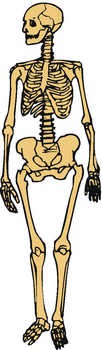
Skeletal System
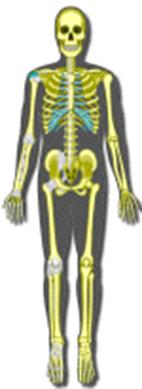
The skeletal system is made up of bones, ligaments and tendons. It shapes the body and protects organs. The skeletal system works with the muscular system to help the body move. Marrow, which is soft, fatty tissue that produces red blood cells, many white blood cells, and other immune system cells, is found inside bones.
The Spine
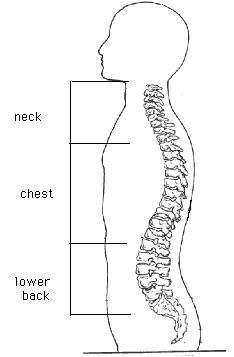
The spine is the central support for the body. Another word for the spine is the backbone. The spine is made of separate irregular bones called vertebrae. The vertebrae are made up of spongy or cancellate bone surrounded by a layer of compact bone. In between each vertebrae is a layer of cartilage that keeps the bones from rubbing against each other.
There are twenty six vertebrae in the spine. Although each vertebrae can only move a little bit, the total spine is very flexible. The spine of a human being is curved. Most other mammals have a straight spine. The curves allow the spine to support and balance the body on only two legs.
The Ribs
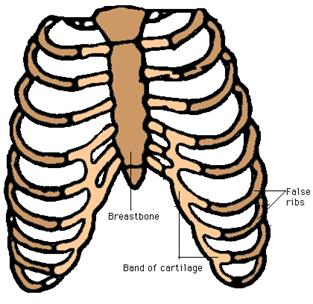
The breastbone, or the sternum, is linked to the bones which make up the ribs. The sternum is a flat bone that is about 6 inches long. The ribs curve around from the spine to the front of the body. This makes a bony framework which is known as the thoracic case. This case helps protect your chest.
Most people have 12 pairs of ribs. The ribs are connected to the sternum by cartilage. This makes the ribs more flexible, which is necessary during breathing. The first seven pairs of ribs are attached directly to the breastbone. The eighth, ninth and tenth pairs are attached to the sternum by a cartrilage band. The last two pairs of ribs are not attached to the sternum or cartilage. The last five pairs of ribs are called false ribs.
Hands & Feet
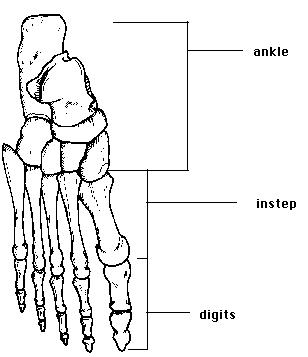
The bones of the hands and feet are flexible. The foot has twenty-six bones, one less than in the hand. The bones in the toes are shorter and fatter than the bones in the fingers. This helps us to balance on two feet.
The seven bones in the ankle are called tarsal bones. The main part of the foot is made of metatarsal bones. Phalanges are the bones in the toes. The arch in the foot helps to support the body's weight.
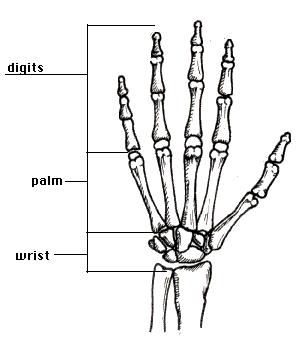
Each hand has twenty-seven separate bones. These are connected with muscles and tendons. Hand bones are also called the metacarpus. Just like the foot, the bones in the fingers are called phalanges.
The fingers have three phalanges and the thumb has two. These joints allow the finger to flex. Because of this, the human hand can make more precise and finer movements than other creatures.
Hips & Legs
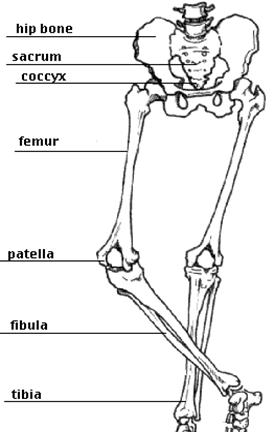
The hip bones help us stand upright and move. They support much of the body's weight. Each hip is made up of three bones. These bones are called the ilium, ischium, and pubis. When you are born, these three bones are separated. As you get older, they begin to join together.
The main bones of the legs are the femur, tibia and fibula. Another name for the femur is the thigh bone. The femur extends from the hip joint to the knee This is the longest bone in the body.
The tibia and fibula are the bones of the lower leg. As it helps to support the body's weight, the tibia is the strongest bone in the body. The thinner bone is the fibula and helps to control the movement of the ankle. Another name for the fibula is the shin bone.
The bone that is at the middle of the leg is the patella, or knee cap.
Arm
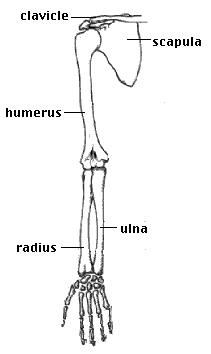
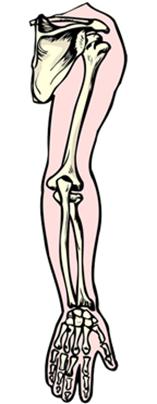
Just like the bones in the hand, the arms bones are also very flexible. The arm is made up of three bones. These are the ulna, radius, and humerus. In the humerus, there is a deep groove near the top that holds the biceps in place.
The lower bones are connected with the humerus at the elbow and with the carpal bones at the wrist. As the arm turns, so do the bones in the lower arm. There is a membrane between the two bones. The elbow allows the arm to bend and straighten.
At the shoulder are two bones that form the shoulder joint. These are the clavical (collar bone) and the scapul (shoulder blade). This is a ball and socket joint. This joint allows the arm to move in circles.
Crossword | |
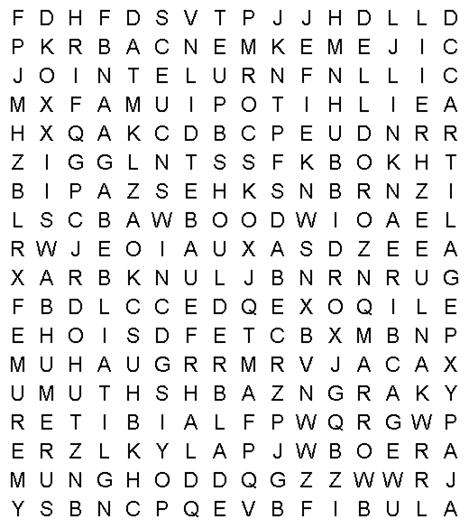
| Find the skeletal system words below in the grid to the left.
|
Across 4. The place where two bones meet. 5. The triangle shaped bone in your upper back. 8. The bone that holds your lower teeth. 10. The substance inside a bone that makes blood cells. 13. The bone that protects your brains. 15. The bone in your shoulders. 16. One of the lower leg bones. 17. Your backbone. 18. The upper arm bone a. k.a. your funny bone. | Down 1. Something that joins muscles to bone. 2. One of the bones in your spine. 3. Something that joins bone to bone. 6. One of the lower leg bones. 7. The largest bone in the human body. 9. The bone in the center of the chest between the ribs. 11. The collection of bones that protect your lungs. 12. One of the forearm bones. 14. One of the forearm bones. |

Word Research | |||
|
| ||
breastbone calcium cartilage collarbone femur fibula | hipbone humerus jawbone joint ligament | marrow radius ribcage shoulder blade skull | spine tendon tibia ulna vertebrae |
Quiz Instruction: Use the words in the box to fill in the blanks. | |||
protect blood shape bones | skeleton ribcage tendon minerals | skeletal cranium ligaments | jellyfish marrow move |
There are around 206 ________________ in the adult human body. These bones plus the connecting tissue make up the _______________ system. The skeletal system is very important for many reasons. Some bones help _____________ our organs. The _____________, for example, protects our brains and the ________________ protects our lungs. The skeletal system also gives us our _______________. Without a ______________, we would be shapeless blobs like a ______________ or an earthworm. Our bones, which are connected by ______________, provide a frame for the rest of the organs, giving us our unique body shape. The skeletal system also helps us ______________. Muscles, which are attached to bones by _______________, cause the bones to move, which makes our bodies move. Bones also help your body store ________________ such as calcium. If there is too much calcium in the blood, some of it becomes bone. If there is not enough calcium, then the bones gives some to the blood. Finally, another important function of bones is to produce ________________. Inside bones there is a soft substance called ________________, which is used to make blood cells. |
Muscular System
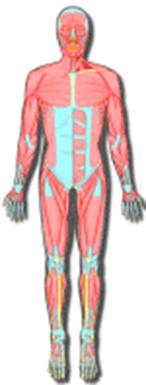
The muscular system is made up of tissues that work with the skeletal system to control movement of the body. Some muscles—like the ones in your arms and legs—are voluntary, meaning that you decide when to move them. Other muscles, like the ones in your stomach, heart, intestines and other organs, are involuntary. This means that they are controlled automatically by the nervous system and hormones—you often don't even realize they're at work.
The body is made up of three types of muscle tissue: skeletal, smooth and cardiac. Each of these has the ability to contract and expand, which allows the body to move and function. .
Skeletal muscles help the body move.
Smooth muscles, which are involuntary, are located inside organs, such as the stomach and intestines.
Cardiac muscle is found only in the heart. Its motion is involuntary
Skeletal Muscles
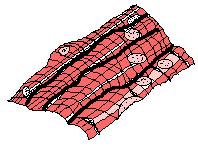
Skeletal muscles move and support the skeleton. They make up fifty percent of your body weight. There are 640 individually named skeletal muscles. A skeletal muscle links two bones across its connecting joint. When these muscles contract or shorten, your bone moves. Muscles are arranged in layers over the bones. Those nearest to the skin are called superficial muscles. Those closest to the inside of the body are called deep muscles. Skeletal muscles are voluntary muscles. These are muscles that we can consciously control.
A muscle's name usually describes its shape, location or job. Some skeletal muscles are:
frontalis (forehead)
deltoid (moves shoulder and upper arm)
biceps (bends arm)
rectus abdominis (stomach)
sartorius (bends and turns leg)
Smooth Muscles
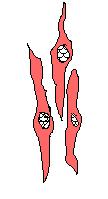
Smooth muscles are found in the hollow parts of the body. This would be in places like the stomach, intestines, blood vessels and the bladder. Smooth muscles are arranged in layers with the fibers in each layer running in a different direction. This makes the muscle contract in all directions.
A smooth muscle is an involuntary muscle. This means that you cannot consciously control this muscle. These muscles are under the control of autonomic nervous system. This system controls many systems without us being aware of them.
Cardiac Muscles
Cardiac muscles cells are striped, like skeletal muscle cells. Cardiac muscles contract automatically to squeeze the walls of the heart inward. The heart beats nonstop about 100,000 times each day. It can do this because of the cardiac muscles.
Final Test
Human Body
1. What is the body temperature of a normal man?
a) 81.1oC
b) 36.9oC
c) 98.6oC
d) 21.7oC
2. Total volume of blood in a normal adult human being is
a) 5-6 liters
b) 3-4 liters
c) 8-10 liters
d) 10-12 liters
3. Red blood corpuscles are formed in the
a) Liver
b) Bone marrow
c) Kidneys
d) Heart
4. How many bones are there in an adult human being?
a) 210
b) 260
c) 206
d) 300
5. The pancreas secretes
a) Insulin
b) Bile juice
c) Peptic juice
d) None of these
6. Tibia is a bone found in the
a) Skull
b) Arm
c) Leg
d) Face
7. The largest part of the human brain is the
a) Medulla oblongata
b) Cerebellum
c) Cerebrum
d) None of these
8. What is the main component of bones and teeth?
a) Calcium carbonate
b) Calcium phosphate
c) Calcium sulphate
d) Calcium nitrate
9. The main constituent of hemoglobin is
a) Chlorine
b) Iron
c) Calcium
d) None of these
10. The main function of the kidney is
a) To control blood pressure
b) To control body temperature
c) To remove waste product from the body
d) To help in digestion of food
11. The function of hemoglobin is
a) Transportation of oxygen
b) Destruction of bacteria
c) Prevention of anemia
d) Utilization of energy
12. Which is the largest gland in the human body?
a) Thyroid
b) Liver
c) Pancreas
d) None of these
13. Which is the largest organ in the human body?
a) Liver
b) Heart
c) Skin
d) Kidney
14. A person of which of the following blood groups is called a universal donor?
a) O
b) AB
c) A
d) B
15. Which gland in the human body is called the master gland?
a) Pancreas
b) Thyroid
c) Pituitary
d) Spleen
16. How many bones are there in a newly born infant?
a) 206
b) 230
c) 280
d) 300
17. Which of the following vitamins promote healthy functioning of eyes in human beings?
a) Vitamin B
b) Vitamin C
c) Vitamin A
d) Vitamin D
18. The average heartbeat per minute in a normal man is
a) 50
b) 70
c) 80
d) 100
19. A person with which of the following blood groups can receive blood of any group?
a) A
b) AB
c) B
d) O
20. Appendix is appendix is a part of
a) Small intestine
b) Large intestine
c) Stomach
d) Liver
21. Dialysis is used for the treatment of
a) Kidney failure
b) Heart weakness
c) Brain diseases
d) None of these
22. Lungs are situated in the
a) Abdominal cavity
b) Pericardial cavity
c) Buccal cavity
d) Thoracic cavity
23. The human cell contains
a) 44 chromosomes
b) 48 chromosomes
c) 46 chromosomes
d) 23 chromosomes
24. Food is normally digested in the
a) Liver
b) Stomach
c) Small intestines
d) Large intestines
Answers
1. b
2. a
3. b
4. c
5. a
6. c
7. c
8. b
9. b
10. c
11. a
12. b
13. c
14. a
15. c
16. d
17. c
18. b
19. b
20. b
21. a
22. d
23. c
24. c
TEST
The Human Body
Variant 1
1. Give the determination of the human body.
2. Translate the system from Russian into English and write main organs which complain it.
a. сердечнососудистая система,
b. нервная система.
3. Read the following sentences and give correct answers.
Ø These are inside your chest. You need them to breathe.
Ø You have five of these on the end of your foot.
Ø This is between your head and your shoulders.
Ø This is inside your chest. It moves blood around your body.
4. Describe the structure of the upper limbs.
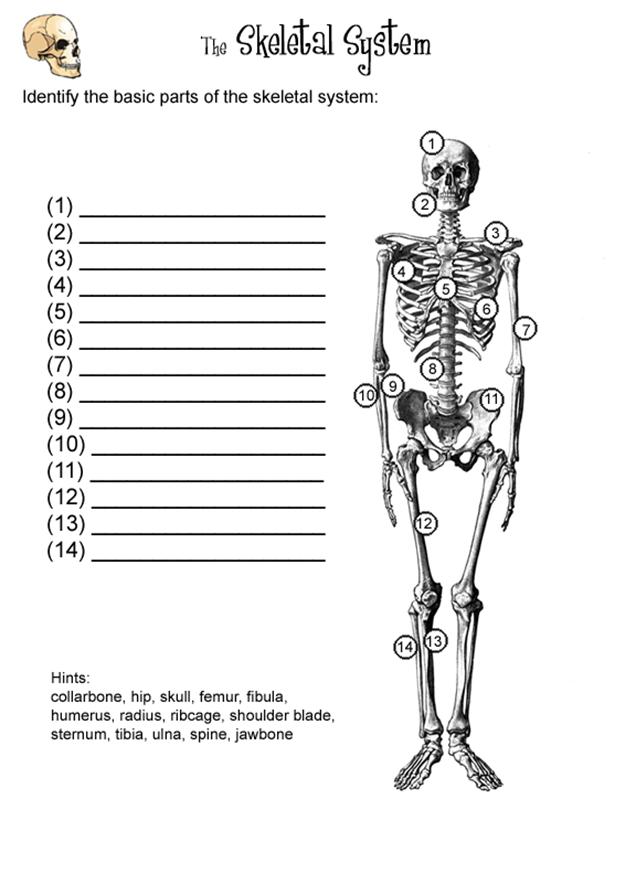
5. Point out the following parts of the human body.


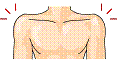


а b c d e f g h
GOOD LUCK!!!
TEST
The Human Body
Variant 2
1. Give the determination of the human body.
2. Translate the system from Russian into English and write main organs which complain it.
a. дыхательная система,
b. пищеварительная система.
3. Read the following sentences and give correct answers.
Ø This is in the middle of your leg. Your leg bends here.
Ø This is inside your head. It controls your body.
Ø You have five of these on the end of your hand.
Ø You have two eyes, two ears a nose and this (for eating and speaking!)
4. Name all main organs of abdominal cavity.
5. Point out the following parts of the human body.
а b c d e f g h
GOOD LUCK!!!
THE GLOSSARY
A
acids - substance that helps in the breakdown of food for the digestive process
alveoila - tiny, thin-walled sac in the lungs where the exchange of oxygen and carbon dioxide takes place
B
biceps - large muscle in the front of the upper arm that flexes the forearm
bile - a fluid that is secreted by the liver and stored in the gallbladder; used in the digestion and absorption of fat
bladder - stretchy bag with muscular wall that collects and stores urine
bone marrow-soft jellylike substance in the center of a bone that produces blood cells for the body
bronchi - main branch of the trachea (windpipe) that leads directly to the lungs
C
cartilage - tough, elastic tissue that is found in various parts of the body, such as the joints, outer ear, and nose
capillaries-tiny blood vessels that connect arteries and veins; where the exchange of carbon dioxide and oxygen take place
carbon dioxide- gas formed formed during respiration; given off from the lungs
cardiac - of or pertaining to the heart
carpal - of or pertaining to the wrist
condense-the process where the water vapor from your breath meets cold and turns into tiny droplets of liquid which looks like white puff of steam
corneas- transparent outer coat of the eyeball
D
digestion - process by which food is changed into substances that can be absorbed and used by the body
diaphragm-muscle that separates the abdominal and thoracic cavities;helps in breathing
E
enzyme-chemical that helps to break down and digest food
esophagus- muscular tube for the passage of food from the mouth to the stomach
exhale-the breathing out and discharge of stale air, also allowing you the ability to talk
H
hepatic-relating to the liver
humerus - long bone of the arm, extending from the shoulder to the elbow
I
inhale-filling the lungs with fresh, oxygen-rich air
K
kidney - organ used tomaintain water and electrolyte balance along with filtering the blood of waste products
L
liter - metric unit of volume equal to approximately 1.056 liqud quarts
larynx - part of the respiratory tract in the throat area that contains the vocal cords
lungs-spongy, saclike respiratory organs in the chest cavity that together with the heart work to remove carbon dioxide from the blood and provide it with oxygen
M
mandible-lower bone in the jaw
metatarsus - middle part of the human foot that includes the five bones between the toes and the ankle
membrane - thin, pliable layer of tissue that covers surfaces or seperates or connects other body parts
metacarpus - part of hand that includes the five bones between the fingers and the wrist
N
nasal cavity-the air passage behind the nose from which moisture is added to the air you breathe during the breathing process
nephrons- filtering units of the kidney that remove waste matter from the blood
O
organ-a part of an organism that performs a specific function.
oxygen-an element essential for plant and animal respiration; essential to life
P
pancreas-long, irregularly shaped gland that produces enzymes and hormones that aid in digestion
pancreatic juice-clear, alkaline secretion of the pancreas containing enzymes that aid in the digestion of proteins, carbohydrates, and fats
peristalsis-wavelike muscular contractions that help to move food down the digestive system
pharynx-section that extends from the mouth and nasal cavities to the larynx
phalange-bone between the finger and toe joints
process-A series of actions, changes, or functions bringing about a result
R
radius - the shorter of the two lower arm bones on the inside of the arm
respiration- process by which the body's cells use oxygen in order to break down nutrients and supply the body with energy
rib cage- enclosing structure formed by the ribs and the bones to which they are attached, that forms a cage to protect the heart and lungs
ribs-one of a series of long, curved bones that form a bony cage to protect the heart and lungs
S
saliva-watery mixture of secretions from the salivary glands that lubricates the mouth and starts to digest food
starch - naturally abundant nutrient found chiefly in seeds, fruits, roots, notably in corn, potatoes, wheat, and rice
T
tarsal - one of the seven bones in the ankle
tendons - band of tough fibrous tissue that connects a muscle to a bone
thoracic
trachea - tube that joins the bronchi to the lungs
U
ulna - bone extending from the elbow to the wrist on the side opposite to the thumb
ureter - long, narrow duct that takes urine from the kidney to the bladder
V
vertebrae-any of the bones forming the spinal column
villi-tiny projections in the intestines from which digested food is absorbed into the blood
Использованная литература
1. , , Мифтахова язык для старших курсов мдицинских училищ и колледжей – М.: «АНМИ», 1999.
2. Козырева язык для медицинских колледжей и уилищ. Учебное пособие/ , . – Изд. 4-е. Ростов н/Д: Феникс, 2005. – 320с.
3. Английский язык для медиков. Конспект лекций Е. Беликова. М.: Эксмо, 20с.
4. Англо-русский медициский словарь. Составители , . Издательство «Медицина», Москва, 1969.
Интернет-ресурсы
1. http://library. thinkquest. org
2. http://www. bbc. co. uk/science/humanbody
3. http://www. /htm/body. html
4. http://training. seer. cancer. gov
5. http://www. /subject-index/31-health/337-human-body. html
6. http://www. /health_games_body_parts. html
7. http://www. sciencekids. co. nz/sciencefacts/humanbody. html
8. http://www. teachers. ash. org. au/jmresources/systems/body. html
9. http://www. /index. html
10. http://www. teachervision.
11. http://www. britishcouncil. org/new/
12. http://www.
13. http://www.

|
Из за большого объема этот материал размещен на нескольких страницах:
1 2 3 |
