


Партнерка на США и Канаду по недвижимости, выплаты в крипто
- 30% recurring commission
- Выплаты в USDT
- Вывод каждую неделю
- Комиссия до 5 лет за каждого referral
defect: a congenital heart defect, a birth defect, Atrial septal defect, Ventricular septal defect. There are over 30 different types of heart defect; cyanotic: a cyanotic heart disease, a cause of cyanotic heart disease. Children with cyanotic heart disease are usually small for their age. acyanotic: acyanotic heart disease, symptoms of acyanotic heart disease. Babies born with acyanotic heart disease may not have any apparent symptoms; experience: to experience symptoms of breathlessness, to experience attacks of chest pain and fainting. Children with cyanotic heart disease often experience episodes of hypoxia.
2. Translate into Russian the following word-combinations:
1) to affect the heart; 2) right ventricular hypertrophy; 3) to lead to blood with a lower-than-normal oxygen; 4) to develop symptoms of cyanotic heart disease; 5) a lack of oxygen; 6) delayed growth; 7) to be underweight; 8) to restore normal lung function; 10) to withstand the after-effects of surgery.
3. Match Russian and English equivalents:
1) oxygen-rich blood | a) кровь с низким содержанием кислорода |
2) require emergency surgery | b) пальцы синего цвета |
3) poor appetite and feeding difficulties | c) отверстие между левым и правым желудочками |
4) to receive enough oxygen | d) содержать достаточно кислорода |
5) a narrowing of the pulmonary valve | e) анастомоз (шунт) Блалока-Тоссига |
6) open heart surgery | f) совокупность четырех разных пороков сердца |
7) a hole between the left and right ventricles | g) кровь, обогащенная кислородом |
8) a combination of four different heart defects | h) сужение легочного клапана |
9) oxygen-low blood | i) получать достаточно кислорода |
10) to contain enough oxygen | j) операция на «открытом» сердце |
11) blue-coloured fingers | k) требовать срочной операции |
12) a Blalock-Taussig shunt | l) плохой аппетит и проблемы с кормлением |
5. Translate the following sentences:
1. The heart is essentially a pump that is made up of four chambers: the left atrium, the left ventricle, the right atrium, and the right ventricle. 2. There are also four valves that control how the blood flows through the heart and around the body: the mitral valve, the aortic valve, the tricuspid valve, and the pulmonary valve. 3. The heart’s purpose is to supply oxygen-rich blood to the body’s cells and tissues. 4. Congenital heart disease develops when abnormalities in the heart structure prevent it form working as it should. 5. An infection during pregnancy, such as rubella, can cause congenital heart disease. 6. Half of all babies born with congenital heart disease will require immediate surgery after birth, while the other 50% will probably require surgery or medication at some point during their childhood. 7. Due to advances in heart surgery, 85% of children with congenital heart disease survive into adulthood. 8. In the most serious cases of congenital heart disease, it may be necessary to remove the damaged heart and replace it with a healthy one.
6. Read the text and give the examples of two main types of congenital heart disease.
Congenital heart disease is a general term that is used to refer to a series of birth defects that affect the heart.
Types of Сongenital Heart Disease
There are over 30 different types of heart defect. The two main types of congenital heart disease are cyanotic heart disease and acyanotic heart disease.
· Cyanotic heart disease: where problems with the heart mean that there is not enough oxygen present in the blood (e. g. Tetralogy of Fallot (TOF), Transposition of the great arteries (TGA).
· Acyanotic heart disease: where the blood contains enough oxygen but it is pumped abnormally around the body (e. g. Aortic stenosis, Atrial septal defect (ASD), Ventricular septal defect (VSD), Pulmonary stenosis).
7. Read and translate the text. Make the plan of the text using key-words.
Text A. Tetralogy of Fallot
Tetralogy of Fallot (TOF) is the most common cause of cyanotic heart disease. TOF is not one heart defect but a combination of four different heart defects. Tetralogy is a Greek word that means ‘four-fold’, and Fallot is the name of the doctor who first identified the condition. In cases of TOF, there are four defects that affect the heart:
- A hole between the left and right ventricle (Ventricular Septal Defect). A narrowing of the pulmonary valve (pulmonary stenosis). The muscles of the right ventricle are unusually thick (right ventricular hypertrophy). The aortic valve is in the wrong position (displaced aorta).
Normal Heart and Heart with Tetralogy of Fallot 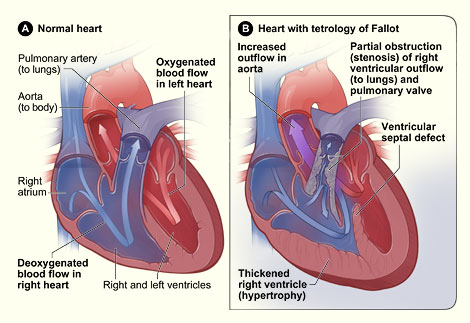
Figure A shows the normal structure and blood flow in the interior of the heart. Figure B shows a heart with the four defects of Tetralogy of Fallot.
As a result of this complex set of heart defects, oxygen-rich blood and oxygen-low blood become mixed. This leads to blood with a lower-than-normal oxygen content being pumped around the body.
As the body’s cells and tissue are not receiving enough oxygen, the child will develop symptoms of cyanotic heart disease, such as blue-coloured fingers, toes and lips as a result of a lack of oxygen. They also experience symptoms of breathlessness, fainting, chest pains, fatigue, and episodes of hypoxia. Hypoxia occurs when the body is suddenly starved of oxygen. There are some common symptoms that are present in both cyanotic and acyanotic heart disease. These include poor appetite and feeding difficulties, sweating, particularly when a baby is feeding, and delayed growth. Children with TOF are usually underweight and small for their age.
8. Answer the questions:
1. What’s the main cause of cyanotic heart disease?
2. How many defects are there in case of Tetralogy of Fallot? What are they?
3. Why does the body suffer from insufficiency of oxygen?
4. What symptoms does the child develop in cyanotic heart disease?
5. What symptoms are common for both cyanotic and acyanotic heart disease?
9. Translate into English the following word-combinations:
1) «белый» порок сердца; 2) тетрада Фалло; 3) испытывать приступы гипоксии; 4) тяжелые симптомы отдышки; 5) причина порока сердца «синего» типа; 6) кровь с низким содержанием кислорода; 7) обморок; 8) анастомоз Блалока-Тоссига; 9) срочная операция; 10) врожденный порок сердца
10. Find the synonyms for the following words in the texts:
1. opening (n) | 6. shortness of breath (n) |
2. blue skin (n) | 7. damage (v) |
3. develop (v) | 8. respiratory (adj) |
4. sufficient amount (n) | 9. tiredness (n) |
5. sign (n) | 10. perspiration (n) |
11. Translate the sentences:
1. (Врожденный порок сердца) is the most common type of birth defect, with six out of every 1,000 babies being born with the condition. 2. Half of all babies born with congenital heart disease (требуют срочной операции) after birth. 3. (Дефект межжелудочковой перегородки) is the most common cause of acyanotic heart disease. 4. As the aortic valve is the main route (для крови, обогащенной кислородом) to supply the body, the narrowing can lower the body’s oxygen supply. 5. Babies and children with TOF (испытывают приступы цианоза), which can sometimes be severe. 6. The symptoms of cyanotic heart disease include (отдышку, обморок и приступы гипоксии).
10. Read and translate the text B.
Text B. Treatment of Tetralogy of Fallot
Babies born with Tetralogy of Fallot (FOT) who are experiencing severe symptoms of breathlessness may require emergency surgery to restore normal lung function. This can be done using a procedure known as a Blalock-Taussig shunt (a BT shunt). During a BT shunt, an artery is diverted (or shunted) into the lungs so that a supply of oxygen-rich blood becomes available. Further open heart surgery is then recommended when the baby is old enough to withstand the after-effects of surgery. During open heart surgery, the defect between the ventricles is sealed and the pulmonary valve is widened.
11. From the list below choose the necessary word to fit each blank:
1. Many children with congenital heart defects … delays in their development, such as walking or talking. 2. Some children with congenital heart disease have associated learning difficulties and … specialised educational and psychological assistance. 3. In cases of medium to large –sized defects, … is necessary. 4. In pulmonary stenosis, … is unusually narrow. 5. The … is transported to the body’s cells and tissues, which remove the oxygen from the blood. 6. To understand how congenital heart disease can … a child’s heart and general health, it is useful to understand how a healthy heart works. 7. Children often adopt a squatting posture which can help to relieve the symptoms of ….
oxygen-rich blood; affect; experience; the pulmonary valve; require; breathlessness; open heart surgery |
12. Give the summary of the texts I and II.
13. Translate the following sentences. Pay attention to the use of Present Simple after conjunctions if, when, as soon as, before, until, after, while to talk about the future:
1. If a child is diagnosed with stenosis (narrowing of the aorta or pulmonary valve), the recommended treatment will depend on the extent of the stenosis. 2. I’ll wait for the doctor here until he gets back. 3. If ventricular septal defect is large, open heart surgery will be required. 4. I’ll go home as soon as we visit him at the hospital. 5. Can you feed the baby while I’m away? 6. I’ll have a talk with our surgeon before I go to work. 7. After the lecture about different types of congenital heart defects ends we’ll have a test. 8. Give me a call when you hear some news.
14. Read and translate text C. Make up the plan of the text using key words:
Text C. Atrial Septal Defect
Atrial septal defect (ASD) is the most common cause of acyanotic heart disease. In cases of ASD the hole is between the left and right atria. ASDs occur during fetal development of the heart and are present at birth. During the first weeks after conception, the heart develops. If a problem occurs during this process, a hole in the atrial septum may result.
Normal Heart and Heart with Atrial Septal Defect 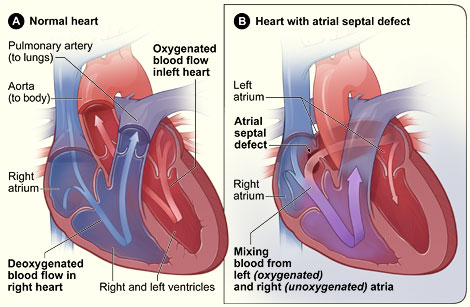
Figure A shows the normal structure and blood flow in the interior of the heart. Figure B shows a heart with an atrial septal defect, which allows oxygen-rich blood from the left atrium to mix with oxygen-poor blood from the right atrium
In some cases, the tendency to develop an ASD may be genetic. There can be genetic syndromes that cause extra or missing pieces of chromosomes that can be associated with ASD. For the vast majority of children with a defect, however, there's no clear cause of the ASD. The size of an ASD and its location in the heart will determine what kinds of symptoms a child experiences. Most children who have ASDs seem healthy and appear to have no symptoms. Generally, kids with an ASD feel well and grow and gain weight normally. Infants and children with larger, more severe ASDs, however, may possibly show some of the following signs or symptoms: poor appetite, poor growth, and fatigue, shortness of breath, and lung problems and infections, such as pneumonia. If an ASD is not treated, health problems can develop later, including an abnormal heart rhythm (known as an atrial arrhythmia) and problems in how well the heart pumps blood. As kids with ASDs get older, they may also be at an increased risk for stroke, since a blood clot that develops can pass through the hole in the wall between the atria and travel to the brain. Fortunately, most kids with ASD are diagnosed and treated long before the heart defect causes physical symptoms. Because of the complications that ASDs can cause later in life, pediatric cardiologists often recommend closing ASDs early in childhood.
15. Answer the questions:
1. What is Atrial septal defect?
2. When does ASD develop?
3. What is ASD caused by?
4. What symptoms does a child experience in ASD?
5. What factors influence on the presence of the signs?
6. What health problems can develop without treatment of ASD? Why?
7. What procedure should be taken to avoid possible complications?
16. Give the English equivalents:
1. a fetal development of the heart; 2. after conception; 3. size and location; 4. severe ASD; 5. poor growth; 6. risk for stroke; 7. to cause physical symptoms; 8. to seem healthy; 9. signs or symptoms; 10. possible complications.
17. Give the Russian equivalents:
1. присутствовать при рождении; 2. отверстие; 3. ясная причина; 4. набирать вес; 5. проявлять признаки; 6. усталость; 7. аритмия предсердий; 8. становиться старше; 9. сгусток крови; 10. детский кардиолог.
18. Translate into English:
1. Дефект межпредсердной перегородки – это врожденный порок сердца, при котором стенка, которая разделяет предсердия, содержит отверстие. 2. Это отверстие обычно закрывается к тому времени, когда ребенок рождается. 3. Если отверстие не закрылось, то кровь поступает () из левого предсердия в правое. 4. Если слишком много крови поступает в правую часть сердца, давление в легких повышается. 5. Если дефект межпредсердной перегородки маленький, ребенок не испытывает больших проблем со здоровьем. 7. При тяжелых случаях у ребенка могут проявляться такие симптомы, как плохой аппетит, усталость, частый респираторные инфекции.
19. Read the text IV and answer the question: “What kinds of treatment are recommended in ASD?”
Text D. Treatment of ASD
If a child is diagnosed with an atrial septal defect, the recommended treatment will depend on the size of the defect.
If the defect is small, a policy of “watchful waiting” may be recommended, where a child receives no immediate treatment but their health is carefully monitored. This is because 90 % of small defects close as the child grows older.
In cases of mild to medium-sized defects, it may be possible to seal the defects using a catheter. The catheter is guided to the site of the hole, and specially designed mesh is passed through the catheter to seal the defect.
In cases of medium to large-sized defects, open heart surgery is required.
20. Give the summary of the texts III and IV.
21. Read and translate the dialogue. Act it out.
At the consultation
Parent: What causes congenital heart defects?
Professor: If you have a child with a congenital heart defect, you may think you did something wrong during your pregnancy to cause the problem. However, most of the time doctors don’t know why congenital heart defects develop.
Parent: But still what factors cause them?
Professor: Heredity may play a role in some heart defects. For example, a parent who has a congenital heart defect may be more likely than other people to have a child with the condition. Children with genetic defects often have congenital heart defects. An example of this is Down syndrome – half of all babies with Down syndrome have congenital heart defects.
Parent: What signs and symptoms of congenital heart defects?
Professor: Many congenital heart defects have few or no symptoms. Severe defects can cause symptoms usually in newborn babies, such as rapid breathing, cyanosis, and tiredness.
Parent: Do defects cause pain?
Professor: No, they don’t cause chest pain or other painful symptoms.
Parent: How can defects be detected?
Professor: Abnormal blood flow through the heart caused by a heart defect will make a certain sound. Your doctor can hear this sound, called a heart murmur, with a stethoscope. However, not all murmurs are a sign of a congenital heart defects. It’s recommended to perform special cardiovascular tests.
22. Make up sentences according to the model:
Model: I’ll tell you about the holiday. I’ll get back (when)
I’ll tell you about the holiday when I get back.
1. She’ll visit old friends. She’ll be in London. 2. I’ll go to the hospital. The class will end (as soon as). 3. I won’t leave the house. The doctor will call (until). 4. Will you call me? You’ll finish your work (when). 5. We’ll begin without him. He won’t come in time (if). 6. We’ll listen to the dialogue. We’ll read the text (after).
23. Make up your own sentences according to the model in Ex.22.
24. Read and translate the text. Make a summary:
Text I. Diagnosing Congenital Heart Disease
Antenatal Diagnosing
An increasing number of cases of congenital heart disease are now diagnosed before a baby is born. This can be done by carrying out a fetal echocardiography. A fetal echocardiography is a type of ultrasound scanner that has been specially designed to build a picture of the insides of the chambers of the heart.
Fetal echocardiography should be carried out during routine antenatal examination, usually some time between 18th and 20th week of pregnancy. However, it is not always possible to detect heart defects (particularly mild ones) using a fetal echocardiography.
Postnatal Diagnosing
If a baby is born with cyanotic heart disease, a diagnosis can usually be made quickly and confidently due to the distinctive blue colour of their skin. If a baby is born with acynotic heart disease, their symptoms may not become immediately apparent for several moths, or possibly years, after birth. In some types of acynotic heart disease, symptoms are not apparent until a child reaches three years of age.
Possible signs that a child may have acynotic heart disease include:
· feeding problems,
· slow growth,
· shortness of breath after exercising,
· tiredness after exercising, and
· swelling of their hands, feet and ankles.
25. Read the text and give its annotation:
Text II. Further Testing
Echocardiogram
This test, which is harmless and painless, uses sound waves to create a moving picture of your child’s heart. During an echocardiogram, reflected sound waves show the structure of the heart. The test allows the doctor to clearly see any problem with the way the heart is formed, and the way it’s working.
An echocardiogram is an important test for both diagnosing a heart problem and following the problem over the time. In children with congenital heart defects, an echocardiogram will outline the problems with the heart structure and show how the heart is reacting to these problems. The echocardiogram will help your child cardiologist if and what treatment is needed.
During pregnancy, if your doctor suspects that your baby has a congenital heart defect a special test called a fetal echocardiogram can be done. If your child is diagnosed with a congenital heart defect before birth, your doctor can plan treatment before the baby is born.
Electrocardiogram (ECG)
An ECG detects and records the electrical activity of the heart. An ECG show how fast the heart is beating and whether the heart rhythm is steady or irregular. It can also detect if one of the heart chambers is enlarged, which can help diagnose a heart problem.
Chest X-ray
A chest x-ray takes a picture of the heart and lungs. It may reveal cardiac enlargement and aortic dilation. It also assesses pulmonary circulation and shows whether the lungs have extra blood or fluid, which can be a sign of heart failure.
Pulse Oximetry
Pulse oximetry shows how much oxygen is in the blood. A sensor is places on the child’s fingertip or toe (like an adhesive bandage). The sensor is attached to a small computer unit, which displays a number that indicates how much oxygen is in the blood.
Cardiac catheterization
During cardiac catheterization, a thin, flexible tube called a catheter is passed through a vein in the arm, groin (upper thigh), or neck to reach the heart. A dye that can be seen on an x-ray is injected through the catheter into a blood vessel or a chamber of the heart. This allows the doctor to see the flow of blood through the heart and blood vessels.
Cardiac catheterization also can be used to measure the pressure inside the heart and blood vessels and to determine whether blood is mixing between the two sides of the heart. It’s also used to repair some heart defects.
26. Read the text and make its abstract with the key words:
Text III. Treating Congenital Heart Disease
There are a number of different surgical techniques that can be used to treat congenital heart disease.
Catheters
A catheter, similar to the tube that is used during diagnosis, is inserted into the heart, and tools are passed down the catheter to repair the heart defect. The advantage of this type of surgery is that it is non-invasive, which means that a child will not have to have a major surgical incision (cut) made in their chest.
Open heart surgery
For more serious type of heart defects, it may be necessary to operate directly on the heart. During open heart surgery, the heart will be stopped and a machine used to pump blood around a child’s body. An incision is made in a child’s chest so that the heart defects can be surgically repaired damaged parts of the heart, such as the valves, can be replaced.
Heart transplant
In the most serious cases of congenital heart disease, it may be necessary to remove the damaged heart and replace it with a healthy heart that has been donated by the family of a child who has recently died.
27. Read the text and underline any points that are new or surprised you:
Text IV. Heart Transplants in Infants and Children
Heart transplantation involves replacing a failing heart with a new one (donor heart). Children undergo heart transplantation for two primary reasons - a congenital heart defect or severe malfunction of the heart muscle. Heart transplantation is considered when there are no other medical or surgical options. The hearts are donated from someone who has suffered an injury resulting in death of his or her brain, but not the other vital organs and whose family has agreed to make the heart and other organs available for donation. Many children who receive heart transplants live years longer than they otherwise would have and have an excellent quality of life.
Children who need heart transplants are placed on a waiting list administered by a national agency called United Network of Organ Sharing (UNOS). The waiting time for a heart can range from days to months (even more than a year) and depends on multiple factors including size, blood type, and whether the patient is hospitalized on intravenous heart medications.
The Pretransplant Work-Up
A transplant team is responsible for assessing whether you are a suitable heart transplant candidate.
Members of the Transplant Team:
· Cardiologist
· Cardiovascular surgeon
· Transplant coordinator
· Social worker
· Dietitian
· Psychiatrist
Specific preoperative tests assess whether any other treatment options exist for you and to ensure that you are physically capable of having a transplant. These tests may include a coronary angiogram (a dye test of the heart arteries), an echocardiogram and a cardiopulmonary study (a stress test using a bicycle or treadmill and a metabolic cart to measure oxygen use). Different blood, urine, and x-ray tests are done to look for other medical problems that may make a transplant impossible; your kidney and liver functions are measured, the presence of infection (such as hepatitis) is determined, and bone density is assessed.
Waiting for Your Heart Transplant
Once on the waiting list, you will receive a pager so that you can be contacted when a heart becomes available. It is important to answer the pager immediately and go to the hospital as soon as possible. When the transplant program notifies you that a heart is available, you are expected to arrive at the hospital within 2 hours of receiving the call. When you arrive, a team of doctors and nurses will prepare you for surgery.
The Heart Transplant
Once the heart has been deemed suitable, you will be taken to the operating room, where surgery will take about 4 hours. During the operation, a bypass machine will be used to give the blood oxygen for use in the rest of your body while the surgeon works on your heart. Most of the old heart is removed and the new one is attached to the incoming and outgoing blood vessels After the surgery, you will be in the cardiovascular intensive care unit. Initially, a ventilator will help you breath, and you will have tubes in your chest to drain fluid around your lungs and heart. Once you wake up and are able to breathe adequately, the ventilator and tubes will be removed. You will have some pain after the surgery and will receive pain medications either intravenously or by mouth. As you recover, you will be transferred to a step-down unit and then to a regular room.
While in hospital, frequent blood tests, including those measuring drug levels, electrolytes, and kidney function are performed. The transplant team will be watching for possible posttransplant complications, including infection and rejection of the heart. You will have several heart biopsies after the transplant to monitor for rejection.
Medications
Many medications are required after the transplant, each with a specific purpose. There are medications to lower rejection (immunosuppressants), medications to treat cholesterol (statins), medications to prevent infection, and sometimes medications to treat high blood pressure and other complications that may occur after transplant. All medications have potential side effects Serious side effects may include an increased risk of infections, diabetes, osteoporosis (thinning of the bones), high blood pressure, kidney disease, and the development of cancer. Avoid direct sunlight and remember to cover up and wear sun block to lower the risk of skin cancer.
Going Home
After leaving hospital, take 1 day at a time and increase your activities slowly over the following 6 to 8 weeks. You should watch for possible signs of infection, including fever, sore throat, shortness of breath, cough, change in sputum, cold sores, flu-like symptoms, or redness, swelling, or drainage from your incision. If any of these develop, you should contact your transplant center as soon as possible. Be careful handling animals and do not clean litter boxes or birdcages because of the risk of infection. Signs of rejection include shortness of breath, weight gain, fever, and fatigue. The only way to diagnose rejection is by heart biopsy. Regular cardiological follow-up with your physician is mandatory.
Unit 5. INFECTIOUS DISEASES OF CHILDHOOD
1. Read and learn the words by heart:
acquired infection | приобретенная инфекция |
direct contact | прямой контакт |
causative agent | Возбудитель |
pathogenic microorganism | патогенный (болезнетворный) микроорганизм |
vaccine ['væksin] | Вакцина |
inoculation | Прививка |
innate immunity | врожденный иммунитет |
to penetrate | Проникать |
communicable, contagious, infectious | заразный, инфекционный |
measles ['mi:zlz] | Корь |
whooping cough ['hupiŋ kof] | Коклюш |
mumps | Свинка |
quinsy ['kwinzi] | Ангина |
scarlet fever | Скарлатина |
chickenpox | ветряная оспа (ветрянка) |
smallpox | Оспа |
period of decline | период спада (болезни) |
convalescence | Выздоровление |
suppurative | гнойный, гноеродный |
resistance | Сопротивляемость |
exposure | подвергание, выставление |
to spread, to disseminate | распространять(ся) |
2. Translate the word combinations with the given key-words:

|
Из за большого объема этот материал размещен на нескольких страницах:
1 2 3 4 5 6 7 |
