


Партнерка на США и Канаду по недвижимости, выплаты в крипто
- 30% recurring commission
- Выплаты в USDT
- Вывод каждую неделю
- Комиссия до 5 лет за каждого referral
Примеры теста и писем в формате BEC Vantage можно найти на сайте http://www. cambridgeesol. org/support/dloads/bec_downloads. htm
Приложения
Приложение 1 Рекомендации по подготовке презентации.
1. Презентация не должна повторять выступающего и должна минимум содержать текстовой информации. Ни в коем случае не читайте с экрана презентации. Если в презентации вы решили разместить полные тексты своих выводов или полное определение какого-либо понятия – не зачитывайте то, что явно и очевидно всем. Обратите внимание слушателей на экран с просьбой ознакомиться с выводами вашей работы или с определением понятия. Время, которое было бы бесцельно потрачено на чтение с экрана употребите с большей пользой: ответьте на возникшие вопросы, сообщите дополнительную и интересную информацию. Помните, что презентация – цифровой аналог бумажных плакатов, применявшихся на выступлениях ранее. Поэтому презентация должна содержать рисунки, фотографии, видео (при необходимости), таблицы, графики и схемы. Презентация не повторяет слова выступающего, а лишь дополняет их, создавая целостную и яркую картину выступления.
2. Будет очень хорошо, если размер презентации не превысит 5Мб. С «легкой» презентацией компьютеру (да и человеку за ним) проще работать, менее вероятны вылеты и зависания. Для этого никогда не вставляйте в презентацию графику с оригинальным размером в несколько мегапикселей. Посредством Фотошопа или средствами MS Office ужимайте картинки до приемлемых 800х600 или 640х480 точек. Ведь большая часть офисных проекторов дает на выходе максимум 1024х768 точек. Облегчить презентацию позволит использование стандартных фоновых изображений или вовсе отказ от них. Не загромождайте презентацию музыкой и звуковыми спецэффектами.
3. Информация в презентации должна быть хорошо читаема даже с последних рядов предполагаемой аудитории, где и произойдет выступление. Для этого тексты и цифры должны быть достаточно крупными, а шрифт понятным (например, Tahoma или Times NR). Каждый слайд должен быть контрастным. Лучший фон для презентации – белый. Черное на белом – наиболее контрастный вариант. Все будет видно даже при использовании слабого проектора в светлой комнате. Если таблица, которую вы хотите разместить в презентации слишком объемна – разбейте ее на несколько слайдов. Не мельчите, пытаясь запихнуть все в один слайд.
4. Не увлекайтесь анимацией в презентациях. Еще неизвестно на компьютере какой мощности и с какими предустановленными программами будет воспроизведена ваша презентация. Анимация может быть полезна для выделения на презентации каких-либо ключевых схем, слов и цифр. Например, по щелчку ряд цифр в таблице меняют свой цвет с черного на красный. Это привлечет дополнительное внимание к ним аудитории и позволит вам не отвлекаться на поиск этих цифр и обозначение той-же лазерной указкой при анализе таблицы. Или на слайде последовательно появляются сначало один график (дается его полный анализ) а затем, рядом, для сравнения – другой. Презентация, лишенная спецэффектов более кроссплатформенна и без труда запустится на любом компьютере.
5. Наиболее удобны презентации, в которых смена слайдов происходит по щелчку мыши. При этом вы должны четко прописать себе в текст доклада (лекции) на каком моменте выступления происходит смена слайда. Если на вашем выступлении руководить презентацией будет третье лицо – всегда имейте при себе копию доклада с обозначением времени и порядка показа слайдов. Это удобно и вам (результат гарантирован) и технику, руководящему презентацией.
6. Желательно, чтобы все слайды презентации были пронумерованы. Если в ходе доклада у слушателей возникнет вопрос по графику или таблице из вашей презентации, вы сможете легко обратиться к этим объектам зная номер слайда. Своя нумерация должна быть у рисунков, отдельно – у таблиц.
Прочие полезные советы:
Часто возникают проблемы с переносом вашей презентации на компьютер, подключенный к проектору. Чтобы избежать таких проблем всегда дублируйте файл с вашей презентацией на флэшку и CD-R диск.
Если при правильном подключении проектора к ноутбуку изображение с компьютера не выводится – удерживая клавишу Fn, нажмите клавишу F5 или F7 или иную, на которой схематично изображены прямоугольники мониторов.
Для запуска презентации на весь экран откройте файл и нажмите F5.l
Для сокрытия манипуляций на компьютере по запуску следующей презентации или поиску нужного слайда воспользуйтесь кнопкой «Freeze» на пульте вашего проектора («заморозит» последний кадр). Для возобновления презентации вновь нажмите кнопку «Freeze».
Презентации, сопровождающие научные доклады всех уровней должны быть максимально простыми. Первый слайд (титульный) содержит информацию о теме исследования, авторе и его научном руководителе. Второй слайд содержит сокращенные формулировки цели и основных задач работы. Затем следуют слайды с графической и табличной информацией по результатам исследования. Затем слайд (слайды) с выводами, которые лучше не зачитывать (пусть слушатели читают со слайда). Можно поблагодарить за внимание. Завершает презентацию точная копия титульного слайда. На фоне этого слайда докладчик отвечает на вопросы. Фотографии, графики, таблицы на слайдах оформляются в соответствии с принятыми в научных публикациях нормами и последовательно нумеруются.
(выдержки http://tana. *****/load/ Автор: )
Дополнительную информацию по подготовке презентаций можно получить по ссылке
http://www. *****/projects/txt/presentations/index. shtml
Рекомендации по подготовке презентации
(выдержки из учебно-методического пособия Ненашева пособие по подготовке к устному выступлению-презентации. Спб ф ГУ-ВШЭ, 2009)
SECTION 1. GENERAL RECOMMENDATIONS
Introduction
Presentations and reports are ways of communicating ideas and information to a group. But unlike a report, a presentation carries the speaker's personality better and allows immediate interaction between all the participants. A good presentation has:
- Content - It contains information that people need. But unlike reports, which are read at the reader's own pace, presentations must account for how much information the audience can absorb in one sitting. Structure - It has a logical beginning, middle, and end. It must be sequenced and paced so that the audience can understand it. Where as reports have appendices and footnotes to guide the reader, the speaker must be careful not to loose the audience when wandering from the main point of the presentation. Packaging - It must be well prepared. A report can be reread and portions skipped over, but with a presentation, the audience is at the mercy of a presenter. Human Element - A good presentation will be remembered much more than a good report because it has a person attached to it. But you still need to analyze if the audience's needs would not be better met if a report was sent instead.
1. PREPARING THE PRESENTATION
With good preparation and planning you will be totally confident and less nervous. And your audience will feel your confidence. Your audience, too, will be confident. They will be confident in you. And this will give you control. Control of your audience and of your presentation.
WHY? WHO? WHERE? WHEN? HOW? WHAT?
WHY? Objective
Before you start to prepare a presentation, you should ask yourself: "Why am I making this presentation?" Do you need to inform, to persuade, to train or to sell? Your objective should be clear in your mind. If it is not clear in your mind, it cannot possibly be clear to your audience.
WHO? Audience
"Who am I making this presentation to?" Sometimes this will be obvious, but not always. You should try to inform yourself. How many people? Who are they? Business people? Professional people? Political people? Experts or non-experts? Will it be a small, intimate group of 4 colleagues or a large gathering of 400 competitors? How much do they know already and what will they expect from you?
WHERE? Venue
"Where am I making this presentation?" In a small hotel meeting-room or a large conference hall? What facilities and equipment are available? What are the seating arrangements?
WHEN? Time and length
"When am I making this presentation and how long will it be?" Will it be 5 minutes or 1 hour? Just before lunch, when your audience will be hungry, or just after lunch, when your audience will be sleepy?
HOW? Method
How should I make this presentation?" What approach should you use? Formal or informal? Lots of visual aids or only a few? Will you include some anecdotes and humour for variety?
WHAT? Content
"What should I say?" Now you must decide exactly what you want to say. First, you should brainstorm your ideas. You will no doubt discover many ideas that you want to include in your presentation. But you must be selective. You should include only information that is relevant to your audience and your objective. You should exclude all other ideas. You also need to create a title for your presentation (if you have not already been given a title). The title will help you to focus on the subject. And you will prepare your visual aids, if you have decided to use them. But remember, in general, less is better than more (a little is better than a lot). You can always give additional information during the questions after the presentation.
Notes
When you give your presentation, you should be - or appear to be - as spontaneous as possible. You should not read your presentation! You should be so familiar with your subject and with the information that you want to deliver that you do not need to read a text. Reading a text is boring! So if you don't have a text to read, how can you remember to say everything you need to say? With notes. You can create your own system of notes. Some people make notes on small, A6 cards. Some people write down just the title of each section of their talk. Some people write down keywords to remind them. The notes will give you confidence, but because you will have prepared your presentation fully, you may not even need them!
Rehearsal
Rehearsal is a vital part of preparation. You should leave time to practise your presentation two or three times. This will have the following benefits:
- you will become more familiar with what you want to say you will identify weaknesses in your presentation you will be able to practise difficult pronunciations you will be able to check the time that your presentation takes and make any necessary modifications
So prepare, prepare, prepare! Prepare everything: words, visual aids, timing, equipment. Rehearse your presentation several times and time it.
2. STRUCTURE
A well organised presentation with a clear structure is easier for the audience to follow. It is therefore more effective. You should organise the points you wish to make in a logical order. Most presentations are organised in three parts, followed by questions:
Beginning | Short introduction |
|
Middle | Body of presentation |
|
End | Short conclusion |
|
Questions and Answers |
As a general rule in communication, repetition is valuable. In presentations, there is a golden rule about repetition:
Say what you are going to say, say it, then say what you have just said.In other words, use the three parts of your presentation to reinforce your message. In the introduction, you tell your audience what your message is going to be. In the body, you tell your audience your real message. In the conclusion, you summarize what your message was.
We will now consider each of these parts in more detail.
Introduction
The introduction is a very important - perhaps the most important - part of your presentation. This is the first impression that your audience have of you. You should concentrate on getting your introduction right. A good presentation often starts out with an icebreaker such as a story, interesting statement or fact, joke, quotation, or an activity to get the group warmed up. The introduction also needs an objective, that is, the purpose or goal of the presentation. This not only tells you what you will talk about, but it also informs the audience of the purpose of the presentation.
The following table shows examples of language for each of the following functions. You may need to modify the language as appropriate.
Function | Possible language |
1 Welcoming your audience |
|
2 Introducing your subject |
|
3 Outlining your structure |
|
4 Giving instructions about questions |
|
Body
The body is the 'real' presentation. If the introduction was well prepared and delivered, you will now be 'in control'. You will be relaxed and confident.
The body should be well structured, divided up logically, with plenty of carefully spaced visuals.
Remember these key points while delivering the body of your presentation:
- do not hurry be enthusiastic give time on visuals maintain eye contact modulate your voice look friendly keep to your structure use your notes signpost throughout remain polite when dealing with difficult questions
Conclusion
The following table shows examples of language for each of these functions. You may need to modify the language as appropriate.
Function | Possible language |
1 Summing up |
|
2 Giving recommendations |
|
3 Thanking your audience |
|
4 Inviting questions |
|
Questions
Keep cool if a questioner disagrees with you. You are a professional! No matter how hard you try, not everyone in the world will agree with you!
Although some people get a perverse pleasure from putting others on the spot, and some try to look good in front of the boss, most people ask questions from a genuine interest. Questions do not mean you did not explain the topic good enough, but that their interest is deeper than the average audience.
Always allow time at the end of the presentation for questions. After inviting questions, do not rush ahead if no one asks a question. Pause for about 6 seconds to allow the audience to gather their thoughts. When a question is asked, repeat the question to ensure that everyone heard it (and that you heard it correctly). When answering, direct your remarks to the entire audience. That way, you keep everyone focused, not just the questioner. To reinforce your presentation, try to relate the question back to the main points.
Make sure you listen to the question being asked. If you do not understand it, ask them to clarify. Pause to think about the question as the answer you give may be correct, but ignore the main issue. If you do not know the answer, be honest, do not waffle. Tell them you will get back to them...and make sure you do!
Answers that last 10 to 40 seconds work best. If they are too short, they seem abrupt; while longer answers appear too elaborate. Also, be sure to keep on track. Do not let off-the-wall questions sidetrack you into areas that are not relevant to the presentation.
If someone takes issue with something you said, try to find a way to agree with part of their argument. For example, "Yes, I understand your position..." or "I'm glad you raised that point, but..." The idea is to praise their point and agree with them. Audiences sometimes tend to think of "us verses you." You do not want to risk alienating them.
Questions are a good opportunity for you to interact with your audience. It may be helpful for you to try to predict what questions will be asked so that you can prepare your response in advance. You may wish to accept questions at any time during your presentation, or to keep a time for questions after your presentation. Normally, it's your decision, and you should make it clear during the introduction. Be polite with all questioners, even if they ask difficult questions. They are showing interest in what you have to say and they deserve attention. Sometimes you can reformulate a question. Or answer the question with another question. Or even ask for comment from the rest of the audience.
Visual aids
Of all the information that enters our brains, the vast majority of it enters through the eyes. 80% of what your audience learn during your presentation is learned visually (what they see) and only 20% is learned aurally (what they hear). The significance of this is obvious:
- visual aids are an extremely effective means of communication non-native English speakers need not worry so much about spoken English - they can rely more heavily on visual aids
It is well worth spending time in the creation of good visual aids. But it is equally important not to overload your audience's brains. Keep the information on each visual aid to a minimum - and give your audience time to look at and absorb this information. Remember, your audience have never seen these visual aids before. They need time to study and to understand them. Without understanding there is no communication.
Apart from photographs and drawings, some of the most useful visual aids are charts and graphs, like the 3-dimensional ones shown here:

Piecharts are circular in shape (like a pie).
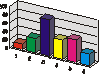
Barcharts can be vertical (as here) or horizontal.
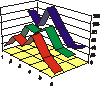
Graphs can rise and fall.
Language
Simplicity and Clarity
If you want your audience to understand your message, your language must be simple and clear.
Use short words and short sentences.
Do not use jargon, unless you are certain that your audience understands it.
In general, talk about concrete facts rather than abstract ideas.
Use active verbs instead of passive verbs. Active verbs are much easier to understand. They are much more powerful. Consider these two sentences, which say the same thing:
Toyota sold two million cars last year. Two million cars were sold by Toyota last year.Which is easier to understand? Which is more immediate? Which is more powerful? #1 is active and #2 is passive.
Signposting
When you drive on the roads, you know where you are on those roads. Each road has a name or number. Each town has a name. And each house has a number. If you are at house #100, you can go back to #50 or forward to #150. You can look at the signposts for directions. And you can look at your atlas for the structure of the roads in detail. In other words, it is easy to navigate the roads. You cannot get lost. But when you give a presentation, how can your audience know where they are? How can they know the structure of your presentation? How can they know what is coming next? They know because you tell them. Because you put up signposts for them, at the beginning and all along the route. This technique is called 'signposting' (or 'signalling').
During your introduction, you should tell your audience what the structure of your presentation will be. You might say something like this:
"I'll start by describing the current position in Europe. Then I'll move on to some of the achievements we've made in Asia. After that I'll consider the opportunities we see for further expansion in Africa. Lastly, I'll quickly recap before concluding with some recommendations."
A member of the audience can now visualize your presentation like this:
Introduction |
|
Body |
|
Conclusion |
|
He will keep this image in his head during the presentation. He may even write it down. And throughout your presentation, you will put up signposts telling him which point you have reached and where you are going now. When you finish Europe and want to start Asia, you might say:
"That's all I have to say about Europe. Let's turn now to Asia."
When you have finished Africa and want to sum up, you might say:
"Well, we've looked at the three continents Europe, Asia and Africa. I'd like to sum up now."
And when you finish summing up and want to give your recommendations, you might say:
"What does all this mean for us? Well, firstly I recommend..."
The table below lists useful expressions that you can use to signpost the various parts of your presentation.
Signposting | |
Function | Language |
Introducing the subject |
|
Finishing one subject... |
|
...and starting another |
|
Analysing a point and giving recommendations |
|
Giving an example |
|
Dealing with questions |
|
Summarising and concluding |
|
Ordering |
|
Приложение 2
Рекомендации по аналитическому изложению прочитанного RENDERING
(выдержки из учебно-методического пособия Supplementary Business Reading(Texts for rendering in English)Тексты и задания для чтения для студентов факультета экономики, СПб, изд-во Ютас, 2009
To summarize or to render means to restate a portion of a text in a shortened form. A summary should bring out the main ideas of the passage, but it does not need to follow the same order as the original text. A summary should be clear, concise, and accurate in representing the original text.
Webster's calls a summary the "general idea in brief form"; it's the distillation, condensation, or reduction of a larger work into its primary notions.
It doesn’t matter if the initial text is in English or in Russian
- When asked to render or summarize a text it doesn’t mean you should mention all the details. Read the text, trying to understand what it is about. Do not stop if you are not sure about all the words. Think of the main idea of the text. It is often clear from the title or you can find it in the first paragraph. Divide the text into parts. Try to summarize the ideas of each part in 2-3 sentences. Omit specific details, examples, descriptions, and unnecessary explanations. Note: you may need to go through the article twice in order to pick up everything you need. If you are not sure about key words – look them up in the dictionary. Do not forget about pronunciation. Use linking words and phrases to make the text logically clear. Write your rough draft of the bine the information from the first four steps into paragraphs. Edit your version. Be concise. Eliminate needless words and repetitions.
Compare your version to the original.
NOTE: Include all the important ideas.
| Use the author's key words. |
| Follow the original organization where possible. |
| Include any important data. |
| Include any important conclusions. |

Useful words and phrases
The text (article)
is about…
deals with…
presents…
describes…
From the text (article)
the reader gets to know…
the reader is confronted with…
the reader is told about…
The text (the article)
is concerned with (deals with)…
The subject of the article is …
At the beginning of the text(the article) it is said that…
This text deals with the following aspects of the question...
The aim of this article is…
The first part of the text focuses on...
In the next part it is noted that …
The article (text) ends with …
To sum up the ideas of the article (the text) we should mention that…
You can also use these phrases
The text reports on … | В тексте говорится о … |
A detailed description is given to … | Подробно описывается… |
Much attention is given to … | Особое внимание уделяется… |
It is claimed that … | Заявляется, что… |
It is pointed out that … | Отмечается, что… |
The article provides information on … | В статье имеется информация о… |
The article discusses … | В статье обсуждается… |
A careful account is given to … | Особое внимание уделяетя… |
A comparison of … with … is made. | Приводится сравнение… с… |
It is assumed that … | Полагают что… |
The article reports on … | В статье сообщается о… |
It is shown that … | |
The objective of the article is … | Цель статьи… |
The article suggests the problem … | В статье поднимается проблема … |
The article contains the most up-to-date information on … | В статье приводятся современные данные относительно…. |
The article touches upon … | Статья касается… |
The article is of great interest / no particular interest. | Статья очень интересная / не представляет интереса |
The results of … are presented. | Представлены результаты… |
Of particular interest is … | Особенно интересно… |
Аn example of a compressed English text. The summary that goes after the text is also in English
“Brain drain” is the phenomena whereby nations lose skilled labor because there are better paid jobs elsewhere. In recent years, this has affected poorer countries more so, as some rich countries tempt workers away, and workers look to escape bleak situations in their poor home countries.
The term “Brain drain” originated in the 1960s, when many British scientists and intellectuals emigrated to the United States for a better working climate. In recent years, however, the problem of “brain drain” has been acute for poorer countries that lose workers to wealthier countries. Almost ironically, England is now a country where many such workers end up.
The problem has been noted in healthcare in particular because the loss of healthcare professionals in poorer countries leaves already struggling healthcare systems in an even more desperate state.
For its World Health Report 2006, the World Health Organization (WHO) noted that there is a global shortage of 4.3 million doctors, midwives, nurses, and support workers. Furthermore, “these [shortfalls] often coexist in a country with large numbers of unemployed health professionals. Poverty, imperfect private labor markets, lack of public funds, bureaucratic red tape and political interference produce this paradox of shortages in the midst of underutilized talent.” In addition, “Unplanned or excessive exits may cause significant losses of workers and compromise the system’s knowledge, memory and culture.”
The prestigious journal, British Medical Journal (BMJ) sums up another aspect of the “brain drain” problem in the title of an article: “Developed world is robbing African countries of health staff” (Rebecca Coombes, BMJ, Volume 230, p.923, April 23, 2005.) This, Coombes notes, is because rich countries are also hiring medical staff from abroad, because they are far cheaper. (Many health systems in the first world are under budgetary pressures.) In a way, this becomes a form of subsidy for the rich!
Some countries are left with just 500 doctors each, with large areas without any health workers of any kind. A shocking one third of practicing doctors in UK were from overseas in mid 2005 for example as the “BBC” reported. The British Medical Association and the Royal College of Nursing have described this as “poaching” because “staff migration from developing nations is killing millions and compounding poverty.”
The WHO admits that numbers are difficult to come by, but looking at countries that do track such data (often limited to nurses and doctors only), the number of doctors and nurses from abroad working in the OECD (rich) countries comprises a significant percentage of the workforce.
Other industries also suffer this issue. Some countries are able to afford this loss. For example, during the tech boom in the US around 2000, many IT workers from India were attracted to the US under the H1-B visa program. At that time, concerns were raised in India that this was a form of brain drain as highly skilled workers were being lost. However, some Indian politicians confidently claimed that this was not a problem because there were so many tech workers in the pool. Indeed, today India is a major off-sourcing center for technology. However, most poor countries are not of the size of India and per person lost, the impact can be more severe.
Summary
This article deals with the phenomena which everyone nowadays has heard about. “Brain drain” is defined by the author as the phenomena whereby nations lose skilled labor because there are better paid jobs elsewhere. It is pointed out that in recent years it has affected mostly poorer countries.
The term “Brain drain” has British origin. The reader gets to know that it is originated in the 1960s. In that period many British intellectuals emigrated to the USA looking for better working conditions. It is assumed that this negative process has influenced particularly healthcare. Many healthcare professionals – practicing doctors and scientists as well as nurses and midwives left and are still leaving poorer countries.
From a global perspective “Brain drain” may cause the breakdown of all spheres of life of a country. It is mentioned in the article that he whole system’s knowledge, memory and culture – everything is compromised.
The article refers to the publication in one of the prestigious journals British Medical Journal (BMJ) which is devoted to other serious aspects of this problem. It is declared that “Developed world is robbing African countries of health staff” meaning that rich countries are also hiring medical staff from abroad, because they are far cheaper. It is also mentioned that according to BBC data a great number of doctors (1/3 of practicing doctors) in Britain in mid 2005 were from overseas.
The article ends with the facts showing that other industries in some countries also suffer this issue. It’s true about IT workers from India who came to the US during the tech boom 2000. It is interesting to note that some Indian politicians claimed that it was not a problem because there were so many tech workers there. The author makes a conclusion that in other countries the impact of “Brain drain” can be more severe.
An example of a compressed Russian text. The summary that goes after the text is in English
Экономист предупреждает о "двойной рецессии"
По словам одного из немногих известных экономистов, предсказавших финансовый кризис, мир не решил проблем, лежавших в основе экономического спада, и может снова скатиться к рецессии, сообщает The Financial Times.
Выступая в понедельник на конференции Sibos в Гонконге, Уильям Уайт, бывший главный экономист Банка международных расчетов (Bank for International Settlements), предупредил, что действия правительств, направленные на оказание скорой помощи экономике, могут посеять плоды будущего кризисa.
"Вступим ли мы в W-образную рецессию? Почти наверняка. Вступим ли мы в L-образную рецессию? Я нисколько не удивлюсь", - заявил он, говоря об опасности так называемой двойной рецессии или продолжительной стагнации, такой, от которой страдала Япония в 1990-х.
"Единственное, что удивило бы меня по-настоящему, - это быстрое и стабильное выздоровление с учетом того положения, в котором мы находимся", - добавил он.
По словам Уайта, по всему миру центральные банки и правительства за последние два года вложили тысячи миллиардов долларов напечатанных денег в финансовую систему и промышленность в попытке предотвратить депрессию, что может в итоге привести к инфляции. Кроме того, насущные проблемы мировой экономики, такие как несбалансированность торговли между США, Европой и Азией, остаются нерешенными.
Summary
Economist warns of double-dip recession
The article, published in The Financial Times, presents the opinion of William White, the one of the famous economists, about the global financial crisis. He claims that the world has not tackled the problems at the heart of the economic downturn and is likely to slip back into recession.
Speaking at the Sibos conference in Hong Kong on Monday, William White, the former chief economist at the Bank for International Settlements, also warned that government actions to help the economy in the short run may be sowing the seeds for future crises.
He is sure that the global economy is going into a W-shaped recession. He also added that he would not be surprised if we going into an L-shaped recession, referring to the risks of a so-called double-dip recession or a protracted stagnation like Japan suffered in the 1990s. The only thing that would really surprise him is a rapid and sustainable recovery from the position we’re in now.
It is pointed out that worldwide, central banks and governments, have pumped thousands of billions of dollars of new money into the financial system and industry over the past two years in an effort to prevent a depression. The economist assumes that it may cause the inflation. economist.
Meanwhile, the underlying problems in the global economy, such as unsustainable trade imbalances between the US, Europe and Asia, had not been resolved, Mr. White said.
Приложение 3 Список книг для подготовки домашнего чтения, имеющихся в библиотеке
Human resource management. Theory and practice. (3rd edition). John Bratton, Jeffrey Gold. Modern management. 10th edition. Samuel C. Certo, S. Trevis Certo. Virtuoso teams (lessons from teams that changed their worlds). Andy Boynton, Bill Fischer. Intercultural business communication. Lilliam H. Chaney. Jeanette S. Martin. Making innovation work (how to manage it, measure it, and profit from it). Tony Davila The social construction of Free Trade (The European Union, NAFTA, and MERCOSUR) Derivatives markets. Robert L. McDonald Mastering business administration. Margaret Nicholson. The economics of money, banking and financial markets. 8th edition. Frederic S. Mishkin Organizational behavior. 3rd edition. Marc Buelens Contemporary human resource management. Text and cases. Tom Redman, Adrian Wilkinson. Marketing metrics: 50+ metrics Every executive should master. Paul W. Farris Researching business and management. Harvey Maylor and Kate Blachman. Financial markets institutions. Frederic S. Mishkin Organizational behavior and management. John Martin. 3rd edition. Risk management. Problems and solutions. William H. Beaver, George Parker. Innovation management and new product development. 3rd edition. Paul Trolt Introduction to business. William F. Schoell. 7th edition Marketing research. An international approach. Marcus J. Schmidt and… Sunk costs and market structure. Price competition, advertising and the evolution of concentration. John Sutton The strategic managing of human resources. John Leopold. Lynette Harris and Tony Watson Business Ethics. David Stewart. How customers think. Essential insights into the mind of the market. Gerald Zaltman. Transnational management. Christopher A. Bartlett. Advertising. Principles and practice. Wells Burnett Moriarty Public speaking. 4th edition. Strategies for success. David Zarefski. International financial management. Cheol S. Mastering basic management. 2nd edition EC EYRE Essentials of strategic management 4th edition. J. David Hunger, Thomas L. Wheelen. Environmental business management. Sustainable development in the New Millennium. Andrew Hutchinson and Frances Hutchinson. Understanding change. Linda Holbeche. Strategic Management (an integral approach). Charles W. L. Hill, Garett R. Jones. International management (culture, strategy, and behavior). Hodgetts/Luthans/Doh. 6th edition. Marketing communications(engagement, strategic and practice) 4th edition. Chris Fill. Labor relations. 6th edition. John A. Fossum. Marketing Research (an applied approach). Thomas C. Kinnear and James R. Taylor Comparative international management. Carla I. Koen. Organizational theory, design, and change. 5th edition. Gareth R. Jones (+disk). Firms, Markets, and economic change. Richard N. Langlois and Paul L. Robertson. Principles and practice of marketing. 2nd edition. David Jobber. Negotiation. 5th edition. Roy J. Lewicki, David M. Sanders, Bruce Barry. Innovation that fits (moving the fads to choose the right innovation strategy for your business). Purchasing and supply chain management. Kenneth Lysons. Brian Farrington. Managing for conflict and consensus. Why great leaders don’t take yes for an answer. Michael A. Roberto. Global marketing strategy. Susan P. Douglas… Fundamentals of management. 9th edition. Dounelly… Introduction to risk management and insurance. 8th edition. Mark S. Dorfman Strategic management and competitive advantage concepts. Jay B. Barney Strategic marketing channel management. Donald J. Bowersox…

|
Из за большого объема этот материал размещен на нескольких страницах:
1 2 3 4 5 6 |
