


Партнерка на США и Канаду по недвижимости, выплаты в крипто
- 30% recurring commission
- Выплаты в USDT
- Вывод каждую неделю
- Комиссия до 5 лет за каждого referral
3. Signs in Canada, the U. S. and Australia use the English language. Québec uses the French language, while New Brunswick uses both English and French. Mexico uses the Spanish language. Within a mile of the U. S.-Mexico border, road signs are often in English and Spanish.
Europe
4. Despite efforts to devise pan-European standards, the European Union has not yet standardised road signs across member states, with non-member states also differing in road signage. All EU members currently use the metric system for road signs, with the exception of the UK.
Ireland
5. Roads in Ireland. Until the partition of Ireland in 1922 and the independence of Southern Ireland (now the Republic of Ireland) British standards applied across the island. Some time after independence, road signs in the south were changed to differ from the UK standard, most visibly in the adoption of US-style "diamond" signs for many road hazard warnings (junctions, bends, railway crossings, traffic lights). Some domestic signs were also invented, such as the stay-left sign (a black curved arrow pointing to the upper-left), while some other signs are not widely adopted outside Ireland, such as the no-entry sign (a black arrow pointing ahead in a white circle with a red slashed circumference).
United Kingdom
6. In general, the UK's signage is largely similar to that in the rest of Europe, though it has a large number of signs that are unique to the UK. In addition, the system and style of signage employed for route information is specific to the UK. Signs which predate WW2 are also still found, and these have a different standard again. Also, the UK is the only European Union member to use a system other than the metric system, i. e. imperial.
Words to Text 2
1. (roadway) marker дорожный знак; дорожный указатель
2. pentagon пятиугольник
3. county графство (Англии), округ (в США)
4. inconsistent нелогичный, противоречивый
5. devise разрабатывать
partition раздел circumference окружностьExercise 10
In which passage can you find the answer to the following questions?
Федеральная магистраль, уникальные знаки, синий знак в форме пятиугольника, изменяются от штата к штату, несмотря на усилия, за исключением, до раздела Ирландии; изменились, чтобы отличаться; предупреждения об опасной дороге; знаки в значительной степени сходны со знаками в остальной Европе
Exercise 11
In which passage can you find the answer to the following questions?
Which country is the only European Union member to use a system other than the metric system? Which countries currently use the metric system for road signs? What kinds of road signs are used in different countries? What languages are used on the road signs in different countries? In which country were some domestic signs invented? How do American road signs measure distances?Exercise 12
Say whether these statements are true or false.
On American road signs you can see distances measured in kilometres rather than miles. Every state and province use standard markers for its own highways. In some U. S. counties numbered county roads appear on a pentagon-shaped blue sign with yellow letters. Within a mile of the U. S.-Mexico border, road signs are often in English and French. All EU members currently use the metric system for road signs. In Ireland some time after independence, road signs in the south were changed to differ from the UK standard. The stay-left sign (a black curved arrow pointing to the upper-left) is common in Ireland as well as in the UK.Exercise 13
Correct the sentences containing false information from Exercise 11 according to the Text 2.
Exercise 14
Translate these texts in a written form.
1. Central and South America
Road signs in Central and South America vary from country to country. For the most part, conventions in signage tend to resemble North American signage conventions more so than European and Asian conventions. For example, warning signs are typically diamond shaped and yellow rather than triangular and white. Notable exceptions include speed limit signs, which follow the European conventions.
2. Asia. People's Republic of China
Mainland China uses simplified Chinese characters for its traffic signs. It is gradually moving toward internationally-accepted signs; it abandoned, for example, a localised version of the "no parking sign" (with a Hanzi character) and used the blue-red cross sign as of the late 1990s. In larger cities and on expressways of China, both English and Chinese are used.
3. Asia. Hong Kong Special Administrative Region
Although the mainland uses simplified Chinese characters, traditional Chinese characters are still used in Hong Kong (as the policy of "one country, two systems" allows Hong Kong to maintain most affairs, including road traffic regulations, the way they were prior to the handover).
Most, if not all, of Hong Kong's signs are bilingual, as English and Chinese are considered official languages. English often appears on top of text in traditional Chinese.
Unit 3
Main Text: Road Traffic Safety
Grammar: 1. Objective-with-the-Infinitive Construction
2. For-to-Infinitive Construction
Pre-reading Activities
Exercise 1
Read and memorize the words from the text.
road safety правила безопасности уличного движения harm вред; убыток, урон, ущерб; причинять вред injury вред, повреждение; рана, ушиб result from вытекать crash авария, столкновение (автомобилей и т. п.) acute острый victim жертва imperative настоятельный, срочный; обязательный overwhelmingly ошеломляюще investigation исследование discover обнаруживать, открывать, находить reduce сокращать, уменьшать consequences последствия fatality смерть (от несчастного случая и т. п.) data collection сбор данных; совокупность данных convey выражать, передавать (идею, смысл и т. п.) due to обусловленный potent действенный, эффективный appeal призыв, обращение exonerate освобождать (от ответственности) devoid лишенный; не имеющий predictability предсказуемость preeminent превосходящий других, выдающийся suicide самоубийство homicide убийствоExercise 2
Try to guess the meaning of the words and word combinations from the text.
to reduce the harm, crashes of road vehicles, vehicles traveling on public roads, all other transportation modes combined, the world’s largest public health problems, overwhelmingly young and healthy, prior to their crashes, it is imperative to separate, fatal consequences, a road-traffic fatality, the preeminent contributors, to convey a sense, a lesser number, a severely damaged vehicle
Exercise 3
Choose the meaning of the word in which it may be used in the text.
1. For reasons of clear data collection, only harm involving a road vehicle is included.
a) светлый b) отчётливый c) незашифрованный d) очевидный
2. The word accident conveys a sense that the losses are due exclusively to fate.
a) перевозить b) выражать c) передавать d) сообщать
3. Saying the driver was killed in a traffic crash describes in simple terms what is observed.
a) следить b) соблюдать (законы) c) замечать d) наблюдать
Exercise 4
Find English equivalents to the following Russian word combinations in the Main Text.
Стремится сократить вред; что раскрыли научные исследования; до аварии; необходимо разделять; из соображений сбора незашифрованных данных; чтобы считаться; транспортные происшествия с пешеходами со смертельным исходом; наиболее престижные рецензируемые специалистами журналы; освобождать участников от ответственности; хотя целью изучения безопасности является.
Exercise 5
Read and translate the sentences with the Infinitive Constructions.
It is not allowed for two persons to ride on one bicycle. It is evident for road-traffic crashes to be one of the world’s largest public health problems. We know road-traffic safety to deal with road-traffic crashes. The victim must be struck by a road vehicle for an event to be counted a pedestrian fatality. They expected the word “accident” to disappear from professional literature in the late 1960s as more science was focused on the problem.Exercise 6
Read and translate the Main Text.
Main Text
Road-Traffic Safety
Road-traffic safety aims to reduce the harm (deaths, injuries, and property damage) resulting from crashes of road vehicles traveling on public roads. Harm from road-traffic crashes is greater than that from all other transportation modes (air, sea, space, off-terrain, etc.) combined.
Road-traffic crashes are one of the world’s largest public health problems. The problem is all the more acute because the victims are overwhelmingly young and healthy prior to their crashes. According to the World Health Organization more than a million people are killed on the world’s roads each year.
Definition of road–traffic crash
Because most of the world’s billion drivers have opinions about this subject, it is imperative to separate what scientific investigation has discovered from the rich mix of available material. A clear understanding requires defining what we are talking about.
Road-traffic safety deals exclusively with road-traffic crashes – how to reduce their number and their consequences. A road-traffic crash is an event starting on a public road involving a road vehicle that results in harm. For reasons of clear data collection, only harm involving a road vehicle is included. A person tripping with fatal consequences on a public road is not included as a road-traffic fatality. To be counted a pedestrian fatality, the victim must be struck by a road vehicle.
The word “accident” began to disappear from professional literature in the late 1960s as more science was focused on the problem. It should not be used for reasons published in the world’s most prestigious peer-reviewed journals and by the preeminent contributors to the science of the subject.
The word accident conveys a sense that the losses are due exclusively to fate. Perhaps this is what gives accident its most potent appeal – the sense that it exonerates participants from responsibility. Accident also conveys a sense that losses are devoid of predictability. Yet the purpose of studying safety is to examine factors that influence crashes. Some crashes are purposeful acts for which the term accident would be inappropriate even in popular use. At least a few percent (perhaps as much as 5%) of driver fatalities are suicides, while a lesser number are homicides. Very few of the deaths that are suicides or homicides can be identified as such. When a severely damaged vehicle with a dead driver is observed, saying the driver was killed in a traffic crash describes in simple terms what is observed; calling it an accident implies you know more than you do.
Exercise 7
Find sentences in the text which have similar meaning with the following sentences.
1. It is important for people to know that the danger from road-traffic crashes is really great.
2. World Health Organization considers more than a million people to be killed on the world’s roads each year.
3. They think five percent of driver fatalities to be suicides.
Exercise 8
Answer the following questions using information from the Main Text.
What does road-traffic safety aim to do? Why is the problem of road-traffic crashes really acute? How many people are killed on the world’s roads each year? How is a road-traffic crash defined? Why is only harm involving a road vehicle included into the definition of a road-traffic crash? What sense does the word accident convey? What is the purpose of studying safety? Why can very few of the deaths that are suicides or homicides be identified as such?Exercise 9
Give a summary of the text “Road-Traffic Safety”.
Exercise 10
Read the title of Text 2 and look at the illustrations. What do you think this text is about?
Exercise 11
Scan Text 2 looking for details your instructor asks.
Text 2
Sponsored in part by: American Traffic Safety Serv. AssocCenter for Excellence in Rural SafetyNHTSA
Endorsed by: ITS AmericaOllie the Otter
Why Traffic Safety Culture?
Traffic crashes represent the largest cause of fatal injury for nearly all age groups, especially in rural *****ral states such as Montana have the misfortune of having the highest traffic fatality rates both in terms of exposure (VMT) and population risk (per capita). Driver behavior represents the single largest causal factor for these traffic crashes. Specifically, most crashes result from poor decision making rather than misperceiving information or not having the requisite skills to act correctly. This implies that most crash-related behavior factors – such as speeding, drunk driving, failure to yield, seat belt non-compliance – are the direct result of deliberate decisions by drivers that increase crash risk and injury severity. Consequently, unless we can focus our research efforts on understanding how culture influences driver attitudes and decision-making processes, we cannot expect to engineer a fundamental and enduring change in driver behavior in our transportation systems.
Initiated in 2009, the first National Summit for Rural Traffic Safety Culture met with overwhelming success. Building on this success, the Summit has become an annual event with the second Summit to be held July 11-13, 2010 in Big Sky, Montana.
Our objective for the Second Annual Summit? Similar to the first Summit, we will continue to strive for increased understanding amongst traffic safety researchers, practitioners, and policy makers about the role of traffic safety culture on
1) behavioral factors that increase rural (and national) traffic crash risk;
2) attitudinal barriers to public and political acceptance of traffic safety interventions; and
3) organizational resistance to safety program change or implementation.
However, the second Summit will take these goals a step further by helping the audience to see the connections between theory and practice. Attendees should come prepared to listen, learn, share and discuss not only their experiences, but those of others in both facilitated small-group discussions and larger question/answer sessions.
 Scholarship Fund
The Western Transportation Institute and the AAA Foundation for Traffic Safety have recognized that these are difficult economic times. Many local and state travel budgets have been negatively impacted by declining revenues, preventing employees from traveling to educational and networking events. As such, the Travel Scholarship Fund is a tool created to facilitate public sector participation in the Summit. Funds will be disbursed in increments of $500. Applicants must be public sector employees and must complete an application to be considered. The number of scholarships awarded will be based, in part, on available funds. While all applications must be received by Friday, May 28, 2010, it is recommended that you apply early as funds will be distributed, in part, on a first-come, first-served basis.
rural деревенский, сельский
misfortune несчастье; злоключение
exposure воздействие; подвергание какому-л. воздействию
per capita на душу (населения)
causal являющийся причиной
misperceiving неправильное восприятие, понимание
requisite необходимый, нужный, требуемый
yield уступать
attitudes позиция; отношение
endure длиться; продолжаться, тянуться
strive б ороться, прилагать усилия
Exercise 12
Give the title to the first part of the Text 2.
Exercise 13
Divide the text into parts and make up a plan. Retell the text according to your plan.
Exercise 14
Read Text 2 again. Say what you learnt about:
· the situation with traffic crashes in rural states such as Montana;
· the first National Summit for Rural Traffic Safety Culture;
· the objective for the Second Annual Summit
· Scholarship Fund
Exercise 15
Translate these texts in a written form.
February 8, 2010. Montana is a top-ten state when it comes to fatalities on rural roads, according to the National Center for Excellence in Rural Safety at the University of Minnesota. That's largely because the majority of roads in Montana are rural. Making the state's rural roads safer is the job of the state's Transportation Department. Kay Erickson reports that officials look at the accident numbers and then figure out why they're happening and what can be done to reduce them.
February 22, 2010. The federal Transportation Department is taking on the issue of distracted driving. The agency recently announced a new rule that prohibits commercial drivers from texting while driving. As Jackie Yamanaka reports, while this regulation is targeted, the issue is broader.
Unit 4
Main Text: Organization of Traffic
Grammar: 1. Nominative-with-the-Infinitive Construction
Pre-reading Activities
Exercise 1
Read and memorize the words from the text.
1. advanced развитый; отлаженный, современный
2. traffic flow транспортный поток
3. discerned различать
4. viz. а именно сокр. от лат. Videlicet
5. occupy занимать
6. lane полоса
7. vehicle транспортное средство, автомобиль
8. basis (on a basis) основа (на основе)
9. rate скорость, темп
10. average rate средняя скорость
11. contribution вклад
12. utilization использование, коэффициент загруженности
13. presume [prш`zju:m] предполагать, полагать
14. deviant имеющий отклонения (от нормы)
15. congested перегруженный, перенаселенный
16. actual value фактическое [истинное] значение
17. coherence связь, когерентность
18. reciprocal взаимный, обоюдный
19. dissimilar непохожий, несходный, отличный
20. linear model линейная модель
21. commencement отправная точка, начало
22. impede мешать, препятствовать
23. constitute составлять
24. suffer from страдать от чего-л.
25. decrease уменьшение, снижение
Exercise 2
Try to guess the meaning of the words and word combinations from the text.
Advanced Traffic Management System, Traveler Information Systems, road traffic flows, traffic density, traffic speed, on a per kilometer basis, on a per lane basis, in a given period of time, is expressed as, kilometers per hour, the average rate of motion, under normal conditions, for this reason, vital importance, both ATIS and ATMS, can be derived from, can best be explained, by means of, reciprocal relation, linear speed-density model, above the theoretically optimum speed
Exercise 3
Choose the meaning of the word in which it may be used in the text.
1. This parameter depends on the actual values of the three elementary parameters.
a) ценность b) достоинства c) значение d) стоимость
2. The contribution of ATMS and ATIS to an optimal utilization of the available road infrastructure will be relatively small under normal conditions.
a) доступный b) полезный c) действительный d) наличный
3. The three fundamental diagrams can be formulated, which outline the behaviour of the traffic flow.
a) очертание c) набросок e) наметить
b) схема d) рисовать контур f) основная идея
4. Their general outline is commonly considered to be appropriate.
a) очертание c) набросок e) наметить
b) схема d) рисовать контур f) основная идея
Exercise 4
Translate the sentences with the Infinitive. Pay special attention to the Complex Subject (the Nominative-with-the-Infinitive Construction).
1. The contribution is presumed to be considerable in the case of deviant traffic conditions.
2. Another macroscopic traffic parameter can be derived from the three elementary traffic flow parameters.
3. Their coherence can best be explained by means of the well-known reciprocal relation.
4. The three so-called fundamental diagrams can be formulated.
5. Their general outline is commonly considered to be appropriate.
6. This is likely to eventuate in (кончаться) a diversion (отклонение от курса) recommendation.
7. The other elementary macroscopic traffic flow parameters might contribute to the ATIS objectives.
8. When you cause a traffic accident, you are required to assume (брать на себя) civil liabilities.
Exercise 5
Read and translate the Main Text.
Main Text
Organization of Traffic
Road Traffic Models
Advanced Traffic Management Systems (ATMS) and Traveler Information Systems (ATIS) are based on mathematical models on the behavior of road traffic flows.
Traffic Flow Parameters of Interest
Three elementary parameters are commonly discerned that collectively determine the status of the actual macroscopic traffic process, viz. traffic density k, traffic flow q and traffic speed v. The following definitions are given for these three elementary macroscopic traffic flow parameters.
The traffic density k is defined as the number of vehicles occupying a section of roadway in a single lane and is expressed on a per kilometer and a per lane basis (veh/km/lane).
The traffic flow q is defined as the number of vehicles passing a specific point or short section in a given period of time in a single lane and is expressed as an hourly rate on a per lane basis (veh/hr/lane).
The speed v is defined as the average rate of motion and is expressed in kilometers per hour (km/hr).
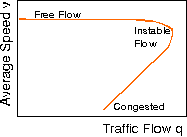 It is generally accepted that the contribution of ATMS and ATIS to an optimal utilization of the available road infrastructure will be relatively small under normal conditions, but is presumed to be considerable in the case of deviant traffic conditions. For this reason, we distinguish another macroscopic traffic parameter that is of vital importance for both ATIS and Figure: typical v, q-diagram ATMS and that can be derived from the three elementary traffic flow parameters: the prevailing traffic flow regime, i. e. free flow or congested traffic.
This parameter depends on the actual values of the three elementary parameters. Their coherence can best be explained by means of the well-known reciprocal relation that exist between the three elementary traffic parameters, namely q = v k. Based on this relationship the three so-called fundamental diagrams can be formulated, which outline the behaviour of the traffic flow, expressed in the elementary parameters q, v and k. Although various, dissimilar theories exist about the exact shape of the fundamental diagrams, their general outline is commonly considered to be appropriate. The Figure illustrates one possible and rather simplified appearance of one of the fundamental diagrams, viz. the speed-flow (vq) diagram based on the linear speed-density model of Greenshields. In this speed-flow (vq) diagram, we can observe two distinct states of the macroscopic traffic flow. In the commencement of the first state, that of free-flow traffic, the individual vehicles that constitute the traffic flow hardly impede one another and the prevailing speed v remains well above the theoretically optimum speed vo. As the number of vehicles in the traffic flow increases, the vehicles more and more suffer from one another and the speed decreases and eventually approaches vo. In the second state, that of congested traffic, the individual vehicles impede each other in such a way that both the flow and the speed further decrease.
Exercise 6
Decipher the following contractions and translate them into Russian.
ATMS, ATIS, veh/km/lane, veh/hr/lane, km/hr
Exercise 7
Find the definition to the following traffic flow parameters.
1. the traffic density k A. free flow or congested traffic
2. the traffic flow q B. the number of vehicles occupying a section of roadway in a single lane
3. the speed v C. the number of vehicles passing a specific point or short section in a given period of time in a single lane
4. the prevailing D. the average rate of motion
traffic flow regime
Exercise 8
Answer the questions on the text.
What are ATMS and ATIS based on? How is the traffic flow expressed? What basis is the traffic density expressed on? How is the speed expressed? In which case is the contribution of ATMS and ATIS to an optimal utilization of the available road infrastructure presumed to be considerable? What relation does the equation q = v k show? What can we observe in the speed-flow (vq) diagram? What happens if the number of vehicles in the traffic flow increases?Exercise 9
Scan Text 2 looking for details your instructor asks.
Text 2
Part 1
So, the fourth macroscopic traffic parameter that we distinguish indicates the currently prevailing traffic regime, hence free flow or congested traffic. Although often three traffic states are discerned, the right-most part of the vq-diagram comprising of both a free-flow and congested component is often separately considered as the unstable region, for our purposes we will follow the two-regime approach.
Besides the four depicted elementary traffic flow parameters, also other characteristics of the actual traffic flows on the road network(s), might be of interest for ATMS or ATIS. Examples of such additional relevant traffic flow parameters would be the actual capacity and origin-destination data.
Part 2
From the perspective of ATIS, the most important topic is informing the (equipped) road user with respect to the optimal route from its origin to its destination, giving the traffic conditions at the moment of passage. Without fixing the exact criteria that are used to determine whether a particular route is optimal (a weighed combination of travel time, distance, costs, etc. might be used), in general, the real-time link mean speed v or travel time t is the most determinative (and the most difficult to determine) component. Furthermore, ATIS should notify the (equipped) road users when a disturbance in the traffic flow has occurred that will significantly affect the travel time that they will experience on their (planned) route from origin to destination, and which is likely to eventuate in a diversion recommendation. Hence, for ATIS, also selection of the prevailing traffic regime, i. e. detecting delaying congestion, is of importance.
The other elementary macroscopic traffic flow parameters that we have distinguished, viz. the density k and the flow q, might, in some subordinate way, contribute to the ATIS objectives, but are certainly not indispensable. Therefore, we will only suggestively address obtaining and further processing data concerning the actual value of the flow q and the density k.
Part 3
From the perspective of ATMS, the most important topic is distributing the available traffic over the accessible infrastructure. For this, predominantly the actual amount of traffic, i. e. the traffic flow q (possibly also the traffic density k), and the actual performance of each part of the road network(s), i. e. link mean speed v or travel time t, are of means of infrastructure based traffic detector, so we will not consider the issue of obtaining the flow or density by means of infrastructure based traffic detectors for ATMS any further.
Since , is crucial for ATMS, also selection of the prevailing traffic regime, i. e (automatic) detection of incidents, is of major importance for ATMS. Existing Automatic Incident Detection (AID) systems basically belong to the class of ATCS (i. e., they are local-oriented).
Exercise 10
Give the appropriate title to each part of the text.
Part 1 A) Relevant ATMS Parameters
Part 2 B) Relevant ATIS Parameters
Part 3 C) Free-Flow or Congestion
Exercise 11
Say whether these statements are true or false.
The fourth macroscopic traffic parameter indicates the currently prevailing traffic regime. The right-most part of the vq-diagram is often separately considered as the stable region. It is impossible to give the road users information about the optimal route from its origin to its destination. The other elementary macroscopic traffic flow parameters (the density k and the flow q) are not indispensable. The traffic flow (and more or less also the density) can be measured directly and accurately.Unit 5
Main Text: Road Design
Exercise 1
Read the title of the text. Say what information you can learn from it.
Exercise 2
Read and translate the text using a dictionary.
Road Design
On neighborhood roads where many vulnerable road users, such as pedestrians and bicyclists (both young and old) can be found, traffic calming can be a tool for road safety. Shared space schemes, which rely on human instincts and interactions, such as eye contact, for their effectiveness, and are characterised by the removal of traditional traffic signals and signs, and even by the removal of the distinction between carriageway (roadway) and footway (sidewalk), are also becoming increasingly popular. Both approaches can be shown to be effective.
Outside neighborhood roads, design features are added to increase motorized safety and mobility. These features come at increasing costs; costs which include monetary amounts, decreased or discouraged usage by non-motorized travelers, as well as aesthetics. Benefits include a broader spectrum of occupational, cultural and entertainment options than enjoyed by more travel-limited generations.
At the other end of the spectrum from neighborhood roads are motorways, which may be called freeways, limited access highways, Autobahnen, Interstates or other national names. Motorways have the best engineered road features, limited access and minimise opportunities for conflict so are typically the safest roads per mile travelled and offer better fuel economy despite higher average speeds.
Road Design Features
Better highways are banked on curves in order to reduce the need for tire-traction and increase stability for vehicles with high centers of gravity. Most roads are cambered (crowned), that is, made so that they have rounded surfaces, to reduce standing water and ice, primarily to prevent frost damage but also increasing traction in poor weather. Some sections of road are now surfaced with porous bitumen to enhance drainage; this is particularly done on bends.
Most street furniture is now designed to absorb impact energy and minimize the risk to the occupants of cars, and bystanders. For example, most side rails are now anchored to the ground, so that they cannot skewer a passenger compartment, and most light poles are designed to break at the base rather than violently stop a car that hits them. Some street furniture is designed to collapse on impact. Highways authorities have also removed trees in the vicinity of roads; while the idea of "dangerous trees" has attracted a certain amount of skepticism, unforgiving objects such as trees can cause severe damage and injury to any errant road users.
The ends of some guard rails on high-speed highways in the United States are protected with Fitch Barriers, a system of sand-filled barrels designed to gradually absorb the kinetic energy of a vehicle and slow it more gently before it can strike the end of the guard rail head on, which would be devastating at high speed.
Road hazards and intersections in some areas are now usually marked several times, roughly five, twenty and sixty seconds in advance so that drivers are less likely to attempt violent maneuvers.
Most signs and road line paint are retro-reflective, incorporating small glass spheres to reflect headlights more efficiently.
Lane markers in some countries and states are marked with Cat's eyes or Botts dots, bright reflectors that do not fade like paint. Botts dots are not used where it is icy in the winter, because frost and snowplows can break the glue that holds them to the road, although they can be embedded in short, shallow trenches carved in the roadway, as is done in the mountainous regions of California.
In some countries major roads have "tone bands" impressed or cut into the edges of the legal roadway, so that drowsing drivers are awakened by a loud hum as they release the steering and drift off the edge of the road. Tone bands are also referred to as "rumble strips," owing to the sound they create.
The U. S. has developed a prototype automated roadway, to reduce driver fatigue and increase the carrying capacity of the roadway. Roadside units participating in future Wireless vehicle safety communications networks have been studied.
There is some controversy over the way that the motor lobby has been seen to dominate the road safety agenda. Some road safety activists use the term "road safety" (in quotes) to describe measures such as removal of "dangerous" trees and forced segregation of the vulnerable to the advantage of motorized traffic. Orthodox "road safety" opinion fails to address what Adams describes as the top half of the risk thermostat, the perceptions and attitudes of the road user community.
Exercise 3
Give English equivalents to the following words and expressions and use them in sentences of your own.
Пешеходы и велосипедисты, традиционные сигналы и знаки дорожного движения, межквартальные дороги, магистраль с ограниченным доступом, лучше экономия топлива, средние скорости выше.
Exercise 4
Explain the meaning of the following words and phrases from the text and reproduce the contexts in which they occur:
Tire-traction, high centers of gravity, to increase motorized safety and mobility, non-motorized travelers, limited access highways, the best engineered road features, they have rounded surfaces, are surfaced with porous bitumen, side rails are anchored to the ground, are designed to break at the base.

|
Из за большого объема этот материал размещен на нескольких страницах:
1 2 3 4 5 |
