


Партнерка на США и Канаду по недвижимости, выплаты в крипто
- 30% recurring commission
- Выплаты в USDT
- Вывод каждую неделю
- Комиссия до 5 лет за каждого referral
In NSW, police have the power to:
· Stop drivers at random to test for alcohol.
· Arrest drivers who test over the legal limit.
· Arrest drivers they believe are impaired by drugs, and conduct a blood and urine test
· Require a driver to undergo a sobriety test in certain circumstances.
Since the introduction of RBT in 1982, fatal crashes involving alcohol have dropped from 40 per cent of all fatalities to the current level of 19 per cent.
Drink driving is stupid. Driving is dangerous when you’re affected by alcohol and/or drugs. When you’re having a hangover or sobering up – even the next day – your driving may still be affected.
Exercise 4
Find English equivalents to the Russian sentences in the text.
1. Вождение автомобиля в алкогольном опьянении неприемлемо.
2. Алкоголь – это наркотик, который оказывает воздействие на ваши навыки, психологическое состояния и поведение.
3. Вождение автомобиля опасно, когда вы находитесь под действием алкоголя или наркотиков.
4. Даже немного алкогольного напитка увеличивает содержание алкоголя в крови.
5. Вождение автомобиля в состоянии алкогольного опьянения является причиной одной из каждых пяти аварий, в которой кто-либо расстается с жизнью.
6. Начинающие водители с любым уровнем содержания алкоголя в крови сильнее подвержены риску попасть в аварию.
Exercise 5
Insert the missing words and word combinations into the sentences.
1. You don’t have to be drunk to … by alcohol.
2. Police have the power to require a driver to undergo a … in certain circumstances.
3. Other drugs also impair your driving and mixing one drug with another, or mixing alcohol with other drugs, dramatically increases your risk of … if you’re stupid enough to try ….
4. The RTA’s drink driving campaign, ‘Brain’, shows the affect just a few beers can have on your … to respond to ….
5. You might feel normal but no one drives as well after ….
6. When you’re coming down or sobering up – even the next day – your driving may still ….
Exercise 6
Give the definition to the term “drink driving” using information from the text.
Exercise 7
Answer the questions on the Text.
1. Does drink driving increase your risk of being involved in a crash?
2. Do you have to be drunk to be affected by alcohol?
3. What is the statistics of drink driving being a factor in fatal crashes?
4. Why are learners and provisional licence holders restricted to a zero alcohol limit?
5. Can coffee, food, physical activity or sleep speed up the process of sobering up?
6. What power has police in NSW against drink or drug drivers?
7. What do you think of drink driving? Give your arguments against or for it.
Exercise 8
Work in pairs. Student A: read the sentence and translate it into Russian. Listen to your partner’s back translation and correct the mistakes if necessary. Student B: see Exercise 12 of this unit.
If you are affected by drugs or alcohol:
· Use public transport or a taxi.
· Get a lift with someone who has not been drinking or using drugs.
· Let people know where you are by taking your mobile or a phonecard.
· Stay at a friend’s house.
· Tell a friend or let someone know if you’ve taken drugs and don’t feel right to drive.
· Sleep it off before you even think about driving, but remember, don’t drive when you’re having a hangover.
Exercise 9
Read Text 2 and give the information about:
1. skills required for safe driving
2. consequences of taking drugs and then driving
3. penalties for driving while impaired by drugs
Exercise 10
Give the title to the text.
Text 2
Safe driving requires precise skills, clear judgment, concentration, and being able to react to what happens on the road.
Drugs affect all of these skills, and not just illegal drugs.
Prescription drugs and even over the counter medicines can affect your driving skills if you don’t follow instructions or your Doctor’s advice.
Taking more than one drug or mixing alcohol and drugs and then driving is even more dangerous. But taking drugs of any kind and then driving puts you at greater risk of injuring or killing yourself, your friends or other innocent people.
There are harsh penalties for driving while impaired by drugs, including a $2, 200 fine, up to 9 months in jail and license disqualification. Heavier penalties apply for a second offence.
Exercise 11
Fill in the blanks with the words given below. Translate the text into Russian.
country areas, drink drive, between 9 pm and 3 am, crashes, men, drink drivers
Drink driving is a factor in about 18 per cent of all fatal … in NSW.
The figure is even higher (27 per cent) in…. In fact, 70 per cent of all fatal … crashes happen in the country.
· The majority (90 per cent) of drink drivers in fatal crashes are….
· One third of all … in fatal crashes are aged 17-24 years (despite making up only about one-seventh of all licensed drivers).
· One quarter of all in fatal crashes are aged 30-39 years.
· 30 per cent of all fatal drink drive crashes occur … on Thursday, Friday and Saturday nights.
Exercise 12
Work in pairs. Student B: Listen to your partner’s translation of the English sentence and correct the mistakes if necessary. Read the sentence in Russian and translate it into English.
Если вы находитесь под действием алкоголя или наркотиков (лекарств):
· Воспользуйтесь общественным транспортом или такси.
· Пусть вас подвезет кто-то, кто не употреблял алкоголя или наркотических препаратов.
· Сообщите знакомым, где вы находитесь по мобильному телефону или воспользуйтесь телефонной карточкой.
· Останьтесь у друга.
· Скажите другу или сообщите кому-нибудь о том, что вы приняли наркотики и не можете вести машину.
· Проспитесь, прежде чем даже подумаете сесть за руль, но помните, не садитесь за руль, когда находитесь в состоянии похмелья.
Unit 9
Main Text: Aggressive Driving
Grammar: 1. Gerund. Its forms and functions
2. Verb+Gerund. Verb+Infinitive
Pre-reading Activities
Exercise 1
What do you think the term “aggressive driving” means?
Exercise 2
Read the international words and guess their meanings.
Risk, result, personality, to adopt, activities, normally, extreme, serious, panic, emotions
Exercise 3
Read and memorize the following words and word combinations.
1. violent яростный, жестокий
2. cause something послужить причиной для чего-либо
3. accident несчастный случай, катастрофа, авария
4. incident происшествие
5. automobile operation управление автомобилем
6. behave вести себя, поступать
7. behavior образ действий, поступки; манеры; поведение
8. contempt towards smb презрение к кому-либо
9. offended обиженный, оскорбленный
10. engage вовлекать; уговаривать; принуждать, понуждать, заставлять
11. pass обгонять, опережать
12. cut off подрезать (об автомобиле)
13. retaliate отвечать (на агрессию, обиду и т. п.); отплачивать, мстить
14. unsafe опасный
15. reckless driving неосторожная езда
16. speeding езда с недозволенной скоростью
17. manslaughter непредумышленное убийство
18. murder убийство (предумышленное, совершённое со злым умыслом)
19. injure (v) ранить, ушибить
20. case случай
21. hunt down затравить; преследовать
22. deliberately преднамеренно, умышленно, нарочно
23. attempt пытаться, стараться
24. rage ярость, гнев, бешенство
25. caused by something вызванный чем-либо
26. mental illness умственная (психическая болезнь)
27. mental diseases психические заболевания
28. confused смущённый; озадаченный; поставленный в тупик, сбитый с толку; поражённый
29. fear боязнь, страх; испуг
Exercise 4
Match the verbs from the left column and the nouns from the right column they can go with.
to pass automobile
to cut off
to operate the risk
to increase
to run off the driver
Exercise 5
Translate the following expressions into Russian.
to cause accidents or incidents on roadways
an extreme case of aggressive driving
to behave with contempt towards other drivers
to increase the risk of an automobile accident
to run someone off a highway
Exercise 6
Read and translate the Main Text.
Main Text
Aggressive Driving
Road rage is a term used to refer to violent behavior by a driver of an automobile, which thus causes accidents or incidents on roadways. It can be thought of as an extreme case of aggressive driving.
Aggressive driving is a form of automobile operation in which an operator will deliberately behave with contempt towards other drivers and drive in such a manner as to increase the risk of an automobile accident.
Unlike drunk driving, aggressive driving is not usually the result of a drug or chemical, but rather the personality of the person operating the automobile. An aggressive driver may adopt a "King of the Road" attitude and become offended when other drivers engage in such activities as passing or "cutting off" the driver. The aggressive driver will then take the actions of the other driver personally, and seek to retaliate. This normally leads to unsafe driving acts such as reckless speeding or attempting to run someone off a highway.
Aggressive driving can also lead to much more serious crimes, such as manslaughter or murder. An aggressive driver may drive so recklessly as to injure or kill another driver or, in extreme cases, will "hunt another driver down" and then deliberately attempt to harm the person. This is often known as "road rage".
Aggressive driving may, in rare cases, be caused by mental illness. Persons with mental diseases, who are driving, may become confused about where they are and who the drivers around them are. This could lead to fear, panic or other emotions causing the person to start driving aggressively.
According to statistic data the great majority of people (96 percent) have not found that the road rage incidents have affected their confidence to drive. However, women and motorists aged 55-64 were the groups most likely to say that the last incident had affected their confidence. It must be stressed that the chances of any driver becoming the victim of a violent road rage attack are very small. The risks of driving alone can be exaggerated -- be sensible about your safety but don't be afraid to drive on your own.
Exercise 7
Fill in the blanks with the words given below and translate them into Russian:
manslaughter, recklessly, murder, automobile operation, road rage, confused
1. … can be thought of as an extreme case of aggressive driving.
2. Aggressive driving is a form of … in which an operator will deliberately behave with contempt towards other drivers and drive in such a manner as to increase the risk of an automobile accident.
3. An aggressive driver may drive so … as to injure or kill another driver.
4. Aggressive driving can also lead to much more serious crimes, such as … or …
5. Persons with mental diseases, who are driving, may become … about where they are and who the drivers around them are.
Exercise 8
Answer the questions on the Text.
1. What is road rage?
2. What is the difference between drunk driving and aggressive driving?
3. What normally leads to unsafe driving acts such as reckless speeding or attempting to run someone off a highway?
4. What can aggressive driving lead to?
5. What can aggressive driving be caused by?
6. What are the chances of any driver to become the victim of a violent road rage attack?
Exercise 9
Look back into the text and find the sentences with Gerund. Identify the forms of each Gerund and translate the sentences.
Exercise 10
Fill in the blanks with the correct form: -ing or to Infinitive. Sometimes both variants are possible.
1. Are you fond of … (to drive)?
2. An aggressive driver can’t help … (to become) offended when other drivers engage in such activities as passing or "cutting off" the driver.
3. He became offended when other drivers engaged in … (to pass) the driver.
4. There is no probability of … (to speed) on this part of the road.
5. I was driving slowly when another driver started … (to cut off) me.
6. I can’t understand why he stared … (to drive) aggressively.
7. He was accused of … (to drive) drunk.
8. Always fix your seat belt before … (to start up).
9. The rain prevented me from … (to drive) too fast.
10. We have the pleasure … (to send) you our new catalogues of spot cars.
11. He is afraid … (to get) into a car accident.
12. They had no intention … (to get) into a car crash.
Exercise 11
Scan Text 2 looking for details your instructor asks.
Text 2
General Advice for Reducing Stress and Fatigue on the Road
Before starting a journey, make sure that you know how to get to your destination and, if possible, have an alternate route in mind or at least an atlas in the car. Think about the timing of the journey – you wouldn't want to be traveling the M252 at 5:15 p. m. on a Friday.
Make sure your car is regularly serviced and carry out routine checks (tire pressure, oil, water, etc.) regularly. Carry spare items (bulbs, fan belt, emergency sign for the windshield, etc.). Also, make sure your windshield is clean, particularly before a long journey. Peering through a dirty windshield is a common source of stress and fatigue when driving. Also, have a window cloth, de-icer, and sunglasses accessible.
Make sure that you are comfortable before starting the journey. Adjust your seat and mirrors. You should also ensure that your seat belt and head restraint are correctly positioned, if they are adjustable.
Too often we have unreasonable expectations of journey times. Take journeys in easy stages and never remain behind the wheel of a car for more than three hours without a break. Don't try to cover more than 300 miles a day and, on a long trip, be careful on the second day of driving – this is when you tend to be most vulnerable to fatigue.
When you take a break, make sure that you get out of the car and stretch your legs. Eat a light snack but avoid heavy meals, particularly at lunchtime. Try to avoid eating in noisy, crowded places.
The likelihood of getting stressed while driving is largely dependent on your attitude of mind before you even turn the key in the ignition. Wind down before you crank up. Try to take one or two minutes to concentrate your mind on the task at hand and try to forget about other problems when driving.
Anticipate situations that are likely to wind you up and be tolerant of other road users’ errors. If you find yourself in congestion, try to accept that there is probably very little that you could have done or can do to prevent the delay.
Take remedial action before stress and fatigue get the better of you. Learn to spot the warning signs and develop positive coping strategies, such as listening to the radio or a cassette (many people listen to novels or humorous tapes in jams).
Wind down the windows to increase ventilation and consciously breathe in the air slowly. Also, don't grip the steering wheel too hard as this will tense arm and neck muscles, leading to fatigue symptoms such as headaches.
If your mind is full of images of recent events or you are replaying conversations repeatedly in your mind, make a conscious effort to slow them down until they become softer and more distant.
Exercise 12
Make the plan of the text and retell it.
Unit 10
Main Text: Reckless Driving
Grammar Gerundial Constructions
Pre-reading Activities
Exercise 1
What do you think the term “reckless driving” means?
Exercise 2
Read the international words and guess their meanings:
Deportation, constitutional, constitutionality, potential (adj.)
Exercise 3
Read and memorize the following words and word combinations:
1. law закон
2. involve вовлекать; включать в себя; влечь за собой
3. wanton распутный, развратный;
4. disregard безразличие, невнимание, равнодушие;
5. constitutional rule конституционное правило
6. apply to использовать, применять
7. severe строгий, суровый
8. remain silent хранить молчание
9. consequence следствие, результат (чего-л.)
10. punishment for smth. наказание за что-либо
11. conviction обвинение, осуждение, обвинительный приговор
12. prove a case доказывать версию
13. beyond a reasonable при отсутствии обоснованного сомнения
doubt
14. suspension приостановка; временное прекращение; отсрочка
15. substantial fine солидный (большой) штраф
16. jail sentence приговор к краткосрочному тюремному заключению
17. severity строгость
18. penalty наказание
19. admit guilt признать вину
20. offense проступок, нарушение чего-л
21. minor незначительный, несущественный
22. amount (v) быть равным, равнозначащим; означать
23. experienced знающий, опытный
24. criminal law уголовное право
25. defense attorney адвокат защиты
26. challenge возражение, оспаривание, протест
27. charge обвинение
28. argue заявлять
29. ordinance указ, декрет, закон; предписание; постановление; распоряжение
30. void не имеющий юридической силы; недействительный
31. uphold поддерживать; подтверждать, одобрять
32. vague неопределённый, неясный, смутный
33. to succeed выигрывать (дело)
34. raise the issue поднять вопрос
(bring up the issue)
35. constitutionality соответствие конституции
36. trial суд
37. appeal апеллировать, подавать апелляционную жалобу; обжаловать
38. court суд
39. insufficient недостаточный; несоответствующий, неподходящий; неудовлетворительный; неполный
40. establish учреждать
41. infraction нарушение (правил, законов)
42. sudden неожиданный
43. skid заносить (об автомобиле)
44. turn signal сигнал поворота, поворотник
45. run a red light проехать на красный свет
46. support поддержка; помощь
Exercise 4
Learn the meaning of the following words and word combinations you will meet in the text.
deter – удерживать от совершения чего-л. (с помощью средств устрашения)
willful – упрямый; своевольный, своенравный; несговорчивый; не поддающийся (убеждениям, уговорам)
misdemeanor crime – юр. мисдиминор (категория наименее опасных преступлений, граничащих с административными правонарушениями)
apply for – 1) обращаться с просьбой, обращаться с заявлением
2) применять, использовать, употреблять
prosecution – судебное преследование, обвинение (как сторона судебного процесса)
parole – юр. временное или досрочное условное освобождение заключённого из тюрьмы
to plea bargain – заключить сделку, соглашение между обвинением и защитой (защита обещает не оспаривать обвинение, а обвинители обещают предъявить обвинение по статье уголовного кодекса, предусматривающей менее строгое наказание, чем предполагалось первоначально)
brake application – торможение, приведение в действие тормозной системы
commission of – доверенность; полномочие
Exercise 5
Read and translate the Main Text.
Main Text
Reckless Driving
1. Laws against reckless driving, or "reckless operation of a motor vehicle," like laws against speeding or drunk driving (DUI or DWI), make such actions a crime and act to deter dangerous driving. Reckless driving differs because it involves a "willful" or "wanton" disregard for the safety of others.
Generally, reckless driving is a misdemeanor crime. This means that constitutional rules apply to prosecutions for reckless driving. The prosecution must prove its case beyond a reasonable doubt. Police officers must inform you of your right to remain silent before you start answering questions.
2. The potential consequences of and punishments for a conviction of reckless driving can be severe. A reckless driving conviction can result in:
· A misdemeanor criminal record
· Deportation
· Revocation of parole
· Automatic suspension or revocation of your driver's license
· A substantial fine and a jail sentence
Given the severity of penalties, it's common for drivers to plea bargain and admit guilt to a less serious offense, such as speeding or some other minor traffic violation.
3. Whether or not your driving amounts to reckless driving depends on how state or local law defines the offense in your area. If you're not sure how the law applies in your state, think about seeking help from an experienced criminal law or defense attorney.
4. State laws usually define reckless driving as "driving with a willful or a wanton disregard for the safety of persons or property," or in similar terms.
Challenges to reckless driving charges by arguing that state laws or local ordinances don't clearly define the offense are possible. The argument is that the law is unconstitutional and void for vagueness. Most states have upheld definitions of reckless driving over such arguments. However, a few states have found reckless driving laws to be unconstitutionally vague. Depending on the language of the state law or local ordinance, it's possible to succeed with a constitutional challenge. Remember, if you don't raise the issue of constitutionality at trial, you probably won't be allowed to bring it up if you later appeal.
5. Among the specific acts or types of conduct that have been found by courts as insufficient in themselves to establish reckless driving are:
- The commission of mere traffic violations or infractions, such as running a red light The sudden application of brakes on a wet road, followed by skidding Making a U-turn without using turn signals Driving without headlights Speeding Being involved in a traffic accident Inattentive driving Driving after drinking alcohol
While any one of these acts, standing alone, usually won't support a conviction for reckless driving, a combination of more than one of these acts could.
Exercise 6
Complete the definitions:
1. … – a less serious crime
2. … – the large bright lights at the front of the car
3. … - the act of finding someone guilty of a crime in a court of law.
4. … - a punishment that someone is given for doing something which is against a law or rule.
5. … – a crime (a formal use)
6. … – the lawyers who try to prove that a person on a trial is guilty
7. … - the act of charging someone of a crime and putting them on trial.
Exercise 7
Find the words from Exercise 6 in the text and reproduce the context in which they occur.
Exercise 8
Match the parts of the text (from 1 to 5) and the titles:
Part 1 A) Penalties for Reckless Driving
Part 2 B) Required Conduct
Part 3 C) General Information
Part 4 D) Legal Definitions of Reckless Driving
Part 5 E) Elements of the Crime of Reckless Driving
Exercise 9
Answer the questions on the Text.
1. Do constitutional rules apply to prosecutions for reckless driving?
2. What can a reckless driving conviction result in?
3. What does the decision whether or not your driving amounts to reckless driving depend on?
4. How can reckless driving be defined?
5. What are the specific acts or types of conduct that have been found by courts as insufficient in themselves to establish reckless driving?
Exercise 10
Scan Text 2 looking for details your instructor asks.
Text 2
1. Speeding alone doesn't ordinarily amount to reckless driving. In some states, however, speeding creates a presumption of recklessness, which the driver may rebut or defeat. Speeding can be viewed in several ways. An extremely high rate of speed might be enough to establish recklessness. On the other hand, the mere fact that a driver obeyed the posted speed limit doesn't negate the possibility that the driver could be found guilty of reckless driving.
2. Speeding combined with other factors can support a reckless driving conviction. Factors considered along with speed include:
· The roadway being traveled, including its width and surface
· The presence or lack of vehicular traffic or pedestrians
· Visibility factors
· The time of day that the defendant was driving
3. Generally, the fact that a defendant drove while intoxicated or under the influence of alcohol or drugs won't support a reckless driving conviction. Rather, courts consider alcohol and drug use as a factor in deciding whether the driver's actions were reckless.
Nevertheless, a driver who gets behind the wheel and drives knowing that he or she is intoxicated or drunk and that his or her physical condition is impaired, might be found guilty of reckless driving.
4. Reckless driving and DUI or DWI offenses are separate crimes. Reckless driving isn't a lesser-included offense of DUI or DWI because each crime is separate and distinct and can be proved by different evidence. Reckless driving involves how a vehicle was being operated; it isn't necessary to show that the driver used drugs or alcohol to prove a violation of a reckless driving law. In a prosecution for DUI or DWI, on the other hand, how the vehicle was being operated might tend to show that the driver was impaired, but it is not a necessary ingredient of the offense.
So, because reckless driving and DUI or DWI are distinct and separate offenses, a conviction or an acquittal of one offense does not bar a prosecution for committing the other offense.
mitting a traffic offense, such as running a stop sign or turning without signaling, doesn't alone constitute reckless driving. However, combinations of traffic violations or aggravating circumstances can support a reckless driving conviction. For example, a court could find that running several stop signs at high speed when other traffic or pedestrians are around is reckless driving.
6. Intent isn't an element of reckless driving, so the prosecution doesn't need to prove that a driver intended to act recklessly. The prosecution must prove, however, that the reckless driver was aware of the risk and consciously disregarded it.
7. In deciding a reckless driving case, a court weighs the nature and degree of risk disregarded by the driver, the nature and purpose of his actions, and the circumstances known to the driver while he was driving. The prosecution must show more than the driver's simple, gross or criminal negligence in proving reckless driving.
Exercise 11
Match these questions (A-G) with the paragraphs that answer them (1-7).
A. When can speeding support a reckless driving conviction?
B. Does speeding alone ordinarily amount to reckless driving?
C. Does the prosecution need to prove that a driver intended to act recklessly?
D. What traffic violations can support a reckless driving conviction?
E. What is important in deciding a reckless driving case?
F. Does drink or drug driving support a reckless driving conviction?
G. Can Reckless driving be a lesser-included offense of DUI or DWI?
Exercise 12
Give the title to the Text 2.
Exercise 13
You are an attorney defending the driver who is charged for reckless driving. Answer the questions of your defendant (if you don’t know the answer find the information in the Internet):
1. Are reckless driving charges on the rise due to all the distractions we have in our cars?
2. If I have an accident, am I more likely to be charged with reckless driving if I was using my cell phone, a GPS system, or a DVD player?
3. Can I be charged with reckless driving if an accident happens on both public and private property, like hitting someone while backing out of my driveway or my car leaves the road and hits a house?
4. If my blood alcohol level was below the legal limit when my accident happened, could I be charged with reckless driving instead?
5. I was in an accident at an intersection that's on the list of top accident sites in my area. Is it a valid defense to reckless driving that the intersection is inherently dangerous?
Grammar References
The Verbals
Finite and non-finite verbs (Личные и неличные формы глагола)
Личные формы глагола (finite verbs)
Личные (или финитные) формы глагола – это такие формы, которые выражают лицо, число, наклонение, залог.
Примеры:
I am driving a new car. (Present Continuous Active, 1st person, sing.) – Я управляю новым автомобилем.
She drives a car skillfully. (Present Simple Active, 3rd person, sing.) – Она ловко управляет автомобилем.
Always use the Zebra crossing. (Imperative) – Всегда пользуйтесь пешеходным переходом.
Неличные формы глагола (non-finite verbs)
Неличные формы глагола не выражают лица, числа, наклонения, залога. К неличным формам глагола относятся:

Не все неличные формы английского глагола имеют соответствия в русском языке. Как видно из таблицы, в обоих языках есть инфинитив, или неопределённая форма глагола и причастие. Однако у английского глагола нет такой формы, как деепричастие, а у русского нет герундия. Как в таком случае переводить несуществующие формы с одного языка на другой? Это мы узнаем, познакомившись ближе с неличными формами английского глагола.
The Infinitive
l The Infinitive (Инфинитив) – это неличная форма глагола, которая называет действие, не относя его к какому-либо лицу. Это начальная, или 1-ая форма глагола. Инфинитив сочетает в себе свойства глагола и существительного.
l Как глагол The Infinitive имеет категорию залога (Active, Passive) и формы Indefinite, Continuous, Perfect и Perfect Continuous. А также The Infinitive может иметь прямое дополнение.
l Как существительное The Infinitive в предложении может выполнять функцию подлежащего, дополнения, определения, обстоятельства.
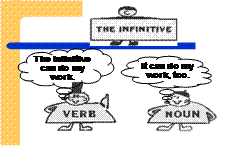
Ü Infinitive не может быть сказуемым в предложении!
Формальным признаком английского инфинитива является частица to (particle to), которая ставится перед глаголом. В русском языке признаком инфинитива являются окончания: -ть, -ти, - чь.
Сравните:
to read – читать В английском языке формальный признак
to go – идти инфинитива стоит перед словом, а в русском
to bake – печь языке – в конце слова.
to + V1

 Английский инфинитив может употребляться в утвердительной (affirmative) и отрицательной (negative) форме.





Для образования отрицательной формы инфинитива частица not ставится перед инфинитивом.

1) Инфинитивы могут употребляться с частицей to ( To-infinitive ) и без частицы to ( Bare infinitive ).
2) Образование форм инфинитива:
а) Simple Infinitive представляет собой основную форму глагола Basic verb form, например, (to) do. Примеры употребления Simple infinitive To-infinitive и Bare infinitive.
To-infinitive Инфинитив с частицей to
1) Инфинитив с частицей to (to-infinitive) представляет собой одно из возможных употреблений любой формы инфинитива
2) Инфинитив с частицей to со своими зависимыми (дополнениями, обстоятельствами) образует инфинитивный оборот.
3) Инфинитив с частицей to, употребляется:
а) в функции подлежащего (Subject ).
To study is boring — Учиться скучно.
б) в функции части составного именного сказуемого.
My desire is to be sent to the conference — Чего я хочу, так это поехать на конференцию.
в) в функции обстоятельства цели:
I came to ask if you had any news of our poor John — Я пришел, чтобы спросить, нет ли новостей о нашем бедном Джоне.
г) в функции обстоятельства, обозначающего действие, последовавшее за действием, выраженным глаголом, к которому относится инфинитив.
We came home to find our garden neat and tidy — Мы вернулись домой и нашли наш сад в чистоте и порядке.
He returned after the war to be told that his wife had left him — После того, как он вернулся с войны, ему сказали, что жена оставила его.
д) в качестве дополнения при некоторых глаголах.
I hope to see you on Monday — Надеюсь увидеть тебя в понедельник.
I'd like to be lying in the sun right now. — Хотелось бы мне сейчас валяться на солнышке!
е) с некоторыми глаголами в качестве части относящегося к ним сложного дополнения.

|
Из за большого объема этот материал размещен на нескольких страницах:
1 2 3 4 5 |
