


Партнерка на США и Канаду по недвижимости, выплаты в крипто
- 30% recurring commission
- Выплаты в USDT
- Вывод каждую неделю
- Комиссия до 5 лет за каждого referral
Министерство образования Российской Федерации
Владивостокский государственный университет
экономики и сервиса
ИНОСТРАННЫЙ ЯЗЫК
(ЕВРОПЕЙСКИЙ)
Практикум
Для студентов специальности 190702.65 «Организация и безопасность движения»
Владивосток
Издательство ВГУЭС
2010
ББК
Рецензенты: , доцент каф. западноевропейских языков, к. ист. н.
, доцент каф. иностранных языков ДВГТУ, к. пед. н.
,
ИНОСТРАННЫЙ ЯЗЫК (ЕВРОПЕЙСКИЙ): Практикум. – Владивосток: Изд-во ВГУЭС, 2010. – 90 с.
Практикум по дисциплине «Иностранный язык (европейский)» содержит аутентичные тексты и упражнения к ним по темам организации и безопасности дорожного движения, а также грамматический справочник с упражнениями. Цель практикума: обучение различным видам извлечения информации из оригинальных текстов на английском языке.
Для студентов специальности «Организация и безопасность движения» и широкого круга лиц, изучающих английский язык для использования в профессиональной деятельности.
ББК
Утвержден на заседании кафедры ЗЕЯ 09.06.10 протокол
Рекомендован УМК ИИЯ 11.06.10 протокол
Печатается по решению РИСО ВГУЭС
© Издательство Владивостокский государственный университет экономики и сервиса, 2010
ВВЕДЕНИЕ
Настоящий практикум рассчитан на студентов 2 курса специальности 190702.65 «Организация и безопасность движения», а также на широкую аудиторию специалистов, изучающих английский язык для использования в профессиональной деятельности. Практикум помогает заложить основы языка для специальных целей и дает студентам возможность освоиться в мире языка по своей специальности. Работа по данному практикуму развивает навыки профессионально ориентированного чтения.
Практикум состоит из следующих разделов:
1. Базовый курс
2. Грамматический справочник с упражнениями
Базовый курс состоит из 10 блоков. Тематика уроков практикума охватывает систему правил дорожного движения, организации и безопасности движения стран Европы, Северной Америки и Азии. В текстах затрагиваются вопросы, связанные с правилами для пешеходов, дорожными знаками в разных странах, безопасностью и организацией дорожного движения, проектированием дорог, типами ущерба и повреждений в результате дорожных происшествий, скоростным режимом, управлением автомобиля в состоянии алкогольного или наркотического опьянения, рискованным и неосторожным вождением.
В структуре урока базового курса предусмотрено два текста, объединённых общей тематикой и сопровождаемых предтекстовыми и послетекстовыми упражнениями. Первый текст (Main Text) предназначен для изучающего чтения, второй текст (Text 2) – для поискового или ознакомительного чтения. Структура двух уроков, предназначенных для домашнего чтения, несколько отличается от остальных блоков, так как эти тексты предназначены для развития навыков работы со словарём и самостоятельного пополнения словарного запаса.
Предтекстовые упражнения направлены на устранение смысловых и языковых трудностей. Послетекстовые упражнения предназначены для проверки понимания прочитанного и для закрепления активной лексики. Грамматический справочник содержит информацию, необходимую для освоения программного материала курса. Грамматические упражнения направлены на усвоение и закрепление грамматических явлений, представленных согласно учебной программе.
После усвоения материала, содержащегося в практикуме, обучаемый должен уметь читать и понимать литературу по специальности.
Unit 1
Main Text: Traffic Rules to be Followed by People
Grammar: 1. The Verbals
2. The Infinitive, its Forms and Functions
3. The Bare Infinitive
Pre-reading Activities
Exercise 1
Read and memorize the words from the Main Text.
1. cell phone переносной телефон
2. accident несчастный случай; катастрофа; авария
3. occur происходить, случаться
4. alcohol-impaired driver водитель автомобиля, находящийся в состоянии опьянения
5. alight (from) сходить, спешиваться
6. board садиться на (любой вид транспорта)
7. precautions меры предосторожности
8. pillion заднее сиденье (мотоцикла)
9. helmet каска, шлем
10. carry иметь при себе, носить с собой
10. driving license водительские права
11. defensively зд. безопасно
12. drowsiness сонливость
13. headlight прожектор, фара, фонарь, лампочка (на передней части транспортного средства)
14. to dim headlights переключить фары с дальнего света на ближний
15. overdrive перегружать
16. wiper стеклоочиститель
17. curb бордюрный камень; обочина
18. apply a brake нажать на тормоз
19. impair ослаблять, уменьшать, ухудшать (качество)
20. Angina pectoris стенокардия, грудная жаба
21. judgment суждение
22. warning light лампа аварийной сигнализации
23. pedestrian пешеход
24. round-about объезд; участок дороги с круговым движением
Exercise 2
Try to guess the meaning of the words and word combinations from the text.
hard drinks, Zebra crossing, sub-way, over-bridge, a two wheeler, “Highway hypnosis”, fog lights, central line, edge lines, road signs, roadway, roadway marker, uncontrolled, indicate, sharp bend, the give way rules
Exercise 3
What traffic rules do you know?
Exercise 4
Work in pairs. Student A: read the sentence and translate it into Russian. Listen to your partner’s back translation and correct the mistakes if necessary. Student B: see Exercise 11 of this unit.
1. Children should not be allowed to play on the roads.
2. Never board or alight from a moving vehicle.
3. On the highway don’t drive a vehicle too close to the vehicle moving ahead, maintain safe distance.
4. It is too dangerous to drive under such conditions.
5. Always carry driving license and vehicle papers.
6. Get your eye sight checked regularly. A good vision is essential for road safety.
Exercise 5
Read and translate the Main Text.
Main Text
Traffic Rules to Be Followed by People
1. Do not use cell phone while driving on the road.
2. Accidents may occur as a result of alcohol-impaired driving but the term does not necessarily mean driving after taking hard drinks and alcohol impaired driver is one who is under the influence of any drug having alcohol concentration.
3. Children should not be allowed to play on the roads.
Some rules for safety on the road:
· Always use the Zebra crossing.
· Look to the right and left before crossing a road.
· Use sub-way and over-bridge wherever there is one.
· Never board or alight from a moving vehicle.
· Never run while crossing a road.
4. Take these precautions to be safe on the road:
· Keep your vehicle under control.
· To follow traffic rules is vitally important.
· While riding a two wheeler both the driver and the pillion rider must wear ISI marked helmets.
· Don’t mix driving and drinking.
· It is always necessary to carry driving license and vehicle papers.
· Always concentrate on the road and drive defensively.
· While taking a long trip avoid drowsiness or “Highway hypnosis” by stopping frequently to take water, tea, and exercise or nap.
· On the highway don’t drive a vehicle too close to the vehicle moving ahead, maintain safe distance.
5. It may be dangerous to drive in a fog. However if you must drive in fog, drive with your head light set on dim or use fog lights. Don’t over drive your head lights.
6. During the rainy season the roadway becomes slippery due to oil, water, dust and leaves. It is too dangerous to drive under such conditions. You must drive with your head lights on while operating your wipers. Take special care on turns and curbs and while applying brake.
7. While driving during the night take the following precautions:
· Never over drive your head lights. The head lights should be always cleaned and aimed properly.
· Use central lines and edge lines on the road of the roadway as guides.
· Don’t park your vehicle on the roadway. If you must, use a red warning light.
8. Such persons must avoid driving:
· Very old people.
· People suffering from epilepsy and seizures.
· Those who are on anti-histamine medication (like Benadryl etc.) as such medicines impair driving ability.
· Patients suffering from Angina pectoris (stable or unstable).
9. The skills which are necessary to drive safely:
· A driver must have good vision in front and out of the corners of the eyes (frontal as well as peripheral vision).
· A driver must have quick reactions to be able to brake or turn to avoid crashes.
· A driver must have good eyes – hands – legs coordination
· A driver must have ability to take quick decisions i. e. must be able to make judgments about what is happening on the road.
10. These road signs mean:
1. 2.
2. 3.
3. 
4. 5.
5. 6.
6.
1. Uncontrolled T intersection ahead: slow down, indicate left or right.
2. Sharp bend ahead to the right: slow down, keep left and don’t cut.
3. Pedestrian crossing ahead: slow down, look for pedestrian crossing on the road and stop if you have to.
4. Round about ahead: choose correct position for left turn, right turn or going straight through. Slow down and apply the give way rules. Indicate if you have to.
5. Road narrows: slow down, scan the road ahead for on coming traffic and keep well to the left.
6. Railway crossing ahead: slow down, look for trains and stop if you have to.
11. Get your eye sight checked regularly. To have a good vision is essential for road safety.
Exercise 6
Fill in the table with the examples from the text.
Forms of the Infinitive
INFINITIVE Active Passive__
Indefinite ____________ ____________
Continuous ____________ ____________
Perfect ____________ ____________
Perfect Continuous ____________ ____________
Exercise 7
Write out the examples of the Bare Infinitive from the text above. Classify them according to the rules.
a) after auxiliary verbs d) after the verb ‘to let’
b) after modal verbs e) after the verb ‘to help’
c) after verbs of sensual perception f) after the verb ‘to make’
Exercise 8
Write out the examples of the Infinitive from the text above. Classify them according to their functions.
Subject:
Part of the Predicate:
Object:
Attribute:
Adverbial Modifier
of purpose:
of result:
Exercise 9
 Complete these sentences with the words you can see on the display.
driving on the road crossing a road
maintain safe distance moving vehicle
a red warning light on the roadway
left or right for road safety
drinking too close
applying brake if you have to
1. Do not use cell phone whileLook to the right and left beforeNever board or alight from a … 4. Don’t mix driving andOn the highway don’t drive a vehicle … to the vehicle moving ahead, Take special care on turns and curbs and whileDon’t park your vehicle... If you must, use... 8. Uncontrolled T intersection ahead: slow down, indicatePedestrian crossing ahead: slow down; look for pedestrian crossing on the road and stopGet your eye sight checked regularly. A good vision is essential...
Exercise 10
Answer the questions.
1. Who must avoid driving? 2. What skills are needed to drive safely? 3. When is it dangerous to drive? 4. What should you do to avoid drowsiness? 5. What should you always carry? 6. What shouldn’t you do while crossing a road? 7. What should you do before crossing a road? 8. What do you use if you need to cross the road? 9. What can alcohol-impaired driving cause? 10. What rule should you remember while riding a two wheeler?
______________________________________________________________
Exercise 11
Work in pairs. Student B: Listen to your partner’s translation of the English sentence and correct the mistakes if necessary. Read the sentence in Russian and translate it into English.
Детям не следует разрешать играть на дороге. Никогда не садитесь или не сходите с движущегося транспорта. На шоссе не ведите автомобиль слишком близко к автомобилю, движущемуся впереди, удерживайте безопасное расстояние. Слишком опасно вести машину при таких условиях. Всегда имейте при себе водительские права и документы на автомобиль. Регулярно проверяйте зрение. Иметь хорошее зрение важно для безопасности движения._____________________________________________________________________________
Exercise 12
Read and memorize the words from the Text 2
1. resident житель; постоянно проживающее лицо
2. involve втягивать; касаться, затрагивать
3. victim жертва
4. assailant противник, нападающая сторона
5. abide by оставаться верным, следовать чему-л.,
6. pedestrian пешеход
7. sidewalk тротуар
8. available доступный; имеющийся в распоряжении
9. intersection перекресток
10. approach подход
11. margin обочина
12. grip схватить ( on, onto); сжать
13. handle bar руль мотоцикла; руль велосипеда
14. use caution быть острожным
15. regulations правила; нормы; инструкция
16. possess владеть, иметь, обладать
17. exceed превышать; превосходить
18. observe соблюдать (законы и т. п.) ; твердо придерживаться (чего-л.)
19. dusk сумерки; полумрак, сумрак
20. valid действительный, имеющий силу; правомерный
21. fasten застегивать(ся)
22. consideration здесь: вежливость, предупредительность; почет, уважение
23. stall застревать; глохнуть (о двигателе)
24. button кнопка
25. emergency warning unit устройство аварийного предупреждения
26. alarm боевая тревога, сигнал тревоги
27. mount монтировать, устанавливать
28. flammables воспламеняющиеся вещества
29. flare сигнальная вспышка, световой сигнал
30. injury повреждение, рана, ушиб
31. aid помощь
32. civil liability гражданско-правовая ответственность
33. insurance страхование
34. liability insurance страхование ответственности
35. inflict наносить
36. indemnify for компенсировать, возмещать
Exercise 13
Translate the words and word combinations from the text.
right-of-way, traffic regulations, road markings, fasten one’s seatbelt, child-car seat, a child under six years old, elderly people, speed limits, railroad crossing, voluntary, keep to the right, bright-colored clothes, press the button, easily produce smoke, until rescuers arrive, give first aid, to prevent traffic accidents.
Exercise 14
Scan Text 2 looking for details your instructor asks.
Text 2
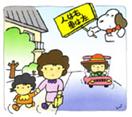 Do you know Japanese traffic rules?
Part 1
A number of traffic accidents occur every year in Aichi Prefecture. Foreign residents are involved in traffic accidents as victims or assailants in an increasing number of cases. To protect yourself from traffic accidents, please, abide by the basic rules below.
 Pedestrians keep to the right, while cars and bicycles keep to the left.
Pedestrians have the right-of-way over cars.
Observe traffic signals and road signs.
Follow the instructions of police officers.
 Part 2
Use a sidewalk whenever one is available.
Keep to the right on roads without sidewalks.
When crossing a road at an intersection, observe traffic signals for pedestrians. Where there is no traffic light, use a zebra crossing.
Before crossing a road, first look right and left carefully to make sure that no cars are approaching. When there are cars approaching, be sure that they have stopped before you start to cross the road.
At night, wear a reflector or bright-colored clothes whenever possible.
 Part 3
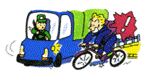
Keep to the left margin of the road. Get into line with other bicycles.
You may ride a bicycle on a sidewalk where it is indicated so.
It is not allowed for two persons to ride on one bicycle. Always grip the handle bars firmly with both hands. It is dangerous to hold an umbrella or other things while riding a bicycle.
At railway crossings or STOP signs, stop and look both ways before crossing.
Observe traffic signals at intersections.
In Aichi Prefecture, many foreign residents are involved in traffic accidents while riding bicycles. Please use caution when you ride a bicycle.
Part 4
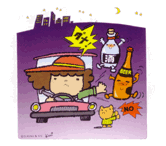
Never drive a car if you do not possess a valid driver’s license or if you are under the influence of alcohol.
 Observe traffic regulations, signals, signs and road markings.
When driving a car, the driver and passengers are required to fasten their seatbelts. When riding a motorcycle, make sure to wear a helmet.
Make sure to use a child-car seat for a child under six years old.
Do not exceed the speed limits indicated by signs or markings.
Turn on the lights at dusk as early as possible.
Do not use a cell phone while driving a car.
Senior citizens are involved in a number of traffic accidents. When you see elderly people, please give extra consideration to them while driving your car.
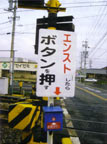
What to do in these situations:
 Part 5
If your car stalls on a railroad crossing, take the steps below to let the train operator know about the trouble immediately. Also, move your car outside the railroad crossing.
Press the button of the emergency warning unit (mounted on the column of the railroad crossing alarm, etc.).
Use an emergency flare in your car or other means to let the train operator know that trouble lies ahead.
When an emergency flare or other means are not available, burn flammables that easily produce smoke near the railroad crossing.
Part 6
In case you are involved in a traffic accident, keep calm and follow the measures listed below.
Move your car to a safe place out of the way of traffic and turn off the engine.
If there are any injuries, call the fire department (119). Until rescuers (including physicians and ambulances) arrive, give first aid (such as stopping bleeding with gauze or a handkerchief) to the best of your ability.
Immediately call the police (110) and inform them of the location of the accident, the number of injured persons and the extent of their injuries. The police will then give you instructions.
If you are not injured, do not leave the scene of the accident until police officers arrive.
When you cause a traffic accident, you are required to assume civil liabilities (compensation for damages) as well as gross administrative sanctions (suspension/revocation of driver’s license) and penalties (including a fine). A traffic accident brings misery to you, your family and friends. For this reason, ensure safe driving to prevent traffic accidents.
Exercise 15
Look through Text 2 again.
A) Mark the words you have learnt before.
B) Mark the words you consider to be the terms.
Exercise 16
Look through the Main Text and Text 2. Find the Bare Infinitive in both of them. Explain the rule.
Exercise 17
Match the titles and the Parts of the Text.
Part 1 A) When your car stalls on a railroad crossing
Part 2 B) Basic rules for bicycles
Part 3 C) Basic rules for pedestrians
Part 4 D) When you are involved in a traffic accident
Part 5 E) Basic rules for cars
Part 6 F) Basic traffic rules
Exercise 18
Render one of the parts of the text into Russian.
Exercise 19
 Translate the following abstracts in a written form.
Car insurance
It is recommended that you subscribe to the voluntary insurance in addition to the compulsory insurance, so that you can prepare yourself for a possible car accident and get potential compensation for damages.
Compulsory insurance
(Automobile collision liability insurance)
An owner of a car or a motorcycle is required to subscribe to this insurance under the Automobile Liability Security Law. You have to buy the insurance when purchasing an automobile or having a periodical, legally-mandated inspection of your car. An insurance agency (including car dealers and car inspection shops) handles the application process.
Voluntary insurance
This voluntary subscription insurance covers compensation for damages inflicted on the vehicles and passengers involved (because such compensation is not covered by the compulsory insurance), and indemnifies you for damages beyond the limit of compulsory insurance.
Unit 2
Main Text: Traffic Signs
Grammar: The Infinitive
Pre-reading Activities
Exercise 1
Learn the words from the text.
traffic sign дорожный знак impart сообщать barrier помеха, преграда, препятствие develop разрабатывать, создавать adopt принимать define определять, давать определение warn предупреждать priority первенство, преимущество prohibitory запретительный, запрещающий restrictive ограничительный mandatory обязательный, принудительный12. facilities средства обслуживания, удобства; услуги
direction направление indication указание, указатель additional добавочный, дополнительный erect возводить intersection перекресток film плёнка reflective отражательный, отражающий major road главная дорога bracketed заключённый в скобки22. destination место назначения, пункт назначения
adhere придерживаться чего-л lodging жилище, жилье curve изгиб, поворот detour объездExercise 2
Try to guess the meaning of the words and word combinations from the text.
road signs, road users, language differences, barriers to understanding, symbols in place of words, Vienna Convention on Road Signs and Signals, special regulation signs, service signs, in different ways, stone columns, multidirectional signs, metal rather than wood, coated in a thin film, filled with small glass particles, military establishments, bracketed numbers
Exercise 3
Choose the meaning of the word in which it may be used in the text.
1. The red outline is used for military establishments.
a) набросок b) основная идея c) контур d) конспект
2. In Québec, the usage of blue and brown is reversed.
a) обратный b) отменённый c) обратимый d) изменённый
3. Traffic signs became more important with the development of automobiles.
a) создание b) улучшение c) эволюция d) вывод
4. Many U. S. states now use fluorescent orange for construction signs.
a) состояние b) излагать c) штат d) государство
Exercise 4
Find the Infinitive in the sentence. Say if “to” is a particle before the Infinitive or a preposition. Translate these sentences.
Language differences can create barriers to understanding. The Romans erected stone columns throughout their empire to give the distance to Rome. Despite efforts to devise pan-European standards, the European Union has not yet standardised road signs across member states. Road signs in the south were changed to differ from the UK standard. The UK is the only European Union member to use a system other than the metric system. For the most part, conventions in signage tend to resemble North American signage conventions more so than European and Asian conventions. In North America and Australia, signs generally adhere to the special colours.Exercise 5
Read and translate the Main Text.
Main Text
Traffic Sign - Definition
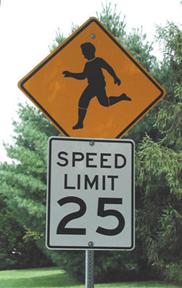 Most countries place signs, known as traffic signs or road signs, at the side of roads to impart information to motorists and other road users. Since language differences can create some barriers to understanding, international signs using symbols in place of words have been developed in Europe and adopted in most countries and areas of the world. Annexe 1 of the Vienna Convention on Road Signs and Signals of November 8, 1968 defines eight categories of signs:
· A. Danger warning signs
· B. Priority signs
· C. Prohibitory or restrictive signs
· D. Mandatory signs
· E. Special regulation signs
· F. Information, facilities, or service signs
· G. Direction, position, or indication signs
· H. Additional panels
However, countries and areas categorize road signs in different ways.
History
The earliest road signs gave directions, for example the Romans erected stone columns throughout their empire to give the distance to Rome. In the Middle Ages multidirectional signs at intersections became common giving directions to cities and towns.
Traffic signs became more important with the development of automobiles. The basic patterns of most traffic signs were set at the 1908 International Road Congress in Rome.
Since then there have been considerable change. Today they are almost all metal rather than wood and are coated in a thin film filled with small glass particles that make them highly reflective.
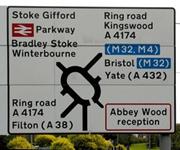 A road sign near Bristol in England, giving directions to Parkway railway station (red symbol), motorways (blue backgrounds) and an assortment of A roads (major roads). The red outline is used for military establishments (the Ministry of Defence at Abbey Wood). The bracketed numbers indicate destinations reachable by routes accessed via the unbracketed roads listed.
Categorization
United States of America
· Regulatory signs
· Warning signs
· Marker signs
· Guide and informational signs
· Recreational and cultural interest signs
· Signs for bicycle facilities
· Construction signs
· Railroad crossing signs
· School signs
· Civil defense signs
Design
North America and Australia
In North America and Australia, signs generally adhere to the following colours:
· green with white letters for informational signs, such as directions, distances, and places
· brown with white for signs to parks, historic sites, ski areas, forests, and campgrounds
· blue with white for rest areas, food, gasoline or petrol, and lodging
· white with red or black letters for regulatory signs, such as speed limits or parking
· yellow with black letters and symbols for warning signs, such as curves and school zones
· orange with black letters for construction zones and detours
Regulatory signs are also sometimes seen with white letters on red or black signs. In Québec, the usage of blue and brown is reversed, and many black-on-yellow signs are red-on-white instead. Many U. S. states now use fluorescent orange for construction signs, and fluorescent yellow for school zone and crosswalk signs.
Exercise 6
Answer the questions to the text.
1. Where are traffic signs placed?
2. Why have international signs using symbols been developed?
3. What categories of signs do you remember?
4. What earliest road signs can you describe?
5. When did traffic signs become more important?
6. What are modern road signs made of?
7. For what signs are green with white letters used?
8. What colours are used for regulatory signs?
9. What symbols and letters are used for curves and school zones?
10. What kind of signs is used in many U. S. states now?
Exercise 7
Compare the categories of signs defined in 1968 and Categorization of signs in the United States of America. Speak of similar and different features.
Exercise 8
Give examples from the history of road signs.
Exercise 9
Scan Text 2 looking for details your instructor asks.
Text 2
Traffic Signs in Different Countries
1. Warning signs are one of the important types of traffic signs.
Every state and province has different markers for its own highways, but use standard ones for all federal highways. Many special highways, such as the QEW or Trans-Canada Highway, or originally on U. S. highways like the Dixie Highway, have used unique signs. Counties in the U. S. sometimes 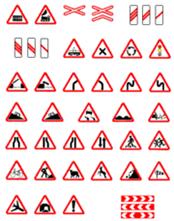 use a pentagon-shaped blue sign with yellow letters for numbered county roads, though the use is inconsistent even within states.
2. American road signs measure distances in miles rather than kilometres. Traffic signs in the United States have been standardized through the Manual on Uniform Traffic Control Devices (MUTCD), though they sometimes still vary from state to state, particularly on older signs.

|
Из за большого объема этот материал размещен на нескольких страницах:
1 2 3 4 5 |
