


Партнерка на США и Канаду по недвижимости, выплаты в крипто
- 30% recurring commission
- Выплаты в USDT
- Вывод каждую неделю
- Комиссия до 5 лет за каждого referral
Exercise 5
Match the words or word combination from the column A with its definition or description from the column B.
A | B |
1. cambered roads | a) a system of sand-filled barrels designed to gradually absorb the kinetic energy of a vehicle |
2. vulnerable road users | b) bright reflectors that do not fade like paint |
3. human instincts and interactions | c) can cause severe damage and injury |
4. motorways | d) eye contact |
5. trees | e) for drowsing drivers to be awakened by a loud hum |
6. Fitch Barriers | f) freeways, Interstates, Autobahnen, limited access highways |
7. retro-reflective paint | g) incorporating small glass spheres to reflect headlights more efficiently |
8. Cat's eyes or Botts dots | h) made so that they have rounded surfaces |
9. "tone bands" | i) pedestrians and bicyclists |
j) the safest roads per mile travelled |
Exercise 6
Complete the sentences from the text.
Road hazards and intersections in some areas are now usually marked … Botts dots are not used where it is … Drowsing drivers are awakened by a loud hum as they release the steering and … The U. S. has developed …, to reduce driver fatigue and increase the carrying capacity of the roadway.Exercise 7
Say whether the following statements are true or false.
1. Motorized safety and mobility can be increased outside neighborhood roads by adding design features.
2. Motorways are the most dangerous roads per mile travelled.
3. Neighborhood roads offer better fuel economy despite higher average speeds.
4. Rounded surfaces of the roads reduce standing water and ice increasing traction in poor weather.
5. Some sections of road are now surfaced with porous bitumen to enhance drainage; this is particularly done on grades.
6. Some street furniture is designed to be destroyed on collision.
Exercise 8
Answer the questions on the Text:
1. What can be a tool for road safety on neighborhood roads?
2. Why are most roads cambered, that is, made so that they have rounded surfaces?
3. What have highways authorities removed in the vicinity of roads?
4. Why are road hazards and intersections in some areas marked several times?
5. What are Cat's eyes or Botts dots used for?
6. Where are Botts dots not used and why?
7. Where do major roads have "tone bands" impressed or cut into and what for?
8. Why are tone bands referred to as “rumble strips”?
9. What has a prototype automated roadway been developed for?
10. What term do some road safety activists use to describe measures such as removal of "dangerous" trees?
Exercise 9
Read the text again. Say what you learnt about:
· neighborhood roads;
· the motorways;
· the road design features;
· some road safety activists.
Unit 6
Main Text: Types of Harm
Grammar: 1. Participle I
2. Participle II
Exercise 1
Fill the table with the forms of the Participle from the given verbs:
to safe, to reduce, to cause, to report
Forms of the Participle | ||
Active | Passive | |
Present | ||
Perfect | ||
Past |
Exercise 2
Read the title of the text. Say what information you can learn from it.
Exercise 3
Read and translate the text using a dictionary
Main Text
Types of Harm in a Road-Traffic Crash
· 1
Conceptually, the clearest type of harm in a road-traffic crash is death – or a fatality. However, the definition of a road-traffic fatality is far more complicated than a casual thought might indicate, and involves many essentially arbitrary criteria. In the United States, for example, the definition used in the Fatality Analysis Reporting System (FARS) [2] run by the NHTSA is a person who dies within 30 days of a crash on a US public road involving a vehicle with an engine, the death being the result of the crash. In America therefore, if a driver has a non-fatal heart attack that leads to a road-traffic crash that causes death, that is a road-traffic fatality. However, if the heart attack causes death prior to the crash, then that is not a road-traffic fatality. If a victim dies many days after a crash, a difficult judgment may be required to decide whether it is a road-traffic fatality. For example, a frail person may die from pneumonia during hospitalization to treat crash trauma. As we all have some chance of dying at any moment, some people die within 30 days of even the most minor crash. While far from perfect, fatality data are by far the most reliable information we have, and much of the solid findings in traffic safety relate to fatalities. The case study can better show the results.
The National Highway Traffic Safety Administration (NHTSA, often pronounced "nit-suh") is an agency of the Executive Branch of the U. S. Government, part of the Department of Transportation. It describes its mission as “Save lives, prevent injuries, reduce vehicle-related crashes.”[1].
One of NHTSA’s major achievements in pursuit of this mission is the data files maintained by the National Center for Statistics and Analysis. In particular, the Fatality Analysis Reporting System, or FARS, has become a resource for traffic safety research not only in the US, but throughout the world. Research contributions using FARS by researchers from many countries appear in many non-US technical publications, and provide the most solid knowledge on the subject.
The agency has an annual budget of US $815 Million (2007).
· 2
How many road-traffic crash injuries occur in the world? The answer to this question is highly uncertain. Whether an injury is reported may depend upon compensation and medical procedures as well as on the amount of harm. While the definition and determination of fatalities are difficult, injuries involve much more complexity.
· 3
Data for property damage crashes is even more uncertain than for injuries. In some jurisdictions the criterion for reporting is damage exceeding some monetary amount specified by statute. Because of inflation, this requirement may include more and more minor crashes as time passes, until the amount is abruptly changed, thereby reducing the reported number of crashes. Drivers generally report single-vehicle property damage crashes only if they see some benefit in reporting them, regardless of legal obligations.
- 4
Crashes resulting in property damage vastly outnumber crashes resulting in minor injuries, which vastly outnumber crashes resulting in major injuries, which vastly outnumber crashes resulting in fatality. Fatality is often referred to as a fatal injury. Most analyses focus on fatalities, injuries (specified as including or not including fatalities) and property damage (specified as including or not including injuries – nearly all crashes damage property).
The total annual cost of property damage ($60 billion) is greater than the fatality cost ($41 billion) for the US (all harm converted to dollar equivalent), reflecting how vastly more minor crashes occur. The total cost of road-traffic crashes to the US in 2000 was $231 billion (Blincoe LJ et al. The economic impact of motor vehicle crashes, 2000. Report DOT HS Washington, DC: National Highway Traffic Safety Administration, US Department of Transportation; May 2002).
· 5
The quantities that can be measured in road-traffic safety are nearly always rates. That is, some measure of harm (deaths, injuries, or property damage) divided by some indicator of exposure to the risk of this harm. Simple counts are almost never used. The annual count of fatalities is a rate, namely, the number of fatalities per mon rates related to road-traffic fatalities include the number of deaths per capita, per registered vehicle, per licensed driver, or per vehicle mile traveled. There is no one rate that is superior to others in any general sense. The rate to be selected depends on the question being asked – and often also on what data are available. What is important is to specify exactly what rate is measured and how it relates to the problem being addressed.
· 6
Road-traffic crashes are as old as the roads themselves. Nicolas-Joseph Cugnot crashed his steam-powered "Fardier" against a wall in 1770. Amongst the earliest recorded motor vehicle accident fatalities were Mary Ward who died after being thrown from an experimental steam car on August 31, 1869 in Parsonstown, Ireland, and Bridget Driscoll who was hit by a car on August 17, 1896 in London.
Many of the earliest innovations in road safety are credited to William Phelps Eno, sometimes known as the "father of traffic safety". He is credited with conceiving the stop sign, the traffic circle (roundabout), the one-way street, and many other features of traffic control that are taken for granted today.
The earliest methods for improving road safety included traffic signs and signals, and road markings such as center lines (June McCarroll's idea), as well as compulsory driver testing and licensing.
The foregoing list of early interventions is an example of the "three E's": Engineering, Education, and Enforcement efforts to overcome human error and imperfect human reliability. Road user error has been recognized as a principal causative factor of collisions from the beginning, since the percentage of crashes directly attributable to animals or mechanical failure is very small. The term "crash" is preferred by authorities rather than the popular term "accidents" so as to also encompass rare but deliberate acts, such as road rage. Generally, crashes appear to be results of the "three I's", that is, inattention, illness, or impairment, rather than malice or terror. Vulnerable road users bear the consequences of the 3 I's, even in the cases when they themselves are inattentive, ill, or impaired rather than a vehicle user being, perhaps, impaired.
Exercise 4
Give English equivalents to the following words and expressions and use them in sentences of your own.
Дорожно-транспортные происшествия со смертельным исходом; научно исследовательский вклад; предотвращать повреждения; вред, причиненный имуществу; независимо от правовых обязательств; незначительные повреждения; значительные повреждения; смертельная рана (повреждение); простые расчеты; количество смертельных случаев в год; количество смертей на душу населения; основной причинный фактор
Exercise 5
Explain the meaning of the following words and phrases from the text and reproduce the contexts in which they occur:
jurisdiction road-traffic crash injuries
to be taken for granted to be credited to
to see some benefit in to reduce vehicle-related crashes
to bear the consequences of something
to provide the most solid knowledge on the subject
single-vehicle property damage crashes
Exercise 6
Choose synonyms for the word combinations from the text.
uncertain data (unclear, definite, doubtful, difficult to determine) a frail person (very thin, sickly, strong, weak)Exercise 7
Find sentences with the following words in the text. Look up these words in the dictionary and explain the difference in their meaning.
crash, accident, collision
Exercise 8
Find in the text sentences in which the Participle is used. Identify forms and functions of the Participles in the sentences and translate them into Russian.
Exercise 9
Match the titles with the parts of the text.
Part 1 A) All measures are rates
Part 2 B) Injuries
Part 3 C) Fatality
Part 4 D) Property Damage
Part 5 E) History
Part 6 F) Relative Frequency
Exercise 10
Complete the sentences from the text.
The clearest type of harm in a road-traffic crash is … What is the mission of The National Highway Traffic Safety Administration? Common rates related to road-traffic fatalities include … The earliest methods for improving road safety included … Generally, crashes appear to be results of the "three I's", that is, …Exercise 11
Say whether the following statements are true or false.
1. In America if a driver has a non-fatal heart attack that leads to a road-traffic crash that causes death that is not a road-traffic fatality.
2. The Fatality Analysis Reporting System, or FARS, has become a resource for traffic safety research only in the USA.
3. Crashes resulting in minor injuries vastly outnumber crashes resulting in fatality.
4. The percentage of crashes directly attributable to animals or mechanical failure is higher than because of road user error.
Exercise 12
Answer the questions on the Text:
1. What are the main types of a road-traffic crash?
2. Why are the definition and determination of fatalities so difficult?
3. What is the road-traffic fatality?
4. What is the criterion for reporting property damage in some jurisdictions?
5. Who is the "father of traffic safety"? What is he famous for?
6. What is recognized as a principal causative factor of collisions?
Exercise 13
Make a summary of the text and retell it.
Unit 7
Main Text: Speeding
Grammar: plex Object with Infinitive and Participle
2. The Participial Constructions
Pre-reading Activities
Exercise 1
Read and memorize the following words and word combinations:
1. research исследование
2. cause быть причиной, вызывать
3. death смерть
4. injury повреждение; рана, ушиб
5. increase возрастать, увеличиваться
6. rapidly быстро
7. appropriately соответственно, соответствующим образом
8. set устанавливать
9. speed limit лимит скорости, допустимая скорость
10. travelling speed скорость движения
11. travel at the speed limit двигаться с допустимой скоростью
12. serious injury серьезное повреждение
13. fatality crash авария со смертельным исходом
14. twice as … as в два раза …, чем
15. based on this research согласно этому исследованию
16. conclude делать вывод (заключение)
17. involvement in … вовлечение в …
18. casualty crash авария в результате несчастного случая
19. double удваивать(ся)
20. reason причина
21. reduction снижение, понижение, уменьшение
22. make a difference to sth повлиять на что-либо
23. avoid избежать
24. collision столкновение
25. recognise danger осознавать опасность
26. evasive action действия по уклонению (от столкновения)
27. decide on выбрать, определить что-либо своим решением
28. brake тормозить
29. swerve свернуть в сторону; уклониться
30. complete an action выполнить действие
31. furthermore кроме того, более того
32. maneuver маневрировать
33. relationship связь
34. stopping distance путь торможения
35. impact speed скорость при столкновении
36. point точка, место
Exercise 2
Read the international words and guess their meanings:
to calculate, risk, 60 km/h zone, to maneuver, result, to result in, diagram, distance
Exercise 3
Translate the following word combinations into Russian using the words from exercise 1.
an appropriately set speed limit
driving at certain speeds over the speed limit
even small reductions in speed make a large difference to risk
to drive at certain speeds over the speed limit
Exercise 4
Read and translate the Main Text.
Main Text
 Speeding Research
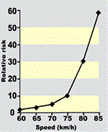
Research has shown that the risk of a crash causing death or injury increases rapidly, even with small increases above an appropriately set speed limit.
Speeding greatly increases the risk of injury and death. Research on travelling speeds and crash involvement has calculated the crash risk of driving at certain speeds over the speed limit in a 60 km/h zone.
 For example a driver travelling at 65 km/h in a 60 zone is twice as likely to have a serious injury or fatality crash as a driver travelling at the speed limit. Driving at 70 km/h in a 60 km/h zone, the driver is more than 4 times as likely to crash.
Based on this research it can be concluded that in a 60 km/h speed limit area, the risk of involvement in a casualty crash doubles with each 5 km/h increase in travelling speed above 60 km/h.
There are three reasons that small reductions in speed make such a large difference to risk.
1. Small differences in speeds mean differences both in time to collision and ability to avoid a crash.
Even if a vehicle cannot be stopped in the available distance, the collision can still sometimes be avoided. When a driver is speeding there is less time for both that driver and any other road user (either a pedestrian or another driver) to:
· Recognise danger
· Decide on an evasive action (brake, swerve)
· Complete the evasive action
Furthermore, a vehicle travelling at a higher speed is more difficult to maneuver.
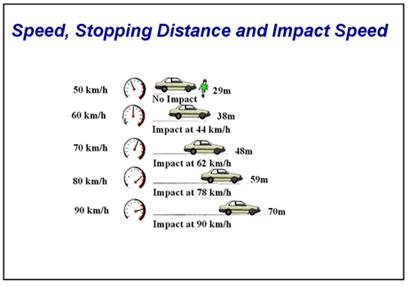
2. Small differences in vehicle speeds, before braking begins, can result in large differences in impact speeds.
The diagram below shows the relationship between speed, stopping distance and impact speed. For each travelling speed both the stopping distance for vehicles travelling 50 km/h to 90 km/h are shown and the impact speeds for vehicles travelling faster than 50km/h at the point where the vehicle travelling at 50 km/h would have stopped (i. e. at 29m).
3. Even small differences in impact speed make a large difference to the probability of serious injury.
The reason for this difference is that the force of the crash varies with the square of the impact speed. For example, a 70 km/h collision has about twice the force of a 50 km/h collision.
Exercise 5
Find English equivalents to the following sentences or word combinations in the text.
1. Риск вовлечения в аварию, произошедшую в результате несчастного случая, удваивается.
2. связь между скоростью движения, путем торможения и скоростью при столкновении
3. транспортные средства, движущиеся со скоростью более 50 километров в час
4. Столкновение на скорости 70 км/ч имеет силу, примерно в два раза превышающую силу столкновения на скорости 50 км/ч.
Exercise 6
Say whether these statements are true or false.
1. Speeding doesn’t influence the risk of a crash causing death or injury.
2. The risk of involvement in a casualty crash in a 60 km/h speed limit area doubles with each 5 km/h increase in travelling speed above 30 km/h.
3. Even small increases in speed make a large difference to risk.
4. A vehicle travelling at a higher speed is less difficult to maneuver.
5. The force of the crash equals the square of the impact speed.
Exercise 7
Answer some questions on the Text:
1. What has research on travelling speeds and crash involvement calculated?
2. What is the crash risk of driving at 65 km/h and 70 km/h speeds in a 60 km/h zone?
3. What are three reasons that small reductions in speed make a large difference to risk?
4. How can differences in speeds influence and ability to avoid a crash?
5. What is the relationship between speed, stopping distance and impact speed?
Exercise 8
Translate the following text into English:
Превышение скорости - самое популярное нарушение ПДД на наших дорогах. Практически каждый когда-нибудь превышал допустимую скорость, и не обязательно, что его штрафовали за это.
В ПДД четко написаны регламентируемые числа: 60 км/ч в городах, 90 км/ч на пригородных дорогах, 110 км/ч по автомагистралям. Есть еще и частные случаи, когда на дорогах стоят знаки, ограничивающие скорость движения. Например, популярен знак 40 км/ч. Все эти числа не случайны. Эти скоростные режимы рассчитаны на то, что водитель, соблюдающий их, всегда сможет успеть сориентироваться в дорожных ситуациях, предотвратить ДТП или прочие несчастные случаи. На дорогах России страшное количество ДТП, и виной тому халатное отношение водителей к ПДД, в том числе и к скоростному режиму. В итоге получается нарушение ПДД, что влечет за собой либо денежный штраф, либо даже лишение водительских прав.
Exercise 9
Read Text 2 without using a dictionary and give the title to the text.
Text 2
 A significant percentage of all crashes are speeding-related. These crashes are a serious problem and have contributed to the slowdown in the reduction of motor vehicle fatalities. GHSA* recommends that NHTSA** should make speeding-related crashes a priority and conduct research on effective countermeasures, identify best practices and provide technical assistance to states that wish to address the issue. NHTSA should also examine a number of issues such as: the impact of speed fines and points, the effect of decriminalizing speed violations, the coordination of speed campaigns with those for safety belts and impaired driving and potential changes to vehicle standards to limit the speed of passenger vehicles. Further, NHTSA should approach speed in an integrated manner by working closely with FHWA on speeding-related engineering issues and with FMCSA on the problem of speeding commercial motor vehicles.
GHSA supports the authorization of a federal incentive grant program to help states combat the problem of speeding. Such a program should encourage state and local speed enforcement initiatives, the use of automated speed enforcement, and implementation of local speed education campaigns and speed management workshops.
Speed limits should be part of a comprehensive speed management program including highway engineering, speed enforcement and public education. They should be established based on several factors including, but not limited to: highway design, highway operations, highway conditions, differences at state or municipal borders and traffic safety. Decisions regarding speed limits should consider the likely safety consequences (crashes, injuries, deaths and economic costs) of different speed limits. Speed limits should be perceived as reasonable by the public and be well publicized and vigorously enforced.
GHSA strongly encourages motor vehicle manufacturers and advertisers to restructure advertising messages to encourage safety instead of speed. GHSA offers to work with other organizations in the transportation and highway safety communities to develop plans and support for responsible corporate advertising.
GHSA supports state and national efforts to prohibit the sale and/or use of speed detection devices (e. g. radar and laser detectors) by the public because such devices undermine law enforcement efforts to control motor vehicle speeds and enhance highway safety.
______________________________________________________________
*GHSA (Governors Highway Safety Association) - некоммерческая организация, состоящая из специально назначенных губернаторами штатов людей для улучшения контроля за безопасностью езды на дорогах штата.
**NHTSA (National Highway Traffic Safety Administration) - Национальное управление безопасностью движения на трассах
Exercise 10
Make up a plan to the texts.
Exercise 11
Make a summary of the text and retell it according to the plan.
Unit 8
Main Text: Alcohol and Drugs
Grammar: The Participle. Revision
Pre-reading Activities
Exercise 1
Read and memorize the following words and word combinations
1. unacceptable неприемлемый
2. drug 1) лекарство, медикамент 2) наркотик
3. skills умения, навыки
4. mood настроение; психологическое состояние
5. increase усиливать
6. to be involved in быть вовлеченным в …
7. stupid глупый, тупой
8. brain’s ability способность мозга
9. respond to smth реагировать на что-либо
10. emergency 1) непредвиденный случай 2) критическое положение; авария
11. be affected by находиться под действием
12. novice drivers начинающий водитель
13. provisional licence временное водительское удостоверение
14. holder владелец
15. restrict ограничивать
16. sober up протрезветь
17. at random наугад; случайным образом
18. conduct a test делать тест
19. certain определенный
20. circumstances обстоятельства
21. require приказывать, требовать
22. sobriety трезвость
23. undergo a test пройти тест
24. have a hangover быть с похмелья
25. current текущий, теперешний, современный
26. level уровень
27. be affected by находиться под воздействием
28. drop падать, снижаться
Exercise 2
Read the international words and guess their meanings.
Fatality, fatal, legal limit, to test, alcohol limit, licence, factor, affect, dramatically, alcohol concentration, campaign
Exercise 3
Read and translate the Main Text.
Main Text
Alcohol and Drugs
There’s a belief – particularly among young men – that driving drunk is unacceptable, but having a few drinks and driving is OK.
 Alcohol is a drug which affects your skills, mood and behavior. Just a few drinks increase your Blood Alcohol Concentration (BAC) and as your BAC increases, so does your risk of being involved in a crash:
0.05 – double the risk
0.08 – 7 times the risk
0.15 – 25 times the risk
Other drugs also impair your driving and mixing one drug with another, or mixing alcohol with other drugs, dramatically increases your risk of crashing if you’re stupid enough to try driving.
The RTA’s drink driving campaign, ‘Brain’, shows the affect just a few beers can have on your brain’s ability to respond to emergencies.
Drink driving is a factor in about one in every five crashes in NSW where someone loses their life. Of the people who are killed, 88 per cent are men and 75 per cent are under the age of 40.
You don’t have to be drunk to be affected by alcohol. You might feel normal but no one drives as well after drinking alcohol.
Novice drivers with any level of alcohol in their blood are at a much higher risk of crashing. This is why learner and provisional licence holders are restricted to a zero alcohol limit.
Getting back to zero (sobering up), takes a long time. No amount of coffee, food, physical activity or sleep will speed up the process.

|
Из за большого объема этот материал размещен на нескольких страницах:
1 2 3 4 5 |
