


Партнерка на США и Канаду по недвижимости, выплаты в крипто
- 30% recurring commission
- Выплаты в USDT
- Вывод каждую неделю
- Комиссия до 5 лет за каждого referral
At an exchange office
A: ___________________________________________________
B: Yes. If I could just see your passport….. Thanks.
A: ___________________________________________________
B: Just here. Where it says “signature”.
In the street
A: Excuse me, ________________________________
B: No, I’m sorry. I can’t.
A: __________________________________________
B: Yes – there’s one just round the corner.
I. Do the test and find out how healthy you are.
How healthy are you?
1. How do you usually go to work (school, Institute)?
a) by bike or on foot
b) by tube, tram, train
c) by car or bus
2. Do you practise any sports?
a) often
b) sometimes
c) never
3. How often do you do morning exercises?
a) every day
b) sometimes
c) never
4. How many hours do you sleep every night?
a) at least seven or eight hours
b) five or six
c) four or less
5. When do you go to sleep every night?
a) before midnight
b) at midnight
c) after midnight
6. Do you smoke?
a) not at all
b) a little (less than 10 cigarettes a day)
c) heavily (more than 15 cigarettes a day)
7. How much coffee or tea do you drink?
a) none at all
b) less than 5 cups a day
c) at least 5 cups a day
8. How often do you eat fresh fruit and salad?
a) every day
b) sometimes
c) rarely
9. How often do you eat white bread, sugar, cakes, sweets?
a) very seldom, rarely
b) occasionally
c) very often
Score: Give 3 marks for every “a”, 2 marks for every “b” and 1 mark for every “c”. More than 25 marks: You are a health fanatic. You can expect to live until you are over 100. 20–25 marks: You are in excellent form and able to get the most out of life. 15–20 marks: Not bad, but why don’t you invest in a pair of shorts. Less than 15: Oh dear. |
plete the sentences with suitable phrase. Each answer should include one item from box A and one from box B.
A | B |
examine give go have make stay take | appointment bed chemist’s chest pills prescription toothache |
1. “I’d like to _____________________ to see the doctor, please.”
2. If _____________________ you should go and see a dentist straight away.
3. “Take off your shirt, please,” said the doctor. “I need to _________________”
4. “You must ____________________________ every four hours.”
5. Before I left, the doctor __________________________ for some medicine.
6. “I want you to ____________________ for a day or two and get some rest.”
7. “Would you _________________________ and get my medicine for me?”
III. Fill the gaps with suitable words.
1. 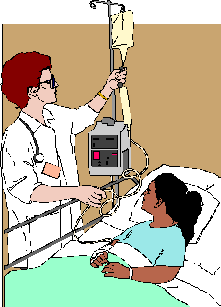 I hit my hand on the desk and it really _______________________________
2. They say she died of a heart _________________________________
3. She had some apples that weren't ready to eat and now she's got stomach-_________________________________
4. He died of ____________________ cancer even though he never smoked a cigarette in his life.
5. I went to the doctor, and she gave me a ______________ for some tablets.
6. She felt some pain in her heart when she had a heart ________________
IV. What advice would you give to a friend with the problems on the left? For each one, choose one or more items from the right.
1. I’ve cut my finger badly. 2. I think I’ve broken my leg. 3. I’m always tired. 4. I’m smoking too much. 5. I’ve got flu. 6. I’m getting a bit short-sighted. 7. I’m going deaf. 8. I’m getting fat. 9. There’s something wrong with my heart. 10. I’ve lost my appetite. 11. I’ve got a headache. 12. I’m sleeping badly. | a) Go and see a doctor. b) Take a day or two off work. c) You’ll probably need an X-ray. d) Why don’t you have your eyes tested? e) You should go on a diet. f) The chemist will be able to give you something for it. g) Well, you’d better cut down. h) You might need a hearing-aid. i) Just take it easy for a few days. j) Go to bed for a few days. k) You should see a specialist. l) You need more exercise. m) You may need an operation. |
V. Use the verbs in brackets with to + infinitive or an -ing form to complete the questions. And then answer them.
1. Are you for _____________________ (smoke) in public places? _____________________________________________________
2. Would you advise people ______________________ (stop)? _____________________________________________________
3. Are you against __________________ (advertise) cigarettes? _____________________________________________________
4. Do you dislike ________________ (breathe) other people’s smoke? _____________________________________________________
5. Would you refuse ______________ (let) people smoke in a car? ______________________________________________________
6. Do you mind people _________________ (smoke) around you? ______________________________________________________
7. Do most people start __________________ (smoke) too young? ______________________________________________________
8. Should shopkeepers refuse ______________ (sell) cigarettes to children? ______________________________________________________
9. Can most smokers manage ___________________ (stop) smoking? ______________________________________________________
10. Do smokers risk ________________ (damage) their health? ______________________________________________________
11. Are most teenagers persuaded _____________ (smoke) by their friends? ______________________________________________________
I. Match the subject on the left with the topic on the right.
1. maths 2. physics 3. history 4. geography 5. physical education 6. English 7. chemistry 8. biology 9. information technology | a. animals b. gymnastics c. 25y+32x=51z d. e=mc2 e. H2O f. the countries of the world g. the 15th century h. computers i. spelling |
II. Match the words and expressions on the left with their definitions on the right.
1. postgraduate 2. break 3. lecturer 4. degree 5. undergraduate 6. primary school 7. grant 8. lectures 9. term 10. graduate 11. tuition 12. public school 13. vocational school | a) period of continuous work b) school where you have job training; c) the money some students receive if they get a place at university; d) teaching; e) the qualification you get at the end of university; f) the name we give students during this period at university; g) private school where you have to pay to send your child there; h) teachers at university; i) students when they have completed their first degree; j) the talks that students go to while they are at university; k) school children go to at the age of 5; l) time for rest between lessons |
plete the sentences using the verbs from the box. Put the verb in the correct form.
give pass fail | do take get | learn study |
John did well at school. He always found it easy to (1)_____________ and he always (2)_________________ his home work. He (3)_____________ all his school exams. Now he (4)_____________ geography at university. He is also (5)_____________ a special geology course. He enjoys sitting in lectures, listening to the lecturer and (6)______________ notes. He will (7)___________ his final exams next year. If he (8)_____________, he will (9)_____________ a degree in geography. If he (10)______________, he will be very sad. He would like to become a geography lecturer. He would like to (11)_____________ lectures.
plete the sentences in a suitable way.
1. A person who goes to school is a ___________________
2. A school attended by children under 10 is a ______________ school.
3. There are three ______________ in a school year in England.
4. Some students can receive a ______________ from local authorities.
5. Students at university are called ______________ while they are studying for their first degree.
6. _______________ schools are private and parents have to pay to send their children there.
7. When you complete your first degree, you are a ________________
8. If you want to ______________ university, you must first pass examinations called ‘A’ levels.
9. In a year of studies after your first degree you can get a ______________ degree.
10. Department at which you may study without leaving a job is called __________________
I. Match the professions to the correct descriptions.
1. 2. a chambermaid 3. a tailor 4. a nurse 5. an electrician 6. a carpenter 7. a cabinet-maker 8. a mechanic 9. a plumber 10. a body-guard | · a skilled workman who makes, uses or repairs machinery. · a skilled workman who makes furniture. · a workman who makes the wooden parts in house-building. · a workman who fits pipes into buildings and repairs them. · a woman who keeps rooms in order at a hotel or a private house. · an expert in setting up and repairing electrical appliances. · a person hired to look after a baby while his parents are out. · a maker of garments, mainly men’s suits to order. · a man or a group of men guarding an important person. · a person usually with a special training, who cares for sick or injured people. |

II. Fill gaps 1-11 in Diagram A and Diagram B. Then read the answers to number 12.
A
| 1 | 12 |
| |||||||||
| 2 |
|
| |||||||||
| 3 |
|
| |||||||||
| 4 |
|
| |||||||||
| 5 |
| ||||||||||
| 6 |
|
| |||||||||
| 7 |
|
| |||||||||
| 8 |
|
| |||||||||
| 9 |
|
| |||||||||
10 |
|
| ||||||||||
| 11 |
|
| |||||||||
| | 12 |
| ||||||
| 2 |
| |||||||
| 3 |
| |||||||
| 4 | ||||||||
| 5 |
| |||||||
| 6 |
| |||||||
7 |
| ||||||||
| 8 |
| |||||||
| 9 |
| |||||||
| 10 |
| |||||||
11 |
|
1. I’m a (A) officer. I arrest people who break the (B).

|
Из за большого объема этот материал размещен на нескольких страницах:
1 2 3 4 5 6 7 |
