


Партнерка на США и Канаду по недвижимости, выплаты в крипто
- 30% recurring commission
- Выплаты в USDT
- Вывод каждую неделю
- Комиссия до 5 лет за каждого referral
10. If I came home and found someone burgling my house _______________________________________________________
11. If I could speak English fluently _______________________________
12. If I were younger ___________________________________________
IV. Make up questions with the expressions given. Begin with Would you …..?
1. give a lift to a hitch-hiker at night __________________________________________________?
2. give money to a beggar in the street __________________________________________________?
3. swim in the sea in winter __________________________________________________?
4. drive a car after drinking alcohol __________________________________________________?
5. kill someone in self-defense __________________________________________________?
V. What would or wouldn’t you do, if you got more pocket money? Write five sentences. Begin you sentences with If I got more pocket money, I would.....
1. If I got more pocket money, I would _____________________________
2. ___________________________________________________________
3. ___________________________________________________________
4. ___________________________________________________________
5. ___________________________________________________________
plete the sentences with the words in brackets in the past perfect or with would have + past participle.
Ben: Will you lend me your bike? I have to get to basketball training in five minutes.
Nick: The last time I lent it to you, you got a flat tyre and didn’t repair it.
Ben: Well, I wouldn’t have got (not get) a flat tyre if you had put (put) enough air in it.
Nick: That’s not true. You rode straight over some broken glass.
Ben: Well, I___________________ (not ride) over the glass if someone _______________ (not leave) it all over the road. Besides, I _____________ (go) round the glass, if a car _______________ (not come) from the other direction.
Nick: Well, you could have stopped.
Ben: I _________________ (stop) if the brakes ______________ (not fail).
Nick: Well, you should have checked the brakes before you started. I _______________ (not lend) you my bike if I _______________ (know) that the brakes weren’t working.
VII. Say what you would have done if these things had happened to you.
1. Jim saw a car accident. He didn’t help immediately, but he ran into a shop to telephone an ambulance. ________________ ___________________________________________________________
2. Mike heard a friend tell a lie. He didn’t say anything. Later he asked the friend why he had lied. ______________________ ___________________________________________________________
3. Susan found a purse in the street. There was only a little money in it and no important papers or cards. There was no one in the street. She kept the money. ____________________________________________________ ___________________________________________________________
4. A stranger asked Pat for some money in the street. The stranger said he had to go somewhere urgently by taxi and had forgotten his wallet. Pat gave him the money and her telephone number. ________________ ___________________________________________________________
VIII. Give reasons why some people don’t like the following things. What do they think might happen? Say your answers.
Example: Some people don’t like flying. They think the plane might crash.
1. Some people don’t like going in lifts. __________________________________________________
2. Some people don’t like driving in cities. __________________________________________________
3. Some people don’t like being in the dark. __________________________________________________
4. Some people don’t like heights. __________________________________________________
5. Some people don’t like dogs. __________________________________________________
6. Some people don’t like snakes. __________________________________________________
IX. Write a sentence using I wish... for each of the following situations.
1. The weather’s horrible. __________________________________________
2. We can’t go swimming. _________________________________________
3. Last night we went to the Ritz restaurant, and I was ill all night. ________________________________________________________
4. I wanted to go to Spain. __________________________________________
5. The children keep asking me for money. ________________________________________________________
6. In the hotel, we have to get up for breakfast at 7.00 in the morning. ________________________________________________________
7. Sue has straight hair. ____________________________________________
8. Nick can’t dance. _______________________________________________
9. Ben doesn’t know how to repair his tape-recorder. _____________________________________________________________
10. The boots are too expensive for Amanda. ____________________________
11. Jane can’t afford the ear-rings. ____________________________________
X. Do you ever wish that some things were different? Write two sentences with I wish I had, two with I wish I was and two with I wish I could.
I wish I had ________________________________________________
I wish I had ________________________________________________
I wish I was ________________________________________________
I wish I was ________________________________________________
I wish I could _______________________________________________
I wish I could _______________________________________________
I. Read, analyze and translate the following sentences paying special attention to the tenses.
a) Peter says (that) he moves to a new flat.
he moved to a new flat.
he will move to a new flat.
b) Mary asks me if I know her address.
I knew her address.
I’ll know her address.
c) Mary said (that) she was busy.
she had been busy.
she would be busy.
d) Mary asked me if I saw American films on TV.
I had seen the film the day before.
I should see the film the next day.
II. Make the sentences in Direct Speech into those of Indirect Speech. Use the following verbs.
thank greet explain | offer wish call | introduce congratulate |
Example: He said «Thank you». He thanked her.
He said «Merry Christmas». He wished me a Merry Christmas.
1. He said «Good morning». ______________________________________
2. He said «Congratulations!» _____________________________________
3. He said «Dear». ______________________________________________
4. «Have a cigarette», he said. _____________________________________
5. «Many happy returns of your birthday», we said. ________________________________________________________
6. «Thank you», answered the boy. _________________________________
7. «Welcome home, my dear», said his wife. ________________________________________________________
8. «Miss Brown, this is Miss White; Miss White, this is Miss Brown», he said. _______________________________________________________
9. «You pressed the wrong button», said the mechanic. ________________________________________________________
III. Write the questions in indirect form.
1. What’s your name? She asked _________________________________
2. Are you all right? ___________________________________________
3. How old are you? ___________________________________________
4. Where do you live? __________________________________________
5. What do you think about violent sports? ________________________________________________________
6. How did it happen? __________________________________________
7. Where had you been? _________________________________________
8. Shall I phone your parents? ____________________________________
IV. Look at what some people say. Rewrite the sentences beginning them with ‘(Peter) said ......’.
Peter: I saw a tall blond boy running out of the shop. ____________________________________________________________
Paul: Mrs. Fox always blames the wrong people. ____________________________________________________________
Max: Lots of boys wear blue jeans. ____________________________________________________________
Jill: I don’t know anything about it. ____________________________________________________________
Alice: Mrs. Fox can’t see very well. ____________________________________________________________
James: I’ll ask the boys in my class about it. ____________________________________________________________
Tony: Mrs. Fox has told the police. ____________________________________________________________
Jane: Ben has never stolen anything. ____________________________________________________________
Tom: We will all help Ben. ____________________________________________________________
V. Read the dialogue and then rewrite it.
Girl: What a stupid thing to do! You stopped without warning.
Driver: I had to stop. A dog ran across the road. But you weren’t looking. And now my van’s badly damaged.
Girl: I didn’t see a dog. I’ll write down your name and insurance number. My light is broken and the bike won’t start.
Driver: It only needs a bit of paint. It can be fixed in no time. But the back of my van’s a mess. The repairs will cost hundreds of pounds.
The girl said that the driver ______________ without warning. The driver said that he ________________ to stop because a dog ______________________ across the road. He said the girl __________________ and his van ______________. Then the girl said that she _________________ dog. She said she __________________ down the man’s name and insurance number. She said her light __________________ broken and the bike _________________ start.
The driver said the bike only ___________________ a bit of paint and it _________________ be fixed in no time. But his van _____________ a mess and the repairs ___________________ cost hundreds of pounds.
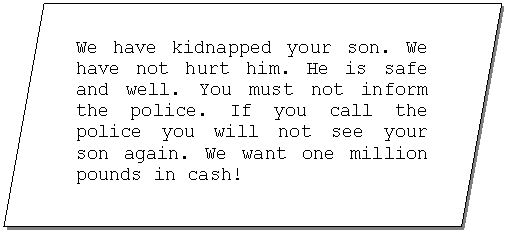
VI. Read the note below. What does it say? Use Reported Speech.
 |
___________________________________________________________________________________________________________________________________________________________________________________________________________________________________________________________________________________________________________________________________________________________________________________________________________________________________________________________________________________________________________________________________________________________________________________________________________________________________________________________________________________________________________________________________________________________________________________________________________________
Infinitive | Simple past | Past participle |
|
be | was/were | been | быть |
become | became | become | становиться |
begin | began | begun | начинать |
blow | blew | blown | дуть |
break | broke | broken | ломать |
bring | brought | brought | приносить |
burn | burnt | burnt | гореть, жечь |
build | built | built | строить |
buy | bought | bought | покупать |
catch | caught | caught | ловить |
choose | chose | chosen | выбирать |
come | came | come | приходить |
cost | cost | cost | стоить |
cut | cut | cut | резать |
do | did | done | делать |
draw | drew | drawn | рисовать, чертить |
dream | dreamt | dreamt | мечтать |
drink | drank | drunk | пить |
drive | drove | driven | водить (автомобиль) |
eat | ate | eaten | есть, кушать |
fall | fell | fallen | падать |
feel | felt | felt | чувствовать |
find | found | found | находить |
fly | flew | flown | летать |
forget | forgot | forgotten | забывать |
forgive | forgave | forgiven | прощать |
get | got | got | получать |
grow | grew | grown | расти, выращивать |
have | had | had | иметь |
hear | heard | heard | слышать |
hit | hit | hit | бить, ударять |
hold | held | held | держать |
hurt | hurt | hurt | причинять боль |
keep | kept | kept | держать, хранить |
know | knew | known | знать |
lead | led | led | вести, руководить |
learn | learnt | learnt | учить |
leave | left | left | покидать, оставлять |
let | let | let | позволять |
lie | lay | lain | лежать |
lose | lost | lost | терять |
make | made | made | делать |
mean | meant | meant | значить |
meet | met | met | встречать |
pay | paid | paid | платить |
put | put | put | класть |
read | read | read | читать |
ride | rode | ridden | ехать (верхом) |
ring | rang | rung | звонить |
run | ran | run | бежать |
say | said | said | сказать |
see | saw | seen | видеть |
sell | sold | sold | продавать |
send | sent | sent | посылать |
shake | shook | shaken | трясти |
shine | shone | shone | светить |
shoot | shot | shot | стрелять |
show | showed | shown | показывать |
shut | shut | shut | закрывать |
sing | sang | sung | петь |
sit | sat | sat | сидеть |
sleep | slept | slept | спать |
speak | spoke | spoken | говорить |
spend | spent | spent | тратить, проводить |
stand | stood | stood | стоять |
steal | stole | stolen | воровать |
swim | swam | swum | плавать |
take | took | taken | брать |
teach | taught | taught | преподавать, учить |
tell | told | told | рассказывать |
think | thought | thought | думать |
throw | threw | thrown | бросать |
understand | understood | understood | понимать |
wake | woke | woken | будить |
wear | wore | worn | носить (одежду) |
win | won | won | выигрывать, побеждать |
write | wrote | written | писать |
Bibliography
1. В. Л. Скалкин «Английский язык для общения». – М.: «Высшая школа», 1997.
2. John and Liz Soars “Headway” (Elementary). Oxford University Press 1997.
3. John and Liz Soars “Headway” (Intermediate). Oxford University Press, 1997.
4. Stuart Redman “English Vocabulary in Use” (Pre-Intermediate and Intermediate). Cambridge University Press, 1997.
5. Adrian Doff and Christopher Jones “Language in Use” (Pre-Intermediate). Cambridge University Press, 1997.
6. Adrian Doff and Christopher Jones “Language in Use” (Intermediate). Cambridge University Press, 1997.
7. Jennifer Seidl “Grammar Three”. Oxford University Press, 1997.
8. Bernard Hartley and Peter Viney “Streamline. Departures.” Oxford University Press, 1995.
9. Joanne Collie, Stephen Slater “True to Life” (Elementary). Cambridge University Press, 1997.
10. Ruth Gairns, Stuart Redman with Joanne Collie “True to Life” (Intermediate). Cambridge University Press, 1996.
11. Simon Greenall “Reward” (Elementary). Heinemann, 1997.
12. Simon Greenall “Reward” (Pre-Intermediate). Heinemann, 1994.
13. Michael Vince “Highlight” (Intermediate). Heinemann ELT, 1992.
14. B J Thomas “Elementary Vocabulary”. Longman, 2000.
АНГЛИЙСКИЙ ЯЗЫК
Базовый курс
Рабочая тетрадь №2
Составители:
Ирина Николаевна Карташова
Людмила Давыдовна Гартман
Рецензент: доцент
Подписано к печати
Формат 60х84/16. Бумага ксероксная.
Плоская печать. Усл. печ. л. 3,14. Уч.-изд. л. 2,84.
Тираж экз. Заказ. Цена свободная.
ИПФ ТПУ. Лицензия ЛТ №1 от 18.07.94.

 Типография ТПУ. Томск, пр.Ленина, 30.

|
Из за большого объема этот материал размещен на нескольких страницах:
1 2 3 4 5 6 7 |
