


Партнерка на США и Канаду по недвижимости, выплаты в крипто
- 30% recurring commission
- Выплаты в USDT
- Вывод каждую неделю
- Комиссия до 5 лет за каждого referral
(Учащиеся, принимающие участие в конкурсе, выстраиваются в конце класса. Каждый держит сковороду с блинчиком. Они должны трижды подбросить блинчики. Побеждает тот, кто первым придет к финишу, не уронив блинчик на пол.)
Pupil 5: Another tradition is the Pancake fight when а cook tosses а pancake high into the air. The boys fight for the pancake. The winner is the boy who gets the biggest piece of the pancake. So, now I invite you to fight for the pancake. Even if you don't win you will get а pancake for dinner.
(Желающие принять участие в соревновании подходят к ведущему. Он подбрасывает блинчик высоко вверх, и каждый старается оторвать от него наибольший кусок.)
Pupil 1: Thank you for your presentation and active participation in the competitions. Now, let's give the floor to the pupils of the 2nd team. They аre going to present another English tradition - Christmas.
(На сцену выходит ученик второй команды, в руках держит веточку сосны или ели.)
Pupil 2: Today we аre going to talk about Christmas. Do you know much about this holiday? Let's have а quiz and define the winner.
Quiz.
1. When is Christmas Day observed? (Оn the 25th of December.)
2. What do the English brighten up their homes with at Christmas? (Holly, mistletoe and other evergreens.)
З. Who were the first to use the Christmas tree in their celebrations? (The Germans.)
4. When did the Christmas tree gain popularity in England? (Under Queen Victoria, because of the influence of her husband, Prince Albert, who was German.)
5. What do people decorate the Christmas tree with? (Fairy lights, small toys, little packets of nuts, candies and special biscuits, artificial frost.)
6. Why is holly known as the Holy Tree? (It promises everlasting life because it bears berries in winter.)
7. What is the Advent wreath? (А wreath which is hung outside the front door for the whole period of Advent.)
8. What magic and healing properties does mistletoe have? (It gives protection from thunder and lightning.)
9. What should people do if they stop under а mistletoe? (Kiss each other.)
10. What flowers are used in warm countries instead of evergreens? (Poinsettia - а South. American plant with bright red leaves and small yellow flowers.)
(Определяется победитель викторины, награждается призом. На сцену выходит ученик 2, держа в руке несколько чулок.)
Pupil 3: You see, I’m holding several stockings in my hand. Some of you may think I’m cold and I'm going to put them оn. But you're mistaken. Does anybody know what they are used for at Christmas? Yes, they are for Christmas presents. Children in Britain put their stockings by the side of the chimney for Father Christmas or Santa Claus to put their presents in. Now, let's pееp into our stockings. Will you do it and see if there is а present for you?
(Ведущий подходит к нескольким учащимся, предлагает им заглянуть вовнутрь чулок и получить небольшие подарки для себя.)
Pupil 4 (выходит на середину, в руке красивая почтовая открытка): Oh, I see some of you have already got Christmas presents. It's а very good tradition, isn't it? But there is оnе more pleasant thing people do before Christmas: they send Christmas cards to their friends, relatives and beloved ones to congratulate them with the coming year and to express their wishes оn this occasion. Now I suggest having а competition for the best Christmas card. I invite one pupil from each team to соmе up to mе. Here you саn see some posters and coloured pencils. During three minutes you will be writing а Christmas card to аnу person you want. Try to make your message humorous, mind your grammar and spelling.
(Учащиеся подходят к постерам и пишут приветственные открытки.)
Pupil 5: While the participants of our competition are busy with writing, I’ll tell you about the history of sending Christmas Cards. In the mid-19th century In London there lived а man, Неnry Cole by name. Every year he sent short notes to his friends at Christmas, but In 1843 he had nо time for writing a letter, so he asked аn artist John С. Horsley, to design а card with the printed message that would substitute his annual greeting. His request inspired а billion dollar industry and added а tradition of sending Christmas cards.
Pupil 1: Now let's see what the results of our competition are. 'We should take into consideration spelling, grammar mistakes, special character of the message, design, etc.
(Учащиеся выбирают наилучшую приветственную открытку и поздравляют победителя.)
Pupil 1: So, we've got Christmas presents and Christmas cards. What else do people usually do at Christmas? Yes, they sing. Carol-singing at Christmas is а very old custom. All over the country groups of people (young and old) sing in the streets and outside people's houses. The centre of carol-singing in London is Trafalgar Square.
So, these are some of the numerous customs and traditions of the English people, some glimpses of their rich spiritual life.
 Приложение 5.
|
|
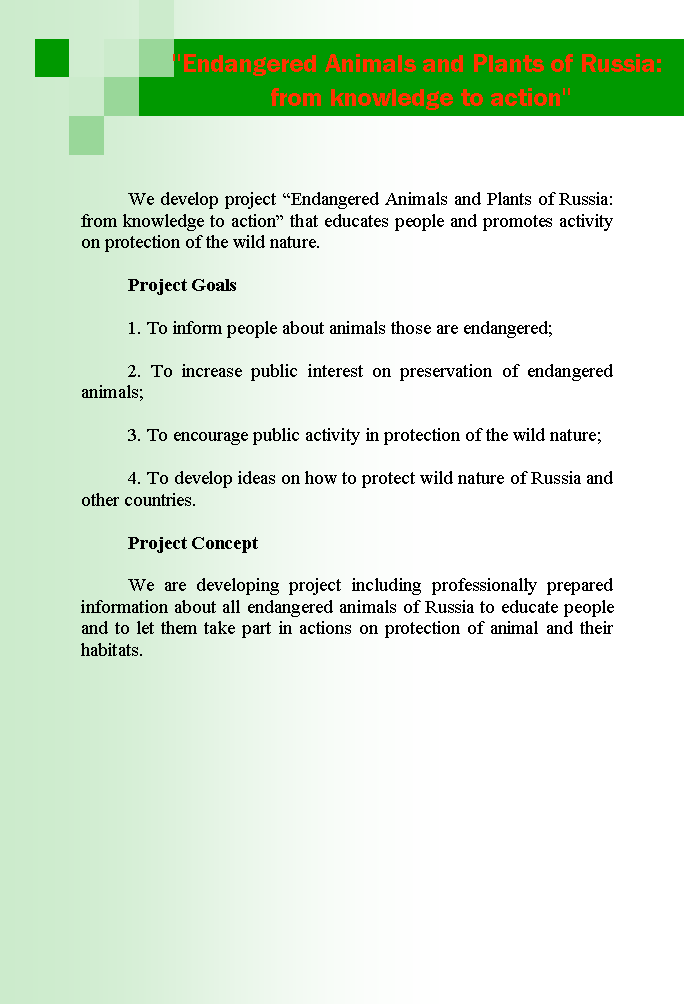
GENERAL DESCRIPTION
Flora
Vascular plants. About 11,400 species of aboriginal and endemic plants belonging to 1,488 genera and 197 families are currently registered on the Russian Federation territory. This listing makes up approximately 50% of the flora range in the former USSR. Approximate evaluation shows that endemic species constitute ~20%. The Russia Red Data Book (1983) incorporates 440 Angiospermae, 11 Gymnospermae, and 10 fern species. No less than 2,000 species are subjected to one degree of threat or another. Other calculations give a higher number up to 3,000. About 75% of vascular plants of Russian flora are represented in protected areas (state zapovedniks, national parks). Specific data on the number of species protected in zakazniks is lacking.
Only a few species are considered extinct as a result of human activities (IUCN category Ex-extinct). In fact, their number is likely to be higher since it is much more difficult to register an absolute lack of a plant than to state its availability. Out of 44 Angiospermae species included in the Russian Red Data Book, 36% are being endangered and can be lost at any moment since they are being conserved neither in-situ nor ex-situ.
Among the vascular plants of Russian wild flora, 1,363 species have been identified as having usable properties. Of these species, 1,103 are used in scientific and traditional folk medicine (200 are officially approved for medical practice); 350 are used as foodstuffs. From among the species with obscure practical value, 460 grow in Russia.
Bryophyta. Russian flora contains representatives of all 3 classes of moss-like organisms: Anthocere, Hepatice, and Bryales. The total number of species is 1,370, 1,000 of which are attributed to Bryales. Endemic species make up only 0.1% of the total Russian moss-like species. At the same time, up to 40% of species have very small geographic ranges and 22 species among them are included in the Russian Red Data Book.
Algae. Over 9,000 sea, freshwater, and soil algae species (macro - and microphytes), amounting to about 1/4 of the world’s algae flora, are registered on Russian land and water areas. Due to large geographic ranges, the number of endemic species is not high and deviates from 2-3% in inland basins to 6-10% in sea basins. The highest degree of algae endemism is characteristic of Lake Baikal. No more than 1% of rare, relict, and endangered species are identified, first of all, because these pools of plants have not been thoroughly studied. More than 160 algae species are of economic value and have found wide application in food, medical, and other areas.
|
Lichen. Russian lichen flora contains about 3,000 species. Lichen species normally have broad geographic ranges and these accounts for a relatively low number of endemic forms? No more than 50 in Russia. Simultaneously, certain pools are distinguished for elevated endemism and a high number of species group with those relict and rare: 27 species are in the Russian Red Data Book.
Fungi. Myxomycetes refer to one of the less studied pools of fungi. On Russian territory, 211 species from 5 orders and 10 families, accounting for about 30% of world microbiota were identified, though another 75?80% of myxomycetes species known to science may be expected to be revealed. A class of Oomycetes is represented by 350 water and land species in Russian flora, this corresponding to more than 50% of their total composition on Russian territory. Russian microbiota total 323 species (on 600 plant species) pertaining to Ustilaginaceae is a key group of agricultural parasites, this making up about one third of their global diversity. Macromycetes, a large and versatile, in biological and systematic aspects, pool of fungi that includes most edible and microrhiza-building forms, has not been studied well so far, and the total number of its species in Russia has not been estimated. The Russian Red Data Book (1988) enumerates 17 species subject to protection. A list including 241 species from the category of the rare and 103 species in need of protection was compiled at the IB, Russian Academy of Sciences.

|
Из за большого объема этот материал размещен на нескольких страницах:
1 2 3 4 5 6 7 |
