

Партнерка на США и Канаду по недвижимости, выплаты в крипто
- 30% recurring commission
- Выплаты в USDT
- Вывод каждую неделю
- Комиссия до 5 лет за каждого referral
1.3.3. Ancient Rome.
The Romans feasted at the Saturnalia; worshipers of the Persian sun god Mithraism celebrated December 25 as the birthday of the invincible sun. The date of Christmas was probably fixed arbitrarily for the same day because it coincided with and offered competition to these pagan Festivities [8]. People were interested as the brightest star the sun attracted even a primate man. In those days the sun meant so much people that when it began to go lower each day till December 23 people worried for they thought the sun was dying out. They watched the sun and ate less keeping the food for the next year. On December 23, the sun stayed longer in the sky and gradually the days became longer and the nights shorter. When this happened the primitive man was very happy. He even felt he wanted to celebrate it. Now he could eat more - he was not afraid for his future any longer. It was wonderful. Gradually man began to understand the material of the sun. December 25 was approximately the date of the solstice. In fact, solstice is the time of the year when the sun is farthest from the equator, June 22 and December 22. In modern times, solstice falls on December 21 or 22 [10]. The birth of the Christ Child is associated with winter solstice because it was meant to bring light into a world of darkness. For Christians this day marked the coming of the sun of God to the Earth in human form. The story of Christmas was based on the biblical accounts given in the Gospel of Matthew and the Gospel of Luke.
In winter solstice was also the most practical time for the feast to be held: cattle which couldn’t be fed through the winter were slaughtered in late autumn, and as a result winter would be the only time when European peasants were most likely to have a stock of fresh meat, which needed to be either salted, or eaten. Equally the beer which had been brewed in autumn would be just ready to drink by the time of winter festivals.
Over the centuries many have tried to revert to a more solemn celebration of Christ’s birth: Oliver Cromwell cancelled Christmas after the events of the English Civil War, disquieted by the behavior of common people at what was supposed to be a religious festival.
To sum up we should assert that church adopted the date of Christmas according to the interests of European peasant.
2.THE MAIN SYMBOLS OF CHRISTMAS.
2.1 Christmas tree. The Christmas Tree is often explained as Christianization of pagan tradition and ritual surrounding the Winter Solstice, which included the use of evergreen plants and adoption of pagan tree worship [1]. The tradition dates back to the Roman Saturnalia. The legend that associates the fir tree with the Christian celebration comes from Germany, and goes back to the 8th century.
The people of Germany believed that the first person to have decorated a Christmas tree was Martin Luther (1483-1546). One day as he was walking through a forest he looked up at the sky which was full of stars. He was touched by the beautiful sight. He took home a small fir tree which he decorated with lighted candles, as a reminder to his followers of the heavens [2].
Nowadays many argue that Martin Luther began the tradition in the 16th century. The modern Christian tree tradition is believed to have begun in Germany in the 18th. The English language phrase “Christmas tree” was first recorded in 1835 and represents an important borrowing from the German language.
From Germany the custom was introduced to England, first by Queen Charlotte, wife of George III, and then more successfully by Prince Albert during the Queen Victoria’ reign..
Prince Albert was born in Germany where the decorated tree was already an established part of the Christmas tradition. In 1840 he introduced a beautiful tree into the royal family’s Christmas, and many other people soon followed him.
*Charles Dickens (1812- 1870), one of the world’s greatest novelists, who lived in the time of starting the tradition of decorating a Christmas tree in Great Britain, confirms German origin of a Christmas Tree. He called a Christmas Tree “that pretty German toy”: “I have been looking on, this evening, at a merry company of children assembled round that pretty German toy, a Christmas Tree. The tree was planted in the middle of a great round table, and towered high above their heads. It was brilliantly lighted by a multitude of little tapers; and everywhere sparkled and glittered with bright objects” [3].
Charles Dickens stresses that the main role of a Christmas tree is creating the atmosphere of happiness: “Now, the tree is decorated with bright merriment, and song, and dance, and cheerfulness. And they are welcome. Innocent and welcome be they ever held, beneath the branches of the Christmas Tree, which cast no gloomy shadow! But, as it sinks into the ground, I hear a whisper going through the leaves.” This, in commemoration of the law of love and kindness, mercy and compassion. This, in remembrance of Me!”
Besides, his words “in remembrance of Me” prove that the tradition of decorating a Christmas Tree became a part of everybody’s life. Nowadays people can’t imagine the holiday without this important symbol. Evergreen or artificial fir trees decorate their houses. Every Christmas British people get a huge fir tree from Norway which stands in Trafalgar Square, in the center of London, shinning down on all the people who gather on Christmas Eve.(Pic.2)
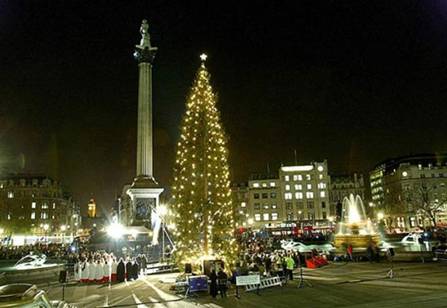
Picture 2. Christmas tree at Trafalgar Square in London
2.2 Folk Heroes
2.2.1. Santa-Claus.
Of all folk heroes, Santa Claus is probably the most familiar and the most misunderstood.(Pic.3) The name is strictly an Americanism. The American Santa Claus is the latest step in a legend that began in the fourth century in Asia Minor. The prototype of the Christmas gift- bringer was the bishop of Myra, St. Nicholas, who was universally loved for his generosity and who today remains a principal saint of the Eastern Church [4].
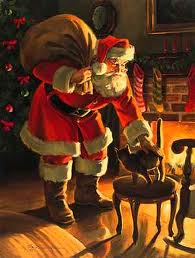
Picture 3. Santa-Claus.
Pressed in a bishop’s garb and sporting a long while beard, he is supposed to have left good children presents on his feast day, December 6. Reformation zealots banished this honey character from the Church calendar, and he was widely replaced by the Christmas Man, a secular Yuletide supplier known in England as Father Christmas. There is also another legend connected with this folk hero. According to it, Saint Nicholas brought a dowry for three girls, who were too poor to find husbands. Whilst they were sleeping he put the gift in their stockings, which were hung by the fire to dry [5].
The cult of Saint Nicholas spread across much of Europe. More surprising, Santa Claus didn’t always arrive at Christmas. In Europe he showed up on December 6.
In Western culture Santa Claus is also known as Father Christmas, Saint Nicholas or St. Nicholas, Kris Krihge, Saint Basil and Father Frost [6].
The idea of St. Nicholas spread about America with the Dutch colonists, and it was the American press, that transformed Father Christmas into his current image. Clement Moore’s poem “The night Before Christmas” published in 1822, introduced Father Christmas flying reindeer, and the way he distributed presents down chimney stacks to the world.
According to another source the popular image of Santa Claus was created by the German-American cartoonist Thomas Nast (1840-1902), who drew a new image annually, beginning in the 1880s, Nast’ Santa had evolved into the form we now recognize. The image was standardized by advertisers in 1920.Father Christmas, who predates the Santa Claus character, was first recorded in the 15th century, but was associated with holiday merrymaking and drunkenness [7]. In Victorian Britain, his image was remade to match that of Santa. The French Pere Noel evolved along similar lines, eventually adopting the Santa image. In Italy, Babbo Natale acts as Santa Claus, while La Befana, is the bringer of gifts and arrives on the eve of the Epiphany. It is said that La Befam set out to bring the baby Jesus’ gifts, but got lost along the way. Now, she brings gift to all children [8].
2.2.2 Rudolf the Red-Nosed Reindeer.
Rudolf, the Nosed Reindeer, is considered to be the second popular folk hero Rudolf Christmas. In fact he has two names: Rollo, the Red - Nosed Reindeer and Reginald, the Red - Reindeer.(Pic.4)
The story of Rudolf, the reindeer whose shiny nose lighted Santa Claus’s way “one foggy Christmas Eve”, is as a well - known to American children as the story of Santa himself. Its popularity is the result partly the fact that it is, in sociologist James Barnett’s description, “the only original addition to the folklore of Santa Claus in the century”, and party to the fact that, as a variation on the ugly ducking motif, it addresses children’s innate confusion about social roles. The “lesson” of the Rudolph tale is a necessary and comforting one: Whoever you are, you are special.
The story was created in 1939 by a Montgomery Ward adman named Robert May, known throughout the firm for his light verse. Seeking something that their store Santas could hand out to children, company managers asked May for a poem. With the editorial advice of his four - year - old daughter, he came up with Rudolph and his nose. That first year, 2.4 million copies, illustrated by May’s friend Denver Gilllen, were distributed in Montgomery Ward stores. World War II stopped Rudolph’s rounds, but they picked up again in 1946, and a year later the poem appeared in book form. . In 1949 the red - nosed charmer’s career really took off, when singing cowboy star Gene Autry recorded Johnny Marks’s musical version and propelled it to the top of the Hit Parade. Soon Rudolph was appearing on television and was on hit way to becoming an institution.
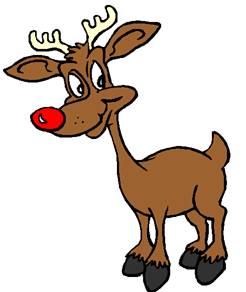
Picture 4. Rudolf the Red-Nosed Reindeer.

|
Из за большого объема этот материал размещен на нескольких страницах:
1 2 3 4 |
