

Партнерка на США и Канаду по недвижимости, выплаты в крипто
- 30% recurring commission
- Выплаты в USDT
- Вывод каждую неделю
- Комиссия до 5 лет за каждого referral
3. MODERN TRADITIONS OF CHRISTMAS CELEBRTION
3.1 A Christmas miscellany.
The sending of Christmas cards is very much a part of the festival in Great Britain. Something like 650 million were posted here many years ago.(Pic.5)
The cards vary and one can divide them into categories. Out of eighty cards, twenty-one were religious, nineteen had a picture of flowers, holly or pine cones, fourteen were “good cause” cards, nine were views, six had pictures of birds, four had other animals, and seven were “miscellaneous». According to the time-honored tradition, all English children hang a stoking at the foot of their beds on Christmas Eve. During the night Father Christmas comes in his reindeer-drawn sleigh, creeps stealthily down the chimney and fills the stocking with presents But in the twentieth century Father Christmas was moving with the times. For example, when he visited the Pestalozzi international village for refugee children in Sussex, he arrived by helicopter. The children shouted their greetings in a dozen languages as Santa’s “sleigh” made a perfect landing on the village green, and rushed forward to receive their gaily wrapped presents. There was one for each child, and also a splendid Christmas tree for the village library.
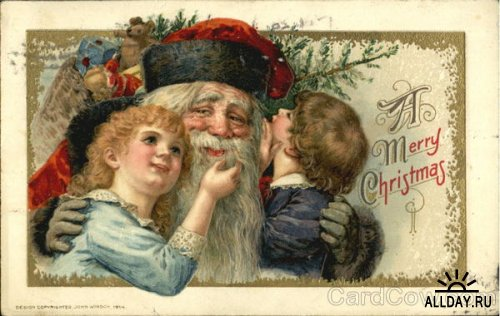
Picture 5. Christmas card.
It was Queen Victoria’s consort, Prince Albert, who introduced the Christmas tree to Britain, ever since it has been an essential ingredient of the Christmas season. No family which takes a properly enthusiastic view of the festival could possibly contemplate Christmas without a Christmas tree. It just would not be the same!
With somewhere between ten and twenty million families in Britain, it is not suprising that the seasonal trade in Christmas trees should be brisk. The largest supplier is the Forestry Commission which reckons to sell about half a million trees each year. But there are so many others-large and small landowners, nurserymen, and so on-that it is impossible to estimate the total number sold. Sales of artificial trees. Very attractive they are too, and there is always the advantage that they can be folded up and put away till next year.
There is something else which no English Christmas party could possibly do without-Christmas crackers. Crackers originated in France in the nineteenth century, but in those days they were just a way of wrapping sweets. People took a sheet of colored paper, rolled up the sweets in it and gave it a twist near each end so that they could not fall out. The result was a paper cylinder with two constricted pulling on each end you tore the paper, and out fell the sweets.
When this simple invitation arrived in Britain someone had the bright idea of putting a minute quantity of gunpowder into each cracker, arranged in such a way that when the cracker was pulled the gunpowder would go pop. The amount is controlled by law, in the interests of safety Nowadays, crackers don’t have sweets in them. They are tiny crackers which are mainly used to hang on the Christmas tree usually contain a plastic charm or similar inexpensive item. Going up in price, you get whistles wire puzzles. [8]
3.2 The Nativity.
The Nativity is a central way in which Christians celebrate Christmas. First of all it helps in expressing a religious significance of the holiday.
Besides it stresses the humble origin of Joseph, the carpenter, and Mary, who must travel to Bethlehem to pay taxes. They go on foot and with a Donkey, and Mary is heavily pregnant. On arrival there is no room in Hostels or inns for them. The only shelter is a manger, a stall of hay and, Straw near oxen and asses. There, in the stillness of night and under a starry sky, the birth takes place, shepherds nearly are alerted by angelic singing, and further field wise men from the East have a magnificent star to guide them as they seek the king predicted by Scripture and astrological scholars. Traditional versions of the Christmas story often took their starting point from the Garden of Eden itself, and the battle between good and evil which culminated with Lucifer’s banishment from heavens and earth to his realm and role as Satan. He is foiled in his later attempt to find to corrupt the Christ baby - by the goodness and strength of Archangel Michael, by the honesty and clear thinking of the shepherds, by the purity and innocence that birth represents.
The very first Christmas Nativity scene was life-size, with real people and animals standing figure in the Christian story. It was set up by St. Francis of Assisi, in his tiny chapel in Italy over 700 years ago [11]. In some Christian churches children performed plays retelling the events of the Nativity, or sang carols that referred to the event. Some Christians also display a small re-creation of the Nativity scene, in their homes, using figurines to portray the key characters of the event. Live Nativity scenes are also performed, using actors, animals to portray the events with more realism [12].
Nativity scenes traditionally include the Three Wise Men, Balthazar, Melchior and Caspar, although their names and number are not referred to in the Biblical narrative(Pic.6). They are said to have followed a star, known as the Star of Bethlehem, found Jesus and presented gifts of gold, frankincense, and myrrh[13].
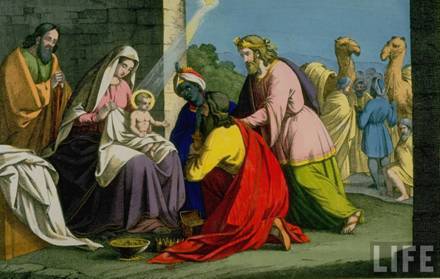
Picture 6. Wise Men Balthasar, Melchior and Caspar present gifts to Christ.
3.3 Gift Receipt.
When you buy something as a gift for your nearest and dearest, you may ask for a Gift Receipt. Very often during holiday time (Christmas, Easter), you will be offered such a Gift Receipt without asking for it. In case your relatives or friends don’t like the gift, they can go to the store with the Gift Receipt, and return it for money. As a rule, the price of the gift is not indicated on the Gift Receipt. On this receipt you can only find the name of the store and code or number of the purchased item.[14]
3.4 Rose Parade.
This colorful event takes place every year during Christmas time in the small town of Pasadena that is situated not far from Los Angeles, California (Pic.7). During Christmas time, Colorado Boulevard in Old Town Pasadena is a picture-perfect portrait of the season: shops are adorned with wreaths and thinking white lights, shoppers make their way past metal bleachers in place along the main route of the upcoming Rose Parade.
Since the first parade in 1890, the preparations that accompany the Tournament of Roses have been as much a part of December in Pasadena as any holiday tradition. A lot of years ago, small crowds of onlookers wearing straw hats bustled dresses lined dusty streets. Nowadays, there is still no better way to ring in the New Year than with the sweet smell of roses. With its floral floats, marching bands and equestrian units, the Rose Parade draws one million spectators, and it is broadcast live to millions more worldwide. Pasadena and neighboring cities offer an up-close look at the Rose Parade in the days leading up to the event. As a rule, before the Parade people can watch float teams applying natural materials, including seeds, dried flowers and more fresh rose blooms, to spectacular floats. Usually the are 4 float-decorating pavilions. The Rose Parade usually lasts for a week and includes;
1. Band fest where Rose Parade bands perform field shows:
2. Equates-it is a show of Rose Parade horses:
3. Rose Parade itself, which is a colorful show of magnificent floral floats, marching bands, high-stepping equestrians;
4. Post-Parade Showcase of floats in which more than 50 floats are on display.[14]
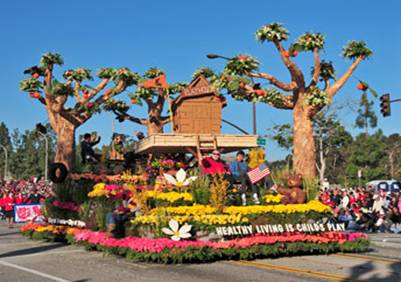
Picture 7. Rose Parade in Pasadena.
3.5 The Christmas Pantomime.
A pantomime is a traditional English entertainment at Christmas. It is meant for children, but adults enjoy it just as much(Pic.8). It is a very old form of entertainment, and can be traced back to 16th century Italian comedies. Harlequin is a character from these old comedies.
There have been a lot of changes over the years. Singing and dancing and all kinds of jokes have been added; but the stories which are told are still fairy tales, with a hero, a heroine, and a villain. Because they are fairy tales we don’t have to ask who wins in the end! The hero always wins the beautiful princess, the fairy queen it triumphant and the demon king is defeated.[8]
In every pantomime there are always three main characters. These are the “principal girl”, “principal boy”, “and the dame”. The principal boy is the hero and he is always played by a girl. The principal girl is the heroine, who always marries the principal boy in the end. The dame is a comic figure, usually the mother of the principal boy or girl, and is always played by a man.
Pantomimes are changing all the time. Every year, someone has a new idea to make them more exiting or more up-to-date. There are pantomimes on ice, with all the actors skating; pantomimes with a well-known pop singer as the principal boy or girl; or pantomimes with a famous comedian from the English theatre as the dame. But the old stories remain, side by side with the new ideas.[8]
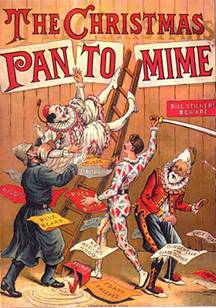
Picture 8.The old poster of Christmas Pantomime.
3.6 Yule Log.
The traditional English Christmas included the burning of a massive Yule log that had been ceremoniously dragged in by many hands and placed on the hearth on Christmas Eve.(Pic.9) The mundane reason for the custom was to keep chilly English houses warm, but there was a ritualistic aspect to it as well. “Yule” (in Anglo-Saxon, geol) was the winter solstice period in pagan England, and the burning of a huge log at this time was part of the ceremonies that honored the return of the sun. In a classic instance of sympathetic magic, the ancient Celtic and Teutonic peoples would light the log as both a register and an assurance of heavenly light. The cyclical nature of the custom was enshrined in the later folk belief that each year’s Yule log should be lighted from the relit remnant of the last year’s.

|
Из за большого объема этот материал размещен на нескольких страницах:
1 2 3 4 |
