

Партнерка на США и Канаду по недвижимости, выплаты в крипто
- 30% recurring commission
- Выплаты в USDT
- Вывод каждую неделю
- Комиссия до 5 лет за каждого referral
Муниципальное общеобразовательное учреждение
«Маардуская гимназия»
Маарду – Таллинн, Эстония
Научно-практическая конференция школьников «Исследовательская работа школьников»
Исследовательская работа
ученика 12 класса
Дроздова Александра
«Традиции рождества в жизни современной молодежи»
Руководитель:
Учитель английского языка,
Старший учитель
Маардуская гимназия
Г. Таллинн
Эстония
Маарду 2011
Scientific-practical conference of students "Student Research"
Research work
Christmas traditions in life of modern youth
Aleksandr Drozdov, 12th grade
Maardu Gymnasium
Scientific Adviser:
Galina Nast,
Senior teacher
Мaardu Gymnasium
Maardu
Estonia
MAARDU 2011.
CONTENTS
CONTENTS……………………………………………………………………………….2
LIST OF PICTURES........................................................................................................
INTRODUCTION…………………………………………………………………………
1. ORIGIN OF THE CHRISTMAS HOLIDAY………………………………………….
1.1 Etymology of word Christmas ...................................................................................
1.2 Analogues of word Christmas in other languages.............................................................
1.3The History of Christmas....................................................................................................
1.3.1 A Virgin Mary and Joseph………………………………………………………..
1.3.2. Christ’s birth..............................................................................................
1.3.3. Ancient Rome…………………………………………………………………. 2. THE MAIN SYMBOLS OF CHRISTMAS..........................................................................
2.1 Christmas tree..................................................................................................
2.2 Folk heroes…………………………………………………………………
2.2.1. Santa-Claus ……………………………………………………………………..
2.2.2Rudolph the Red-Nosed Reindeer............................................................................
3.MODERN TRADITIONS OF CHRISTMAS CELEBRATION…………………
3.1 A Christmas miscellany…………………………………………….
3.2 The Nativity…………………………………………………………
3.3 Gift Receipt…………………………………………………………..
3.4 Rose Parade……………………………………………………………
3.5 The Christmas Pantomime…………………………………………….
3.6 Yule Log………………………………………………………………
3.7 Modern traditions of Christmas celebration………………..
3.7.1 Youth traditions of celebration Christmas…………….
CONCLUSION…………………………………………………………………………….
LIST OF SOURCES…………….............................................................................................
LIST OF PICTURES:
Picture 1.Christ’s birth.
Picture2. Christmas tree at Trafalgar Square in London.
Picture 3. Santa-Claus.
Picture 4. Rudolf the Red-Nosed Reindeer.
Picture 5. Christmas card.
Picture 6. Wise Men Balthasar, Melchior and Caspar present gifts to Christ.
Picture 7. Rose Parade in Pasadena.
Picture 8. The old poster of Christmas Pantomime.
Picture 9. Burning of Yule Log.
INTRODUCTION
Christmas is one of the most popular holidays. It’s celebrated in many countries around the world. In many religions holiday recognized by the church.
Subject of research work is devoted to the traditions of Christmas in the life of modern youth. The choice of this theme has been carried out by taking into account the huge popularity in English-speaking world of a holiday which originally had a religious orientation, and so vivid memorable traditions, which came into Christianity from pagan times, have evolved and made it safely to our century. Interest in this subject was aroused by the fact that the history of the holiday and its traditions associated with the unforgettable and fascinating myths and legends, which are also fertile ground for research.
Subject of research in this work – Christmas holiday. The object of research – attitude of young people to the traditions of the holiday.
Objective: To explore the traditions of Christmas in the life of modern youth.
Research objectives:
1. Consider the origins of Christmas.
2. Examine the principal symbols of Christmas.
3. Explore the contemporary traditions of celebrating Christmas.
To solve these problems we used the following methods:
1. Study and analysis of the theoretical literature.
2. Compare and contrast the studied data of the subject.
3. Description, allowing to establish not only the facts but the relationship between them: a sequence, simultaneity, causality, the relationship of the Christmas traditions.
Chronological framework of the defined objectives: to study modern traditions of Christmas, so to compare with historical analogues, giving characteristics. Therefore, the beginning of the study relates to the origins of the holiday and ends with the modern tradition of celebration.
Geographically, the study deals mainly with the traditions of Christmas celebrations in England, but as the holiday multiethnic, the study will deal with the traditions of Christmas celebrations in Europe.
Hypothesis: Christmas - a religious holiday.
The work consists of an introduction, three chapters, conclusion and list of sources used. The first chapter is devoted to the origin of Christmas. In the second chapter deals with the main symbols of Christmas. The third chapter describes the modern traditions of Christmas celebrations.
1. ORIGIN OF THE CHRISYMAS HOLIDAY.
1.1. Etymology of word Christmas.
Christmas takes its name from the old English Christes, or Christ Mass [1]. The title, “Christ” is form of the Greek word “Christos” which means “Messiah” [2]. The word “Messiah” according to The ALL Nations English Dictionary means “the anointed one’’. ”Jesus Christ was anointed by God with the Holy Spirit and with power to preach good news (the Gospel to the poor,’’. From this dictionary we can also find out that “Jesus Christ is the true Messiah that is the promised Savior of the world. The phrase “Christes Maesse” or “Christmas” was first recorded in 1038.
1.2. Analogues of word Christmas in other languages.
Dutch has a similar word, Kerstmis, often shortened to Kerst. The German name Weinachten means simply “hallowed night”. After the conversion of Anglo-Saxon Britain in the early 7th century, Christmas was referred to as geol, name of the pre - Christian solstice festival from which current English word “Yule” is derived. In early Greek versions of the new Testament, the letter X (chi), is the first letter of Christ. Since the mid-sixteenth century X, or the similar Roman letter X, was used as an abbreviation for Christ [3].
1.3. History of Christmas.
1.3.1. A Virgin Mary and Joseph.
Not far from Jerusalem is Bethlehem. The mother of Jesus - Virgin Mary was born there. Since she was three years old, she was raised in church and in the fourteen years she vowed not to marry and serve only to God. Priests entrusted Mary to Joseph, widower, eighty years old man who replaced her father. They lived in the house of Joseph in Nazareth. Once in the house where lived the Virgin Mary and Joseph, the angel Gabriel appeared and said: "You shal bear a son and name him Jesus. He will be great and shall be called the Son of God, and the Lord God will give him the throne. " [12]
1.3.2. Christ’s birth.
At that time Roman emperor Augustus ordered to carry out census of all the land of Judah. Every Jew had to record where he was born. Therefore, Joseph and Mary went from Nazareth to Bethlehem. It was a difficult road, as Mary was to give birthsoon. In Bethlehem they came late at night, but could not stay because of the large crowds of people either in hotels or in homes of residents, so they stayed in a cave near the town. In this cave, the shepherds in inclement weather drove the cattle. That night the VirginMary had a son. Baby swaddled and laid on straw in a manger, to put livestock feed.(Pic.1) on the eighth day after birth, Joseph and Mary gave him the name Jesus means "God saves"or "savior. "[12]
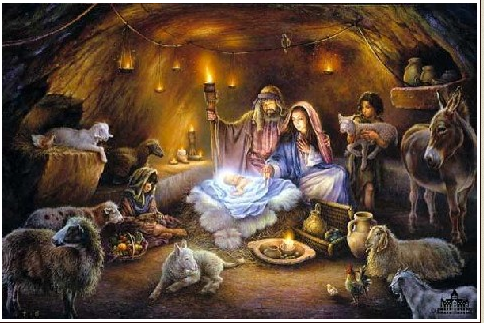
Рисунок 1. Рождение Иисуса.
Рисунок 1. Birth of Jesus
Many people look on Christmas as the time to celebrate the birth of Christ. It has its own history. In fact the early followers of Christ believed that infants entered this world with the original sin of Adam condemning their souls. The world was considered to be a harsh, cruel place. There was no reason to celebrate one’s birth. The death day was the passage to eternal paradise and it was a more significant event. That’s why with the rise of Christianity, the tradition of celebrating birthdays ceased. But in the fourth century the church began to alter its attitude towards birthday celebrations. In fact no one commenced serious discussions to settle the date of Christ’s birth [5], no one knows the exact date and the year of the birth of Christ. The Bible does not give us any clue, and no record was handed down. Christmas may have been celebrated from as early as 98 AD, but it was only in 350 AD that Julius I declared Christmas to be the 25th of December. According to a Roman almanac, the Christian festival of Christmas was celebrated in Rome by AD 336. In Britain this day was a festival long before the conversion to Christianity. The English historian the Venerable Bede relates that “the ancient peoples of Angle began the year on the 25th of December, and the very night was called in their tongue modranecht, that is “mother’s night” [6]. Besides, there is such a version that the 25th of March was the pagan festival of spring. The church adopted this date as that of Mary’s visit by the angel Gabriel, and added nine months to it to arrive at 25 December [7]. Thus, the choice of the 25th of December was rather controversial. Besides, The Catholic Encyclopedia also asserts that Christmas is especially controversial in the 4th century. First of all, the choice of the 25th of December was connected with various customs, many of which have been influenced by early winter solstice.

|
Из за большого объема этот материал размещен на нескольких страницах:
1 2 3 4 |
