


Партнерка на США и Канаду по недвижимости, выплаты в крипто
- 30% recurring commission
- Выплаты в USDT
- Вывод каждую неделю
- Комиссия до 5 лет за каждого referral
Таблица 4. Анализ разложения энергии рассчитанных комплексов методом АФП (все значения в ккал/моль).
Комплекс | ΔEподг | ΔEПаули | ΔEэлстат | ΔEорб | De | Eij(2) |
HCN. SO3 | 0.9 | 22.4 | -13.2 | -10.6 | 0.5 | 8.1 |
MeCN. SO3 | 1.7 | 35.2 | -21.0 | -18.2 | 2.4 | 15.4 |
HCCCN. SO3 | 0.9 | 23.4 | -13.6 | -11.1 | 0.4 | 8.6 |
(HCN)2.SO3 | 0.7 | 31.4 | -18.8 | -16.1 | 2.8 | 13.1 |
NH3.SO3 | 6.5 | 125.3 | -76.4 | -71.5 | 16.1 | 93.1 |
NMe3.SO3 | 11.5 | 162.9 | -97.4 | -97.5 | 20.4 | 142.8 |
Py. SO3 | 10.0 | 153.3 | -90.5 | -89.7 | 16.9 | 105.4 |
IClAr | 0.0 | 0.1 | 0.0 | -0.2 | 0.1 | 1.0 |
IClCO | 0.7 | 67.8 | -34.3 | -36.5 | 2.3 | 13.5 |
IClNH3 | 1.3 | 45.2 | -32.6 | -24.1 | 10.1 | 53.5 |
IClPy | 1.9 | 59.4 | -40.9 | -31.5 | 11.1 | 56.8 |
I2NMe3 | 1.8 | 50.0 | -33.2 | -28.4 | 9.7 | 40.2 |
I2Py | 0.4 | 48.6 | -32.1 | -25.6 | 8.7 | 36.4 |
IBrPy | 1.7 | 44.9 | -31.3 | -24.9 | 9.6 | 45.2 |
Таблица 5. Анализ SO3…В комплексов с точки зрения метода натуральных орбиталей связи.
Комплекс | Орби-таль | Заселен-ность | Гибридизация атома S, % | Eij(2/ (ккал/ моль) | Взаимодействие между связывающими и антисвязывающими орбиталями | ||
s | p | d | |||||
H3N. SO3 | BD(N-S) | 1.888 | 17.7 | 43.5 | 38.8 | 93.1 | BD(N-S)→BD*(S-O) |
Me3N. SO3 | LP(O) | 1.751 | 12.5 | 85.1 | 2.4 | 142.8 | LP(O)→BD*(N-S) |
HCN. SO3 | LP(N) | 1.942 | 33.1 | 65.3 | 1.6 | 8.1 | LP(N)→BD*(S-O) |
Py. SO3 | BD(N-S) | 1.851 | 16.4 | 46.8 | 36.8 | 105.4 | BD(N-S)→BD*(S-O) |
MeCN. SO3 | LP(N) | 1.906 | 33.0 | 65.3 | 1.7 | 15.4 | LP(N)→BD*(S-O) |
HCCCN. SO3 | LP(N) | 1.937 | 32.1 | 66.3 | 1.6 | 8.6 | LP(N)→BD*(S-O) |
(HCN)2.SO3 | LP(N) | 1.920 | 31.2 | 67.0 | 1.8 | 13.1 | LP(N)→BD*(S-O) |
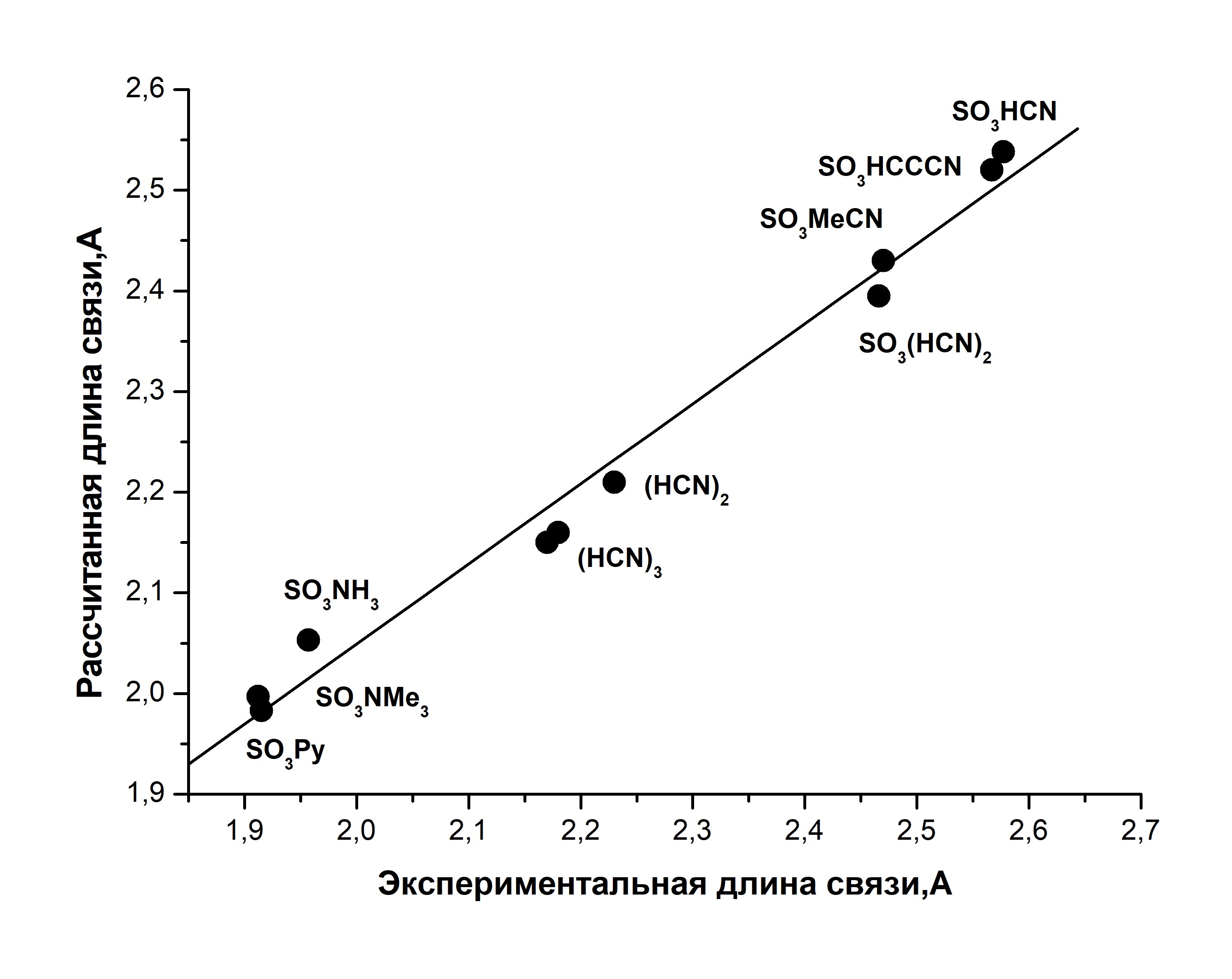
Рис. 1
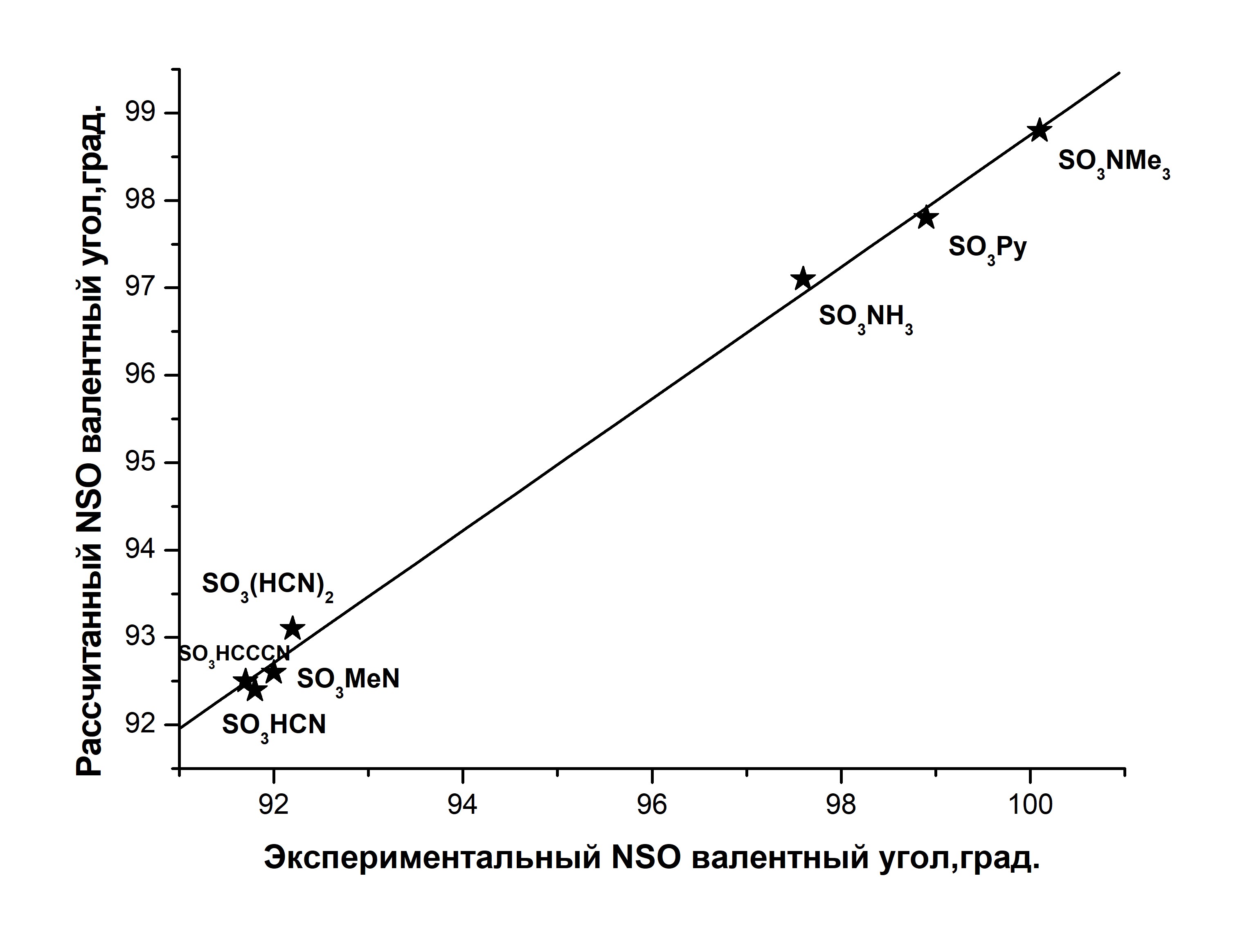
Рис. 2
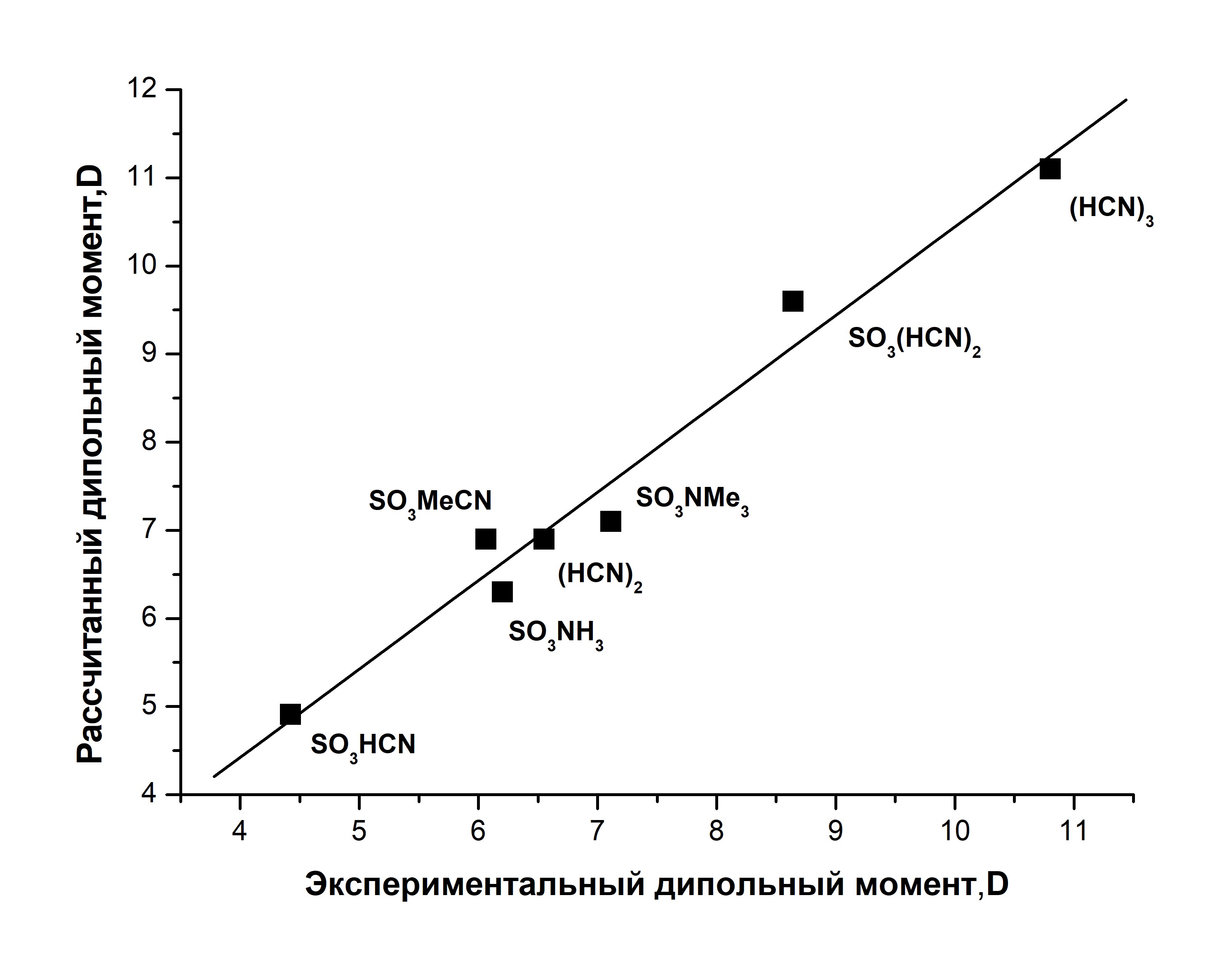
Рис. 3
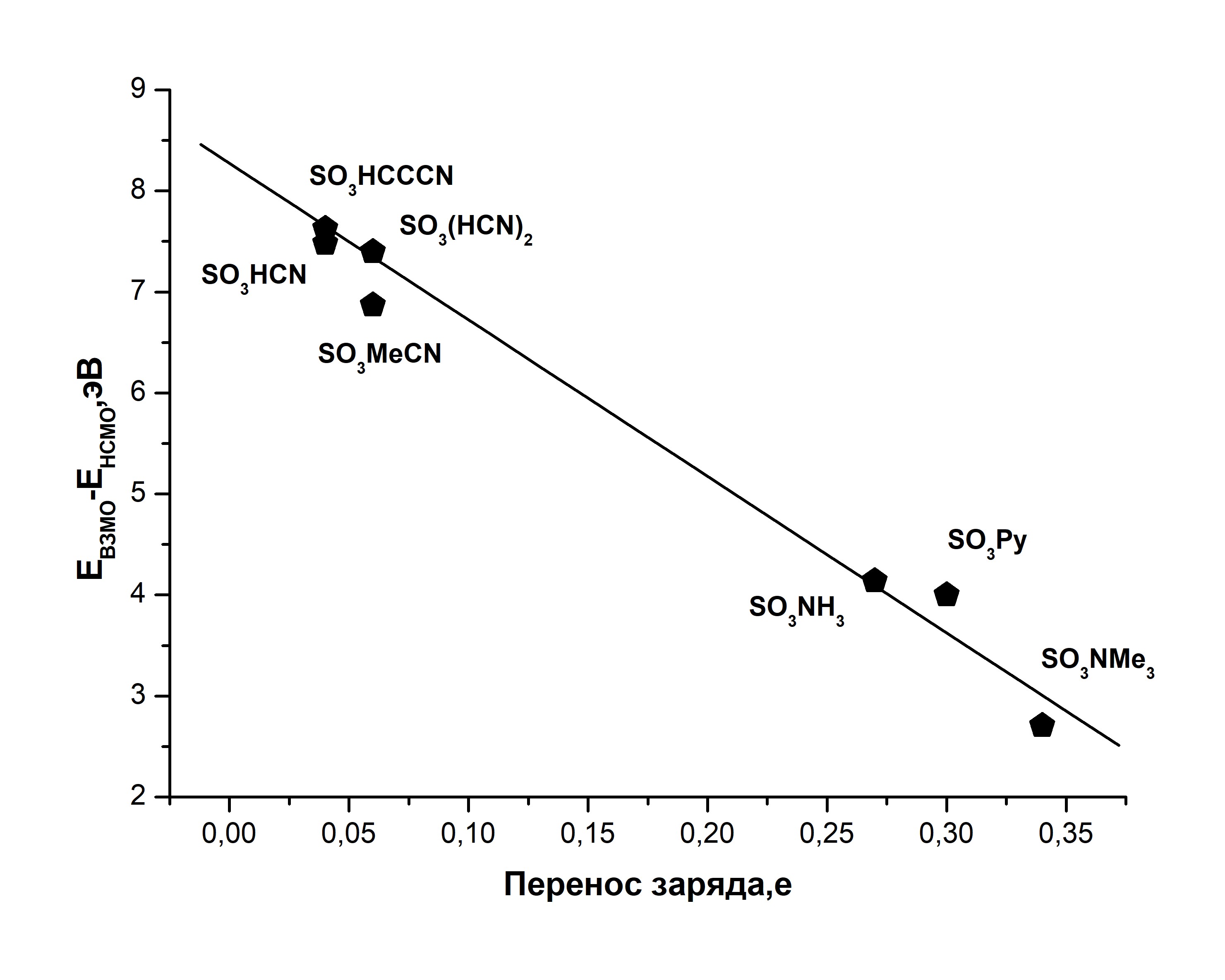
Рис. 4
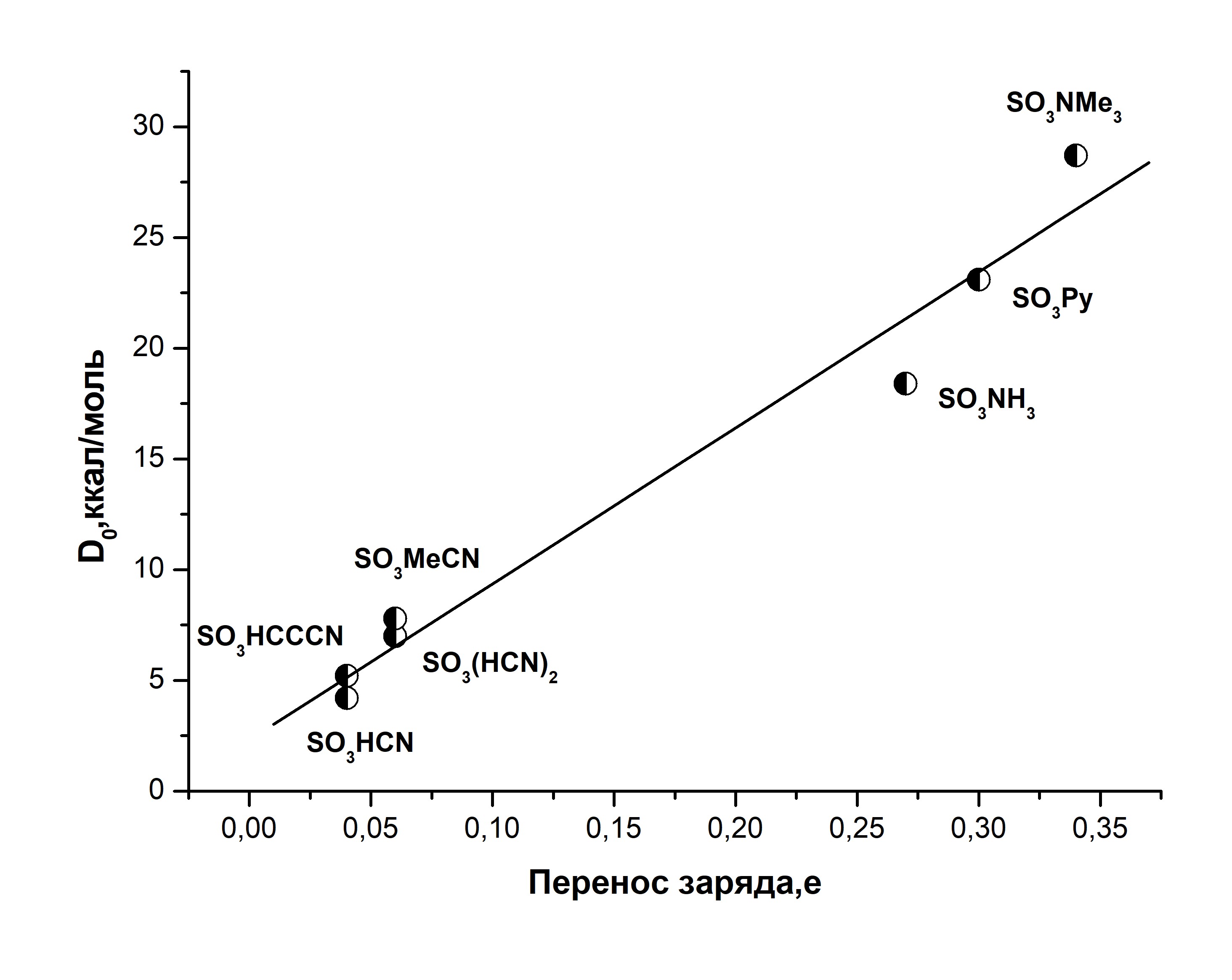
Рис. 5

Рис. 6
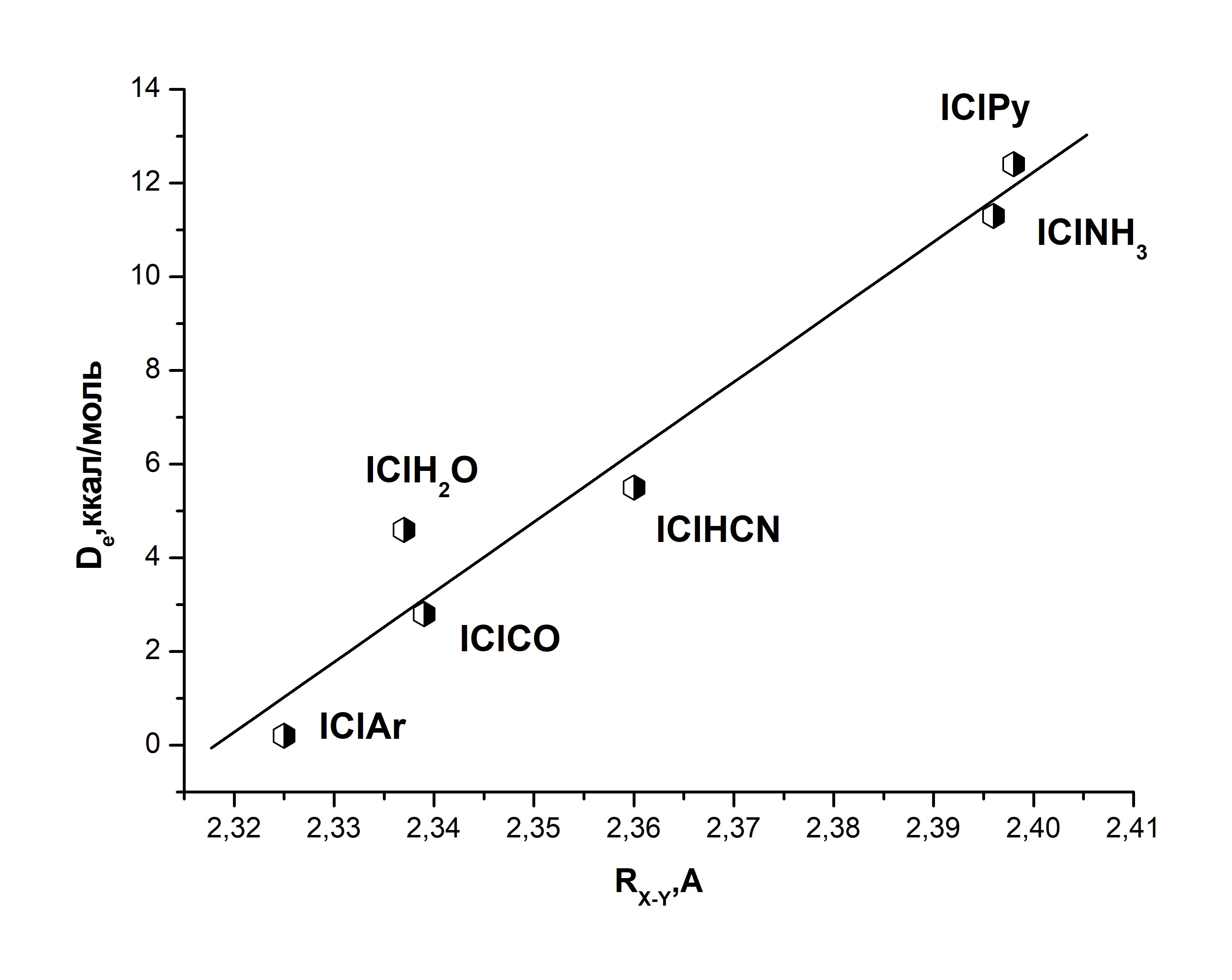
Рис. 7
Подписи к рисункам
Рис. 1 Корреляция между экспериментальными и рассчитанными B3PW91/6-311+G(df, pd) длинами связей в SO3 комплексах
Рис. 2 Корреляция между экспериментальными и рассчитанными B3PW91/6-311+G(df, pd) валентными углами NSO в SO3 комплексах
Рис. 3 Корреляция между экспериментальными и рассчитанными B3PW91/6-311+G(df, pd) дипольными моментами в SO3 комплексах
Рис. 4 Величина энергетической щели относительно переноса заряда в SO3 комплексах
Рис. 5 Энергии связывания для комплексов SO3 относительно переноса заряда
Рис. 6 Корреляция между энергией связывания и длиной связи S-O
Рис. 7 Корреляция между энергией связывания и длиной связи XY
The investigation of the electronic structure of the I2 and SO3 complexes on the base of DFT
O. Kh. Poleshchuk, A. G. Yurieva, A. V. Fateev, V. Branchadell
We have analyzed by means of DFT calculations of nitrogen nuclear quadrupole coupling constants of a range of SO3…B, I2…B complexes (n aπ, n aу type in Mulliken notation) formed between molecules SO3 and Lewis bases B. The geometrical parameters, the rotational constants and the nitrogen and halogens nuclear quadrupole coupling constants obtained by these calculations substantially agree with the data from microwave spectroscopy in the gas phase. A good correlation is found between the calculated bond strengths of these complexes and the lengthening of the S-O bond. The NBO partitioning scheme and the stabilizing orbital interaction term suggest that there are good correlations between the charge transfer and the bond strength. The ZORA mode leads to realistic values of nitrogen and halogens nuclear quadrupole coupling constants. From electron partitioning analyses and Klopman’s approach, it follows that for the SO3…B complexes the electrostatic contribution to the bonding is comparable to the covalent contribution, and for the ICl…B complexes the electrostatic bonding is predominant relative to covalent bonding.

|
Из за большого объема этот материал размещен на нескольких страницах:
1 2 3 4 |
