


Партнерка на США и Канаду по недвижимости, выплаты в крипто
- 30% recurring commission
- Выплаты в USDT
- Вывод каждую неделю
- Комиссия до 5 лет за каждого referral
One of the key components in the programs of the audit is qualified energy auditors. For this reason, we can use the accreditation or certification of energy auditors to provide qualifications for auditors, as proposed in the European Union Energy Efficiency Directive (EED). In any case, industrial production processes are very complex and auditors are not required to be experts in all processes associated with the system of industrial power. Visualization of existing energy efficiency measures proposed in the previous energy audit with a web-based platform has an extremely high potential, as it helps to improve knowledge of energy auditors. Europe is the leading actor in connection with the development of the European standard for energy management. This standard is based to a large extent based on the Swedish and Danish national energy management standard. Recently, the international ISO-standards - ISO 50001 has been completed. Thollander and Palm presented a more detailed overview of the energy management in industry [5].
The main objectives of the audit are to define how to operate the power system is now, finding ways to improve the efficiency and determination of the proposed measures. American Society of Heating, Refrigerating and Air-Conditioning Engineers (ASHRAE) identified three progressive levels or types of energy audits: Level 1 - pre-audit, Level 2 - Energy research and analysis and Level 3 - detailed analysis of capital changes [6].
Level 1 alternatively called a “simple audit” or “screening audit” is the main starting point for the optimization of energy consumption. Level 1 includes a brief interview with the staff, analysis of utilities costs, other operating information and easy overview of the building as a whole. ASHRAE Level 1 is aimed at identifying the potential of reducing energy consumption, understanding the overall configuration of the building, and the determination of the type and nature of the energy systems. The audit should lead to a preliminary energy analysis of the entire object, and a summary report detailing the results, which may include the identification of a variety of possibilities to improve efficiency. Typically, this report does not give detailed guidance, in addition to the obvious errors of operations.
ASHRAE Level 1 is designed to help understand how the building consumes energy with compared with the same; create a basis for measuring improvements; give the basis for decisions on further examination; outline the potential financial incentives available from state and local sources.
ASHRAE Level 2 begins with an analysis of conclusions of the audit level-1, and evaluates energy systems for the purpose of energy efficiency potential. This analysis should include a survey of the building, lighting, heating, ventilation and air conditioning (HVAC), hot water systems, pumping and compressed air (for manufacturing, services, or processing capacity). This audit begins with a detailed analysis of the energy consumption for the collection of quantitative data, the analysis of seasonal fluctuations and energy costs. The audit should also include an assessment of lighting, air quality, temperature, ventilation, humidity, and other conditions that could affect the energy efficiency and comfort. This process also includes detailed personal discussion with the owner of the building, managers and tenants to examine potential problem areas, and clarification of financial and non-financial objectives of the program [6].
Audit Level 2 should result in a report describing the various measures of energy efficiency and low-cost activities, changes in the management system and building automation, operational changes and the potential renewal of fixed capital. Conclusions should include the total costs and performance indicators to assess the proposed measures and decision-making.
Many of the measures identified during the audit ASHRAE Level-2 can be quickly implemented with fast and direct financial payback for the owner. Other measures would require a more detailed analysis of costs and benefits that are important to the owner. The audit should identify the next steps for the implementation of the analysis and decision-making, or by discussions with manufacturers. ASHRAE Level-3 is used in case of significant investments identified in Level 2.
ASHRAE Level 3 is detailed analysis of capital changes. ASHRAE Audit Level 3 focuses on computer modeling of the energy system of the whole building. ASHRAE Audit Level 3 includes much more detailed data collection during weeks or months, and data recorders are usually placed temporarily for the control of pumps and motors, room temperature, light level, switching behavior and other factors. This data is used to calibrate a computer model of the object, so that the computer model can perform simulations. This calibration is checked and confirmed during a year or more for the analysis of changes in energy consumption resulting from changes in production capacity, and other parameters. This model allows supporting informed investment decisions [6].
Before the start of an energy audit, it is recommended a preliminary analysis in order to compare the energy consumption of the process with the national or world average. This procedure is usually done with the benchmarking.
Benchmarking as concept
Abroad, in order to improve energy efficiency, benchmarking as concept of energy efficiency is widespread. Benchmarking is to disseminate best practices and the best achievements in this field both in industry and for companies with different activities and any form of ownership. In a general sense benchmarking - is the process of adaptation of existing examples of effective functioning of the company, in a given field, in order to improve their own work. Benchmarking equally involves two processes: evaluation and comparison. The purpose of benchmarking is to establish a research-based need for change, and the way to achieve success as a result of these changes. Benchmarking is done in the analysis of competitors' activities and is not a new approach for the majority of industrial enterprises. Benchmarking provides a more detailed and ordered control than using only the methods of analysis, which includes a comparative analysis of the information field of the company and its competitors, identify the strengths and weaknesses of the information policy [7].
Benchmarking - is one of the instruments of support and continuous improvement activities in the field of energy saving. Benchmarking is used as part of the energy management system in the planning. Benchmarking results provide valuable information to carry out an objective analysis of the energy and the formulation of energy objectives. There are two types of benchmarking energy - external and internal [7].
- External is aimed at establishing such an energy-efficient installation, equipment, products, services, which is the "best" in the industry;
- Internal benchmarking of energy efficiency is aimed at finding objects of industrial enterprises with different levels of energy efficiency within the organization, in order to disseminate best practices.
An important role is played by organizational and stimulating factors affecting the level of efficiency of functioning of industrial enterprises in the field of energy saving. Organizational factors include - the collection, processing and dissemination of information, incentives - incentives, taxes and loans to improve the energy efficiency target. The experience of leading industrial countries of Western Europe and the United States in benchmarking can to identify the «best» companies according to certain criteria and structural divisions in different directions of their activities.
International benchmarks, based on the energy use of BPTs (or international benchmark), are estimated for a total of 26 industrial processes, products and industry sectors. These processes include the energy intensive sectors such as the iron and steel, and chemical and petrochemical sectors, as well as number of light industries and small-scale sectors such as foundries and lime kilns [8-13].
Energy indicators are estimated based on literature data, i. e. production statistics and international energy statistics, and country-level comparisons are based either on an Energy Efficiency Index (EEI) or on an average of current levels of Specific Energy Consumption (SEC) as developed by Phylipsen et al and Neelis et al for the Netherlands.
The SEC analysis uses the average current SEC at country or regional level depending on data availability. If SEC data are not available, energy statistics provide the only basis for assessing energy efficiency. Energy statistics provide information on energy use at sectoral level, thereby including all production processes within that sector [8-13].
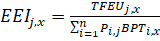
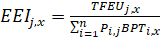
The EEI approach estimates the EEI of country j for sector x with i production processes as follows:
 (1)
(1)
where, TFEU is the actual energy use of sector x as reported in Energy Balances prepared by International Energy Agency (IEA) (in petajoules (PJ) per year),
P is the production volume of product i in country j (in mega tonnes (Mt) per year), BPT is best practice technology energy use for the production of product i (in gigajoules (GJ) per tonne of output) and n is the number of products to be aggregated [8].
It should be noted that there is also a large number of studies aimed at understanding the capabilities more effective use of benchmarking in the energy sector. Many governments of developed countries are using this tool for the evaluation of existing policies in the energy sector, as well as developing new ones. Examples include the following [12]:
1) The Netherlands: Agreement on benchmarking (95PJ energy saving and reduction of ~ 5.8 mln. tons of CO2 emissions in the period 2000-2012) and EU Emissions Trading Scheme (EU ETS): Benchmarking is used as a basic principle for free distribution

|
Из за большого объема этот материал размещен на нескольких страницах:
1 2 3 4 |
