

Партнерка на США и Канаду по недвижимости, выплаты в крипто
- 30% recurring commission
- Выплаты в USDT
- Вывод каждую неделю
- Комиссия до 5 лет за каждого referral
МОДЕЛИРОВАНИЕ ПРОБКОВОГО РЕЖИМА ДВУХФАЗНОГО ТЕЧЕНИЯ, ВЫЗВАННОГО ГЕОМЕТРИЕЙ ТРУБОПРОВОДА
1,2, 1, 1
1Московский научно-исследовательский центр компании «Шлюмберже»
2Московский физико-технический институт (государственный университет)
Нестационарный пробковый (снарядный) режим течения духфазного течения (terrain slugging) формируется в трубопроводах с переменным углом наклона к горизонту. В данных конфигурациях жидкость под действием силы тяжести стекает в колена трубопровода и блокирует течение газа. Накопление газа приводит к росту давления за пробкой жидкости, при превышении давлением определенного значения происходит выплеск жидкости вниз по течению. Этот процесс часто оказывается периодическим и сопровождается колебаниями расходов и давлений в системе. Моделирование пробкового режима течения является важной практической задачей, поскольку указанные колебания могут приводить к неустойчивой работе оборудования, такого как сепараторы, рассчитанные на постоянные расходы жидкости и газа, и, в критических ситуациях, выходу его из строя [1].
В настоящей работе для описания пробкового режима течения используется модель дрейфа (drift-flux model) (см. [2]). Рассмотрение проводится на примере экспериментальных данных для течения вода-воздух в W-образном трубопроводе из [3]. Для получения численных решений уравнений модели дрейфа использован алгоритм, основанный на методе SIMPLE. Подробное описание лабораторной установки и эксперимента может быть найдено в [3].
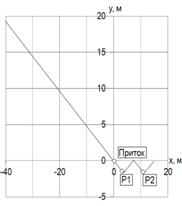
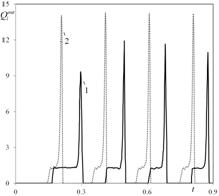
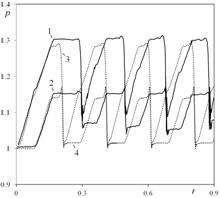
На приведенном рисунке схематически изображена конфигурация экспериментального трубопровода и представлено сравнение результатов экперимента и численного решения уравнений модели дрейфа. Показаны зависимости расхода воды на выходе из системы (1 - эксперимент, 2 - численное решение) и давлений в двух точках трубопровода (1,2 - эксперимент, точки P1, P2; 3,4 - численное решение, точки P1, P2) от времени. За характерные масштабы расхода и давления выбраны расход на входе и давление на выходе из трубопровода, характерный масштаб времени вычислен по полной длине трубопровода и скорости жидкости, определяемой входным расходом.
Представленные результаты показывают принципиальную возможность моделирования существенно нестационарного пробкового режима течения, обусловленного геометрией трубопровода, в рамках модели дрейфа. Полученные результаты находятся в согласии с выводами работы [4], в которой модель дрейфа использовалась для рассмотрения схожих сильно-нестационарных задач. Несмотря на отличия в формах кривых зависимостей расхода и давлений от времени, общее число выплесков воды, период, суммарный расход приходящийся на один выплеск и общий суммарный расход близки к экспериментальным данным. Для более точного совпадения с экспериментальными данными требуется дополнительная настройка замыкающих соотношений модели дрейфа, неоткалиброванной для нисходящих и окологоризонтальных течений.
ЛИТЕРАТУРА.
1. J. L. Baliño, K. P. Burr, R. H. Nemoto. Modeling and simulation of severe slugging in air–water pipeline-riser systems. Int. J. Multiphase Flow, 2010, 36(8), 643–600.
2. , , . Обоснование модели дрейфа для двухфазных течений в круглой трубе. Изв. РАН. МЖГ, 2014 (принято к публикации).
3. V. De Henau, G. D. Raithby. A study of terrain-induced slugging in two-phase flow pipelines. Int. J. Multiphase Flow, 1995, 21(3), 365–379.
4. R. Malekzadeh, S. P.C. Belfroid, R. F. Mudde. Transient drift flux modelling of severe slugging in pipeline-riser systems. Int. J. Multiphase Flow, 2012, 46, 32––37.
MODELING OF TERRAIN-INDUCED SLUGGING IN TWO-PHASE FLOW PIPELINES
1,2K. F. Sinkov, 1P. E. Spesivtsev, 1A. A. Osiptsov
1Schumberger Moscow Research
2Moscow Institute of Physics and Technology
Highly transient slugging flows are often formed in near-horizontal pipelines on a nonuniform topography. In such configurations, the heavy liquid accumulates in low points due to gravity and blocks the flow of gas, causing an increase of pressure in the gas phase. Once the gas pressure is above a certain threshold, the accumulated liquid also referred to as slug is displaced from the low point downstream. This process can be periodical, with significant oscillations of pressure and flow rates in the system. Modeling of slug flows is an important practical problem, because the oscillations may damage surface equipment (e. g., separators, which are designed for steady-state flow conditions) [1].
In this work the drift-flux model (see [2]) is used for simulation of the experimental data on terrain-induced slugging in the W-shaped pipeline reported in [3]. To solve equations of the drift-flux model numerically, an algorithm based on the SIMPLE method is used. Detailed description of the laboratory set up can be found in [3].
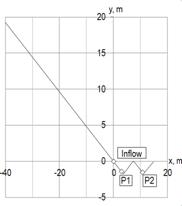
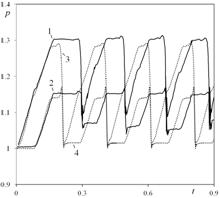
The schematic of flowpath and comparison of the experimental data and the simulation results are shown in figure above. The water flow rate at the exit of the pipe (1 and 2 stand for experiment and simulation correspondingly) and the pressures at two points in the pipe (1 and 2 stand for experiment, points P1 and P2; 3 and 4 stand for simulation, points P1 and P2) are plotted as functions of time. As characteristic scales of the flow rate and pressure, we choose the flow rate at the pipe entry and the pressure at the exit, prescribed in the experiment. Characteristic time scale is defined using the full pipe length and the characteristic fluid velocity defined the by inlet flow rate.
The simulation results demonstrate the possibility to simulate the highly transient terrain-induced slugging phenomenon with the drift-flux model. This is in agreement with results obtained earlier in [4] for similar flow configurations. The comparison shows that there is a certain discrepancy between the shape and the peak values of the flow rates in modeling and experiment. Nevertheless, the total number of slugs, the cumulative volume per slug, and the cumulative flow rate are very similar to the experimental data. The drift-flux model is not calibrated for downward and near-horizontal flows and can be further tuned for better match with the experimental data.
REFERENCES.
1. J. L. Baliño, K. P. Burr, R. H. Nemoto. Modeling and simulation of severe slugging in air–water pipeline-riser systems. Int. J. Multiphase Flow, 2010, 36(8), 643–600.
2. A. A. Osiptsov, K. F. Sinkov, P. E. Spesivtsev. Derivation of the drift-flux model for two-phase flows in circular pipes. Fluid Dynamics, 2014 (accepted).
3. V. De Henau, G. D. Raithby. A study of terrain-induced slugging in two-phase flow pipelines. Int. J. Multiphase Flow, 1995, 21(3), 365–379.
4. R. Malekzadeh, S. P.C. Belfroid, R. F. Mudde. Transient drift flux modelling of severe slugging in pipeline-riser systems. Int. J. Multiphase Flow, 2012, 46, 32––37.
