


Партнерка на США и Канаду по недвижимости, выплаты в крипто
- 30% recurring commission
- Выплаты в USDT
- Вывод каждую неделю
- Комиссия до 5 лет за каждого referral
3. She looks about 20, but in fact she’s much ________ she looks. (old)
4. The problem is not so complicated. It’s __________ you think. (simple)
5. Your English improved. You speak ________________ you did when we last met. (frequently)
6. Health and happiness are ______________ money. (important)
7. We always go camping when we go on holiday. It’s much ___________ staying in a hotel. (cheap)
8. I like the countryside. It’s __________ and ___________ living in a town. (healthy, peaceful)
plete the sentences. Use 'than'.
1. He isn't very tall. You're taller than him ( or..than he is).
2. She isn't very old. You are ___________________________________
3. I don't work very hard. You work _____________________________
4. He doesn't watch TV very much. You __________________________
5. I'm not a very good cook. You ________________________________
6. We don't know many people. You _____________________________
7. They haven't got much money. You ____________________________
8. I can't run very fast. You can __________________________________
9. She hasn't been here very long. You ____________________________
plete the sentences with a superlative and prepositions.
1. It’s a very nice room. It’s the nicest room in the hotel.
2. It’s a very cheap restaurant. It’s ___________________ the town.
3. It was a very happy day. It was _____________________ my life.
4. She’s a very intelligent student. She _______________ the school.
5. It’s a very valuable painting. It ______________ the gallery.
plete the sentences with the suitable form of the adjectives in the brackets.
1. Which is __________________ (long) day of the year?
2. Winter is __________________ (cold) season.
3. Moscow is _________________ (large) than St. Petersburg.
4. Where is it ________________ (beautiful), in the mountains or near the sea?
5. It was ___________________ (bad) cold I've ever had.
6. In spring the days are _________________ (long) than in winter.
7. It is _________________ (cold) today than it was yesterday.
8. Health is _______________ (good) than wealth.
VIII. Write sentences with as.... as.
1. Athens is older than Rome. Rome isn't as old as Athens.
2. My room is bigger than yours. Your room isn't ___________________
3. You get up earlier than me. I don't _____________________________
4. We played better than them. They _____________________________
5. I've been here longer than you. You ___________________________
6. She's more nervous than him. He _____________________________
IX. Translate the following sentences with 'the..... the'.
1. The more you study, the better you pass your exams. _____________________________________________________
2. The longer is the night, the shorter is the day. _____________________________________________________
3. The less we speak English, the worse for us. _____________________________________________________
4. The earlier you get up, the more you can do. _____________________________________________________
5. The more you practise in rapid reading, the quicker you will read. _____________________________________________________
CONTINUOUS TENSES
I. Which is right?
1. ‘Are you speaking / Do you speak English?’ ‘Yes, a little.’
2. Sometimes we’re going / we go away at weekends.
3. It’s a nice day today. The sun is shining / shines.
4. (You meet Ann in the street.) Hello, Ann. Where are you going / do you go?
5. How often are you going / do you go on holiday.
6. Emily is a writer. She’s writing / she writes books for children.
7. I’m never reading / I never read newspapers.
8.“Where are Michael and Jane?’ “They’re watching / They watch TV at home.’
9. Helen is in her office. She’s talking / She talks to somebody.
10. What time are you usually having / do you usually have dinner?
II. Put the verb in the present simple or the present continuous.
1. Excuse me. ________________________ (you/speak) English?
2. “Where’s Tom?” “___________________ (he/have) a shower.”
3. What’s funny? Why ___________________ (you/laugh)?
4. _____________________ (I/watch) television very often.
5. Listen! Somebody _____________________ (sing).
6. Sandra is tired. ___________________ (she/want) to go home now.
7. How often _____________________ (you/read) a newspaper?
8. I’m sorry, ____________________ (I/not/understand). Can you speak more slowly?
9. What time ____________________ (your father/finish) work in the evening?
10. You can turn off the radio. ______________________ (I/not/listen) to it.
11. Martin _________________ (not/usually/drive) to work. He ________________ (usually/walk).
12. Sue _______________ (not/like) coffee. ________________ (she/prefer) tea.
13. “Excuse me, but _____________________ (you/sit) in my place.”
III. Tom and Nick are watching the house across the street. Something strange is happening. Put the verbs in the brackets in the present continuous or the present simple.
TOM: What ____________________ (you stare) at?
NICK: There’s a man at the Johnsons’ house. He _________________
(not live) there. I wonder what he _______________________ (do).
TOM: Perhaps he ___________________ (visit) the Johnsons.
NICK: No. They’re not at home. They both __________________ (work) in town. They ________________ (catch) the same train as Dad every morning. It’s strange. He ________________ (look) at the house very carefully.
TOM: Now he ________________ (try) to open the gate, but it’s locked. Look! He ________________ (climb) over the garden wall. I can’t see him now.
NICK: Let’s follow him. I want to see what he __________________ (do).
TOM: He _________________ (go) to the garage. He ______________ (carry) a ladder. Now he _________________ (put) the ladder up to the bedroom window!
NICK: He must be a burglar … Hey! You! What _______________
(you do)?
MAN: It’s all right, boys. I’m an insurance agent. I ________________
(examine) the storm damage to the roof. The Johnsons _______________ (know) that I’m here.
IV. Some of the sentences are right, but some are wrong. Correct them.
1. Jim isn’t wanting an ice-cream. He doesn’t like it. ____________________________________________________
2. We’re enjoying the course very much. We’re learning a lot. ____________________________________________________
3. I’m understanding you but I’m not agreeing with you. ____________________________________________________
4. Do you think that Vanessa plays golf well? ____________________________________________________
5. I’m sorry. I’m not knowing the answer. ____________________________________________________
6. I’m not believing you. You’re telling lies. ____________________________________________________
7. They know the car costs a lot of money but they want to buy it. ____________________________________________________
8. She listens to a French song but she doesn’t understand what it is
meaning. _______________________________________________
9. What are you wanting to drink? _____________________________
V. Here is the list of some things that Ann did yesterday.
1. 8.45-9.15 had breakfast
2. 9.15-10.00 read the newspaper
3. 10.00-12.00 cleaned her flat
4. 12.45-1.30 had lunch
5. 2.30-3.30 washed some clothes
6. 4.00-6.00 watched television
Now write sentences saying what she was doing at these times :
1. At 9.00 o’clock she was having breakfast.
2. At 9.30 she ____________________________________
3. At 11 o’clock __________________________________
4. At 1 o’clock ___________________________________
5. At 3 o’clock ___________________________________
6. At 5 o’clock ___________________________________
VI. Put the verb into the Past Continuous.
1. When I arrived, Tom ____________ (lie) on the sofa and _____________ (speak) over the phone.
2. He couldn't speak because he _______________ (die) of laugh.
3. What you _______________ (do) between one and two? I phoned you several times.
4. I _______________ (play) the piano and heard nothing.
5. When I got up that morning, the sun ______________ (shine) brightly and the birds ________________ (sing).
6. When you rang me yesterday, I __________________ (have) a bath.
7. Somebody stole the money from Dad's pocket while he _______________ (sleep).
VII. Put the verbs into the past continuous or past simple.
1. What _______________ (you/do) when the phone ______________ (ring)? - I ________________ (watch) television.
2. Was Jane busy when you went to see her? - Yes, she _____________ (study).
3. What time ____________ (the post/arrive) this morning? - It _____________ (come) while I _____________ (have) breakfast.
4. Was Margaret at work today? - No, she _____________ (not/go) to work. She was ill.
5. How fast ________________ (you/ drive) when the police ____________ (stop) you? - I don't know exactly but I _______________ (not/drive) very fast.
6. ___________________ (your team/win) the football match yesterday? - No, the weather was very bad, so we __________________ (not/play).
7. How _______________ (you/break) the window? - We ______________ (play) football. I ______________ (kick) the ball and it _______________ (hit) the window.
8. ______________ (you/see) Jenny last night? - Yes, she ____________ (wear) a very nice jacket.
9. Peter ______________ (fall) off the ladder while he _______________ (paint) the ceiling.
10. Last night I ______________ (read) in bed when suddenly I ______________ (hear) a scream.
11. _______________ (you / watch) television when I phoned you?
12. I ______________ (break) a plate last night. I _______________ (do) the washing up when it ___________ (slip) out of my hand.
13. We ____________ (not go) out because it ________________ (rain).
14. What _______________ (you / do) at this time yesterday?
VIII. Last week Jenny organized a big party for Tom’s plete the sentences with the verbs in the brackets using the past simple or the past continuous.
On Saturday morning, Jenny and Jane ______________ (buy) the food for the party when Tom ___________ (see) them at the supermarket. But he ______________ (not guess) what they _________________ (do).
When Tom ______________ (not look) Jenny ____________ (take) his address book out of his pocket.
Jenny _______________ (phone) all Tom’s friends while he _____________ (play) tennis with Nick.
When Jane _____________ (return) the address book to Tom’s pocket, he ______________ (plan) an article with Jenny.
Tom ______________ (cycle) in the park with Nick when all the guests ________________ (arrive) for the party.
When Tom ______________ (arrive) in front of the house with Nick, all his friends _______________ (hide).
While Tom _______________ (walk) up the stairs all his friends suddenly ______________ (shout), “Surprise!”
МОДАЛЬНЫЕ ГЛАГОЛЫ
I. Answer these questions, using the following word combinations.
write a little, kick a ball, wink, throw a stone, listen and hear, see, to clean one’s teeth, bite. |
1. What can you do with your left hand? ____________________________
2. What can you do with your right hand? ___________________________
3. What can we do with our eyes? _________________________________
4. What can we do with our ears? __________________________________
5. What can we do with our teeth? _________________________________
plete the sentences with can or can’t and make true statements about your country.
1. You _____________ drive a car when you’re sixteen.
2. You _____________ go into a bar when you’re fourteen.
3. You _____________ get married when you’re sixteen.
4. You _____________ visit the USA without a visa.
5. You _____________ travel on a train without a ticket.
6. You _____________ get cheap housing.
7. You _____________ vote when you’re fifteen.
8. You _____________ smoke on buses and trains.
plete these sentences with must or have to (in the correct form). Sometimes it is possible to use either, sometimes only have to is possible.
1. Well, it's 10 o'clock. I must (have to) go now.
2. Ann was feeling ill last night. She had to leave the party early.
3. You really __________ work harder if you want to pass that examination.
4. Many children in Britain _____________ wear uniform when they go to school.
5. Last night Don suddenly became ill. We _____________ call the doctor.
6. Ann _______________ wear glasses since she was eight years old.
7. I'm afraid I can't come tomorrow. I _____________ work late.
8. I'm sorry, I couldn't come yesterday. I _______________ work late.
9. We couldn't repair the car ourselves. We _____________ take it to a garage.
10. When you come to London again, you ______________ come and see us.
IV. Write sentences with I (don’t) think ….. should …..
1. It’s late. (go home now) I think we should go home now.
2. That coat is too big for you. (buy it) ______________________________
3. Diana needs a rest. (have a holiday) ______________________________
4. You don’t need your car. (sell it) ________________________________
5. Sally and Colin are too young. (get married) _______________________
6. You’re not well this morning. (go to work) ________________________
7. James isn’t well today. (go to the doctor) __________________________
8. The hotel is too expensive for us. (stay there) _______________________
V. Give some advice to these peoples’ problems.
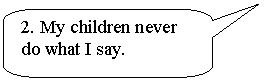

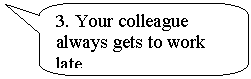

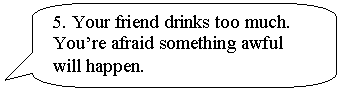

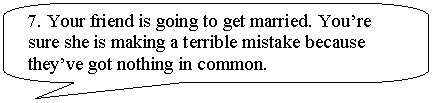
1. _________________________________________________________
2. _________________________________________________________
3. _________________________________________________________
4. _________________________________________________________
5. _________________________________________________________
6. _________________________________________________________
7. _________________________________________________________
СПОСОБЫ ВЫРАЖЕНИЯ БУДУЩЕГО ДЕЙСТВИЯ
plete the sentences. Use going to + one of the verbs from the box.
eat do give lie down stay walk wash watch wear
1. My hands are dirty. - I’m going to wash them.
2. What _____________________ to the party tonight?
3. I don’t want to go home by bus. I ______________________.
4. John is going to London next week. He ________________ with some friends.
5. I’m hungry. I _________________ this sandwich.
6. It’s Sharon’s birthday next week. We _________________ her a present.
7. Sue says she’s feeling very tired. She _________________ for an hour.
8. There’s a good film on TV this evening. __________ you _____________ it?
9. What _____________ Rachel ______________ when she leaves school?
plete the sentences using will or going to.
1. “Why are you turning on the television? “_______________ the news. (I/watch)”
2. “Oh, I haven’t got any money.” “Well, don’t worry. ____________ you some. (I/lend)”
3. “Why are you filling that bucket with water?” “________________ the car. (I/wash)”
4. “Are you going shopping?” “Yes, ________________ something for dinner. (I/buy)”
5. “What would you like to eat?” “________________ a sandwich, please. (I/have)”
6. “Did you post that letter for me?” “I’m sorry. I forgot. _______________ it now. (I/do)”
7. “I’ve decided to repaint this room.” “Oh, really? What colour ______________ it? (you/paint)”
8. “I don’t know how to use this camera.” “Don’t worry. _______________ you. (I/show)”
9. “Please, don’t make too much noise. _______________ everybody up. (you/wake)”
III. Which is correct?
1. I can’t meet you tomorrow afternoon. I’m playing / I’ll play tennis.
2. I meet / I’ll meet you outside the hotel in half an hour, OK?
3. “I need some money.” “OK, I’m lending / I’ll lend you some.”

|
Из за большого объема этот материал размещен на нескольких страницах:
1 2 3 4 5 6 7 8 9 |
