

Партнерка на США и Канаду по недвижимости, выплаты в крипто
- 30% recurring commission
- Выплаты в USDT
- Вывод каждую неделю
- Комиссия до 5 лет за каждого referral
which should be applied for landing of hovercrafts, given resistance coefficient k, measured acceleration v’ - = x’’ -(t) and computed velocity v(t) which allows to determine the correct reactive braking force in (20-5) for the soft landing at v* = 0 for some t* > 0.
7.3.2. Consider the landing of an airplane. In this case, we have to use both equations (20)–(21) with the landing conditions: v1 (t*) = x1’(t*) = 0, x1’’(t*) = 0 for the vertical axis 0x1 in (20-1) to assure soft landing for undefined values of the horizontal parameters v2(t) = x2’(t*) and x2’’(t*) at the moment t* of touchdown at x1(t*)Î [ l1 , l2 ) along the axis 0x2 . Equations (20)–(21) for horizontal landing without vertical braking jet are
m(t)x1’’ = a1 + u1(t) = g - k1 x1’ + u1 (t) ,
tÎ [0, t* ), (20-5)
m(t)x2’’ = a2 + u2(t) = - k2(t)x2’ - + u2 (t) ,
tÎ [0, t* ), x2(t*) Î [ l1 , l2 ) , (20-6)
where k1 x1’ is the vertical resistance of the air for the airplane with u1(t) < 0 added to it by the plane ailerons at landing, and - k2 x2’ - is the horizontal resistance of the air with u2(t) < 0 added to it by the plane controls. Here the values x2’ -(t) are measured by the outboard Pitot tubes, if so equipped and precise enough, and x2’’ -(t) is measured by a special device onboard and fed into the autopilot system of the plane, cf. [15, Section 8]. If there are essential time delays [16] in transmission of signals to ailerons, it should be taken into account by the autopilot system of the airplane.
8. Space Shuttle Example
The ascending vertical motion of a rocket with the axis 0x directed straight up was considered by Mestschersky in 1897 and described by the equation [7, p. 114, Eq. (1)]:
mx’’(t) = - mg + s (p* - px) – m’(t) w* -
– R(x’(t)), (26)
Here m(t) is the variable mass of the rocket, x(t) is its vertical coordinate (height) and g = 9.8 m/s2 is gravitational acceleration; s is the area of the funnel opening that ejects burnt gases, p* is the pressure of ejected gases, px is the air pressure at the height x(t); m’(t) < 0 is the rate of change of mass of the rocket due to combustion, and w* = v – w is "geometric difference between velocities of separating mass and the body directed straight down" [7, pp.113–114] where w is absolute velocity of "separating mass"(gases) and v(t) = x’(t) is the absolute velocity of the rocket; R(x’(t)) is resistance of the air.
A solution of equation (26) is given in [7, pp. 114–115], assuming resistance of the air R(x’) = R(v) = a + bv, uniform combustion m = m0(1- a t) ³ m* > 0, a > 0 over some time 0 £ t £ T = (1– m*/m0)/a where m0 , m* are initial and final mass of a rocket, and the constancy of parameters: w* = const and p = s (p*- px) = const .At higher velocities of a rocket, the air resistance is quadratic, R(x’) = R(v) = a v2. With a finite volume of fuel in a roket, equation (26) and also (27)–(30) below are valid over finite periods of time when combustion takes place, and over periods of free flight one has to set m’(t)º 0, p = 0 in (27) returning to Newton’s equation (1) or its generalization (8) with mass m = const, different and differently distributed over different periods of free flight. Many other examples of motion with variable masses are presented in [7].
To consider the acceleration assisted control, see Section 5 above, we adopt, for simplicity, the assumptions of Mestschersky, except for the resistance of air which we take in the form R(x’) = R(v) = a v2. With the notation x’(t) = v(t), this renders a differential equation of the first order (Riccati equation) for v(t):
m(t) v’(t) = - m(t)g + p – m’(t) w* - a v2,
0 £ t £ T . (27)
Clearly, the same equation governs the launch of a space shuttle, but with a difference.
A rocket is launched like a bullet, but a shuttle ascends slowly which can be seen on T. V. showing a shuttle launch. This is due not only to a greater weight of a shuttle, but mainly to the presence of humans in it. Indeed, the health of a human being requires certain gravitational conditions with total acceleration v’(t) + g in the range [kg , ng], where the numbers 0£ k£ 1, 1£ n£ n* < 9 depend on personal health and flight duration, and are determined by medical considerations since v’(t)+ g > n*g or |v’(t)+ g| < kg for a long time may cause sickness and incapacity of a person in the shuttle.
This means that m’(t), if used to control dangerous gravitational load on people in the shuttle, must depend on acceleration v’(t). Suppose that m’(t) =- b+ qv’, where b, q are positive constants. With small q, we have m’(t) < 0, thus dm < 0, due to combustion, so that qv’ > 0 acts as regulator and moderates the thrust in order to prevent too high accelerations. Substituting the feedback m’(t) =- b + qv’ into (27) and assembling the terms that do not depend on v(t), we obtain the equation with control parameter q :
m(t) v’(t) = h(t)- q w* v’(t) - a v2(t),
h(t) =- m(t)g+ p+ bw* . (28)
However, the feedback qw*v’(t) in (28) depends on measured acceleration which carries a small time delay d > 0, yielding the equation
m(t) v’(t) = h(t)- q w* v’(t-d) - a v2(t) . (29)
This is not an ordinary delay differential equation, DDE, since delay affects the highest order derivative, and there is no theory yet for such equations. An attempt to formally expand v’(t-d) into Taylor series taking the first two terms in it to obtain a normal ODE, yields an equation with a small parameter at the highest derivative, and the method fails. Indeed, we have v’(t-d) = v’(t)- v’’(t)d + v’’’(t)d 2-…, rapidly converging for small d if all derivatives are uniformly bounded. Putting the first two terms into (29) for v’(t-d), we get the equation
q w* v’’(t)d = m(t) v’(t) - h(t) +
+ q w* v’(t) + a v2(t), (30)
which may be extremely unstable. Indeed, assuming that the length of information transmittal is 1 mm and its speed equals the speed of light, we have d = 0.1 cm / 3´1010 cm/sec @ 0.3´10-11 sec, so that the rate of change in acceleration v’’(t) = dv’/dt @ 1011[…], the bracket standing for the right-hand side of (30) divided by qw*, which, if nonzero, would cause the acceleration to explode. To illustrate this effect, consider an example obtained from (29) by setting m(t) @ 1, h(t) @ 2, qw* = 1, a = 0, yielding an equation similar to (29) but much simpler:
v’(t) = 2- v’(t-d), v(0) = v0 (31)
If d = 0, then v’(t) = 1 and the solution is v(t) = v0 + t. If d ¹ 0 small, then, using the first two terms of the Taylor series above, we obtain the equation v’ = 2 - v’+ d v’’, that is, d v’’- 2 v’+ 2 = 0. For this equation of the second order, we have to add one more initial condition, and to comply with (31) for d = 0, t = 0, we should set v’(0) = 1. Characteristic equation is d r 2 – 2r + 2 = 0, with roots r 1,2 = [1 ± (1 - 2d) 0.5] / d . For small d @, we have (1- 2d) 0.5 =1- d + d 2- …, yielding r1 = (2-d) /d @ 2/d, r2 =(d - d 2)/d =1- d @ 1, and the general solution is v(t) = a exp(2t/d) + bet. Using initial conditions v(0) = a + b = v0 , v’(0) = 2a/d + b = 1, we get a = d (1-v0) /(2-d) @ d(1-v0)/2, b =(2v0 -d) /(2-d)@ v0 so that v(t) @ 0.5 d (1-v0)exp(2t/d)+ v0 et® ¥ , and very fast for d @ if v0 ¹ 1. Hence, we have to get rid of delay in (29). One way is to set d = 0, which renders one and the same equation in (28) to (30) with acceleration assisted control whose action provides smoothing effect on a flight with seemingly increased mass of the shuttle corresponding to actually decreased acceleration, with lesser gravitational load on the people in the shuttle. There is another approach to account for time delays, see Section 10, the example of a physical pendulum, Case 3.
9. Generalized Equations
in Independent Coordinates
Let us consider differential systems of Newtonian mechanics in relation to variable masses and higher order derivatives in the right-hand sides. First, we reproduce some well known concepts of analytical mechanics [2–4] with constant masses and without higher order derivatives, thus, considering only the geometry of Newtonian motion as presented in the classical theory.
Newtonian equations of motion for a constrained mechanical system of N point-wise masses are written in the form:
mi xi’’ =Fi(t, x, v)+Ri(t, x, v), i =1,...,N;
x’’ = v’ =d 2x/dt2, v = dx/dt, t ³ 0, xÎ R3N, (32)
where mi are constant masses, Fi are active forces and R i reactions of constraints acting on the masses mi .The variables xi, vi, xi’’ are state, velocity and acceleration vectors in Cartesian (rectangular) coordinate system (phase space). Since the mass mi can be subject to forces acting from other masses, the 3N-vector x composed of N 3D-vectors xi (that denote coordinates of masses mi) is included in the forces Fi and Ri together with velocity v. This is a short form to avoid a double index writing mi xi’’ =Fi(t, xk, vk) + Ri(t, xk, vk), cf. (36) below, where xk means {x1 ,…, xN} with index k not included in subsequent summations. If equations (32) are divided by masses and reduced to the normal form by writing dvi /dt instead of xi’’ with vector equations dxi /dt = vi added, we obtain 6N dimensional vector equation (32) of the first order whereby Fi can be regarded as controls (or containing controls). Constraints are assumed ideal which means that the total work of constraint reactions is zero, å Ridxi = 0, where dxi are any possible, i. e., allowed by the constraints (virtual, t fixed) displacements. Using this equation to exclude the unknown reactions of constraints yields the general equation of motion (principle of D’Alembert):
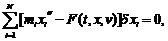 (33)
(33)
for the N – mass system (32). At rest xi’’ ≡ 0, and in this case equation (33) renders the criterion (necessary and sufficient condition) for the equilibrium of active forces Fi (principle of virtual displacements, J. Bernoulli, 1717).
At the time of Newton (1687) [1], and for more than two centuries thereafter, only constant masses mi were considered, with “the motive force impressed” Fi(.) being known functions of time, coordinates and velocities. It means that trajectories of motion were considered as fixed geometric curves x(t) known for all tÎ[0, T). Time t was perceived as absolute, and reactive forces were irrelevant with the consideration of constant masses. Since the results of Buquoy (1815) [6] were not properly recognized, thus, unknown for more than a century, and reactive forces were ignored even after the publications of Mestschersky [7] and Levi-Civita [8], it is not surprising that equations (32), (33) are still written in their maiden form of eighteenth century, without reactive forces nor control forces depending on left higher order derivatives.
With the advent of jet propulsion, the forces in (32)–(33) should be replaced by F*(.) of (7), with variable masses mi(t), which would, of course, alter the classical formulae (32)–(33). With the use of acceleration assisted control, there is no problem, if left and right time derivatives are considered identical and equations of motion are resolved for actual accelerations as in (32), requiring nonzero Jacobian with respect to accelerations. For controls with left higher order derivatives, equations (32)–(33) are propelled by effective forces generated by expressions Fi(.) in (32) with ideal reactions Ri(.) excluded by (33). It means that Fi(.) can still be formally written in (33) with higher order derivatives of v(t) included therein for subsequent integration which would render the trajectories of motion (17), and identify the actual effective forces (18), (19) in the system which are to be recognized as "the motive force impressed" mentioned by Newton in his Law II [1].
9.1 Generalization of the Lagrange equations
The general equation of motion (33) excludes reaction forces of ideal constraints, but not the constraints themselves which are still restricting coordinates and velocities of the motion, no matter if forces of reaction are excluded. Let us consider the exclusion of constraints altogether, i. e., elimination of kineto-statical relations [2] of the problem.
Analytically, constraints are expressed by several independent equations:
lk (t, xi, vi ) = 0 , k = 1,…, s. (34)
If equations (34) do not contain velocities vi or can be integrated not to contain them, the constraints are called geometric, and the system (32)–(34) is called holonomic. In this case, from equations lk (t, xi )=0 one can express certain s coordinates as functions of 3N- s other coordinates and time t and consider those 3N – s coordinates as independent variables that define the state of the system at time t. However, it is not binding to take Cartesian coordinates as independent variables. It may be convenient to express all 3N Cartesian coordinates as functions of n = 3N – s independent parameters q1 ,…, qn and time t which define the so called configuration space. Substituting thus obtained xi = xi (t, q1 ,…, qn ) into (32) and using (33), a new system of second order equations with respect to independent parameters q1,…,qn and time t is derived. Those parameters (called generalized coordinates) do not have transparent meaning of Cartesian coordinates, but they present a differential system without constraints, of minimal order with respect to independent variables qi(t) which define all Cartesian (rectangular) coordinates and velocities, thus, the state of original system (32) subject to constraints (34). Using (33), and noting that elementary work of active forces dA =åj=1NFjdxj =åi=1nQidqi, the minimal order system of the Lagrange equations of the second kind is obtained in the form:

|
Из за большого объема этот материал размещен на нескольких страницах:
1 2 3 4 5 6 |
