

Партнерка на США и Канаду по недвижимости, выплаты в крипто
- 30% recurring commission
- Выплаты в USDT
- Вывод каждую неделю
- Комиссия до 5 лет за каждого referral
Механика
Математическое моделирование
УДК 531
Generalized equations of motion for mechanical systems with variable masses and forces depending on higher order derivatives
E. A. Galperin
Departement de mathematiques Universite du Quebec a Montreal
C. P. 8888, Succ. Centre Ville, Montreal, Quebec H3C 3P8, Canada
galperin. *****@***ca
The Buquoy generalization of Newton’s second law of motion for systems of bodies with variable masses driven by reactive forces produced by ejected burnt fuel (Mestschersky) is considered, with its extension for motions subject to external forces depending on accelerations and higher order derivatives of velocities. Such forces are exhibited in Weber’s electro-dynamic law of attraction; they are produced by the Kirchhoff-Thomson adjoint fluid acceleration resistance acting on a body moving in a fluid and are also involved in manual control of aircrafts and spacecrafts that depends on acceleration of the craft itself. The causality of systems driven by such forces is assured by consideration of the left higher order derivatives in the right-hand sides of the equations of motion. The consistency condition and a new solution method are presented, and the existence and uniqueness of solutions for equations of motion driven by such forces is proved. The notion of effective forces is discussed, and the parallelogram law is verified for the effective forces in mechanical systems with left higher order derivatives in controls. On this basis, the new autopilot design is proposed for added security in civil aviation, independent of the currently used Pitot tubes which may fail or render the local measurements of wind gusts instead of the correct estimates for the average relative velocity of the aircraft with respect to the wind in flight or to the airstrip at landing.
Key words: Motion of bodies with variable masses; Forces with the left higher order derivatives of velocity; Generalized equations of minimum order; Autopilot design in aviation.
1. Introduction
In analytical mechanics, the attention is directed to the study of motion of bodies with constant masses under the forces depending on time, space coordinates, and velocities, according to the classical representation of the second law of Newton [1]. For such motion, various forms of the generalized equations (Lagrange, Hamilton, etc.) were developed, see, e. g., [2–5] and references therein. With the advent of jet propulsion, it is important to consider the motion of bodies with variable masses under forces which may depend on accelerations and higher order derivatives of velocity. However, such systems have different dynamics, follow different laws of motion, and require different forms of the minimum order equations with specific solution methods. These equations and their solution are considered, with application to the autopilot design for added security which may be compromised if based solely on the Pitot tubes currently used in aviation.
First, we reproduce the symbolic representations of the second law of Newton as given in textbooks on mechanics, followed by its generalization by G. Buquoy [6] and later by I. V. Me-stschersky [7]. Another important point is related to the orientation of time and the misconception concerning time-derivatives in the right-hand sides of differential equations which are routinely used in mathematical description of processes. The use of right time-derivatives severely restricts the possibility of control of processes according to the formally written representations of classical laws and some currently accepted forms of generalized equations of motion. New representations are considered, and causality of differential systems is studied in relation to the orientation of time. Then, geometry and time phenomena in classical mechanics are revisited, and the new forms of generalized equations are derived with the left (possibly delayed) higher order time derivatives in the right-hand sides of the equations of motion. The method for their integration is demonstrated by an example of a physical pendulum.
The paper is organized as follows. In Section 2, the classical forms of Newton’s second law of motion are presented. Section 3 describes the generalization of this law for bodies with variable masses due to Buquoy [6] and later Mestschersky [7] and Levi-Civita [8]. Problems related to time and causality are considered in Section 4. Section 5 presents a generalization for systems driven by forces with left higher order derivatives in the right-hand sides. In Section 6, the existence of solution is proved under certain consistency condition related to the left highest order derivative in the right-hand side. In Section 7, the notion of effective forces is presented, and the parallelogram law is verified for effective forces, with application to the autopilot design. Section 8 presents the space shuttle example of motion with variable mass to expose the need for acceleration assisted control. Section 9 presents generalized equations in independent coordinates for motion of bodies with variable masses and left higher order derivatives in the right-hand sides. Section 10 describes a method of integration, and in Section 11, some points of interest are summarized, followed by references immediately relative to the problems considered.
2. Representations of the Second
Newton’s Law of Motion
The second law of Newton states: "Law II. The change of motion is proportional to the motive force impressed and is made in the direction of the right line in which that force is impressed" [1], see also [5, p. 259]. In high school textbooks, this law is written in the form: ma = F where m means a constant mass, a – the acceleration, and F is "the motive force impressed" or simply "a force", a self-explanatory notion known from life experience. In university textbooks, the Law II is specified in more exact terms:
m x’’ = F(t, x(t), v(t)), v(t)=x’(t),
x’’(t)=v’(t)=a(t), x(0)=x0 , v(0)=v0 , t ³ 0, (1)
which define a particular motion starting at x0 , v0 with velocity v(t) defined as time derivative
v(t) = x’(t) = dx/dt = lim [x(t + Dt) – x(t)] / Dt (2)
as Dt® 0, Dt > 0 . Widely used representations (1)–(2) impose heavy restrictions in mechanics and control theory which restrictions are not necessary and can be removed.
3. Generalization for Variable Masses by G. Buquoy [6]
When m = const, the first formula in (1) can be written as follows:
m x’’ = m v’(t) = m dv/dt = d(mv)/dt =
= F(t, x(t), v(t)), t ³ 0 . (3)
The last equality in (3) can be written in a more general form:
d(mv) = m dv + v dm = F(t, x(t), v(t)) dt,
t ³ 0, dt > 0, (4)
where differentials can be viewed as small increments, this leading to the well known interpretation: "the change of momentum, d(mv), equals the impulse of force (or simply impulse), Fdt". If m = const, then dm = 0, and (4) coincides with (1) as dt® 0. If the mass m = m(t) ¹ const, then (4) accounts for the changing mass of a moving body when dm, moving with the same velocity v(t), separates from the body. However, if elementary mass dm is ejected from the body (e. g., as burnt fuel) with a different velocity w(t) ¹ v(t), it will impress an additional force upon the body which force must be proportional to the additional "change of motion" (see the second Newton’s law cited above), i. e., to the additional change of momentum which is itself proportional to the relative velocity v – w with which dm is ejected from the body. Thus, the quantity v dm shown in (4) should be replaced by the quantity (v- w) dm, yielding the equation
m dv + (v- w) dm = F(t, x(t), v(t)) dt,
tÎ [0, T ) , (5)
where velocities v and w are absolute velocities of the body and the ejected mass dm respectively, in a coordinate frame at rest in which the motion of a body is considered. The reader can see the change in the force impressed on the body by the mass dm being ejected, if (5) is rewritten in the form which corresponds to the form in (1), (3)
m dv = F(t, x(t), v(t)) dt + (w – v) dm,
tÎ [0, T ) . (6)
Here the change in momentum of a body is at left, and all impulses are at right of the equation. Now, if m is constant (dm = 0) or is being separated from the body without ejection (w = v, dm < 0), then the force is not changing, only the mass m(t) of the body is decreasing and acceleration increasing since the same force is acting on decreasing mass of the body. In this case, the last term at right is zero, and (6) coincides with (1). However, in a spacecraft with jet engine, the burnt fuel mass is ejected, dm < 0, with velocity w different from the velocity v of the spacecraft. To explain the action of ejected mass dm in (6), we assume, for simplicity, that w, v are collinear vectors. If the burnt fuel mass is ejected in the same direction in which the spacecraft moves, so that w > v, then additional reactive force exerts the braking effect upon the spacecraft since (w – v)dm < 0. If it is ejected in the opposite direction, so that w- v < 0, then additional reactive force accelerates the motion since (w – v)dm > 0. However, the entries in (1)-(6) can be considered as 3D vectors (except time t, dt and mass m, dm which are scalars), so that turning the funnel ejecting the burnt fuel mass allows one to control also direction of the motion. The term (w – v)dm added to the nominal impulse F(.)dt in (6) represents, in fact, the control impulse u(t)dt in the resulting total impulse F*(.)dt = [F(.)+ u(t)]dt, yielding the equation of controlled motion:
m(t) dv/dt = F*(.) = F(t, x(t), v(t)) + u(t),
u(t) = [w(t) – v(t)] dm/dt, tÎ [0, T ). (7)
Burnt fuel generates not only the reactive force of ejected masses but also a direct active force of heated gas pressure which is considered a part of F(.) in (5)–(7), but can be studied as separate action, see Space Shuttle example, Section 8. It is worth noting that equation (7), quite different from (1)–(4), can be included in the original Newton’s statement of the Law II above since it is not specified what "the motive force impressed" actually is. This emphasizes the importance of particular symbolic representations.
Equations (5), (6) represent a fundamental generalization of the classical equations of motion (1)–(4), very important for applications (as we know today). However, when published in 1815, see [6], this generalization was not properly recognized, not entered in textbooks, and thus, quickly forgotten. So, it was rediscovered by I. Mestschersky in 1897, see [7] where many special cases are also studied. Then in 1928, the equation d(mv)/dt = F, cf. the right equality in (3), was independently derived by T. Levi-Civita [8], representing the case w = 0, that corresponds to the motion of a body with variable mass m(t) when dm(t) is being separated from the body without any impulse of force upon the body, thus excluding the control of motion by means of ejected burnt fuel mass.
4. Time Orientation and Causality
In the literature, velocity v(t) on which the motive force F(.) in (1) may depend is defined as right derivative through the limit in (2). However, at the moment t of actual motion, the value v(t + Dt) does not exist for any Dt > 0. This means that the limit in (2) also does not exist, so that equation (1) refers, in fact, to some prospective values of v(t) in future, being thus non-causal. The reader may object: well, then what is shown on the speedometer of a car? Yes, the velocity is shown which is actually measured as left time derivative v(t) = lim [v(t)- v(t-Dt)]/Dt, Dt® 0, Dt > 0, not right derivative as written in (2). This reflects the positive orientation of time: suppose that x(t) in (1) is a distance of the moving mass m from the origin if the motion has started at time t = 0 with initial conditions indicated in (1). If we consider a moment t* > 0 with the past history of motion registered in a measuring device or in a computer over the segment [0, t*], then over the interval (0, t*) there exist both right and left derivatives; at the moment t = 0, there exists only right derivative; at t = t* there exists only left derivative, and over the future interval (t*, T), T £ ¥, there is no motion yet, thus, no derivatives exist, and the same on the interval (-¥, 0) when there was no motion at all. This concerns all natural processes (physical, biological, etc.) developing in time: right time derivatives may exist only in the registered past history of a process.
Of course, right derivatives at the current moment, as well as future situations and/or decisions (called rational expectations), can be postulated (imagined as desired) and taken into account, which is routinely done in economy and finance; but in engineering and technology it may be improper and needless to do so. In natural sciences, there is another way to include current accelerations and other higher order time derivatives into process equations, thereby retaining their causality.
In control of motion, the effect of time orientation is compounded by time uncertainty. Indeed, velocity v(t) as left derivative continuously measured by speedometer in a car appears on driver’s panel with a delay d > 0 due to a finite speed of information transmittal. Hence, at the moment t = t*, a driver sees the velocity v(t*-d), not the actual velocity v(t*). However, in the equation (1) of the motion, the force F(.) is impressed (not measured by a device, but felt as are, e. g., gravitational or resistance forces), thus, at a moment t*, we have the force F(t*, x(t*), v(t*)) acting without delay if there is no information transmittal for the values x(t), v(t), in which case time-uncertainty is not implicated in the motion governed by the laws of mechanics such as Law II above. In contrast, if the control u(.) in (7) depends on certain parameters which are measured on the trajectory and transmitted into the power train of the motion, then u(t-d) actually depends on d > 0, at each moment t > 0, through those measured parameters. Thorough consideration of time-uncertainty is beyond the scope of the paper, so we assume here that d = 0, except of certain cases of special interest, see below.
5. Generalization for Controls with Left Higher Order Derivatives
Consider the specification of Newton’s Law II presented by equation (1) which can be found in all books on mechanics and related subjects. Distinctive feature of this equation is that "the motive force impressed" F(.) is defined for the moment t and depends only on t and/or x(t) and/or v(t). In some textbooks, it is explained that force F(.) does not depend on acceleration a(t) = x’’(t), since if it did, we would have the equation m x’’ = F(t, x, v, x’’) which, if solved for x’’, would render x’’ = F*(t, x, v, m), hence, the right-hand side F(.) would not be “the motive force impressed” in the sense of Newton’s Law II, but rather it would be F*(t, x, v, m) which does not depend on x’’(t) again. What would happen if F(.) = F(t, x, v, x’’, x’’’) is not even mentioned since such a consideration is taken as an obvious blunder.
However, equations of motion with variable mass contain controls: w in (5)–(6), or u(t) in (7), and it is not clear why w and u(t) must not depend on acceleration x’’(t) and its rate of change x’’’(t). In fact, they can, and the so called acceleration assisted control is widely used in practice for soft regulation, despite its contradiction with (1)–(4). Indeed, consider the following railway construction principle. If to change direction of motion, a perfect circular arc is joined to a right line segment of a railway, then at the connection point the train will receive a hard impact of centripetal force, and the train may derail if its speed is high enough. If a person is standing on the platform of a coach with a door open, he will be thrown out of the train by centrifugal force. To avoid such eventualities, the railway connection must be designed as a cubic or higher degree curve in order to soften the turn and eliminate hard impacts by means of a correct profile of the railway. Obviously, the same concerns the profile of a highway. Whatever the actual profile of a road, experienced drivers always soften a turn by crossing the lanes while continuously turning the steering wheel (this cannot be done by a train because of the rails on which it runs). With manual control, the pilot of an aircraft or spacecraft does the same by making a turn along some higher degree curve following his personal feeling of the centrifugal force that appears during the turn. As a matter of fact, in all manually controlled vehicles, a turn is being done by a control u(.) which is called, in theory, "open loop control u(t)", being, in reality, a feedback control u(t, x(t), x’’(t), x’’’(t)) depending on actual acceleration x’’(t) and its rate of change x’’’(t) felt by the pilot, and, maybe, on higher order derivatives if they are felt by a human being (an open question for medicine). In manually controlled aircraft, the pilot always employs a feedback control of the form u(t-d, x(t-d), x’’(t-d), x’’’(t-d)) which depends on time t (with delay d > 0 due to a finite speed of information transmittal in human senses) and distance x(t), if it is seen during landing, but does not depend on v since constant velocity is not felt by a human being nor by instruments on board, according to the postulate of physical equivalence of all inertial systems [3]. Dependence on velocity v(t) means, in fact, dependence on acceleration dv/dt which accompanies a varying velocity v(t). A manual control u(.) always depends on acceleration x’’(t-d) and its rate of change x’’’(t-d), no matter that they are theoretically excluded by a choice of representation in the equations of motion (1), (7). Therefore, it is important to extend the real life situation in manual control onto automatic control systems by removing the existing restriction with a new choice of representation for Newton’s Law II, which would allow higher order time derivatives in the right-hand side of (1), (3)–(7).
Consider equation (7) where w and/or dm/dt, thus u(t), may depend on acceleration and higher order derivatives. Dividing (7) by m(t)>0 and using the left time derivatives at the right-hand side for t > 0, we can write the causal representation of the general equation of motion in the form [9, 10]:
x’’= dv/dt = [F(t, x(t),v(t))+ u(t)]/m(t)=
=F*(t, x, x’-, x’’-, …, x(k)-),
x(0)=x0, x’-(0)=v0, (8)
where superscript ( - ) indicates the left time derivative of corresponding variable which is written in normal script for better visibility. The only right time derivative is x’’ = dv/dt, at left in (8) due to forward propagation of motion. It is clear that F*(.) at right in (8) is well defined for all t > 0. The highest order k ³ 2 in (8) depends on the control u(t) employed. For simplicity, the time-uncertainty is omitted from further considerations as well as m(t) which is not shown explicitly as a variable of F*(.) in equation (8). For a natural phenomenon with resistance in F*(.) depending on acceleration of a solid falling into a viscous liquid, see [9, p. 181] and [10, p. 34]. For an application to acceleration assisted hovercraft control, see [9, pp. 179–180] and [10, pp. 39–41].
Remark 5.1. Forces containing left higher order derivatives can appear in equations of motion not only through controls. Such forces depending on accelerations have been considered by Sir Horace Lamb in equations of motion of a solid in ideal liquid, see [11, p.168, § 124, Equations (1)] with reference to Kirchhoff and Sir W. Thomson (1871), where forces of the fluid pressure linearly depended on the acceleration of the solid itself, see [11, p.168, Equations (2); p.169, Equations (3)]. Such forces usually can be taken into account by the introduction of adjoint masses, see example given in [11, p.190, § 137, Equations (2)] with reference to Thomson and Tait [12, Art. 321]. The author is grateful to V. *****myantsev for these references. Another example is furnished by Weber’s electrodynamic law of attraction, with the force per unit mass F*=[1- (r’ 2- 2rr’’)/c2]/r2 where r is the distance of the particle from the center of force ( W. Weber, Annalen der Phys. LXXIII, 1848, p. 193), see also [2, p. 45], and r’, r’’ should be understood as left time derivatives. ˆ
The causal equation (8) can be solved by standard methods of ordinary differential equations, for which we need the following
Lemma 5.1 [9, 10]. If a function x(t) is defined on an open interval (a, b) and has continuous left derivative on (a, b), then x(t) is continuously differentiable on (a, b).
Proof. By hypothesis, for every t Î (a, b) there is a limit
 ,
,
 , (9)
, (9)
which, as a function of t, is continuous on (a, b), that is
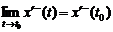 ,
,  . (10)
Let t - Dt = t0 , then (9) can be rewritten as follows, yielding the right derivative at t0 :
 ,
,
 . (11)
Since by construction,
[x(t) – x(t - Dt)] /Dt º [x(t0 + Dt) – x(t0)] /Dt,

|
Из за большого объема этот материал размещен на нескольких страницах:
1 2 3 4 5 6 |
