

Партнерка на США и Канаду по недвижимости, выплаты в крипто
- 30% recurring commission
- Выплаты в USDT
- Вывод каждую неделю
- Комиссия до 5 лет за каждого referral

 , Qi = Qi (t, qk, qk’), T =
=½åaik qi’qk’+å ai qi’+ a0 , i = 1,…,n. (35)
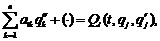
Here at left stand generalized forces of inertia expressed through kinetic energy T of the system, Qi are generalized active forces, and sums are taken from 1 to n. It is clear that Lagrange’s equations at left in (35) represent the second Newton’s law of motion (32) in generalized coordinates {qk}, with constant masses and with reactions Ri excluded by (33). If constraints are stationary, i. e., (34) does not depend on t, then a0 , ai are zero in (35). Substituting the expression of T in (35) into the Lagrange equations yields
 (36)
(36)
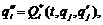
where  stands for terms not containing second derivatives, and the second equation is the unique solution of the first one for qi", since determinant det (aik)ni, k=1 ¹ 0 . This is known as the explicit form of Lagrange’s equations [2, pp. 39–40] which define the motion of the system determined by initial values qi(0), qi’(0).
The transformation to independent generalized coordinates in configuration space that excludes geometric constraints does not depend on the presence of higher order derivatives in (33). For holonomic systems with variable masses, the generalized coordinates qi(t) can be introduced to eliminate the constraints (34) even if forces in (33) depend on higher order derivatives. It is interesting and important that the equations thus obtained will also be in the form of Lagrange’s equations but with quite different entries, and the order of those equations will be minimal, by construction, with generalized forces depending on left higher order derivatives of generalized coordinates and with kinetic energy corresponding to variable masses.
Indeed, we have according to (5), (8) and (33), after the transformation:

 (37)
(37)
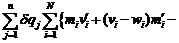
where vi(.) = xi’(.), x(r) - = [x(t, q1 ,…, qn )](r) -, r = 0,…, k, but d xi (t, q1 ,…, qn ) are not arbitrary, due to (34). However, all xi (t, q1 ,…, qn ) , x(r) - = [x(t, q1 ,…, qn )](r) -, and d xi (t, q1 ,…, qn ) can be expressed through qj, qj’,…, qj(k)- and d qj (j = 1,…, n) yielding

here we retain the same notation for Fi*(q,...) derived from Fi*(x,...) of (37) after the transformation. Changing the order of summation, we obtain
 (38)
(38)
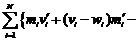
Since d qj in (38) are arbitrary virtual displacements, we have

 (39)
(39)
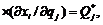
Let us call "generalized forces" the expressions:

 , (40)
so that (39) can be rewritten in the form

(41)
The term [mi vi]’(¶ xi /¶ qj) under summation sign in (41) can be transformed as follows:
[mi vi]’(¶ xi /¶ qj)=d[mi vi(¶ xi /¶ qj)] / dt-
- mi vi d(¶ xi /¶ qj) / dt. (42)
Since
vi = dxi /dt = ¶ xi /¶ t + S (¶ xi /¶ qj) qj’,
so ¶ vi /¶ qj’ =¶ xi /¶ qj. Also, we have
¶ vi /¶ qk = ¶ 2xi /¶ t¶ qk +
+ S (¶ 2xi /¶ qj ¶ qk) qj’ = d(¶ xi /¶ qk) / dt. (43)
Relations (42)-(43) imply
[mi vi]’(¶ xi /¶ qj) = d[mi vi(¶ xi /¶ qj)] / dt -
- mi vi (¶ vi /¶ qj) = d[¶ (0.5 mi vi2) /¶ qj’] /
/ dt - ¶ (0.5 mi vi2) /¶ qj. (44)
Summing up the expression in (44) to obtain the left-hand side of (41), we get


T* = 0.5S mi(t) vi2(t, q1,…,qn), j = 1,…,n. (45)
Relations at left in (45) have the form of Lagrange’s equations (35), with a difference:
1) "generalized forces" Qj* may depend on higher order derivatives of generalized coordinates, qj(k) , thus, explicit form (36) of Lagrange’s equations is not preserved;
2) the function T* = 0.5S mi(t) vi2(.) of (45) corresponds to variable masses with the same formula as in the case of constant masses, but T* ¹ T(.) of (35);
3) the function T* which resembles the expression of kinetic energy may not represent the real kinetic energy of the system. To determine the real kinetic energy of the system, one has to equate left and right derivatives in (40), (45), solve the higher order system with additional initial conditions to obtain the solution in the form of (17), compute the effective velocities vi*, not those vi that appear in (37) to (45), and compute the real (effective) kinetic energy of the system.
Preservation of the form of Lagrange’s equations for holonomic systems with variable masses and forces depending on higher order derivatives in the right-hand sides presents a useful method allowing one to formally construct the equations of motion excluding geometric constraints, solve the resulting differential system of minimal order with respect to independent generalized coordinates in the configuration space, then return to natural rectangular coordinates, velocities and accelerations, and evaluate by (18) the effective forces in the system that represent the Newtonian forces [1] in this case. The reader can check that with m = const and higher order derivatives absent from (37), equations (45) coincide with Lagrange’s equations (35)–(36).
9.2. Generalization of the Hamilton equations
If in the Lagrange equations (35) generalized forces Qi do not depend on generalized velocities, Qi = Qi(t, q1 ,…, qn), then there exists a potential function P(t, q1 ,…, qn) such that Qi = - ¶ P/¶ qi. Introducing kinetic potential (the Lagrange function) L = T - P, the system (35) at left, with constant masses, can be written in the form:

 , i = 1,…, n. (46)
If active forces in (37) depend on left higher order derivatives, so do also the generalized forces Qj*(.) in (40), (41), (45). In this case, consider the “generalized” potential function V(t, q, q’-,q’’-, …, q(k) -), if it exists, such that Qi*(.) of (40) can be expressed by the formulae, cf. [2, p. 44]: Qi* = d(¶ V/¶ qi’) / dt - ¶ V/¶ qi,
i = 1, …, n. (47)
With Qi* from (47), equations (45) can be written in the form (46) if L is substituted by the function L* = T* - V with T* from (45). These new equations are not the second order equations, but a higher order system written in the form (46). This form is preserved in mechanical systems with variable masses and higher order derivatives in active forces, if there exists a potential function V(.) with which Qi* can be expressed in the form (47). An example of such potential is furnished by V = (1+ r’ 2/c2) / r which presents the generalized potential in the sense of (47) for Weber’s electro-dynamic force of attraction F* cited in Remark 5.1, see [2, p.45].
Equations (46) suggest new coordinates proposed by Hamilton. Denote ¶ L /¶ qi’ = pi (generalized impulses), so that by (46) dpi /dt = pi’ = ¶ L /¶ qi , and consider new variables p1 ,…, pn which together with old variables q1 ,…, qn constitute the set of 2n variables of Hamilton. Since ¶ 2L /¶ qi’¶ qk’ = det (aik)ni, k=1 ¹ 0, see expression of T in (35), so Jacobian of ¶ L /¶ qi’ is nonzero, and equations ¶ L /¶ qi’ = pi can be resolved for qi’ yielding qi’=j i (t, qk , pk), which together with pi’=¶ L /¶ qi =q i (t, qk , pk) present Hamiltonian system of 2n equations of the first order equivalent to Lagrangian system of n equations (46) of the second order, cf. (32), (36). If the quantity å pi qi’ – L is expressed as function of {t, qi , pi} and denoted by H, then equations of motion (46) in the Lagrangian form with constant masses can be represented also in Hamiltonian or canonical form as follows [2, pp. 263–264]:
d H = d {å pi qi’– L} = å (qi’dpi - pi’dqi), thus, qi’=¶ H /¶ pi , pi’= - ¶ H /¶ qi. (48)
If instead of L in (46), (48), the function L* = T* - V(t, q, q’-,q’’-, …, q(k) -), with T* from (45) is considered, denote ¶ L* /¶ qi’= pi*(.), so that by (46) with L* instead of L we have dpi*(.) / dt = pi*’ = ¶ L* /¶ qi. If the Hessian ¶ 2L* /¶ qi’¶ qk’ ¹ 0, then Jacobian ¶ L* /¶ qi’ is nonzero, and equations ¶ L* /¶ qi’ = pi*(.) can be resolved for qi’ yielding qi’=j i (t, qk, pk*(.)), which together with pi*’=¶ L* /¶ qi =q i (t, qk, pk*(.)) present generalized Hamiltonian-like system of 2n equations of higher order equivalent to generalized system of n equations (46) with L* substituted for L. If the quantity å pi*(.) qi’ – L*(.) is expressed as function of {t, qi, pi*(.)} and denoted by H*(.), then we see that canonical form (48) is preserved, with the understanding that coordinates pi*(.) contain wi mi’(t) and higher order derivatives on which pi*(.) and Qi* of (47) depend, so that new equations
d H* = d {å pi *(.)qi’– L*(.)} = å (qi’dpi* -
- pi*’dqi), thus,
qi’=¶ H* /¶ pi*, pi*’ = - ¶ H* /¶ qi, (49)
present a higher order system from which the effective forces (18) actually acting in the system can be recovered after integration and passage to Cartesian coordinates.
10. The Method of Integration:
Example
Consider a physical pendulum consisting of a rod OC of the length l suspended in a hinge at O with a heavy disc of mass M fixed at its center to the end C of the rod. With such pendulums are equipped free standing clocks that can be seen in furniture or antiquity stores. Friction at the hinge is neutralized by a spring or a battery, and a mass of the rod can be ignored. The moments of inertia of the disc are
IC = òor r2dm = òor 2pr r3dr = 0.5Mr 2,
IO = IC + M l 2 = 0.5M(r 2 + 2l 2).
The pendulum oscillates in a plane xOy with the axis Ox directed straight down and axis Oy directed to the right. It is required to derive equations of motion.
Case 1. Classical solution. The system has one degree of freedom, and it is convenient to take the angle j between Ox and the rod as the generalized coordinate q = j . The coordinates of the center of mass are: xc = l cos j , yc = l sin j . The acting force of gravity Mg = (X, 0) is directed straight down, so that generalized force Q =X ¶ xc / ¶j = - Mg l sin j . Kinetic energy is T = 0.5 IO j’ 2, so that ¶ T /¶j’ = IO j’, ¶ T /¶j = 0 , yielding the Lagrange equations (35) and (36) for the case as follows:

|
Из за большого объема этот материал размещен на нескольких страницах:
1 2 3 4 5 6 |
