


Партнерка на США и Канаду по недвижимости, выплаты в крипто
- 30% recurring commission
- Выплаты в USDT
- Вывод каждую неделю
- Комиссия до 5 лет за каждого referral
 Matrix Because of the problems inherent in either integrating or separating foreign operations, some firms, such as Dow Chemical, are moving toward matrix organizations, part E in Fig. 17.1. In these organizations a subsidiary reports to more than one group (product, function, or area). The theory is that, since each group shares responsibility over foreign operations, each group will depend on the others. The groups will become more interdependent, will exchange information, and will ultimately take strategic global perspectives as they seek to exchange resources with other groups. For example, product group managers must compete so that R&D personnel responsible to a functional group are assigned to the development of technologies that fall within their product domain. The same product group managers must compete as well to see that area managers put sufficient emphasis on their lines. Not only are product groups competing, the functional and geographic areas also must strive to draw upon resources held by others in the matrix.
Although a matrix form requires that all major perspectives be represented in strategic decision making, this form of organization is not without 'drawbacks. One of the problems is that groups and coalitions inevitably compete for scarce resources, and a management decision must be made above the group level on how to allocate the resources when lower-level managers fail to reach an ch elements as faith in a specific executive or business group may result in more decisions being made in their favor.13 As others in the organization see this occurring, they may perceive that the locus of relative power lies with a certain individual or group, which may lead managers in turn to divert most of their energies toward the activities that are perceived as most likely to be accepted, thus perpetuating the difference in relative power. This may not represent the areas that would be the firm's best strategic choices on a global basis. Consequently, some of the advantages sought in a matrix organization may be diminished because of these interpersonal relationships. A number of alternatives may help to alleviate this problem, including the transfer of individuals among groups and the development of additional reporting and control systems reflecting each of the three groups (product, function, and area) on a global basis. However, these alternatives are not without costs.
MANAGEMENT RECRUITMENT AND SELECTION
College Recruitment
 International companies recruit through universities at home and abroad to find capable nationals of the countries where they have foreign facilities. This method has some drawbacks since the most acute personnel shortage in foreign facilities is for people who already have considerable experience. As the new hires gain experience, however, they may eventually move into higher-level management positions, thus decreasing the need for expatriates. These same firms also recruit home-country nationals, usually to work in their domestic operations until they have gained technical experience and know the corporate culture.
 Management Inventories
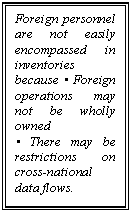
Some companies have centralized personnel record systems, which include home - and foreign-country nationals. These include not only the normal technical and demographic data, but also such adaptive information as foreign-language abilities, willingness to accept foreign assignments, and results of company-administered tests to indicate adaptivity. There are some problems in bringing foreign managers into these systems because, if the firm owns less than 100 percent of the foreign facility, the other stockholders may complain.34 Furthermore, restrictions on data flows among countries could inhibit future uses of centralized management inventories.
Adaptability Assessment
Since companies usually know more about their employees' technical than adaptive capabilities, they must focus on measuring adaptation abilities for foreign-transfer purposes. For example, people who have successfully adjusted to domestic transfers or have previous international experience are more likely to adapt abroad. In addition, some companies use a variety of testing mechanisms to aid in the assessment. One is the Early Identification Program (E. I.P.), which assesses an individual's match with different environments. Many other tests assess personality traits that indicate a willingness to change basic attitudes: These include the Minnesota Multiphasic Personality Inventory, the Guilford-Zimmerman Temperament Survey, and the Allport-Vernon Study of Values.
A small minority of companies include spouses in tests and extensive interviews because a foreign assignment is usually more stressful for the spouse than for the transferred employee. The foreign assignment is generally an advancement for (in most cases) the husband; however, the wife must start at the bottom in developing new social relations and learning how to carry out the day-to-day management of the home. The separation from friends and family often makes the wife very lonely so that she turns to her husband for more companionship. But the husband may have less time because of his new working conditions. This may lead to marital stress which, in turn, affects work performance. Interviewers thus look not only at likely adaptivity, but also at whether the marriage is strong enough to weather the stress and not impede performance of employment duties.
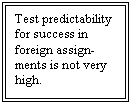 Although some companies follow a rigorous procedure of selecting and training people cross-culturally for foreign assignments, the adjustment and performance of their expatriates have been mixed. Nevertheless, the evidence supports a positive relationship between vigorous procedures and adjustment and performance.
 The Help of Local Companies
One way of attaining personnel for foreign operations is by buying an existing firm abroad and using the personnel already employed; however, firms should consider the possible efficiency problems of acquisitions. Firms also may tie in closely with local companies in the expectation that these firms will contribute personnel to the operation as well as hire new personnel. In countries such as Japan, where the labor market is tight and people are reluctant to move to new firms, the use of a local partner may be extremely important. However, if a local partner handles staffing arrangements, the employees may see their primary allegiance to that partner rather than to the foreign investor.
MANAGEMENT TRAINING
Internationalizing the Organization
|
|
Many employees may still place domestic performance objectives above global ones or feel ill-equipped to handle worldwide responsibilities as they move up in their organizations. One approach is to train those people who are about to take a foreign assignment, such as through language and orientation programs. Another is to include international business components in external or internal programs, where companies train managers regularly. External programs are offered at many universities.39 A sampling of internal programs are those at General Mills and Celanese that include yearlong training in which foreign nationals spend time at all of the companies' domestic divisions, IBM's regional training centers in which managers from several countries are gathered for specific topics, Cummins Engine's voluntary evening language courses that any employee may take, and cultural awareness workshops at Westinghouse.
Program content may emphasize adaptability rather than knowledge of another environment. The Peace Corps, for example, uses sensitivity training, which is designed to develop attitudinal flexibility. Another method is to expose trainees to subcultures within their own countries. Still another has been for a firm in one country to train employees from an unaffiliated firm in another country through on-the-job assignments.

|
Из за большого объема этот материал размещен на нескольких страницах:
1 2 3 4 5 6 7 8 9 10 11 |
