


Партнерка на США и Канаду по недвижимости, выплаты в крипто
- 30% recurring commission
- Выплаты в USDT
- Вывод каждую неделю
- Комиссия до 5 лет за каждого referral
One problem McDonald's did not encounter was attracting sufficient customers. Based on its Hungarian experience, where the company cut its advertising after an unusually heavy response, McDonald's did no advertising prior to its Moscow opening. However, television covered the upcoming event extensively. When the doors opened for the Moscow restaurant, it was almost impossible to accommodate the crowds despite the fact that the 700 indoor seats made this the largest McDonald's anywhere in the world. (There are another 200 outside seats that could not be used for the opening because of the cold January weather.) An estimated 30,000 people were served the first day, eclipsing the previous record of 9100 for one day in 1988 in Budapest, Hungary. The crowds arrived even though the price of a Big Mac, French fries, and soft drink were equivalent to the average pay for four hours of work. In contrast, one could get lunch at a state-run or private-sector cafe for between 15 and 25 percent of what it cost at McDonald's. In spite of such crowds, a Russian engineer was quoted as saying, "We only stood in line for 45 minutes. I've never seen such fast service." Overall response has since been so high that McDonald's has limited sales to ten Big Macs per customer in order to minimize the scalping of hamburgers outside the restaurant.
Given the prices and having to line up outside in the January cold, why were sales so high? Savings rates in the former Soviet were very high, primarily because of insufficient available goods and services to purchase. There was thus a pent-up demand, especially for any type of Western product that could be bought for rubles. The store's location on busy Pushkin Square was another advantage. Having the Moscow City Council as a partner was certainly helpful. About this, Cohon said, "In one way, doing business is easier in Russia. The state owns all the land, so if you want a corner on their equivalent of Park Avenue, all the state has to say is: here's the address."
What will be the future of McDonald's in historically planned economies? The managing director of McDonald's Development Corp. said, "We'll do one store, one country at a time, and plans will be made as we grow and develop." After observing the success of Pizza Hut's restaurant in China, McDonald's has since opened a 500-seat restaurant in Shenzhen, China, near Hong Kong. McDonald's knew that the cost for a meal there in relation to customers' incomes would be even higher than in Moscow; however, Pizza Hut had served to capacity even though one of its pizzas cost about two weeks' salary for the average worker.
The ability to expand by franchising might be limited. McDonald's movements into Hungary, Yugoslavia, the former Soviet Union, and China have all been through its direct ownership in joint ventures. The president of McDonald's international division explained two franchising problems: The first is that franchisers look for individuals with entrepreneurial track records, and in these countries, it's hard to find that; the second is that it is difficult to find people who can afford to buy a franchise.
New words
raw ground beef – сырая молотая говядина
hot spices – острые специи
subsidiary - филиал
experience - опыт
joint venture – совместное предприятие
interest - процент
implementation - осуществление
shortage - нехватка
backing - помощь
mustard - горчица
slaughterhouses - скотобойня
to harvest – собирать урожай
supply - поставка
furnishings - снабжение
hard currencies – твердая валюта
employee - служащий
laundry room - прачечная
direct ownership –прямая собственность
entrepreneurial - предпринимательский
CASE THE
COCA-COLA
COMPANY
From 1886, when Atlanta pharmacist J. S. Pem-berton mixed up his first batch of Coca-Cola, to 1989, when Cuban Robert C. Goizueta presided over the company as chairman and chief executive officer, Coca-Cola's worldwide revenues increased from $50 to $8.966 billion. Coke's rapid worldwide expansion has resulted in over 65 beverage trademarks worldwide and sales in 155 countries. From Fig. 19.7 we can see that Coke's international revenues in 1987 were 55 percent of total revenues. Coca-Cola's international presence has resulted in a number of interesting challenges and opportunities. In 1986 its operations were divided into three different product categories: soft drinks, entertainment, and foods. In 1989 the soft-drinks division comprised about 18 percent of total revenues and foods comprised about 18 percent of revenues. Coca-Cola sold its entire equity interest in Columbia Pictures in November 1989. Its soft-drink business is particularly strong internationally, capturing over 40 percent of the soft-drink market in the 155 countries where it is operating and a significantly higher percentage of the market in its major markets. Coca-Cola management feels that international markets are virtually untapped and are clearly the growth area of the future.
In 1989 Coca-Cola increased its soft-drink sales to more than 48 percent of the global market. A major strength of Coca-Cola is the European Community, which accounts for 24 percent of Coke's total international gallon sales. However, Coke also has a strong presence in Latin America and Asia.
Specific information was provided in the Annual Report on changes in the value of the German mark, the Japanese yen, the British pound, and the Australian dollar. In 1988 other income (a category in the income statement) was reduced by $ 13 million due to transactions and translation losses, and in 1989 other income was increased by $20 million by transactions and translation gains.
In 1989 nearly 96 percent of operating income came from the sale of soft-drink concentrates and syrups. International sales accounted for nearly 80 percent of Coke's soft-drink operating income. International soft-drink operating income grew 13 percent in 1989, despite the effects of a U. S. dollar that strengthened approximately 6 percent against key foreign hard currencies during the year.
Coca-Cola's other major product group is not quite as international as the beverage category, but it is increasingly moving into international markets. Coke's food division is increasing its international sales, especially in Canada.
Figure 19.7
The Coca-Cola Company Geographic Segment Results
Although the United States is clearly the most important geographic area in terms of sales for Coca-Cola, the Pacific and Canada geographic segment provides a greater percentage of operating income than does any other geographic area. Source: 1987 Coca-Cola Annual Report.
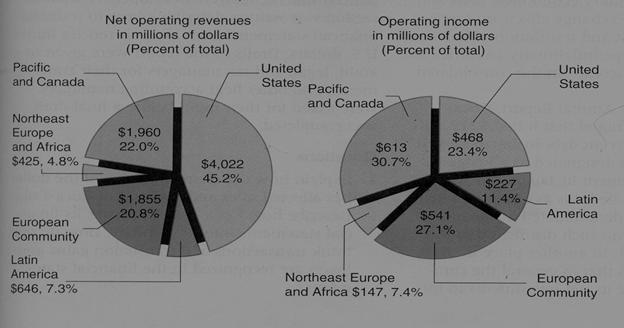
As noted earlier, Coca-Cola operates in 155 different countries; it used 40 different functional currencies to translate its financial statements from foreign currencies into U. S. dollars. The dollar is the functional currency of operations in hyperinflationary economies, such as Brazil and Mexico. Exchange effects on foreign currency transactions and translation of balance-sheet accounts in hyperinflationary countries are included in "other income" in the consolidated income statement.
In one place in its Annual Report, Coca-Cola's management noted that it had $212 million worth of 53/t percent debt in Japanese yen, over half of which is designated as a hedge against its net investment in Japan. The 1986 Annual Report classified this as a European debt (Eurocurrency debt denominated in Japanese yen), but there was no such distinction in the 1989 Annual Report. In another place in the same report, it states that in general the company does not hedge its net investments in foreign operations. However, it sometimes enters into hedges to protect cash flows in foreign currencies.
An Accounting Procedures Manual
In the mid-1980s Coke management saw that its international operations were increasing significantly and that the nature of its business had changed since its last accounting manual had been written. It needed a comprehensive, easy-to-reference accounting manual to help maintain strong financial controls over operations. Management felt that a better accounting manual would help the firm acquire reliable information about units all over the world in order to help local subsidiaries operate at peak efficiency and generate corporate wide reports consistently.
A team consisting of a project manager and three senior accountants worked for eight months to develop an entirely new accounting manual. A universal chart of accounts was set up so that each account in the balance sheet and income statement would be consistent around the world. Based on the chart of accounts, definitions of each account were written and policies and procedures governing the use of each account and the flow of information into the financial statements were developed. A separate section was written describing how to translate financial statements from local currencies into U. S. dollars. Drafts of the report were given to audit, legal, and tax managers for their comments, and other field accounting managers were asked for their input before a final draft was completed.
Questions
1. Explain how the changing value of the dollar has affected sales and earnings of Coca-Cola.
2. Describe how Coca-Cola translates its financial statements into U. S. dollars. How do you think transactions and translation gains and losses are recognized in the financial statements?
3. What are some of the major problems that Coca-Cola might have confronted in writing a uniform accounting policy manual?
4. What would you recommend that management do in order to resolve some of these problems?
New words
revenue, income - доход
increase - повышать
beverage, soft drinks - безалкогольный напиток
percentage – процентное соотношение
annual report – годовой отчет
division - разделение
international sales – международные продажи

|
Из за большого объема этот материал размещен на нескольких страницах:
1 2 3 4 5 6 7 8 9 10 11 |
