


Партнерка на США и Канаду по недвижимости, выплаты в крипто
- 30% recurring commission
- Выплаты в USDT
- Вывод каждую неделю
- Комиссия до 5 лет за каждого referral
Political conditions also have helped to forge Ford's foreign investment pattern. For example, during World War II the French facility was bombed and was not replaced. Assembly facilities were seized by communist governments in Hungary and Romania in 1946. Not until 1977, however, did Ford establish a separate department to evaluate the external political environment. Changes in governmental regulations often have caused Ford to commit a high proportion of its resources to a given area during a given period. This occurred, for example, when Mexico required a higher portion of local content in vehicles, thus forcing Ford to increase its Mexican investment or lose sales there.
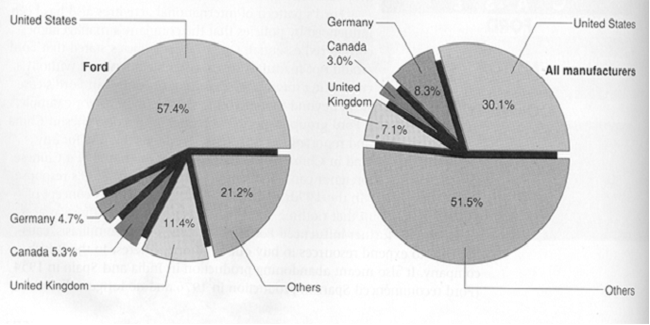
Despite the extended and heavy commitment to foreign operations, Ford's production and sales are highly concentrated in a few countries. Even though Ford sells in over 200 countries and territories, Fig. 16.1 shows that about 80 percent of Ford's unit car and truck sales are in just four countries. These same four countries comprise only about 49 percent of world demand. Because of the heavier commitments in some countries than in others, Ford's competitive position is much stronger in some markets than in others. In the United Kingdom and Canada, where Ford has large investments, its market share in 1989 was 27 percent and 23 percent, respectively. But in Europe outside the United Kingdom, the market share was only 8.5 percent.
Figure 16.1
World Vehicle Unit Sales in Percentages by Markets: Ford versus All Manufacturers, 1989
The figure shows that Ford is much more dependent on unit sales in the United States, Canada, Germany, and the United Kingdom than automobile producers as a whole.
One result of Ford's international commitment is that the dependence on multiple markets and facilities has minimized year-to-year sales and profit fluctuations. This has occurred because demand and price levels may move differently in various countries. From 1981 to 1982, for example, Ford's U. S. vehicle production fell by 91.6 thousand. This was largely made up by a 64.9 thousand increase in EC output. In 1980 Ford lost over $2 billion in the United States, earned $775 million in Britain, and lost $200 million elsewhere in the world. Between 1988 and 1989 Ford's North American net income fell by $1.4 billion; whereas its net income elsewhere in the world was almost steady. This points out not only the positive effect of geographic diversification on the smoothing of earnings, but also the importance of shifting resources in order to exploit areas of greatest profit potential.
With huge amounts of fixed assets already in place, Ford cannot easily abandon countries and then pick them up again. It can, however, compare the attractiveness of each country with actual and potential Ford operations and move toward greater emphasis on those countries with the most promising outlooks. Ford does this separately for each of its major product groups because different market conditions may affect each product group differently.
One of the tools that Ford uses to aid decision makers in choosing where to emphasize their marketing efforts is a country-comparison matrix. Ford staff members rank countries on one axis in terms of how attractive the country appears for sales of a specific type of product being considered, for example, tractors, trucks, or automobiles. On the other axis the same staff members rank the countries in terms of Ford's competitive capabilities for the specific markets. The resultant plotting helps the decision makers to narrow their major focus primarily to the areas of the world that both look attractive and seem to offer the best fit with Ford's unique capabilities. This is by no means the end of the evaluation process. The exercise does, however, enable the decision makers to concentrate on more detailed analyses of a manageable list of alternatives. It also allows them to progress to interrelated decisions, such as where to locate production facilities for the chosen markets.
CASE AUTOMOBILE IMPORTS
The beginning of 1991 marked nine years since Japan began its "voluntary" limitation of automobile exports to the United States. Had Japan not voluntarily limited the exports through negotiations with the United States, the United States would certainly have imposed even more restrictive sanctions. Different groups have disagreed whether the Japanese automobile imports should have been limited, whether the agreements have served the objectives for which they were intended, and whether new controls should be placed on the importation of vehicles. How did this situation develop? Between 1979 and 1980, just prior to the first voluntary limitations, the foreign share of the new-car market in the United States increased from 17 percent to 25.3 percent. Clearly, the U. S. automobile firms and their workers were in the end of 1980, 193,000 of the 750,000 members of the United Auto Workers (UAW) were unemployed.
There was considerable disagreement as to the exact cause of the automobile import problem and on how best to alter the competitive situation. Managers of the U. S. automobile firms and officials of the UAW spoke out in favor of restricting imports. This was a milestone because the automobile industry and its union had long been supporters of free trade and had in the past publicly opposed import restrictions on such products as steel.
Although imports were rising at the same time that sales by U. S. firms were declining, factors other than imports were contributing to the problems of the U. S. automobile industry. U. S. consumers had historically preferred Detroit's major product—large cars with rear-wheel drive. The dramatic increase in gasoline prices during 1979 and 1980 was unexpected and led to a rapid switch in demand. At the same time, the number of consumers demanding cars at all was decreasing as a general recession and high interest rates reduced car sales drastically.
The U. S. automakers were not holding their own in sales of the small cars that they had been producing for several years. Japanese producers, the primary automobile exporters to the United States, were evidently as surprised as Detroit was by the sudden shift in demand. The Japanese lacked capacity to fill U. S. orders quickly, yet many buyers were willing to wait six months for delivery of a Honda rather than purchase a U. S.-manufactured model. The reasons for the American preference for Japanese automobiles were debatable. Some argued that price differences created by labor-cost differences were the cause. Those who accepted this view largely favored the taxing of imports in order to raise their prices. Yet, on the basis of canvassing 10,000 U. S. households, the Motor and Equipment Manufacturers Association found that imports strongly outranked U. S. small cars in perceived fuel economy, engineering, and durability. People who accepted these results were opposed to limiting imports.
The initial arguments for protecting or aiding the U. S. auto industry were based on two premises: (1) that the costs of unemployment are higher than the increased costs to consumers of limiting imports, and (2) that U. S. production could become fully competitive with imports if actions were taken to help it overcome its temporary problems. The first premise is based on such factors as personal hardship for people displaced in the labor market; diminished purchasing power, which adversely affects demand in other industries; and the high taxes that would be needed to support unemployment insurance and food stamps. A New York Times poll showed that 71 percent of Americans felt that it was more important to protect jobs than to have access to cheaper foreign products. The second premise is based on such factors as the historical competitive capability of the U. S. producers, the possibility of scale economies of U. S. production, and the much higher productivity possible with new plants.
Protectionists have argued that the restraints worked. The U. S. auto industry recovered by 1984 when it announced record profits. In fact, however, the turnaround was also due in part to recovery from the recession. For whatever reason, General Motors (GM), Ford, and Chrysler were able to invest heavily in more automated plants and to trim inventory costs.
Opponents of protection blamed the problems on poor management decisions and maintained that consumers and taxpayers should not be expected to reward the companies by footing the bill to see them through what was a crisis of their own making. According to antiprotectionists, any assistance, even short-term, would result in at least one of the following consequences: higher taxes because of subsidies' to companies, higher prices for foreign cars (which are preferred by many consumers), or the necessity of buying domestic cars (which many perceived as inferior). Some antiprotectionists felt that government assistance in limiting imports would result in foreign retaliation against U. S. industries that are more competitive with foreign production—Japan, for example, might curtail purchases of U. S.-made aircraft.
The antiprotectionists have argued that the industry's recovery was primarily due to an increased U. S. demand for more expensive (and more profitable) cars. Some analysts claimed that this was a natural phenomenon of the market, since gasoline prices went down again. Others alleged that it was an outgrowth of the import restrictions, which gave U. S. consumers little choice except to buy more expensive cars. Because Japanese producers were not able to increase their U. S. profits by selling more cars, they did so instead by selling more luxurious models and raising prices. During the three years of the original export restraints, the price of the average Japanese import increased by $2600, and a Wharton Econometrics study attributed $1000 of this to import restraints. In the meantime, the prices of U. S.-made cars increased by 40 percent. These price increases made both U. S. and Japanese producers more profitable.

|
Из за большого объема этот материал размещен на нескольких страницах:
1 2 3 4 5 6 7 8 9 10 11 |
