


Партнерка на США и Канаду по недвижимости, выплаты в крипто
- 30% recurring commission
- Выплаты в USDT
- Вывод каждую неделю
- Комиссия до 5 лет за каждого referral
Although the Japanese have continued their restraint on sales, they have increased their allocation from 1.68 million units of imports in 1982 to 2.3 million units in 1990. Since their imports have been less than their allocations for the last several years, protectionists have argued that the restrictions have become meaningless. The effect on U. S. employment has been minimal as producers have turned to more automated means of production. The high profits increased the bargaining power of U. S. automobile production workers so that they increased their earnings relative to other production workers. This has stimulated even further automation.
Since restrictions were first placed on Japanese automobile imports, the question of which firms and which production to protect has become more complicated. Clearly, the UAW has been primarily interested in maintaining W representatives were instrumental in helping to convince Japanese firms to set up U. S. operations, primarily to assemble vehicles. The UAW wants much more, though; it is pushing to have more parts made in the United States. In 1990 the UAW president estimated that only 38 percent of parts were made in North America and that Japanese firms were keeping the higher-skilled and higher-paid production jobs in Japan. The UAW has also proposed legislation to force U. S.-owned companies to "invest at home and produce vehicles-covering the full range of market segments." This push for "local content" runs counter to some of the policies being pursued by those U. S. auto firms that are trying to produce "global" cars in order to obtain maximum economies of scale and buying specific parts that can be produced more cheaply in other countries (such as die-cast aluminum parts in Italy). The Ford Escort, for example, which was assembled in the United States, Britain, and the former West Germany, contained parts from many countries. Furthermore, many of the cars sold under the Big Three automakers' brand names have been made abroad by other companies, a fact unknown to most U. S. consumers. These cars include the Ford Festiva made by Kia Motors in South Korea, GM's Pontiac LeMans made by Daewoo Motors in South Korea, and Chrysler's Dodge and Plymouth Colt and Vista made by Mitsubishi Motors in Japan. The competitive situation is complicated by the fact that GM owns 36.7 percent of Isuzu Motors, Ford owns 25 percent of Mazda and Chrysler until recently owned 24 percent of Mitsubishi. In addition, Japanese owned operations in the United States, such as Honda and Mazda, are now exporting parts and finished vehicles to Japan.
ORGANIZATIONAL STRUCTURE
As a firm develops international business activities, its corporate structure must adapt to the changing environment in order to accommodate foreign operations effectively. The organizational structure that emerges will depend on many factors, including the location and type of foreign facilities, the impact of international operations on total corporate performance, the nature of assets employed in pursuit of business abroad, and the time horizons for achieving international and total corporate goals.
Firms must establish legal and organizational structures at home and abroad to meet company objectives. Within each foreign country these arrangements may differ because of the unique nature of activities and environmental requirements. Layered above the country organizations are additional structures that coordinate activities in more than one country. The form, method, and location of operational units at home and abroad will affect taxes, expenses, and control. Consequently, organizational structure has an important effect on the fulfillment of corporate objectives.
The more important the foreign operations, the higher they report in the structure.
Level of Importance
 The more important the specific foreign operations are to total corporate performance, the higher the corporate level to which these units should report. The organizational structure or reporting system therefore should change over time to parallel a company's increased involvement in foreign activities.
At one end of the spectrum is the firm that merely exports temporary surpluses through a middleman who takes title and handles all the export details. Clearly, in this situation few people in the firm are concerned with the conduct of the business. Since no personnel are either overseas or engaged in the export arrangement, there is no need for the firm to devise new personnel policies or training programs. Because the title to goods changes hands in the home country, there are no foreign legal or tax matters to consider. Also, since payment is effected in the home currency, there are no problems of transferring funds or evaluating country-by-country performance. Finally, because no attempt is made to increase foreign sales, the firm does not require new marketing programs. The entire operation is apt to be so insignificant to total corporate performance that top-level management is concerned very little with such transactions. The duties may be handled by anyone in the organization who knows enough and has time to discern whether or not orders can be filled. In this situation, foreign activities should be handled at a low level in the corporate hierarchy.
At the other end of the spectrum is the firm that has passed through intermediate stages and now owns and manages foreign manufacturing and sales facilities. Every functional and advisory group within the company undoubtedly will be involved in the establishment and direction of the facilities. Since sales, investments, and profits are now a more significant part of the corporate total, people very high in the corporate hierarchy are affected by the foreign operations.
Integrated Versus Separate International Activities
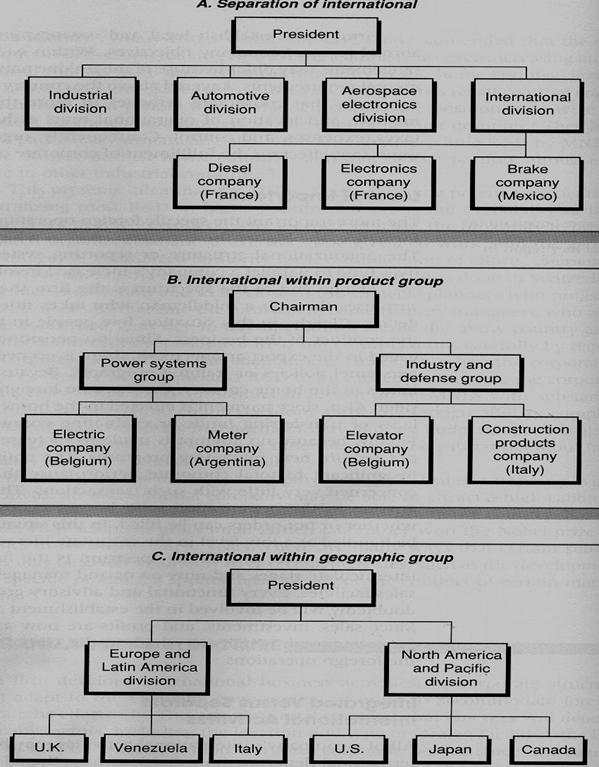
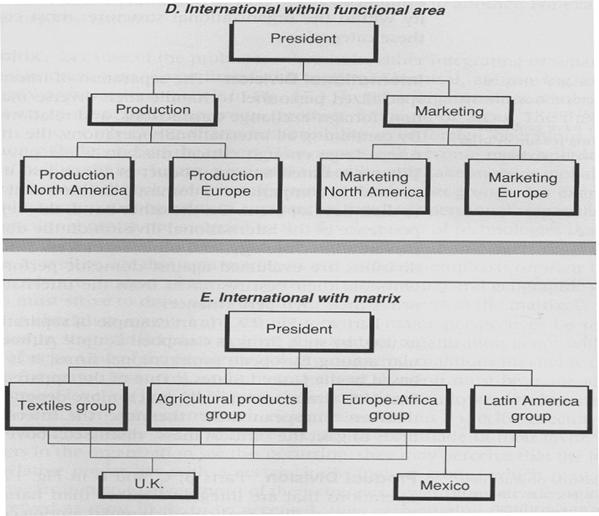
All of a company's international activities may be grouped together (e. g., international department or division) or gathered by the product, function, or geographic structure the company relies on domestically. Figure 17.1 shows simplified examples of different approaches to the placement of foreign activity within the organizational structure; most companies broadly fit one of these categories.
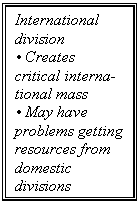 International Division The separation of international activities allows for specialized personnel to handle such diverse matters as export documentation, foreign-exchange transactions, and relations with foreign combining all international operations, the international activities constitute a large enough critical mass to wield power within the organization. When separated among product or functional units, these activities may be so small in comparison to domestic business that the firm gives little attention to their development. On the other hand, this separation may necessitate dependence of the international division on the domestic divisions for product, personnel, technology, and other resources. Since managers in the domestic divisions are evaluated against domestic performance standards, they may withhold their best resources from the international group in order to improve their own performance.
Part A of Fig. 17.1 is an example of separating international operations, as used by such firms as Campbell Soup.11 Although this structure is not popular among European multinational firms, it is very common among those based in the United States.12 One of the apparent causes for the difference is that U. S. firms are typically much more dependent on the domestic market than are European firms; therefore, the international division allows U. S. firms to gain the "critical mass" discussed above.
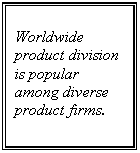 Product Division Parts B, C, and D in Fig. 17.1 are types of international operations that are integrated rather than handled separately. The product organization (B) is particularly popular among companies that operate within highly diverse product groups, especially those that have become diverse primarily through acquisitions, such as Motorola. Since the product groups may have little in common, even domestically, the groups may be highly independent of each other. Note that different subsidiaries within the same foreign country will report to different groups at headquarters.
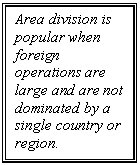 Geographic (Area) Division The geographic organization, part C in Fig. 17.1, is used primarily by firms with very large foreign operations not dominated by a single country or area. This structure is found more commonly among European MNEs, such as Nestle, than among U. S. MNEs because of the dominance of the U. S. domestic market. Recall that Nestle can use this structure because no one region dominates its operations.
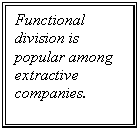
Functional The functional organization, part D in Fig. 17.1, is popular among extractive companies (such as oil or bauxite extraction) because of their very homogenous products for which production and marketing methods are relatively undifferentiated from one country to another. For example, it is used by Exxon.

|
Из за большого объема этот материал размещен на нескольких страницах:
1 2 3 4 5 6 7 8 9 10 11 |
