

Партнерка на США и Канаду по недвижимости, выплаты в крипто
- 30% recurring commission
- Выплаты в USDT
- Вывод каждую неделю
- Комиссия до 5 лет за каждого referral
There is keen interest in how the rate of productivity growth has changed through time and, particularly now, in whether the rate of growth is falling, in line with expectations about growth in other countries with major agricultural sectors[4].
Periods of atypical seasonal conditions and long investment cycles necessitate cautious interpretation of trends in productivity growth. Stoeckel and Miller (1982) argued that productivity growth in Australian agriculture increased after 1968–69 – a ‘watershed’ year for agriculture[5]. After this period, output continued to grow but inputs actually declined. Their study only extended as far as 1980 and inputs have grown since, but at a rate that has rarely exceeded 1% p. a.
Mullen (2002) in his review of productivity growth in broadacre agriculture adopted the Stoeckel and Miller (1982) view, that 1969 was a ‘watershed’ year. Econometric analysis suggests that the growth rate from 1953 to 1968 was 2.0 percent and from 1969 to 2004, 2.5 percent. These estimates have been used in several papers by Mullen and coauthors to estimate the benefits from productivity gains in broadacre agriculture and are applied again below.
However there is some evidence that productivity growth in the grains industry, if not in broadacre agriculture as a whole, may be drifting down[6] while that for livestock specialists has been increasing.
Males et al. (1990) reported productivity growth of 5.5% p. a. for specialist crop farmers for the period 1978 to 1989. Since then the two studies by Knopke et al. (1995; 2000) suggested that productivity growth for crop specialists slowed to 4.6% p. a. for the period from 1978–94 and to 3.6% p. a. for the period from 1978–99, while productivity growth in broadacre agriculture remained unchanged at 2.6% p. a.
Knopke et al. (2000) speculated that this decline may be associated with increased expenditure on capital inputs as wheat prices recovered during this latter period.
A study undertaken by ABARE for the Victorian DPI (ABARE) found that productivity growth in broadacre agriculture had declined to 2.2% p. a.. However, the analysis was conducted over a relatively short period from 1989 to 2004 and drought was a major influence in latter years of this period.
Most recently Kokic et al. (2006) found that for the 1989-2004 period, productivity growth in the grains industry averaged 1.9 % and for specialist croppers, averaged 1.8%. The rate of growth for the grains industry increased to 2.6 % when adjusted for the poor seasonal conditions over this period.
Productivity growth in the sheep industry, at least as estimated using ABARE survey data, has always been disappointing, at 1% p. a. or less in recent decades. Martin et al. (2004) estimated that productivity growth for specialist wool producers had been 0.9% p. a. over the period from 1977–78 to 2001–02 and had been 1.2% p. a. since 1988–89. Villano et al. (2006) found that specialist wool growers achieved rates of growth as high as 5.2% but warned that this finding might be related to the characteristics of the population from which the sample was drawn (i. e. all participants were involved in the Farm Monitor Project).
The productivity of beef specialists has been better than that of sheep specialists but less than that of those predominantly involved in crop production. The estimates from Table 1 suggest that productivity in the beef sector has been increasing. Productivity grew at the rate of 1.8% p. a. from 1978 to 2002 but the growth rate was 2.1% p. a. for the 1989 to 2002 period and 2.5 % to 2004 for specialist beef producers. Mixed beef and crop producers enjoyed a growth rate of 2.4% p. a. to 2002. Northern beef producers experienced higher productivity growth than their southern counterparts. Productivity grew at the rate of 3.3% p. a. from 1989 to 2002. As for other industries ABARE (2004) found evidence that larger beef producers enjoyed higher productivity growth than smaller producers.
It is somewhat puzzling that productivity on crop farms has consistently exceeded that on livestock farms and the issue is not explored in any depth in the literature. Some studies suggest that this might arise from a more rapid development of cropping technologies in recent decades (minimum tillage, crop varieties, improvements to fertilisers and pesticides etc) compared to livestock technologies, the longer breeding cycles for livestock, and perhaps the labour intensive nature of some livestock handling operations. As noted later, expenditure on plant research in Australia has grown more rapidly than expenditure on livestock research in recent years. Whether this is a cause of, or a response to, higher rates of productivity growth in the crop sector is unclear.
What is also puzzling is the apparent ambiguity as to whether or not there are gains in productivity available from economies of scope. It would seem that there are gains for specialist livestock producers to diversify towards more cropping but the rate of productivity growth of specialist croppers is higher than that of mixed farms.
Hailu and Islam (2004) using a multilateral measure and ABARE farm survey data from 1977 to 1999 found that while the level of productivity growth in agriculture was still higher in NSW (2.07% p. a.) and Victoria (1.45% p. a.) than the other states, the gap has narrowed considerably because WA (3.73% p. a.) and SA (3.19% p. a.) in particular, have enjoyed higher rates of productivity growth in recent years, perhaps because of their greater reliance on cropping.
Recent Analysis by Chang Tao Wang
Mullen and coauthors in their analysis of TFP used a dataset extending from 1953 to 1988 and then to 1994 derived from ABARE’s broadacre agriculture survey (see Mullen and Cox (1996) for more detail). For analysis of the relationship with research investment, a series as long as possible helps. Wang (2006) ‘spliced’ an ABARE dataset for the years 1978 to 2003 to the original Mullen and Cox dataset. Small differences between the two datasets were observed for the overlapping years 1978-1994. These can largely be explained because the survey populations changed from being a population in which all farmers had sheep (1953-1994) to one in which crop and beef specialists (having no sheep) were allowed. Wang used the original dataset to 1979 and the more recent dataset from then.
EDIT FOR YEARS
Wang’s estimate of the Fisher TFP index in Australian broadacre agriculture is shown in Figure 1 and Table 2. The Fisher TFP index rose almost 3.5 times from 100 in year 1953 to 343 in 2002 before declining to 261 in 2003, reflecting the drought in that year. The index is highly variable, falling in 18 of the 50 years, reflecting seasonal conditions. The average annual rate of growth over the entire period was 2.5 percent[7].
Figure 1: Productivity in Australian Broadacre Agriculture as measured by a Fisher ideal index and the Terms of Trade facing Farmers
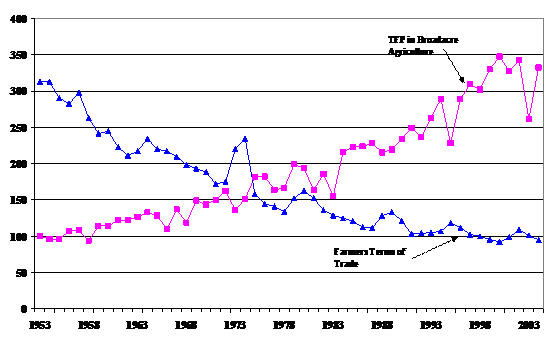
Source: Derived from ABARE data
Table 2: Average Growth in Productivity (Fisher Index) for Broadacre Agriculture
period | 1953-2003 | 1953-1968 | 1969-1984 | 1985-1994 | 1995-2002[8] |
Productivity growth (%) | 2.5 | 1.9 | 1.8 | 2.5 | 2.7 |
Source: Wang (2006)
Relative to other sectors of the Australian economy
The Productivity Commission has been estimating productivity growth in major sectors of the Australian economy such as agriculture (Table 3 adapted from Parham (2004)). These estimates are based on ABS sectoral data from the National Accounts using a value added approach to estimating productivity. The last row in Table 3 displays the ratio of productivity growth in agriculture to the the average for all sectors (market economy).
Table 3: Productivity growth in sectors of the Australian economy: 1974–99.
1975–82 | 1982–85 | 1985–89 | 1989–94 | 1994-99 | |
Agriculture | 1.6 | 1.1 | 1.4 | 2.6 | 4.3 |
Mining | -1.7 | 0.5 | 2.6 | 2.5 | 1.2 |
Manufacturing | 2.1 | 1.8 | 1.7 | 1.6 | 1.3 |
Electricity, gas & water | 2.0 | 3.2 | 4.2 | 3.7 | 1.8 |
Construction | 1.4 | 0.4 | -0.3 | -0.2 | 0.4 |
Wholesale trade | -0.7 | -0.9 | -0.5 | 1.2 | 3.2 |
Retail trade | 1.0 | 0.6 | -0.2 | 0.1 | 1.0 |
Accom., cafes & restaurants | -0.9 | -1.3 | -1.9 | -1.6 | -0.3 |
Transport & storage | 2.2 | 1.2 | 1.0 | 1.4 | 1.9 |
Communication services | 6.5 | 4.9 | 4.8 | 4.9 | 3.7 |
Finance & insurance | -2.0 | -1.0 | 0.2 | 0.7 | 0.8 |
Comm. Rec. Services | -1.4 | -2.2 | -2.9 | -3.1 | -3.3 |
Market Economy | 1.1 | 0.8 | 0.4 | 0.7 | 1.8 |
Agriculture/Market economy TFP | 1.4 | 1.4 | 3.5 | 3.7 | 2.4 |
Source: adapted from Parham 2004

|
Из за большого объема этот материал размещен на нескольких страницах:
1 2 3 4 5 6 7 8 |
