

Партнерка на США и Канаду по недвижимости, выплаты в крипто
- 30% recurring commission
- Выплаты в USDT
- Вывод каждую неделю
- Комиссия до 5 лет за каждого referral
Parham (2004) estimated that productivity growth in the Australian economy during the 1990s (1993–99) was 1.8% p. a., a percentage point higher than previously estimated. This placed Australia in a favourable position relative to other OECD countries. He estimated that the growth in agricultural productivity during the 1990s has been 4.3% p. a., higher than all other sectors and higher than for previous decades. The growth rate in the wholesale trade sector was 3.2% p. a., much improved on previous periods, and 3.7% p. a. in the communications services sector – down on previous periods. Up to 1994, productivity growth in the electricity, gas and water sector and in the communications sector generally exceeded that in agriculture and so did the growth rate in manufacturing although to a lesser extent.
Parham found that productivity growth in agriculture in the 1970s and 1980s was subdued (Table 3)[9]. Undoubtedly, the severe drought in the early 1980s was a factor in this result. The surge in productivity growth in the 1990s coincided with a surge in productivity growth for the Australian economy generally. Factors thought to contribute to this surge include the greater openness of the economy to trade and investment, the continuing deregulation of markets and institutions, and efficiency gains from the computer, telecommunications and transport sectors. Research is regarded as having made a significant ongoing contribution to productivity growth both in agriculture and the economy generally. Parham (2004) tentatively speculated that the relative contributions of greater openness, R&D, and the adoption of ICT to an apparent increase of about 1% p. a. in the rate of productivity growth in the 1990s may have been in the order of 0.5, 0.3 and 0.2% p. a.
It is interesting to note from Table 3 that productivity growth rates in other sectors of the economy seem as variable as that of agriculture and are often negative. While the question of fluctuations in productivity growth was rarely addressed in the ABARE studies, there is less evidence of the variation in growth rates than is apparent in the ABS based sectoral analyses. The ABARE based estimates generally fluctuate within the 2–3 % p. a. range while the ABS estimates fluctuate in a broader band of 1–4% p. a..
Relative to other agricultural sectors
International comparisons of productivity are difficult to make because of differences in methods, data, and observation periods and the contribution of productivity differences to international competitiveness is difficult to separate from other factors. International comparisons are reviewed in Mullen and Crean (2007).
Australia’s recent performance compares favourably with other countries. For example, Rao et al. (2004) for the 1980–2000 period found that Australian agriculture achieved a TFP growth rate of 2.6% p. a. – higher than their estimate of 2.0% p. a. for the period 1970–2001 and higher than estimates from earlier studies. This rate of growth is similar to that achieved by the US but a little slower than that in Canada and Denmark and well above average for the group of OECD countries (Figure 2). This reported acceleration in productivity growth is consistent with recent studies of productivity growth in Australian agriculture in the 90s as described above.
Figure 2: Productivity growth rates – selected OECD countries.

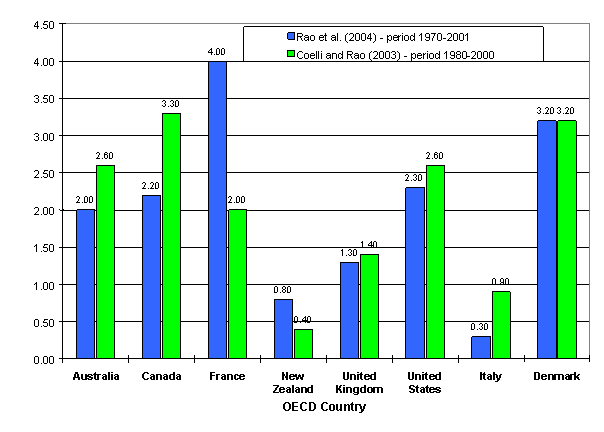

Source: Rao et al. 2004; Coelli & Rao 2003
The lack of international farm survey data comparable to that collected by ABARE appears to be the main reason for the lack of comparative international studies of particular agricultural industries. However, there appears to be some evidence to suggest that Australia’s rate of crop productivity growth of 3.6% p. pares favourably with other countries which ranged from 1.4–2.8% p. a. Livestock productivity appears to be low relative to other livestock sectors although productivity in the Australian beef industry has risen.
Implications for Competitiveness
Most commonly productivity growth has been compared with the terms of trade as a partial indicator of whether Australian agriculture is becoming more competitive.
The conventional wisdom has been that the terms of trade for Australian agriculture have been declining inexorably. However, while the trend in the terms of trade did decline for about 40 years from 1953 (Figure 1), since the early 1990s, the rate of decline has been much slower, at least for the sector as a whole. Using econometric techniques, it was found that the terms of trade declined at the rate of 2.3% p. a. over the whole period 1953–2004 but, that the rate of decline was 2.7% p. a. from 1953–1990, similar to the rates of productivity growth in broadacre agriculture. Perhaps in the 1950s the terms of trade were declining at a faster rate than productivity gains. From 1991to 2006, the rate of decline in the terms of trade was only 0.9%[10]. However, productivity continued to grow. Over the entire period from 1953 it can be seen from Figure 1 that TFP index grew from 100 to almost 350 while the terms of trade declined from about 320 to 100. From Figure 6 it can be seen that only in recent years has the real value of agricultural output in Australia consistently exceeded $30 billion and perhaps these favourable trends in TFP and the terms of trade have contributed.
There is a wide but inconclusive literature about how productivity measures might be adjusted for terms of trade effects (Diewert & Morrison 1986)[11]. The Productivity Commission (Zheng 2005) has decided not to adjust TFP measures for terms of trade effects. Given that there has been little real trend in the terms of trade facing farmers since the early 90s, the bias from price changes in estimates of TFP over this time may be small.
An important indicator of the agricultural sector’s competitiveness is the rate of its productivity growth relative to that achieved by other sectors of the economy. Shane et al. (1998) argued: ‘the assessment of changes in comparative advantage in two countries entails a comparison of the ratio of growth in agriculture to growth in the rest of the economy’.
Agricultural productivity growth in Australia has been up to four times higher than the average productivity growth for the economy as a whole (Table 3). The Australian findings in respect to relative sector performance do not seem unique. Bernard and Jones (1996) in an analysis of 14 OECD countries over the period 1970–87 found that average productivity growth in agriculture grew at the rate of 2.6% p. a. as compared to 1.2% p. a. for industry (Table 4). In respect to the Australian findings, many countries are reported to have higher agricultural sector TFP growth for the 1970–87 period. However, Australia performs well on the basis of its ratio of agricultural TFP growth to non-agricultural TFP compared to other countries. Australia’s ratio of 3.6 was significantly higher than the 2.17 average reported for the group and was only behind two other countries, the US and the United Kingdom. This implies that Australia’s ability to compete on world markets may have improved over the period.
Table 4: Productivity growth rates – agriculture versus other industries (selected OECD countries): 1970–87.
Country | Agriculture Average TFP growth | Total Industry Average TFP growth | Ratio of Agriculture TFP to Non-Agriculture TFP Ratio |
United States | 1.50 | 0.30 | 5.00 |
Canada | 0.90 | 0.40 | 2.25 |
Japan | -0.20 | 1.50 | -0.13 |
Germany | 4.30 | 1.30 | 3.31 |
France | 4.00 | 1.70 | 2.35 |
Italy | 2.00 | 1.00 | 2.00 |
United Kingdom | 3.60 | 0.90 | 4.00 |
Australia | 1.80 | 0.50 | 3.60 |
Netherlands | 4.40 | 1.30 | 3.38 |
Belgium | 3.70 | 1.60 | 2.31 |
Denmark | 4.10 | 1.40 | 2.93 |
Norway | 2.10 | 1.50 | 1.40 |
Sweden | 2.00 | 1.20 | 1.67 |
Finland | 2.20 | 1.70 | 1.29 |
Average | 2.60 | 1.20 | 2.17 |
Trends in Expenditure on R&D for Australia
There are two important sources of data on public investment in agricultural R&D in Australia. The first of these is the dataset assembled by Mullen et al. (1996a) on public investment in research and extension in Australia from 1953–94. The second source is that collected in a biannual survey by the ABS which extends back in some form to 1968–69 where total public expenditure on agricultural R&D was estimated by the sum of expenditure on R&D in the plant and animal socioeconomic objective classes (from which expenditure on fisheries and forestry was deducted for the purposes here). The most recently reported ABS survey year was 2002–03.
Mullen et al. (1996a) advised that in view of the availability of ABS data, it was no longer sensible to update their series. Instead the two series have been ‘spliced’ to give a perspective on investment in R&D from 1953 to the present. In 1991, the two series differed by only 2.5% and from this year ABS data were used. Generally the two series differed by about 10% giving some degree of confidence in this splicing procedure. However, in 1987 and in 1989, the ABS estimates of expenditure exceeded the Mullen et al. (1996a) estimates by 20% or more. The rise and then fall in R&D estimates over this period reported by ABS were not evident in the published financial reports of large R&D institutions used by Mullen et al. (1996) and hence ABS data were not used until 1991. Since the ABS census is only conducted every second year an estimate of R&D expenditure was linearly interpolated for the intervening years. In this paper all expenditure data have been expressed in 2004 dollars using a GDP deflator.

|
Из за большого объема этот материал размещен на нескольких страницах:
1 2 3 4 5 6 7 8 |
