

Партнерка на США и Канаду по недвижимости, выплаты в крипто
- 30% recurring commission
- Выплаты в USDT
- Вывод каждую неделю
- Комиссия до 5 лет за каждого referral
Total public expenditure on agricultural R&D has grown from A$115 million in 1953 to almost A$730 million in 2003 (in 2004 dollars). Figure 3 shows that growth was strong to the mid 1970s. There has been little growth since, although in recent years there is some evidence of renewed growth. As a percentage of total expenditure on R&D, expenditure on agricultural R&D in 2003 was 8%. It has declined steadily from 20% in 1982. Expenditure on environmental research has never exceeded 10% of total expenditure and was 6.5% in 2003.
In Australia, the public sector has always been the dominant provider of research services to the agricultural sector (Figure 4)[12]. The business sector has generally been responsible for less than 10% of total agricultural R&D although its share in 2003 was 14%. This contrasts sharply with other developed countries where agricultural R&D is roughly shared between public and private sectors (Pardey & Beintema 2001). From ABS data, state organisations, presumably dominated by the state departments of agriculture or their equivalents, have been responsible for about half of all agricultural R&D in Australia, with the Commonwealth responsible for a quarter and universities, about 15%. From the 2003 ABS survey, there was evidence that more research is being undertaken by universities and the business sector and less by state and Federal organisations. The share undertaken by states was down to 44%.
The focus of this paper is on publicly funded agricultural research.
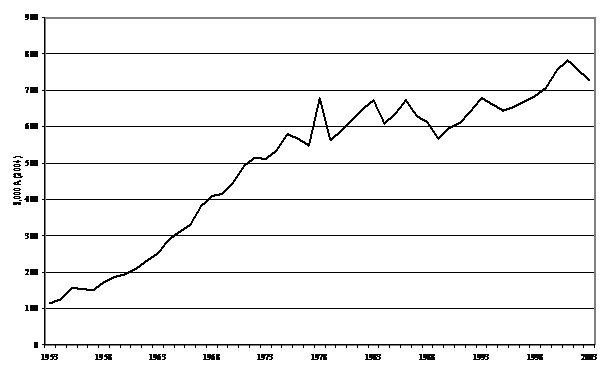
Figure 3: Real public expenditure on agricultural R&D in Australia (in 2004 dollars): 1953:2003.
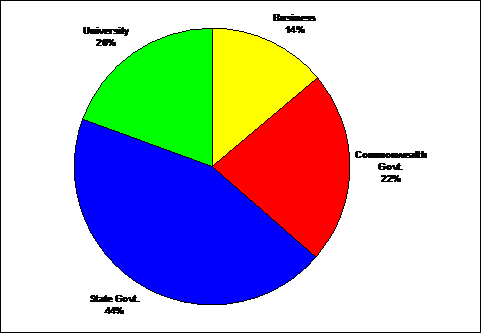
Figure 4: Expenditure shares of agricultural R&D in Australia by providers of research services (2002–03).
Research intensity is a measure of investment in research relative to the size of the agricultural sector. In Figure 5 two measures of public research intensity are presented, one relative to agricultural GVP and one relative to agricultural GDP[13]. The latter measure is the one most frequently used in international comparisons. In research intensity terms, public funding for agricultural research has been drifting down from about 5% p. a. of GDP in the period from 1978–86 to just over 3% p. a. in 2003. Intensity grew strongly in the 1950s and 1960s[14].
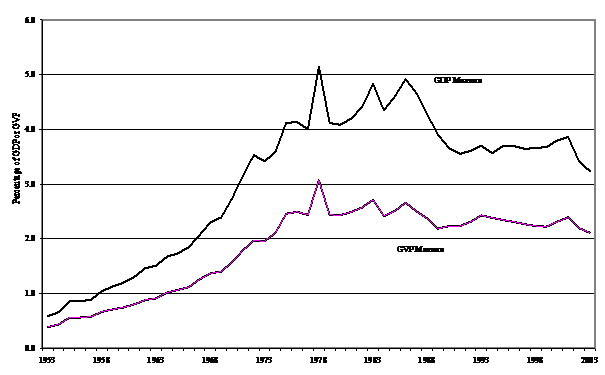
Figure 5: Public agricultural research intensity in Australia (R&D expenditure as proportion of agricultural GDP or GVP).
For most of the 1990s, expenditure on plant and animal research was similar but by 2003 expenditure on plant research was half as much again as that on animal research. Perhaps this partly reflects the growing importance of the Grains Research and Development Corporation (GRDC) as a source of funds. During the 1980s, the share of the GRDC in total RDC funding was under 20% but by 2001 it had risen to 30% before declining to 27% in 2003–04[15]. The leading states for the location of public agricultural R&D in 2003 were Victoria and Queensland (similar amounts), followed by NSW.
The most recent international review of agricultural R&D is that by Pardey and Beintema (2001) based on 1995 data although further insights will soon be available in a study edited by Pardey et al. (forthcoming) [16]. At that time, investment in agricultural research worldwide was still growing but in developed countries, the rate of growth had slowed from 2.2% p. a. in the 1980s to 0.2% p. a. From Pardey et al. (forthcoming), public investment in agricultural research in real dollars (2000 international dollars) had only risen from A$15.2 billion in 1981 to about A$23 billion in 2000. In ‘dollar’ terms, expenditure on agricultural research in 1995 in developing countries exceeded that in developed countries with China, India and Brazil emerging as major investors. Public research intensity in developed countries was 2.6% p. a. and total agricultural research intensity was about 5.5% p. a. Research intensity in less developed countries was often very low such that average public research intensity in the countries Pardey and Beintema (2001) reviewed was just over 1% p. 2000, about a third of all agricultural R&D was undertaken in the private sector, but little of this was in developing countries. The world’s poorest countries are still dependent on technology spillovers from rich countries both individually, through the CGIAR system and through organisations such as Australia’s ACIAR.
A feature of the agricultural research sector in Australia has been the prominent role played by the RDCs. In 2003, total expenditure by the RDCs was A$461 million (nominal) which is approaching half the total public expenditure on agricultural R&D, although it probably overstates RDC funding for agricultural production research because some of these funds were used to fund research of a non-production nature such as research in processing or environmental areas. Recall also that less than half of RDC funds are raised from producers (because of the predominant Federal funding of Land and Water Australia for example). In the 1980s, RDC funding only amounted to about 15% of total public expenditure on agricultural R&D.
The Contribution of R&D to Growth in Agricultural Productivity
Empirical research to estimate the returns from investment in R&D has generally fallen into two classes – econometric analyses at a sector level and benefit cost analysis of particular research investments. Reported here are some recent econometric analyses updating that originally conducted by Mullen and Cox (1995) and some benefit cost analyses based on scenarios about the potential contribution of domestic research to productivity growth in Australian agriculture.
The findings of Mullen and co-authors can be summarised as follows:
- In an alternative to the econometric approach, Scobie et al. (1991) synthesised a production function linking expenditure on research with productivity growth in the Australian wool industry. Gauging public investment in wool production R&D to have been about A$40 million in 1985, they estimated that the average internal rate of return to Australia might have been in the order of 9.5% and the internal rate of return to woolgrowers might be in the order of 25%[17].
- Mullen and Cox (1995) estimated that the returns to research in broadacre agriculture in Australia may be in the order of 15–40% over the 1953-1988 period. The low rate was associated with a 35-year research profile and the high rate with a 16-year research profile.
- Mullen and Strappazzon (1996) using a dataset extended to 1994 estimated that the rate of return to pubic investment in broadacre research was between 18 and 39% for models in which research was defined over 35- and 16-year periods. However they also found that for the Australian dataset, there was no strong evidence of a stable long run equilibrium relationship between expenditure on research and productivity. The lack of a constant long run relationship does not imply that research has no effect on productivity. Rather it suggests that the impact of research may vary through time in response say, to changes in research management or to research opportunities.
- Mullen et al. (1996) attempted to incorporate research in a translog cost model of broadacre agriculture in Australia. While their preferred model did not satisfy all the conditions of a well behaved cost model, they found that research did have a significant impact in reducing costs in broadacre agriculture and that the rate of return to research was as high as 86%.
- Cox et al. (1997) using nonparametric methods estimated the marginal internal rates of returns to research and extension expenditures in the order of 12–20% over the 1953–94 period. They found nonparametric evidence of lagged research and extension impacts on productivity in Australian broadacre agriculture out as far as 30 years.
Alston et al. (2000) conducted a meta-analysis of 292 studies of the rates of return to agricultural research, about one third of which were published in scientific journals. Their main findings included:
- there was no evidence that returns from research investments were declining the returns from research appear higher in developed countries estimated rates of return from research were lower for enterprises with longer production cycles.
According to Alston et al. (2000) the median rate of return reported in the Mullen papers was 25%[18]. Mullen was one of four analysts whose median rate of return was 25% or less[19].
More recently the Productivity Commission (Shanks & Zheng 2006) undertook a comprehensive analysis of the relationship between investment in research, particularly by the business sector, and productivity growth in the Australian economy. They estimated that the return to business investment at the level of the entire market economy was 50%. Their preferred estimate of the rate of return to public investment in agriculture was 24%, relatively precisely estimated in a range of from 1–46%[20]. The estimated rate of return in the manufacturing sector was 50% and the returns to the mining and wholesale and retail sectors were 159% and 438% with very wide confidence intervals.
Recent Analysis Following Chang Tao Wang
Wang (2006) and Wang et al. (2007), using Mullen and Cox’s dataset extended to 2003, examined whether the relationship between research investment and productivity growth in Australian broadacre agriculture has changed over the 15 years since the original Mullen and Cox analysis. The focus of econometric analysis reported here is not so much on change from Mullen and Cox and from 1988, as on modelling the relationship between productivity and research over the entire period for which data are available, 1953-2003.

|
Из за большого объема этот материал размещен на нескольких страницах:
1 2 3 4 5 6 7 8 |
