

Партнерка на США и Канаду по недвижимости, выплаты в крипто
- 30% recurring commission
- Выплаты в USDT
- Вывод каждую неделю
- Комиссия до 5 лет за каждого referral
ЗИМНИЙ СЕМЕСТР
Образец лексико-грамматической работы по материалу, пройденному в первом семестре
Дата
Фамилия
Время выполнения – 90 минут Группа №
Write the 2 forms of the verbs and the “–ing form”
see understand
write buy
begin fall
catch fly
feel drink
______ points out of 5
2. Put the verbs in brackets in the Present Simple or Present Continuous.
1. Liz ……………. (to sing) beautifully, but she …………….. (not to sing) now because she …………………… (to sleep).
2. Roy ………………. (to work) as a bank manager, but today he ……………. (not to work). He ………………….. (to play) golf.
3. It's 7 o'clock now, he ………………….. (to jog), because he …………………. (to do) sport every day.
4. He ……………… (to swim) a lot when he ……………. (to go) on holidays. But now he ………………. (to be) at home, he …………….…… (to look) at the photos of his friends in the Facebook.
_____ points out of 12 (17)
plete the sentences with a comparative or a superlative adjective:
1. Her illness was …………………….. than we thought (serious).
2. Is your headache ……………… (good)? – No, it is ………………… (bad).
3. It’s ……………….……… film I’ve ever seen (boring).
4. Yesterday was ………………… day of the year (long).
5. That house is …………………....…….. building in the town (modern).
6. It is one of the ………………… rooms in the hotel (nice).
____ points out of 7 (24)
4. Ask 2 different questions about each sentence:
1. We aren’t wearing jeans.
2. They were afraid to ask about it.
3. He gave up smoking last year.
4. Jenny goes out every Saturday.
_____ points out of 8 (32)
5. Insert prepositions:
1.He’s going …….. France ………… a year’s time.
2.People all ………… the world speak English.
3.I’m very good ……….. swimming.
4…………... Saturday night we went ……….. a party.
5. Is there a film ……… TV tonight? - Yes, ……… channel 1.
6. What is there …… the picture?
7. Are you afraid ………… him?
8. Peter stayed ….... his grandmother’s ….. Christmas.
__________ points out of 6 (38)
plete the sentences with can - can't - could
1. People.................................. (не умеют летать).
2. I.............................. (не могу идти) to the university tomorrow because I am ill.
3. .................................................. (не могли бы вы открыть) the window, please?
4. When he was fifteen he.............................. (мог бегать) fast but now..…………………………..…. (но сейчас не может).
5. She's a famous ballerina. She..................................... (может танцевать) very well but she........................................... (не могла танцевать) at the party because she had hurt her foot. _____ points out of 7 (45)
7. Today 'Life in Britain' is writing about Alan Jenkins, a London double-decker bus driver. He is telling about his life.
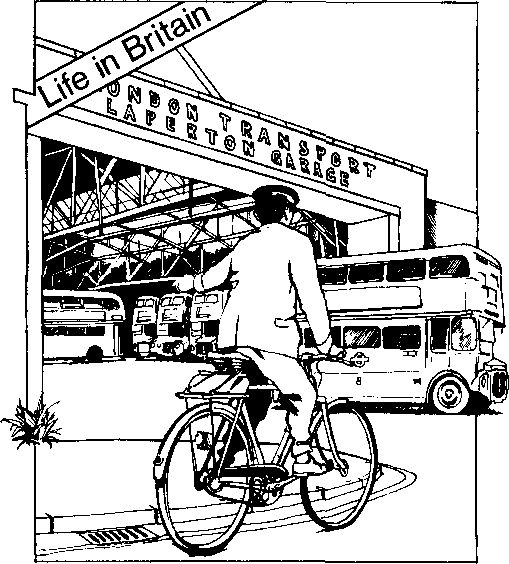
‘Sometimes, I work from 5 o'clock in the morning until lunchtime (that is the 'early shift'); other times I start in the afternoon and work until after midnight. And that is quite normal for a bus driver with London Transport.’
‘When I am on the early shift, I get up about 4 am, have breakfast (toast and tea usually, but sometimes bacon and eggs), and then I cycle to work.’
"I prefer the early shift to the later ones,' Alan is telling us. 'I have more time for the children. For example, I can meet them after school, and then we usually have a quick game of football, if the weather's fine. On the late shift, I sometimes don't see the children for two or three days, because they often leave home in the morning before I get up, and they're always in bed when I get home,'
‘At weekends, too, I do not always have enough time for my children. I usually work three Saturdays out of four, and also on every third Sunday.’
A. Write 7 sentences about Alan Jenkins.
Sometimes he ……………….
______ points out of 7 (52)
B. Write 3 sentences describing the picture, use the Present Continuous Tense
1
2
3
_____ points out of 6 (58)
plete the conversation between Mrs Muggins and the shopkeeper using “some”, "any", "a lot", "many", "a little", "a few" or "much".
Mrs Muggins: Good morning!
Shopkeeper: Good morning, Mrs Muggins. Do you need (1)................ things today?
Mrs Muggins: No, not (2)........................ Have you got (3) .............. coffee?
Shopkeeper: We only have (4).......................... jars.
Mrs Muggins: I'll take one, please. I'd like (5)............................. butter, please.
Shopkeeper: How (6).................................?
Mrs Muggins: A kilo.
Shopkeeper: Oh, no! I'm sorry, there isn't that (7) ..................... left! But we do have (8)........................... margarine.
Mrs Muggins: That's okay. I want some oranges, too. But I don't want (9)........................ , only (10) ................................. .
Shopkeeper: How (11)...............................?
Mrs Muggins: Four, please.
Shopkeeper: Here you are.
Mrs Muggins: Do you have (12) ......................... strawberries?
Shopkeeper: No, but we have (13).......................... blackberries.
MrsMuggins: No, thank you. That's all. How (14) .......................money do you want?
Shopkeeper: Ј10.
MrsMuggins: Ј10!! That's too (15) ........................! I'm not coming here again. Goodbye!
____ points out of 15 (73)
9. Insert a, the, some, any where necessary.
1. Helen usually has ………… sandwich for ……….. lunch.
2. I bought ………. rice and spagetti at the supermarket.
3. I don’t have ………. cigarettes with me.
4. I’ve got …………. water if you’re thirsty.
5. Have you got ………….. map of London?
6. Are there ………. shops near here? ______ points out of 4 (77)
10. Use the correct form of the verbs in brackets.
Marco Santos is a chef. He ………………….. (start) cooking when he ………..
(be) 15 years old. He ……………… (study) in a cookery school for three years and then he ……………. (get) his first job in a restaurant in Lyons. Now he ….. (be) 33 and he ……… already …………(work) all over France. He ……………. just ………….. (decide) to open a restaurant in London. He ………………. (not think) of a name for it yet. Four other French restaurants …………… (open) there this year, but Marco is optimistic. “My food ……….. (be) the best”, he says. “In 2008 I …………. (cook) for the Italian President when he …………. (come) to France, and he ………….. (tell) me that it ………….. (be) the most delicious food outside Italy!” _____ points out 14 (91)
11. Translate into English:
Марко Поло родился в 1254 году в Венеции (Venice). Его отец и дядя (uncle) были бизнесменами. В 1254 году они отправились в Китай. Они были первыми европейцами (Europeans), увидевшими Китай (to see China). Когда он вернулся в Венецию в 1295 году, он был богатым человеком. Поло написал книгу о своих путешествиях. Он умер в 1324 году.
_____ points out of 9 (100)
