


Партнерка на США и Канаду по недвижимости, выплаты в крипто
- 30% recurring commission
- Выплаты в USDT
- Вывод каждую неделю
- Комиссия до 5 лет за каждого referral
The second step in the evaluation of professional qualifications obtained characterize compliance professional qualification standard.
List of the main regulations related to quality assurance in higher education is given in the Annex 3.
Target group the research aims at and definitions used
The research target audience is represented by HEIs employees (32 respondents) that deal with quality of education in their professional life, including 8 specialists directly involved into QMS:
Figure 1.
According to the level of education there are the following groups of respondents:
Respondent categories | 03 – BA | 04 – MA | 05 – specialists | 06 – post-graduates | Total |
middle managers | 1 | 5 | 6 | ||
faculties | 11 | 11 | |||
QMS specialists | 2 | 6 | 8 | ||
TOP | 1 | 1 | 5 | 7 | |
Total | 1 | 1 | 3 | 27 | 32 |
In the interview two definitions of a high quality education have been used.
The first definition is the definition suggested by a respondent himself/ herself. This definition has been used to encourage a respondent to speak judging from one’s own experience and concept of a quality education. Five different definitions have been received (adding their variations) that are described in issue 4.1.
The second definition is a standard definition that is being used by the European Commission as far as quality of education is concerned: “Quality of any educational institute depends on the capacity to achieve prior set targets”1.
These definitions let us organize a more purposeful discussion about diverse markers of EQAVET criteria and CQAFVET model from one and the same point of view.
Respondent showed an inconsistent approach to understanding quality as ability of an institution to achieve its goals:
Only 39 out of 145 quality education criteria (see issue 4.2) that equals to 27% are connected to achieving goals, while all the rest are the criteria that form (67 references, 46%) or describe desirable operational climate (18 references, 12,4%). Remaining 21 references (14,5%) concern quality education in an indirect manner or have no connection at all; Quality education measurements are hardly ever used (see issue 4.3); In EQAVET descriptors achieving the goals that have been previously set is not described enough as well; An analysis of the application of various quality education activities (see issue 6) shows that respondents judge applying the activities concerning interests, level and interaction with students as the lowest. Activities reflecting quality of elaboration and implementation of curricula and academic results recognition are estimated a bit higher. Act for activities reflecting structure and work performed by faculties and tutors, they are estimated quite high. And the highest group is represented by activities concerning different aspect of administering education institution.Profile of respondents and respondents organisation
32 respondents from 23 HEIs have been interviewed. The interview has been conducted in 15 regions of the Russian Federation (Transbaikal and Krasnoyarsk Territories, Ivanovo, Irkutsk, Kemerovo, Novosibirsk, Omsk, Orel, Saratov, Sverdlovsk, Tomsk and Yaroslavl regions, Republic of Bashkortostan, Moscow and Saint-Petersburg).
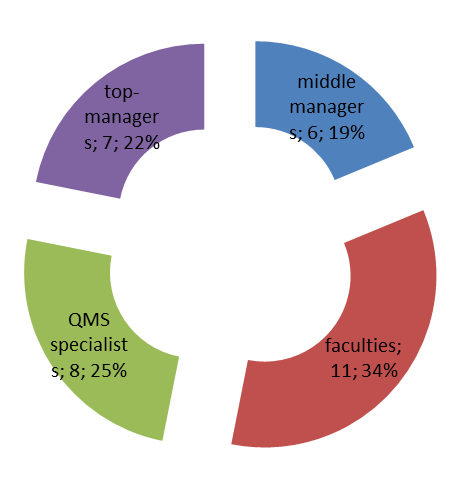
Figure 2. | Top-managers (7 people or 22%), heads of departments (6 people, 19%), faculties (11 people, 34%) and specialists (8 people, 25%) have been interviewed. The respondents have been taking up their posts for:
The interview participants represent in majority of cases state higher education institutions (30 organizations) and only two private HEIs. |
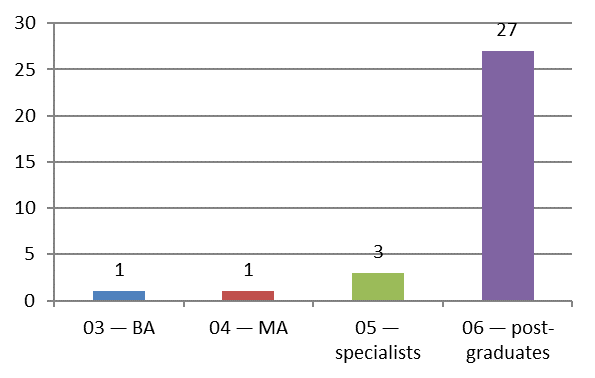
Respondents replied that the highest level of education that their HEI curricula cover is 06 - post-graduates (27 people, 84,4%) and 05 – specialists (9,4%). Only one HEI prepare 04 – MAs (3,1%) and another one 03 - BAs as the highest level of education (3,1%). |
Figure 3. |
Some respondents reported that their organizations deal with further and adult education exclusively (19 people, 59,4%). 13 respondents (40,6%) said that their HEI implement other programs as well.
Average age of HEI students is 21,7 years.
The survey participants are from the HEIs with more than 300 employees (27 replies, 84,4%) or from 50 to 299 (5 replies, 15,6%).
| The biggest HEI according to the number of students represented in the survey is federal state-funded educational institution of higher professional education Financial University under the Government of the Russian Federation that teaches about 80 thousand students a year. |
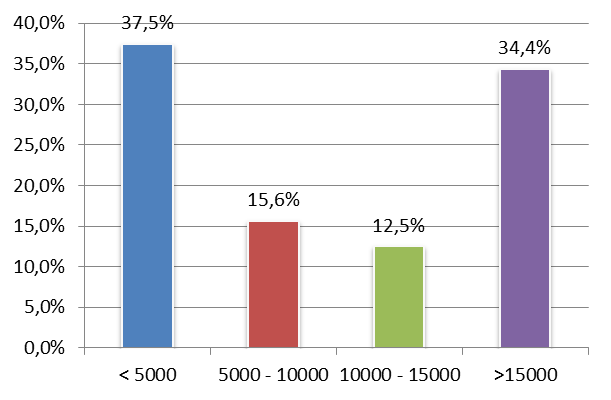
Figure 4.
The smallest HEI is Ivanovo chapter of federal state-funded educational institution of higher professional education The Russian Presidential Academy of National Economy and Public Administration that teaches 700 students. The image shows the number of students studying in the HEIs a year.
Average rate of students hat quitted the HEI is 6,2%. At the same time in 14 HEIs (43,8%) there are less than 5% and in 7 HEIs (21,9%) there are more than 10% of such students. One of the responded couldn’t answer this question.
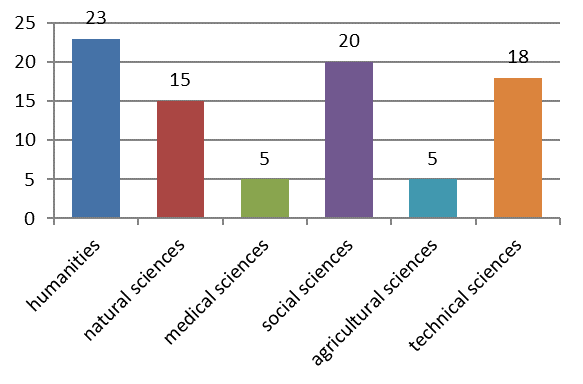
Figure 5. | The respondents were from the HEIs that perform education programs on humanities (71,9%), social (62,5%), technical (56,6%), natural (46,9%), medical and agricultural (15,6%) sciences. Majority of HEIs perform their programs in more than one sphere that is why a sum of these rates is much higher than 100%. |
Majority of respondents reported that their HEI is certified according to ISO 9001 (23 replies, 72%). The reasons for using ISO 9001 model are the following:
- optimize and improve the activity of a HEI; improve the quality of education; improve the administration effectiveness and potency; add to the HEI prestige and its competitiveness; as a toll for proving high quality education services according to the stakeholders requirements; clients require; as far as it is one of the requirements for receiving state accreditation (in the past).
Moreover 8 respondents replied that they do not use ISO 9001. One respondent said that the HEI is getting prepared to the certification according to the ISO 9001 requirements but failed to tell what the reasons for this measure were.
Respondents (19 replies, 59%) stated that they use other models in the HEI as well. Among these are EFQM and ESG ENQA models, self-examination, quality contests and awards, UNIQUe EFQUEL, CDIO, TQM, project leadership systems, student and alumni quality education monitoring, public system of quality higher education assessment, accreditation. The major reasons for applying them are that they suit HEIs and designed for them and that they are required by the overhead organizations and founders.
Good quality of education: what does it mean? Respondent’s definition of good quality of educationTable 1.
Respondents: | Definition / description given: |
15 | High quality education is represented first and foremost by the alumni employability2 and their employer’s satisfaction |
8 | High quality education is a satisfaction of all stakeholders Some of the respondents highlight satisfaction of all stakeholders but others emphasise that this organization and its staff satisfaction is of the highest importance Students satisfaction is seen by all the respondents as a necessary condition for high quality education |
6 | Quality of education is considered to be meeting regulatory requirements of different kind |
5 | High quality education is in students achievements: contests, awards, public recognition etc. |
3 | Excellent organization of a learning process |
37 |
In Annexes 4 full replies without processing are available.
Conclusion: respondents emphasize successful allumni placement (in his / her field, with acceptable fee) and their employers satisfaction as the basic criteria of high quality education. At the same time a significant part of people being interviewed highlights importance of appearance items: meeting the regulatory requirements and studnets and allumni public achievements. Some respondents state that excellent organization of a learning process is important.
Respondent’s most decisive criteria for good quality of educationTable 2.
N - times mentioned | Short description | Why chosen by respondents? | |
Level of teachers | 18 | High level of teaching mastery | HEI criteria 3 Personal opinion 9 Experience and research 6 |
Good material conditions | 18 | High level of the educational institution plant including laboratory equipment | HEI criteria 2 Personal opinion 9 Experience and research 6 Ministry of education and science requirements 1 |
Allumni’s knowledge, skills and satisfaction | 12 | Level of the competences, academic results, graduation thesis results | HEI criteria 3 Personal opinion 4 Experience and research 5 |
High entrance level of students | 11 | Entrants high level of education | HEI criteria 1 personal opinion 7 experience and research 3 |
QMS | 11 | Professional HEI management, properly developed processes, fast reaction to the changes of the environment | HEI criteria 3 personal opinion 7 experience and research 1 |
Allimni emloyability | 11 | Share of the allumni employed and theit employers satisfaction with the quality of their training | HEI criteria 2 personal opinion 3 experience and research 5 Ministry of education and science requirements 1 |
Motivation for being professional | 8 | Supporting further professional development of teachers, students and managers | personal opinion 5 experience and research 3 |
Modern education technologies | 7 | Applying modern education technologies including e-learning and distance learning technologies | personal opinion 5 experience and research 2 |
Quality of academic programs | 6 | Essential programs, meeting the requirements and quality of learning materials | HEI criteria 1 personal opinion 2 experience and research 3 |
Motivating for education | 6 | Students, faculty and HEI administration are interested in the results of learning process | HEI criteria 1 personal opinion 3 experience and research 2 |
Students achievements | 5 | Students win Olympic games and contests of different levels including international one | HEI criteria 1 personal opinion 2 experience and research 2 |
Research | 4 | Scientific schools, rsearch funding, science – industry connection | HEI criteria 2 personal opinion 1 Ministry of education and science requirements 1 |
Partnership with foreign HEIs and students | 3 | Teaching foreign students, expertise in foreign languages, international exchange | personal opinion 2 Ministry of education and science requirements 1 |
External recognition | 3 | Audit results, state and public accreditation | personal opinion 3 |
Implementation of recruitment plans | 3 | Implementing entrants recruitment plans | HEI criteria 1 Personal opinion 2 |
State support | 3 | State funding, other support | Personal opinion 3 |
Stakeholders’ partnership | 3 | Employers participate in education programs starting from design to correction stage, basic sub-faculty, other interaction | personal opinion 2 experience and research 1 |
Client-orientation | 2 | Being oriented onto the market situation | personal opinion 1 experience and research 1 |
The volume of delivery | 2 | Investments and financing education and personnel training | HEI criteria 1 personal opinion 1 |
Folowing the State Educational Standard and Federal State Educational Standard, Professional Standard | 2 | Meeting the requirements set in the regulator documents | personal opinion 1 experience and research 1 |
Students activity | 1 | Close to motivation | Personal opinion 1 |
Covering state-guaranteed order | 1 | Close to Implementation of recruitment plans | HEI criteria 1 |
Limiting teaching load | 1 | Consequence of faculty time deficiency | Personal opinion 1 |
Curiosity | 1 | Close to motivation and encouraging to be professional | Personal opinion 1 |
attendance | 1 | Seen as a symptom of students satisfaction | Personal opinion 1 |
Psychological climate | 1 | Lowering the preassure on faculties to boost their motivation and working time | Personal opinion 1 |
Publication activity | 1 | One of the demonstrations of scientific and pedagogical activity | Ministry of education and science requirements 1 |
A cross-sectional analysis of high quality education named by the respondents and their foundations is of high interest (the reasons are in the table). There is a significant discrepancy between “HEI criteria” and “personal opinion” that in general correspond to the research results and respondents experience. As far as this project is concerned, it means that HEI criteria should be added (enforced, with priorities changed) with relevant criteria.

|
Из за большого объема этот материал размещен на нескольких страницах:
1 2 3 4 5 6 7 8 9 |
