


Партнерка на США и Канаду по недвижимости, выплаты в крипто
- 30% recurring commission
- Выплаты в USDT
- Вывод каждую неделю
- Комиссия до 5 лет за каждого referral
On the other hand, the most popular criteria (“level of teachers” and “ allumni’s knowledge, skills and satisfaction”) are the results and do not show any directions where HEI efforts should be put to improve them.
Table 3.
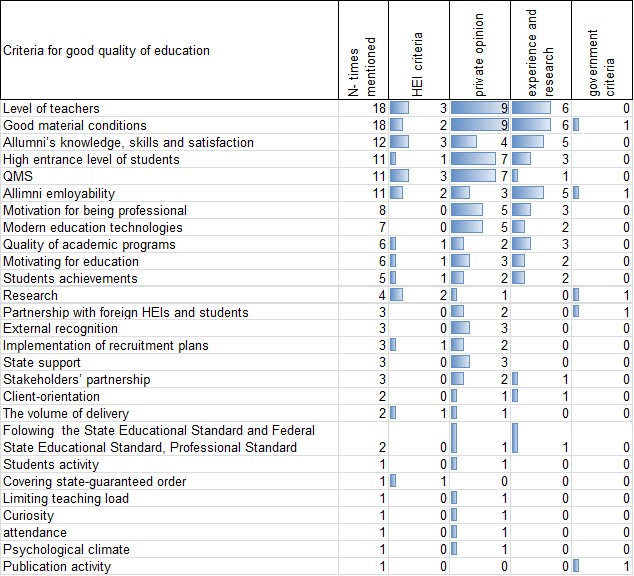
Existing measurements of quality
All respondents’ replies let us define 9 directions (systems) of quality education indicators and 4 ways of measurement.
Table 4.
Indicator: | Way of measurement | Impact on what stakeholder (government, employer, student, parent? |
Allumni’s knowledge and skills (8) | Expert evaluation | Students Employers |
external recognition basing on the business perfection awards / models (5) | Self-evaluation according to the business perfection awards / models and examination performed by authorised specilaists | Students Parents Emplyers Government |
Criteria constellation (4) | Interviewing the stakeholders | All stakeholders |
Recognition basing on the external audits (3) | Expert evaluation by specilaists from other authorised organizations | All stakeholders |
Self-evaluation (3) | Expert evaluation basing on the criteria formulated by specialists from education organizations | Management board of an educational institution |
Meeting stakeholders’ expectations and requirements (3) | Interviewing stakeholders | All stakeholders |
Place in the education organizations rankings (2) | External ranking | Students Parents Government |
Job placement (1) | Collecting feedback by different ways | students employers |
Successful partnerships of stakeholders (1) | Interviewing stakeholders | All stakeholders |
Conclusion: respondents mainly name quality education indicators systems without any details. The most widespread way of getting / measuring is expert evaluation including external representatives (auditors, ranking agencies). Notably employment that is one of the main quality education criteria was named only ones and ways of measuring it were not clear.
Respondents example of good practice in which these criteria are reflected / clearly respected
Table 5.
Short description | Indicators selected as part of the start? | How was effect established? | |
Olympic games and contests | Participation in contests organized by other education institutions | No or partially | On receiving awards |
Job placement after graduation | Yes | On the share of allumni employed | |
Allumni’s notable career and achievements | Yes In absence of indicators respondents name ambitions | On the allumni’s positions and time that they needed to get it | |
Distance courses on international platforms | Not completely but to a major part | On launching a course on an international platform and its popularity (views, learning process) | |
Collective implementation of a project aimed at designing innovative education program “Creating an innovative system for training specialists in humanities technologies in the social sphere” and university strategic development program 2012 – 2016 funded by the Ministry of education and science of the Russian Federation | Project ordered by the Ministry of education and science of Russian Federation | Yes | Successful completion of a project |
Particular courses with high acquisition results (allumni’s knowledge and skills) | Yes | Results of students’ final attestation | |
Partnership programs with employers | Yes | Share of students who completed the program and were employed; employers’ reviews | |
Mobility programs for students and teachers | Yes | Number of program participants, their reviews | |
Fund to support young teachers with successful allumnies | No | х | |
Perspective research | Partially | х | |
Teaching students during research performed under the supervision of scientists (NSU3) | Yes | Number of Candidates and Doctors of Sciences, institute directors, HEI rectors | |
Network education | Yes | Share of students who completed the program and were employed; employers’ and partner HEIs reviews | |
Sub-faculty evaluation system that allows to assess processes and activities in the major departments and implement improvements | Partially | х | |
Proving quality assurance of professional education in an international system for programs and education institutions professional-public accreditation privided by the Further Professional Education Council in Russia. Control independence, external accreditation guarantees objective quality indicators4. | Yes, in the framework of a HEI QMS | х | |
Sub-faculties have affiliates at the major city enterprises and their students have an opportunity to be part-time workers there. Additional subjects content and complex laboratories at these enterprises are collectively formed by the HEI and the company. According to these companies it allowes them to minimize fluctuation movement of personnel. | Yes | Fostering motivation for education (expert), shortening a period for adapting to the production on being employed, minimizing fluctuation movement of personnel. | |
Students practice training in a laboratory –diagnostic and medical prevention centre “Veterinary association” (VETASS) that is the best veterinary clinic in the city. | Yes | Higher level of the allumni’s skills and knowledge, shortening a period for adapting to the production on being employed |
The most notable practice
Proving quality assurance of professional education in an international system for programs and education institutions professional-public accreditation privided by the Further Professional Education Council in Russia. Control independence, external accreditation guarantees objective quality indicators.
How the practice started | The practice started with realizing the importance of labour market orientation and participating in the activities organised by the VET Union aimed at adapting the criteria of professional – public and public accreditation to the conditions of independent assessment of particular professional education programs and education organizations that apply ISO 9001 quality standards. |
Why we decided to start our work this way | At this stage Russian HEIs start to gradualy orient onto the labour market requirements. The motivation for it is enforced with the Ministry of education and science of the Russian Federation initiative of HEIs initiative monitoring where the key indicator is “employability”, introducing a new criterion into the independent quality assessment such as consumers’ satisfaction with the education service, self-evaluation on such criteria as the volume of additional funding for education and science education raised frim the market and developing the Russian National system for qualifications. To guarantee the HEI effectiveness meeting the requirements and indicators set by the Ministry of education and science of the Russian Federation it has been decided to study the experience of the further professional training system that has been demonstrating market-oriented development (receiving practically no state funding) for the last 25 years. |
How the practice was realized | To start with some teachers and specialist from several HEIs completed the programs aimed at training experts in professional – public and public accreditation. These programs included a project part on adapting professional – public and public accreditation criteria to the coditions of independent evaluation of particular professional education programs and education institutions that apply ISO 9001 quality standards. Working out of the projects developed in collective efforts in different regions has been discussed in focus groups. Discussions led to the documents corrections that set the criteria and indicators for voluntary independent evaluation of programs and education institutions VET Union performed a session of independent quality evaluation of professional education programs in a form of professional – public accreditation on these criteria (2 higher education programs and 5 further professional education programs). In two organizations that work with a bigger number of professional education programs and are certified in IQNet QMS a public accreditation according to a simplified scheme has been performed. This scheme is based on the reports by external auditors from a certification organization for the last three years that led to the volume reduction. |
What results have been achieved | Some teachers and specialist from several HEIs acquired an expert experience that is important in granting quality education at the level of an education organization. Some of them have passed the final exams and are currently taking practice training, afterwards they will be included into the catalogue of experts in professional – public and public accreditation. As a result of the work organizations that realize programs provided for the independent evaluation have received documents certifying that these pprograms went through professional – public accreditation in EQAVET system of support in EU and Eastern Europe or in Russian system of professional education and have been included into the VET Union catalogue. These certificates are counted when performing self-evaluation sessions, effectiveness monotoring and higher education programs state accreditation. As a result of the work organizations that realize further professional education programs have received certificates on public accreditation in EQAVET system of support in EU and Eastern Europe and have been included into the VET Union catalogue. This leads to improvign their image in the eyes of employers who trust VET Union and concern it as a quality guarantee. Independent control and external accreditation guaranteed objective quality indicators. |
What indicators have been used for evaluating the effect | Basic indicators for evaluative the impact of this practice: HEIs that took part in professional – public and public accreditation are satisfied with the results; Increase in number of applications for using the model of independent quality evaluation from institutions of higher and further orofessional education. |
Have the PDCA cycle been implemented? | PDCA cycle has been implemented at each stage and during professional-public program accreditation and education institutions public accreditation in general. |
EQAVET indicators in use Effective use of the EQAVET cycle
Table 6.

|
Из за большого объема этот материал размещен на нескольких страницах:
1 2 3 4 5 6 7 8 9 |
