

_______________________________________________
*Head of the research; +Contact person
Key words:acetic acid, oleic acid, hydrogen peroxide, water, supercritical fluid condition, oxidation.
Abstract
All the available methods of waste treatment are presented. The advantage of supercritical water oxidation of organic wastes over thermal neutralization is given. A schematic diagram of the batch-type plantfor supercritical water oxidation with the use of a liquid oxidizer is given. A schematic diagram of the flow-type (continuous) plantfor supercritical water oxidation is given, with the possibility of using ambient oxygen as an oxidizer, which is more cost-effective. The operation principles of both - batch-type and flow-type plants are presented. Chemical oxygen consumption has been selected for the analysis of reaction products as one of the main qualitative indicators of waste-water pollution rate. Also an additional indicator has been applied - the activity control of pH of hydrogen ions and acidity. The method for measuring of chemical oxygen consumption with the use of potassium dichromate at a given temperature in the presence of silver sulfate (oxidation catalyst) and mercury (II) sulfate is described. Emulsification of the mixture of distilled water and acid, which are poorly soluble in each other and poorly miscible under ordinary conditions, has been carried out. The paper represents the results of experimental investigation on oxidation of 10% aqueous solution of acetic acid and 14% aqueous solution of oleic acid with 30% hydrogen peroxide at temperatures of 673-748 K, under pressures of 25-30 MPa and a process time of 30 minutes, carried out in an aqueous medium under supercritical fluid conditions on thebatch-type plant. The paper also represents the results of experimental investigation on oxidation of 10% aqueous solution of acetic acid with 30% hydrogen peroxide at temperatures of 673-748 K, under pressure of 25 MPa, carried out in an aqueous medium under supercritical fluid conditions on theflow-type plant. Some functional connections are revealed between the efficiency index and the process duration as well as between the values of chemical oxygen consumption of reaction products and the duration of the process. Characteristic curves presenting the behavior of the pH of acetic acid subjected to oxidation on theflow-typeplant depending on temperature and duration of the oxidation process are given. The minimum values of chemical oxygen consumption of oxidized samples are determined, depending on duration of the process. The most effective parameters for carrying out the oxidation of acids under supercritical conditions with the use of batch-type and flow-type plants are determined.
Introduction
The existing methods for purifying of organic wastes (mechanical, biological, physical-chemical, etc.) do not give a complete purification of the environment from industrial effluents [1-3]. The method of oxidation in supercritical water (SCWO) – is a relatively new method, demonstrating an unusually high effect in destruction of organic compounds (99.99%), it is also environmentally friendly (no emissions similar to those, which occur during thermal neutralization). This process is especially good for purification of industrial wastewater, including domestic wastewater. Oxidation of wastes in supercritical water medium has a significant advantage over thermal neutralization due to reducing of emissions to the atmosphere, improving of detoxification quality and the possibility of recycling of neutralized water. With the appropriate composition of the oxidized waste, it is possible to use the heat of the exothermic reaction for internal production needs [4-5].
Implementation of SCWO in a continuous mode provides a real possibility for recovery of industrial wastewater [6]. Water in supercritical fluid conditions (Tcr = 374.150С; Рcr = 22.13 МPа) is a universal solvent capable of increasing the intensity of heat and mass transfer processes, as well as accelerating chemical reactions [7-9]. When transferring water wastes into supercritical fluid state in the presence of an oxidizing agent, oxidation of organic compounds takes place, with carbon dioxide and water as the reaction products. Inorganic compounds practically do not dissolve in supercritical water and precipitate in the form of salts, from which valuable metals and inorganic compounds can be retrieved. If the initial reaction mixture contains 10-25% of organic compounds, SCWO process proceeds with the release of heat (10-20 MJ/kg), that can be sufficient not only for the reaction, but also for providing heat to external consumers [10-12].
To investigate the efficiency of SCWO process, the oxidation of acetic and oleic acids with hydrogen peroxide has been chosen.
Experimental part
The oxidation reaction of acetic and oleic acids with hydrogen peroxide in an aqueous medium under supercritical fluid conditions has been studied with the use of two experimental plants: batch-operated and continuously-operated (Fig. 1, 2). The technique of the investigations is described in [13] in details.
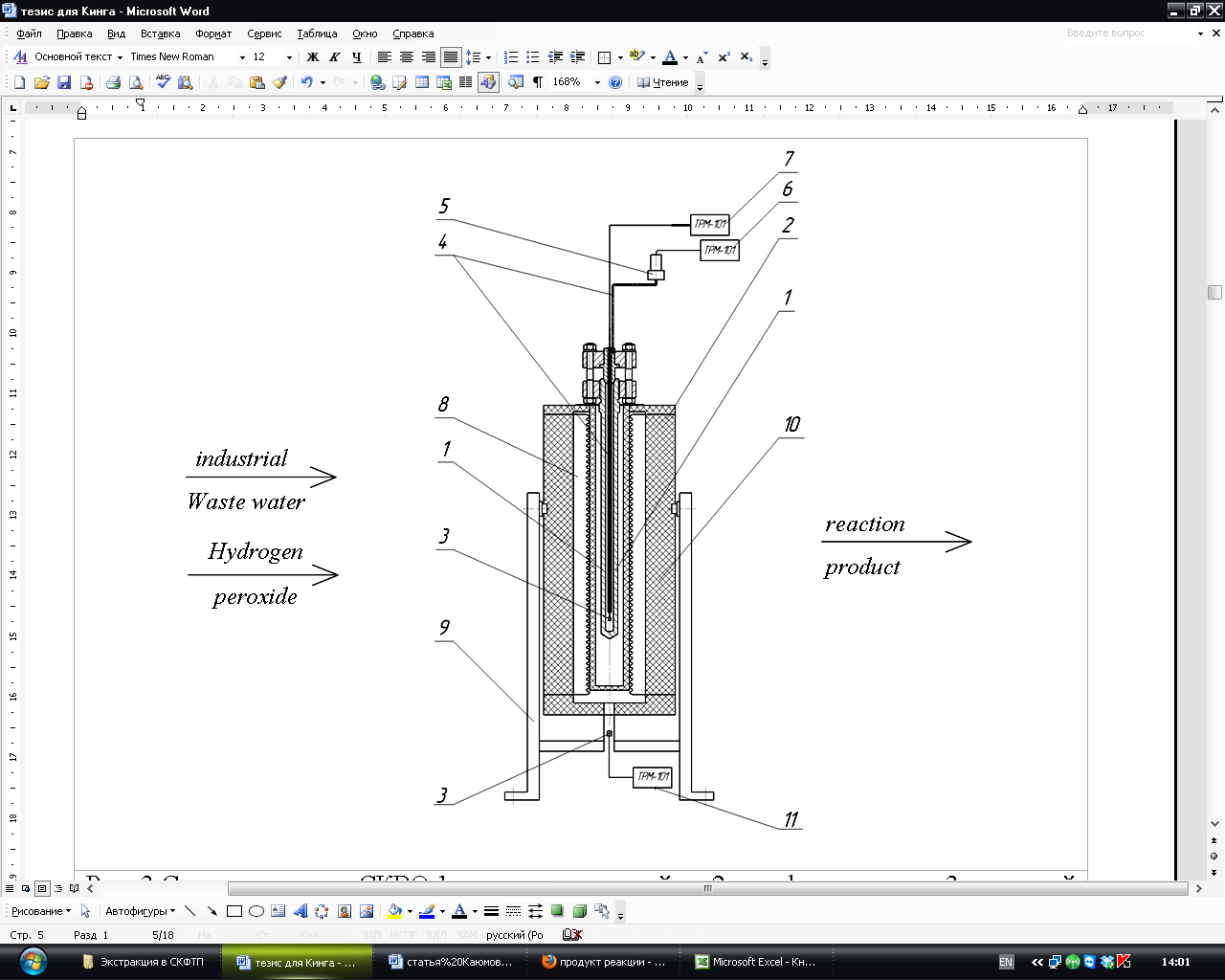
Fig. 1. Schematic diagram of the batch-operated plant for supercritical water oxidation:
1 – high-pressure cell; 2 – heating furnace; 3 – thermocouple; 5 – pressure indicator PD100-DI; 6,7,11 – secondary instruments TRM-101 for pressure and temperature measurements; 8 – electric heating unit; 10 – thermal insulation.
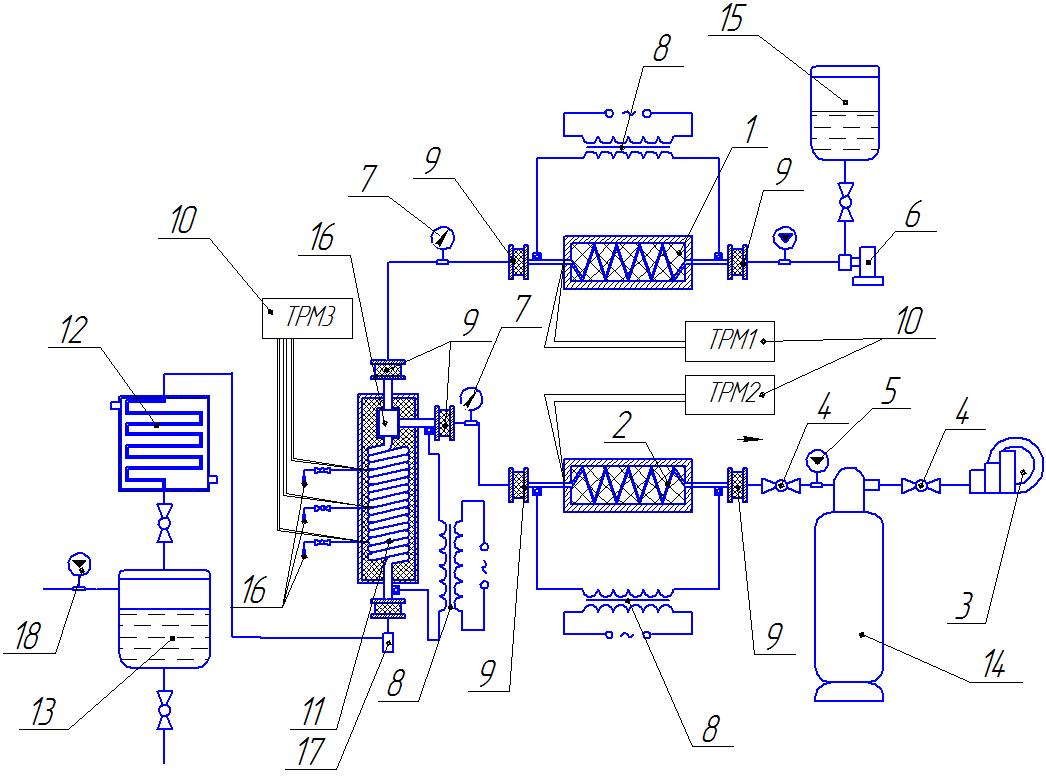
Fig. 2. Schematic diagram of the continously-operated plant for supercritical water oxidation: 1- wastewater preheater; 2- feeding air preheater; 3- air compressor; 5- flow rate meter; 6- high-pressure pump; 7- pressure gage; 8- reducing transformer; 9- current-insulating element; 10- temperature indicator with a secondary instrument; 11- reactor; 12- cooler; 13- reservoir for purified wastes; 14- receiver tank; 15- reservoir for initial unpurified wastes; 16- mixing chamber; 17- chamber for collecting of residuals; 18- flow rate meter.
Operating principle of the batch-type plant is quite simple and consists of heating the reaction mixture in the high-pressure cell 1 (Fig. 1), monitoring of temperature (TRM devices 6, 7, 11) and pressure (pressure gauges) and analyzing of composition and properties of the initial reaction mixture and the reaction products.
Operating principle of the continuously-operated plant is more complicated and consists of the following: wastewater from the reservoir (15) is compressed to 25 MPa by the high-pressure pump (6) and supplied to the heat exchanger (1), where it is heated by passing an electric current through the coil pipe of the heat exchanger connected to the secondary winding circuit of the transformer (8). Air, used as an oxidizer, is compressed to 25 MPa by the air compressor (3) and, after passing through the receiver (14), enters the air preheater (2). Reagents (wastes and air in a certain volume ratio), preheated up to supercritical temperature, are sent to the mixing chamber (16). After that the mixture enters SCWO reactor, where the oxidation reaction takes place, carried out in an aqueous medium under SCF conditions. Inorganic compounds that do not dissolve in supercritical water precipitate in the chamber (17). SCWO reaction proceeds with the release of heat and does not require large power inputs after reaching the operating mode. Waste oxidized in the reactor, enters the cooler (12), then passes through the pressure regulator and enters liquid collector and air separator (13). Temperatures in the reactor and heat exchangers are measured and regulated by thermo-regulators TPM-1 “OVEN” (10). The air flow is measured by a gas flow meter VA-420-19. Wastewater flow rate is regulated by a high-pressure pump.
One of the main quality indicators for pollution rate of drinking, natural and waste water is "chemical oxygen demand" (COD). The analysis of the reaction products on COD has been carried out with the use of photometric COD analyzer "Expert-003-COD" which has a thermo-reactor for 26 samples in accordance with GOST R 52708-2007.
The COD measuring method involves processing of a water sample with sulfuric acid and potassium dichromate at a given temperature in the presence of silver sulfate (oxidation catalyst) and mercuric (II) sulfate, applied to reduce the effect of chlorides. COD value in a given range of concentrations is determined by optical density measurement of the investigated solution at a specified wavelength of 430 or 605 nm (depending on measuring range) with the use of calibration curve for optical density from COD value [14, 15].
The activity of pH of hydrogen ions in a flow of reacting liquid is monitored with the use of ionic composition analyzer "PAIS 01pH" [16].
A 10% aqueous solution of acetic acid has been chosen as a model fluid for SCWO process implementation, carried out in the presence of 30% hydrogen peroxide serving as a liquid oxidizer, the amount of which is calculated from COD value of the liquid under investigation [17, 18]. Emulsification of initial reagents (distilled water and acid) that are slightly soluble in each other and poorly miscible under normal conditions, allows increasing of phases contact area, and correspondingly, increases the reaction rate [19]. To emulsify the reaction mixture, an ultrasonic emulsifier "UIP1000HD" by Hielscher has been applied.
Results and discussion
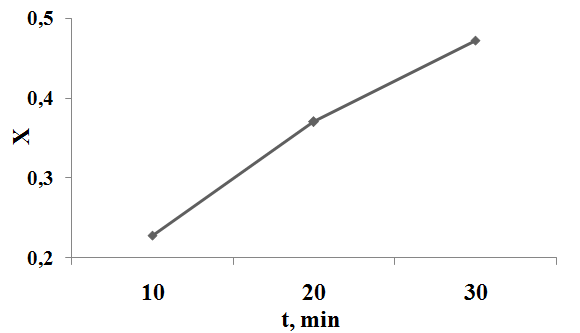
The oxidation of acetic acid in a batch-type plant (enclosed volume) has been carried out at T = 673 K, P = 25 MPa, with reaction duration of 10-30 minutes. Table 1 and Figure 3 show the results of this study
.
Table 1. COD of the reaction product of acetic acid oxidation with hydrogen peroxide, carried out in an aqueous medium at T = 673 K, P = 25 MPa
Reaction duration t, min | 10 | 20 | 30 |
COD, mgО2/l | 8950 | 7300 | 6120 |

|
Из за большого объема этот материал размещен на нескольких страницах:
1 2 3 4 |
