

Fig. 3. The efficiency of acetic acid oxidation depending on duration of the SCWO process, carried out in a batch mode at T = 673K; P = 25MPa.
Continuously-operated process of acetic acid oxidation has been carried out at T = 673K, 698K, 748K and Р = 25 MPa (volumetric ratio of acetic acid to hydrogen peroxide is 50:1).
The values of COD and pH as well as the efficiency ( ) of the acetic acid oxidation process are presented below for the reaction product samples obtained with the use of continuously-operated plant (Fig. 4-6).
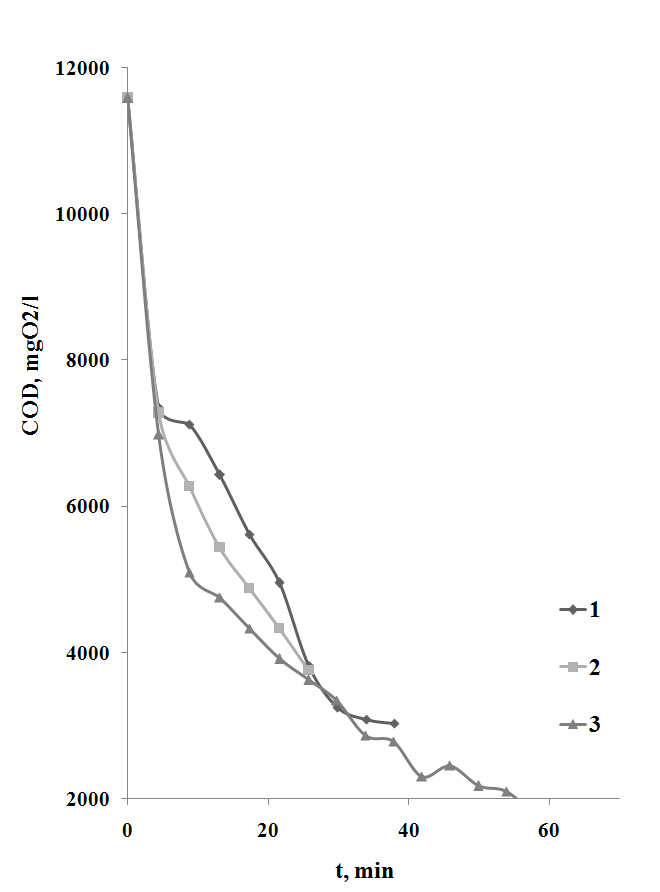
Fig. 4. COD values of the reaction product of acetic acid oxidation depending on duration of the process: 1 – T=673K; 2 – T=698K; 3 – T=748K. (P=25 MPa)
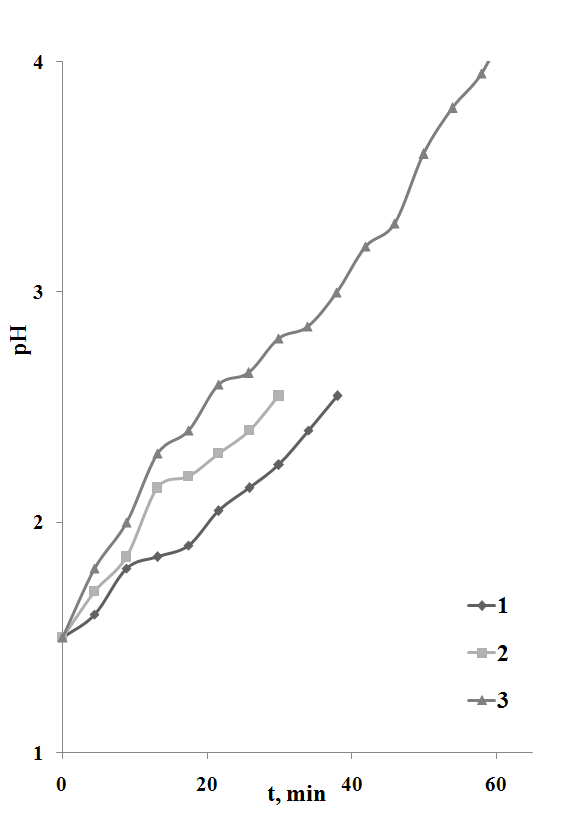
Fig. 5. рН values of the reaction product of acetic acid oxidation depending on duration of the process: 1 – T=673K; 2 – T=698K; 3 – T=748K. (P=25 MPa)
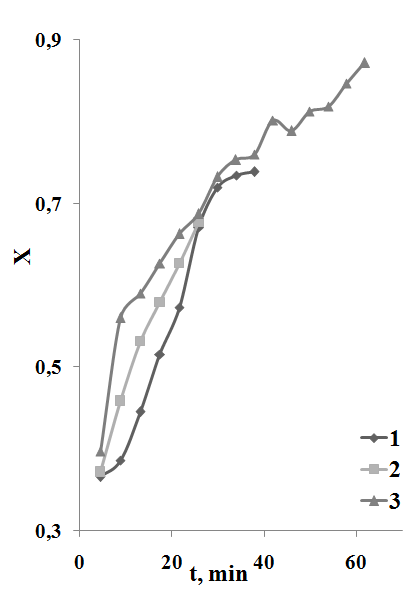
Fig. 6. The efficiency of acetic acid oxidation process depending on duration of the SCWO process carried out in a continuously-operated mode: 1 – T=673K; 2 – T=698K; 3 – T=748K. (P=25 MPa)
The figures above show that with an increase in temperature and duration of the process, the COD value decreases, that indicates an increase in the efficiency of the oxidation process. Changes in pH of the samples with the increase in temperature and duration of the reaction indicate that the reaction product becomes less acidic and more neutral.
The investigation of oleic acid oxidation reaction with hydrogen peroxide has been carried out on a batch-type plant with volume ratios of water - oleic acid - hydrogen peroxide of 6:1:1. The results of these studies carried out at T = 673-723K and P = 30MPa are presented in Table 2 and Figure 7:
Table 2. COD (mgO2/l) of the reaction product of oleic acid oxidation in supercritical water
Parameters | Reaction duration t, min | |||
T, K / P, MPa | 0 | 10 | 20 | 30 |
298/30 | 44615 | - | - | - |
673/30 | - | 23924 | 20924 | 12088 |
698/30 | - | 14562 | 14032 | 7670 |
723/30 | - | 7846 | 6927 | 5196 |
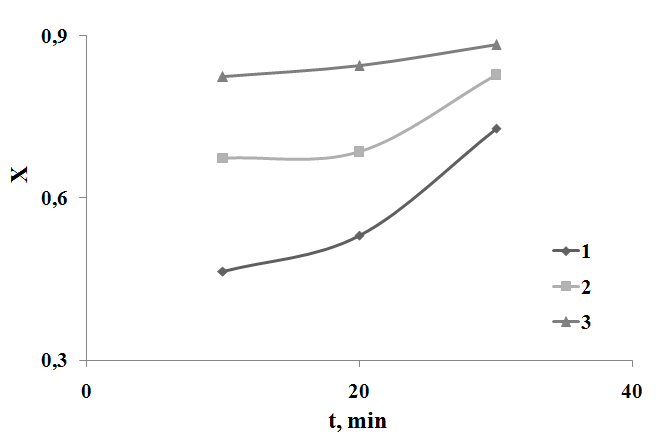
Fig. 7. The efficiency of oleic acid oxidation process depending on duration of the SCWO process:
1 – T=673K; 2 – T=698K; 3 – T=723K. (P=30 MPa)
The results presented in Table 2 show that with an increase in duration and temperature of the oxidation process the COD value of oleic acid is significantly reduced, the smallest COD value has been obtained at T = 723K with reaction duration of 30 minutes. As it can be seen from Fig. 7, for the water-oleic acid-hydrogen peroxide ratio of 6:1:1, the efficiency of the process at T=723K is maximal.
Conclusion
1. Analyzing the results of the experiments carried out, a systematic decrease in the values of COD index of both acetic acid and oleic acid is observed. According to the fact that supercritical state of water is characterized by low strength of hydrogen bonds, the solubility of organic compounds increases. As a result of the investigation on SCWO process of acetic acid aqueous solution (10%), a decrease in the concentration of organic substances has been established, that is evidenced by a decrease in the initial COD from the value of 11590 mgO2 / L, common to all experiments with acetic acid, to the following values:
- 1485 mgО2/l, atT = 748 K; 3750 mgО2/l, atT = 698 K; 3030 mgО2/l, atT = 673 K.
The results of the experiment carried out on the batch-type plant with 10% aqueous solution of acetic acid (Table 1 and Figure 3) show that the maximal effect of purification according to COD is observed at a reaction time of 30 minutes with value of 6120 mgO2/l. For the experiment on oxidation of oleic acid with hydrogen peroxide (Table 2, Figure 7), the maximum effect according to CODis characterized by the value of 5196 mgO2/l, at T = 723K and reaction time of 30 minutes.
2. The experiments carried out in the frames of the current research, show the possibility of implementation of SCWO process in a continuous mode for disposal of industrial effluents containing organic acids, as well as for obtaining water suitable for secondary use in production.
3. The efficiency of the supercritical water oxidation process implemented in a flow mode is higher than the same for the batch process.
Acknowledgement
The research has been carried out in Kazan National Research Technological University with the financial support of government represented by the Ministry of Education and Science of Russian Federation. in the frames of the government assignment No. 13.5112.2017/BCh.
References
Bambang V., Jae-Duck percritical water oxidation for the destruction of toxic organic wastewaters: A review. Journal of Environmental Sciences. 2007. № 19. P.513–522. Gazizov R., Amirkhanov D., Gumerov F., Usmanov R., Gabitov F. et al. Workshop on the fundamentals of supercritical technologies. OOO "Innovative Publishing House" Butlerov Heritage", Kazan. 2010. P.3-4. Cansell. F., Rey S., Beslin P. Thermodynamic aspect of supercritical fluids processing: applications to polymers and wastes treatment. Revue de L’Institut Francais du Petrole. 1998. № 1. 53p. Usmanov R., Shamsetdinov F. Gabitov R., Biktashev Sh., Gumerov F. Pilot unit for permanent transesterification of vegetable oils in supercritical methanol or ethanol media T3. 2011. P.45-61. Galkin A., Lunin V. Water in sub - and supercritical states is a universal medium for chemical reactions. Advances in Chemistry. 2005. T74. 24p. Anikeev V., Ermakova A. Technology of complete oxidation of organic compounds in supercritical water. Journal of Applied Chemistry. 2011. T84. No.1. P.88-94. Vostrikov A., Fedyaeva O., Fadeeva I., Sokol M., Formation of Al2O3 nanoparticles during aluminum oxidation with water at sub - and supercritical percritical Fluids: Theory and Practice. 2010. T5.P.12-24. Gayazova E., 8.Usmanov R., Gumerov F., Friedland S., Zaripov Z. The сombination of сoagulation-flocculation method and the SCWO in the waste water treatment. International Journal of Analytical Mass Spectrometry and Chromatograph. 2013. №1. P.48-54. Gumerov F., Kayumov R., Usmanov R., Sagdeev A., Abdullin I., et al. Waste Management in Propylene Epoxidation Process with the Use of Supercritical Fluid Media. American Journal of Analytical Chemistry. 2012 T.3. P.950-957. Abeln J., Kluth M., Petrich G., Schmieder HSupercritical water oxidation: a process for the treatment of industrial waste effluents. High Pressure Research: An International Journal. 2001. T20. P.1-6. Gabitov R., Usmanov R., Gumerov F., Gabitov F. Investigation of the stability of the rapeseed oil emulsion and ethyl alcohol obtained by the ultrasonic dispersion method. Bulletin of Kazan Technological University. 2012 T.15. P.129-132. Gabitov R., Zakharchuk V., Pavlov V., Usmanov R. Realization of the SCWO process on the experimental installation of the flow type. Bulletin of Kazan University of Technology. 2012. T15. P.119-121. Usmanov R., Gabitov R., Miftakhova L., Gumerov F. Modernization of the experimental setup realizing the flow regime for the SCWO process. Bulletin of Kazan Technological University. 2013. T17. P.244-247. Fedyaeva O., Vostrikov A. Utilization of toxic organic substances in supercritical percritical Fluids: Theory and Practice. 2012. T5. P.15-27. Gumerov F., Sabirzyanov A., Gumerova G., Gabitov F., Usmanov S., etc. Prospects of using sub - and supercritical extractants for extraction of metals from bitumen and high-viscosity oils. Chemistry and Computational Simulation. Butlerov messages. 2004. T5. P.9-15. Gonikberg, M. Chemical equilibrium and reaction rate at high pressures. Publishing house "Chemistry", Moscow. 1969. 430p. Aetov A., Usmanov R., Gabitov R., Mazanov S., Kurbangeleev M. Experimental setup for the investigation of supercritical water oxidation in continuous mode and the principles of its operation. Bulletin of Kazan Technological University. 2016. T19. P.37-39. Aetov A., Usmanov R., Gabitov R., Mazanov S. Experimental study of the process of supercritical water oxidation in batch and flow modes. XIX All-Russian Conference of Young Scientists-Chemists. Abstracts., Kazan. 2016. P.249-250.Gabitov R., Usmanov R., Gumerov F., Gabitov F. Investigation of the stability of the rapeseed oil emulsion and ethyl alcohol obtained by the ultrasonic dispersion method. Bulletin of Kazan Technological University. 2012. T15. P.129-13

|
Из за большого объема этот материал размещен на нескольких страницах:
1 2 3 4 |
