


Партнерка на США и Канаду по недвижимости, выплаты в крипто
- 30% recurring commission
- Выплаты в USDT
- Вывод каждую неделю
- Комиссия до 5 лет за каждого referral
V. Say:
a) what commercial video broadcasting over the air will be replaced by; b) what the electronic in-basket and electronic newspapers will mean in the future.
VI. Find the main information of paragraph 4.
VII. Read paragraph 4 again and say:
a) whether newspapers and magazines will exist in the third millennium; b) how newspapers and magazines will be redefined; c) what inexpensive graphics terminals will permit; d) whether hard copy will be available; e) whether the problem of electronic junk can be solved by individual programming of terminals.
VIII. Summarize the general ideas developed in texts А, В and С
IX. Imagine that you are to make a report about the future trends in the system of communication at a scientific conference. While preparing it use the information of texts А, В and С. Make the report orally.
Key to Lesson 3: The title of the text is "Communicating with Glass and Light".
UNIT FIFTEEN
• Grammar: Subjunctive Mood (§ 6).
Conditional Sentences (§ 7).
Functions of should and would (§11, 12).
• Word-formation: n → v; v + -ion = n.
• Individual Work: Lab Work "Subjunctive Mood."
LESSON ONE
Pre-text Exercises
I. Practise the reading of the following words:
mirror ['mirq], earth [E:T], neutrino [n(j)u:ˊtri:nqV], beam [bi:m], nucleus ['nju:kliqs], convert [kqn'vE:t].
II. Check up if you can read the words correctly and say what words in the Russian language help you to guess their meaning:
horizon, ocean, relay, region, ionosphere, matter, detect, molecule, combine, induce, code, incorporate, civilization.
III. State to what parts of speech the following words belong:
to communicate, signals, telegraphy, rich, to reflect, long, solar, to improve, unreasonable, better, electrical, hard, subatomic, miles, huge, crust, modulation, to incorporate, fields.
IV. a) Find the roots of the following words:
longer, massless, communication, amplified, unreasonable, perceptibly, induction, producing, complicated, modulation, unnecessary, looking, electrical, subatomic, occasionally, charged;
b) Translate the words formed by conversion:
air – to air; influence – to influence; end – to end; place – to place; engine – to engine; start – to start; finish – to finish; work – to work;
c) Read the words. Mind the place of the stress and translate the
words into Russian:
'progress – to pro'gress; 'increase – to inc'rease; 'export – to ex'port; 'object – to ob'ject; 'import – to im'port; 'record – to re'cord; 'project – to pro'ject; 'alloy – to a'lloy;
d) Form nouns adding the suffix -ion(-tion) to the given verbs making changes where necessary:
Example: to reflect – reflection – отражать – отражение
to communicate, to affect, to direct, to detect, to produce, to complicate, to modulate, to incorporate, to induce, to disrupt;
e) Form adjectives adding the suffix - ic to the given nouns making changes where necessary:
Example: atom – atomic – атом – атомный
atmosphere, scientist, electromagnet, base, cycle, electron, graph, hero, optimist, ionosphere.
V. Check up if you know the meaning of the following verbs. Consult a dictionary:
to string, to unite, to travel, to send, to set up, to charge, to take place, to produce, to disrupt, to amplify, to seem, to induce.
VI. Translate the following sentences paying attention to the verbs in the Subjunctive Mood:
1. Without radio we should hardly be able to observe artificial satellites and receive scientific information from space. 2. The solution of the problem requires that all the experimental data obtained be exact. 3. It is required that all measurements be done beforehand. 4. It is necessary that these data should be processed as soon as possible. 5. It is important that engineers should develop automatic control systems. 6. Atomic energy finds such wide and varied application in our life that our age might be called the age of atom. 7. It is important that safety measures be taken while working with the electric equipment. 8. It is desirable that the engine should combine high efficiency and lightness. 9. We suggested that his project be discussed in detail. 10. It is essential that he should inform us about the results of his research.
VII. Translate the sentences. Mind the means of expressing the Subjunctive Mood:
1. Provided all of the requirements were met, the efficiency of the apparatus would be increased. 2. Without the new instrument this experiment would not have been successful. 3. If you classified the data fewer tests would be needed. 4. If you had known about semiconductors more, you would have understood the arrangement of this device. 5. You could have done this work better. 6. You might have asked me about the work of this machine before putting it into operation. 7. They suggest that he should begin the test immediately. 8. It is required that those devices be used in this case. 9. Had he informed me in time I should have sent this device. 10. Without proper care and maintenance this equipment wouldn't operate so well. 11. If the machine were repaired, it would be set in motion immediately. 12. If he had been able to get all the books on that subject, his report would have been much better. 13. Had you taken all the safety measures the machine would not have been broken.
VIII. Find in text A sentences with the Subjunctive Mood. Translate these sentences paying attention to the means of expressing the Subjunctive Mood.
IX. Define the types of conditional clauses in the following complex sentences. Translate them into Russian:
A. 1. If a solid body or a liquid is heated, it will usually expand. 2. If you want to carry out your experiment successfully, you thoroughly prepare all the necessary ingredients. 3. The measurements were always correct provided the necessary instruments were used. 4. If you want to speak a language, you must hear it spoken. 5. If a machine is to make usable translations, the machine itself must be able to extract some meaning of the text. 6. If we are to believe some forecasts, computers may become a common thing of every day used by almost everybody. 7. If the model fits well, the observed data will be correct.
B. 1. If sound could propagate in interplanetary space it would cover this distance in 14 years. 2. If the earth were as hot as Venus, the oceans would evaporate. 3. Were it not for ionosphere, radio waves would propagate like light waves only within the limits of visible horizon. 4. If I were to see your experiment, I should get a clear conception of this phenomenon. 5. But for electricity little could be done in a modern research laboratory. 6. If a new telephone system were installed on the line we should be able to improve the reliability of telephone service. 7. If life existed on the Venus, we should know it. 8. It would be better if some experiments were repeated. 9. If the Earth did not rotate, it would not take the shape of a ball.
C. 1. If he had prepared the material beforehand, he might have done the work quite easily. 2. If they had completed the research, the results would have been discussed at the conference. 3. The manned spaceships might not have been launched into the cosmos, unless scientists had studied the information received from the space satellites. Could these observations have been proved theoretically they would have done much to advance our knowledge in the field of space research. If he had been able to get all the books on that subject, his report would have been much better. 6. Had he taken into account the properties of the substance under investigation, he would have been careful when working with it.
X. Find in text A sentences with conditional clauses, define the types of the clauses and translate the sentences.
XI. Define the functions of should and would. Translate the sentences:
A. 1. He thought I should come to the laboratory. 2. We know we should be able to overcome all the difficulties in our research. 3. We were sure that we should finish our work in time. 4. The director asked whether the materials of our research would be typed. 5. He said that he would mention your work in his report. 6. The teacher thought that the students of this group would be able to understand the new text. 7. Yesterday I found out that the professor would lecture on the latest developments in cybernetics.
B. 1. It is very important that you should take part in the discussion. 2. It is necessary that they should come in time. 3. It is important that the current should be measured exactly.4. Without radio electronics there would be no cybernetics, cosmonautics and nuclear physics. 5. It would be impossible to measure the temperature of Venus without a radio-telescope. 6. They suggest that we should begin the tests immediately. 7. Don't raise the temperature lest the speed of the reaction should be too high. 8. The instruments were packed carefully lest they should be broken during transportation.
С. 1. If they had completed the research, the results would have been discussed at the conference. 2. If you had applied your theoretical knowledge to your practical work, you would have got a different result. 3. If he had not used this formula, he would not have made this mistake. 4. They would finish the work in time, provided they had the necessary material. 5. Should one transmitter fail, the other takes over its functions. 6. Should the temperature decrease, the velocity of electrons will decrease too.
D. 1. It should be borne in mind that this method fails to give good results. 2. He would work on his design for hours. 3. One should keep in mind this property of water. 4. The reaction wouldn't proceed until we added some water. 5. This transistor would operate at 400°C. 6. The results of the experiments should be checked up very carefully. 7. He would prepare for his exams for hours. 8. You should work at your English as hard as possible. 9. Last year we would spend much time in the laboratory.
XII. Find in text A sentences with the verbs should and would. Translate them into Russian paying attention to the functions of should and would.
XIII. Match up the words which have a similar meaning:
a) century, to unite, to move, to set up, to place, to contain, to affect, to take place, to seem, speed, matter, to detect, to send, to build, to improve.
b) to make better, age, to combine, to construct, to go, to transmit, to install, to put, to reveal, to keep, to look like, substance, velocity, to happen, to act upon.
XIV. Try to memorize all the words and word-groups:
■ curve – кривая линия, изгиб ■ earth's surface – поверхность земли ■ light-wave signal – световолновой сигнал ■ relay station – ретрансляционная станция ■ mirror – зеркало ■ upper atmosphere – верхняя атмосфера ■ charged particle – заряженная частица ■ ionosphere – ионосфера ■ to disrupt – прерывать ■ to amplify – усиливать ■ communications satellite – спутник связи ■ massless subatomic particle – субатомная частица, не имеющая массы ■ neutrino – нейтрино ■ at the speed of light – со скоростью света ■ matter – материя ■ atomic nucleus – ядро атома ■ to induce – вызывать, индуктировать ■ earth's crust – земная кора ■ to convert a signal – преобразовывать сигнал ■ straight line – прямая линия ■ electromagnetic field – электромагнитное поле ■ intelligent civilization – разумная цивилизация; цивилизованный мир.
LESSON TWO
I. Try to understand what text A is about by its title:
Text A
Communicating Through the Earth
1. How do we communicate with people beyond the horizon? What can be made to follow the curve of earth's surface?
2. Of course, we can send electrical signals through wires around any curves. In the Nineteenth Century, copper wires were strung across the continents1 and ocean floors and the world was united through telegraphy2. That takes a lot of copper, though, and a lot of maintenance.
3. We could send light-wave signals and do away with wires, but light waves move in a straight line and won't curve around the earth's bulge. We would have to set up relay stations or place mirrors in orbit to make that work.
4. Radio waves, like light waves but a million times longer, do better. They travel in straight lines, too, but the upper atmosphere contains regions rich in charged particles (the ionosphere) that tend to reflect3 the radio waves. It is as though there were natural mirrors in the sky. That makes it possible to send radio signals long distances, and in the Twentieth Century the world was united without wires.
5. However, the ionosphere is affected by the solar wind. When the sun produces flares, an electrical storm can take place that will disrupt radio communications.
6. But short radio waves (microwaves) can go right through the ionosphere4 and be amplified and sent on by communications satellites. As communications satellites improve, signals will be sent from place to place on earth with so little trouble that it would seem unreasonable to ask for anything better.
7. What can go through the earth itself? Light certainly can't. Radio waves can't. We can't even string wires through the earth to carry electrical signals.
8. One thing that does travel through the body of the earth is an earthquake wave, but it takes a very hard blow to set the earth to vibrating perceptibly5.
9. On the other hand6, certain massless subatomic particles called neutrinos travel at the speed of light and go through matter as though it weren't there. A beam of neutrinos7 could travel through trillions of miles of solid lead and come out the other end just about unaffected. Neutrinos reach us from every direction and almost every neutrino that does so passes right through the earth in less than a 20th of a second (and through us if we are in their paths).
10. This doesn't mean that neutrinos can't be detected. Out of many trillions, one neutrino may occasionally combine with an atomic nucleus and induce a detectable change.
11. Thus, huge vats of cleaning fluid made up of molecules that include chlorine atoms can serve as a "neutrino telescope". Such neutrino telescopes can be placed in mines, a couple of miles under the earth's crust. In that case, nothing can reach them but neutrinos, and, in this way, neutrino-producing reactions deep in the sun's core can be studied.
12. Scientists can produce neutrino beams without much trouble. Some day it might be possible to send them out in Morse code or in more complicated modulation. The day may come when improved neutrino telescopes, using water rather than cleaning fluid, will be placed all over the earth. Eventually television sets might be built that would incorporate the equivalent of neutrino telescopes and convert the signals directly into sight and sound.
13. If this could be done, communications satellites would be unnecessary and so would relay stations of any sort. Any two points on earth's surface (or in mines, or under the sea) would be connected by a mathematically straight line along which neutrinos would move at the speed of light. There is no way of communicating more quickly.
14. For that matter8, neutrinos move in a straight line throughout the universe. They are unaffected by the electromagnetic fields and dust clouds that can disrupt or block microwaves and light.
15. In the end9, then, it may be that communications among worlds would be carried out through neutrino beams.
16. Perhaps that is why we aren't detecting signals from other intelligent civilizations out there. We're looking for beams of microwaves, but perhaps we should be looking for beams of neutrinos.
Notes
1. copper wires were strung across the continents – медные провода опоясывали континенты
2. the world was united through telegraphy – связь в мире осуществлялась по телеграфу
3. tend to reflect – имеют тенденцию (обыкновение) отражать
4. can go right through the ionosphere – могут проходить непосредственно через ионосферу
5. but it takes a very hard blow to set the earth to vibrating perceptibly – но для того, чтобы привести землю в состояние сильной вибрации, необходим очень сильный удар
6. on the other hand – с другой стороны
7. a beam of neutrinos – луч нейтрино
8. for that matter – поэтому
9. in the end – в конце концов
II. Read the following statements and say whether they are true or false:
1. In the 19th century copper wires were strung across the continents and the world was united through telegraphy. 2. The upper atmosphere does not contain regions rich in charged particles that tend to reflect the radio waves. 3. Short radio waves can go right through the ionosphere and be amplified and sent on by communications satellites. 4. Subatomic particles called neutrinos travel at the speed of light and go through the matter as though it weren't there. 5. Neutrinos can't be detected. 6. Some day neutrino telescopes will be placed all over the world. munications among worlds will be carried out through neutrino beams.
III. Answer the following questions on paragraph 4.
1. How do radio waves travel? 2. What is peculiar about the upper atmosphere of the earth? 3. What made it possible to unite the world in the 20th century without wires?
IV. Find the information dealing with the possibility of using communication satellites for sending on signals from place to place on earth.
V. In paragraph 9 find the English equivalents of the following words:
субатомный, частицы, нейтрино, перемещаться, свет, скорость, материя, луч, свинец, направление, земля.
VI. Translate paragraph 11.
VII. Read paragraph 12 and speak about the prospects of building television sets capable of converting the signals directly into light and sound.
VIII. Speak about the quickest way of communication using the information of paragraphs 12 and 13.
IX. Describe the properties of neutrinos. Write out of the text words and word combinations you need.
X. Divide text A into logical parts and find topical sentences in each part.
XI. Speak about communicating through the earth using topical sentences.
LESSON THREE
I. Look through the list of the English words and their Russian equivalents facilitating reading text B:
picture information – видеоинформация; teletext – телетекст, вещательная видеография; videotex – видеотекст, диалоговая видеография; frame – кадр; still frame – стоп-кадр; remote data base – удаленная база данных; to augment – увеличивать, прибавлять; terminal – оконечная станция, оконечная аппаратура, терминал; data signal – сигнал данных; line – строка, линия; magazine – кассета, карман, приемник; customer – потребитель; number pad – цифровая клавиатура; to refresh – регенерировать, обновлять, восстанавливать (информацию); data display – отображение данных или информации; информационный дисплей; subtitle – субтитр; подзаголовок; viewdata – данные изображений; transmission medium – средство передачи сообщений; database computer – вычислительная машина для работы с базами данных; public switched telephone network – коммутационная телефонная сеть общего пользования; sophisticated – сложный, усложненный; audio band – диапазон звуковых частот.
II. Skim through text В and say what the main idea of it is. (You are given 10-15 minutes).
Text В
Interactive Picture Information Systems
Two types of picture information systems, TELETEXT and VIDEOTEX, have come into existence1 within the past decade. Both were originally aimed at displaying still frames of information from a remote data base on a home TV set. The TV is augmented by special terminal memory and logic.
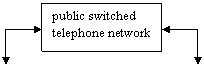
In TELETEXT, a broadcast television channel with data signals describing pictures embedded in lines in the vertical interval is used to send a magazine of frames (see Fig. below) The frames are repetitively broadcast. A typical magazine might have 100 frames, and 20 seconds are required to cycle through them. A customer of the service uses a small number pad to indicate the frame he desires to see, and the next time that frame is broadcast, its description is stored in memory in the terminal, and the frame is refreshed on the customer's TV. At least one of the frames of the magazine is an index to the remaining frames, so a customer will have knowledge of what can be selected. Provision is also made2 for mixing data display with the normal TV picture to give subtitles or news flashes.
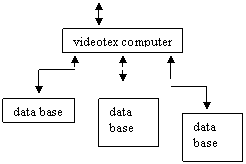
In VIDEOTEX (originally called VIEWDATA), the transmission medium is the switched telephone network. A customer calls up a database computer and requests a frame of information to be sent to his terminal for storage and display (see Fig. 13). Table of contents frames tell a customer the numbers of frames that he can select, including more specialized table of contents frames.
 | |||
|
|
 |  |
 | |

The principal difference between Teletext and Videotex is that videotex service uses the public switched telephone network to transmit the coded textual information. Because of this two-way communications can be used, rather than3 the one-way broadcasting of teletext. This means that a dialogue can be set up between the user and the videotex center so that sophisticated service requirements of the user may be satisfied. Another feature of the interactive type of service is that it may be used for data gathering (for which the term "ingathering" has been coined) as well as data distribution. There are many exciting new possibilities for ingathering like electronic shopping for goods and tickets and some others.
The digitally coded frames of videotex are transmitted along the telephone line in the form of modulated tone that is contained within the audio band passed by long distance telephone lines. This means that it is possible to use videotex systems in offshore vessels4 over a radio telephone channel which has, in fact, about the same bandwidth capability as a long distance telephone line. Thus, mariners would be able to receive any of the services of a videotex base, for example, weather forecasts.
Notes
1. have come into existence – появились
2. provision is also made – предусматривается также
3. rather than – а не
4. in offshore vessels – на кораблях, находящихся в открытом море
III. Find in the text answers to the following questions:
1. What types of picture information systems have come into existence? 2. What were they aimed at? 3. What is Teletext? 4. What is the transmission medium in Videotex? 5. Can Teletext and Videotex be used for electronic shopping of goods and tickets? 6. Where else can interactive picture information systems be used?
IV. Speak about the difference between Teletext and Videotex. Find the information in the text.
LESSON FOUR
I. Look through the list of the English words and their Russian equivalents facilitating reading text C:
profound – глубокий, основательный; commodity – предмет потребления; удобство; расе – скорость, темп; electronic interactive system – электронная интерактивная система; to disseminate – распространять; dissemination – распространение; consumer – потребитель, абонент; terminal – оконечная аппаратура; терминал, вход; image – изображение; character – буква, символ; to utilize – использовать; common-carrier telephone line – (многоканальная) линия ВЧ связи совместного пользования; network – сеть; схема; to retrieve – отыскивать; восстанавливать (информацию); database – база данных; augmented – увеличенный, расширенный; to access (v) – выбирать (из памяти); (n) – доступ; выборка; databank– банк данных, хранилище данных.
II. Scan text С. Find the information of the possibilities of Videotex as a means of communication:
Text С
A Perspective on the Development of Videotex
1. The twentieth century has seen the emergence of the information age1. The telephone, radio, motion pictures, television, and the computer all have had profound effects upon our life style and all are concerned primarily with the communication or storage of information. Information has become a commodity to be produced and traded. The pace of technological development is quickening. The cost of communications and information storage is rapidly decreasing and the whole structure of the information industry is constantly changing. The only thing that can be depended upon is that change will occur. To help manage this need for creation and dissemination of information a new interactive electronic system, videotex, has evolved.
2. Videotex is a name used internationally to represent a class of home and business information services which disseminate information from public information suppliers into the home or office. In the domestic situation the home television receiver, suitably modified would serve as the consumer's terminal equipment. The system essentially makes use of2 the home television set as a picture display medium in which the consumer has control over what is displayed. An electronics module is added to the home television set to allow us to assemble and display an image made up of characters and graphics utilizing the common-carrier telephone line or other interactive network or broadcast system, users of videotex services will be able to retrieve information stored in computer-controlled databases and have it displayed on their augmented TV receivers or video business terminals. They will be able to access textual information or graphic images from centralized public or private data banks. Individuals with slightly more complex terminals will be able to compose their own information to be stored in the data banks for access by others. As mass production reduces the cost of producing electronic components, individuals will be able to communicate with each other and interact by being able to see the same images displayed on their individual television screens. These various capabilities, which bring advanced technologies to the home user, could have a profound effect on communications and in our society. Such systems allow the introduction of many different services for home and business applications.
Notes
1. has seen the emergence of the information age – явилось свидетелем возникновения века информации
2. makes use of – использует
III. Say whether the following statements are true or false:
1. The twentieth century has seen the emergence of the information age. 2. The whole structure of the information industry remains unchanged. 3. Videotex is the name representing a class of home and business information services which spread information from public information suppliers into the home or office. 4. The videotex system makes use of the home television set as a picture display medium. plex terminals will not allow users to compose their own information to be stored in the data banks for access by others. 6. In the future individuals will be able to communicate with each other by seeing the same images displayed on their individual television screens.
IV. Find answers to the following questions:
1. Is the pace of technological development quickening? 2. What has a new interactive electronic system, Videotex, developed for? 3. Does the videotex system make use of the home television set as a picture display medium? 4. Will the users of the videotex system be able to access textual information from centralized public or private data banks? 5. Will the interactive electronic system have a profound effect on our life?
V. Find the information about data banks in the text. Say whether the information is new to уоu.
VI. Divide the text into logical parts and say what each part is about.
VII. Find the main information of paragraph 2.
VIII. Read paragraph 2 again and say:
a) what Videotex is; b) how the home television set might be used in the videotex system;
c) what individuals with complex terminals will be able to do.
IX. Summarize the general ideas developed in texts А, В, С.
X. Imagine that you are to make a report at a conference about the possible means of communication. While preparing it use the information of texts А, В and C. Make the report in written form.
ГРАММАТИЧЕСКИЙ СПРАВОЧНИК
1. ГЛАГОЛ
В английском языке различаются личные и неличные формы глагола.
Личные формы глагола согласуются с подлежащим . Неличные формы глагола – инфинитив, причастие, герундий – не выражают ни лица, ни числа, ни наклонения и не могут быть в предложении сказуемым, но могут входить в состав сказуемого.
К личным формам относятся глаголы во всех временах действительного и страдательного залогов.
§1. Основные формы глагола
Основными формами глагола в современном английском языке являются: I - инфинитив (Infinitive), II – прошедшее неопределенное время (Past Indefinite), III - причастие П (Participle II) и IV – причастие I (Participle I). Эти формы служат для образования всех остальных глагольных форм.
I | II | III | IV | |
Infinitive | Past Indefinite | Participle II | Participle I | |
стандартный глагол | to ask спрашивать | asked спрашивал спросил | asked спрашиваемый спрошенный | asking спрашивающий спрашивая |
нестандартный глагол | to send посыпать | sent посылал послал | sent посылаемый посланный | sending посылающий посылая |
1. Infinitive – неопределенная форма глагола. Она является исходной при образовании грамматических времен, неличных форм и повелительного наклонения. Признаком инфинитива является частица to. На русский язык переводится неопределенной формой глагола: to work – работать, to help – помогать, to know – знать.

|
Из за большого объема этот материал размещен на нескольких страницах:
1 2 3 4 5 6 7 8 9 10 11 12 13 14 15 16 17 18 19 20 21 22 23 24 25 |
