


Партнерка на США и Канаду по недвижимости, выплаты в крипто
- 30% recurring commission
- Выплаты в USDT
- Вывод каждую неделю
- Комиссия до 5 лет за каждого referral
III. Give the initial forms of the following words:
making, concentrating, stimulated, made, waves, lasers, increases, excited, given, seen, including, liquids, solids, purposes, developed, gives, changes, generated, known, allowing, smaller, longer.
IV. State to what parts of speech the following words belong:
Visible, length, ordinary, different, amplifier, amplification, emission, radiation, semiconductor, scientific, industrial, gives, needed, atomic, microwave, unbelievable.
V. Find the roots of the following words:
amplifier, different, development, industrial, intensity, achievement, atomic, revolutionary, building, shorten, achievable, realize.
VI. Form nouns adding the suffixes a)-age, b)-ment and c)-ity to the given verbs and adjectives and translate them:
Example: a) to leak – течь b) to equip – оборудовать
Leakage – утечка equipment – оборудование
с) stable – устойчивый
stability – устойчивость
a) to use, to cover, to store, to break, to pass, to carry, to link, to stop, to assemble, to short(en);
b) to develop, to arrange, to achieve, to move, to measure, to improve, to manage, to establish, to excite, to require-,
c) real, active, able, complex, dense, electric, intense, conductive, capable, special, flexible.
VII. Make sure if you remember the meaning of the following verbs. Consult a dictionary:
to increase, to excite, to give, to include, to fall, to use, to test, to check, to join, to mount, to achieve, to exceed, to oscillate, to reach, to jump.
VIII. Define the functions of the Gerund in the following sentences and translate them:
1. A laser is a machine for making and concentrating light waves into a very intense beam. 2. Go on making the experiment. 3. The idea of using lasers came from A. Prokhorov and N. Basov. 4. The laser beam is made by exciting the atoms of a suitable material. 5. Measuring temperature is necessary in many experiments. 6. There can be no progress in science without experimenting. 7. Solving such problems helps us greatly. 8. Their wish is mastering the fundamentals of radio-engineering. 9. The melting point of aluminium is 657°C. 10. I remember visiting this laboratory. 11. They succeeded in obtaining these data.
IX. Choose the sentences with the Gerund from the ones given below and translate them:
1. Special instruments measuring cosmic radio signals are being installed in the observatory. 2. Penetrating into space was very important for mankind. 3. Applying the method we get better results. 4. Upon adding heat we can change the state of a substance. 5. When measuring the voltage we use a voltmeter. 6. A number of materials, including some gases and semiconductors, possess this property. 7. For many centuries men were interested in obtaining new sources of energy. 8. The engineer insisted on experimenting as the best method to solve this problem. 9. The importance of scientific researches and discoveries is growing with every year.
X. Translate the following sentences. Note the words which help you to define whether the word with the suffix -ing is verbal noun, a gerund or a participle:
1. Our aim is solving this complex problem. 2. They succeeded in obtaining good results working with this metal. 3. The building of the house will be finished next month. 4. In testing the devices they found some serious faults. 5. The growing importance of automatic equipment in industry attracts world-wide attention. *****ssian scientists played a great role in the spreading of the metric system in Russia. 7. After graduating from Petersburg University A. S.Popov remained there as a post-graduate at the Physics Department. 8. After Hertz had published his experiments proving the existence of electromagnetic waves, A. S.Popov thought of a possibility of using Hertz waves for transmitting signals over a distance. 9. On March 24, 1896 he demonstrated the transmission and reception of a radiogram consisting of two words: Heinrich Hertz. 10. Using the new method it is possible to increase accuracy and speed of spectral analysis. 11. Thousands of scientists, using the most modern equipment, are studying the atmosphere.
XI. Translate the following sentences paying attention to the functions of the Gerund:
1. Large-scale application of electronic technique is a trend of technical progress capable of revolutionizing many branches of industry. 2. Leningrad physicists have developed a method for using optical quantum generators for spectral analysis. 3. When atoms or molecules are excited they emit electromagnetic counting the number of waves in a certain period, a very accurate measure of time can be defined. 4. The operating speeds of these systems will be measured in nano-seconds.5.Telemetry is the science of seeing some place without being there. 6. Electronics is not so much a new subject as a new way of looking at electricity. 7. We know of Kondakov's having made the first synthetic rubber in the world. 8. Soviet physicists saw in semiconductors the way of solving complicated engineering problems. 9. These scientists continue working in this promising field of knowledge. 10. We know of Yoffe's having contributed much to the research of transistors.
XII. Match up the words which are opposite in meaning:
a) high, thin, hot, small, long, visible, possible, increase, known, important, include, different;
b) unimportant, unknown, decrease, impossible, invisible, short, big, cold, thick, low, exclude, the same.
XIII. Listen to the following tape-recorded lexical program. Try to memorize all the words and word-groups:
■ laser – лазер, оптический квантовый генератор ■ maser – мазер, микроволновый квантовый генератор ■ light waves – световые волны ■ amplifier – усилитель ■ to make up – составлять ■energy level – уровень энергии (энергетический уровень) ■ to give off energy (light) – отдавать энергию; излучать, испускать (свет), ■to generate – генерировать; вырабатывать, производить ■ solid – твердое тело; твердый ■ property – свойство ■ three-dimensional image – объемное изображение ■ emission – эмиссия, испускание, излучение ■ range – дальность, радиус, сфера (действия); диапазон, пределы ■ wavelength – длина волны ■ by a factor of 10 – в 10 раз ■ to oscillate – колебаться ■ master control – главный орган управления ■ holography – голография
LESSON TWO
I. Study text A. Try to understand all details. Use a dictionary if necessary:
Text A
Lasers and Masers
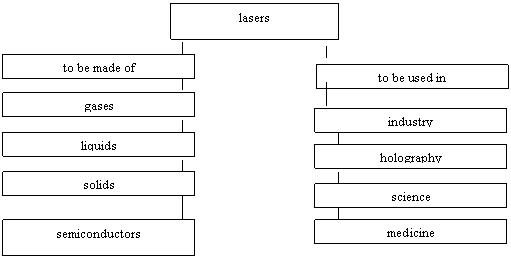
1. A laser is a machine for making and concentrating light waves into a very intense beam. The letters LASER stand for Light Amplification by Stimulated Emission of Radiation. The light made by a laser is much more intense than ordinary light. With ordinary light, all the light waves are different lengths. With lasers, all the light waves have the same length, and this increases the intensity.
2. Atoms are made up of neutrons, electrons and protons. The electrons circle round the protons and neutrons. In a laser, the electrons are "excited" to a high energy level. As the electrons fall back from their "excited" state to their normal state, they give off energy. This energy is given off as light which can be seen. A number of materials have this property including some gases, liquids, solids and semiconductors. Thus a number of different types of lasers have been developed.
3. Lasers are now used for many scientific, medical and industrial purposes. The thin beam of light gives a lot of heat and it is used to join metal when a very small joint is needed. The beam can also be used as a drill, to make holes in steel, or even in diamonds. Because the beam is so small, it's very important in delicate surgery and is used in eye operations.
4. Lasers are also used in holography. A hologram is a three-dimensional image, a bit like1 a photograph. It's different from a photograph because it looks solid. As you walk round a hologram, it changes, as if it were real. Now holography is used for testing engineering ideas. An engineer can use a hologram to build up and check a new building such as a bridge. He can find out all about it before he builds it.
5. The word MASER is also an acronym – for Microwave Amplification by Stimulated Emission of Radiation. The maser is operated on the same principle2 as the laser except that the wavelengths generated are much longer and therefore the energy jumps involved are smaller. The excited bodies in a maser are molecules rather than atomic electrons and the beam generated is a coherent beam of microwaves which is not visible to the eye.
6. Masers have made revolutionary advance possible in a number of different fields. They are up to 1.000 times more sensitive3 than any other type of amplifiers. Maser amplifiers mounted on radio telescopes can increase even their great range by a factor of 10, allowing us to reach out to the bounds of the known universe. Because of the very constant frequency with which masers can be made to oscillate they can be used as master controls for atomic clocks of unbelievable accuracy: an error not exceeding 1 second in 10.000 years has already been achieved.
7. The idea of using stimulated emission of radiation for amplification of very short waves came, from A. Prokhorov and N. Basov of the Lebedev Institute in Moscow.
Notes
1. a bit like – немного напоминающий
2. is operated on the same principle – работает на том же принципе
3.1.000 times more sensitive – в 1000 раз более чувствительный
II. Say whether the following statements are true or false:
1. The light made by a laser is much more intense than ordinary light. 2. With ordinary light, all the light waves have the same length. 3. With lasers all the light waves have different length. 4. A laser concentrates light waves into a very intense beam.
III. Answer the following questions on paragraph 2:
1. What are atoms made up of? 2. To what level are the electrons excited in a laser? 3. When do they give off energy? 4. In what form is this energy given off?
IV.Find the place in paragraph 3 containing the information of the uses of lasers. Render this information to your group-mate.
V. In paragraph 4 find the English equivalents of the following words:
голография, голограмма, объемное изображение, выглядеть, испытывать, проверять, выяснять.
VI. Translate paragraph 5.
VII. Read paragraph 6 and say where masers are used.
VIII. Write out of the text the words and phrases describing a laser.
IX.Describe the uses of lasers.
X. Divide text A into logical parts and find the topical sentences of each part. Put them down.
XI.Speak about lasers using the topical sentences and the logical diagram given below.
LESSON THREE
I. Look through the list of English words and their Russian equivalents facilitating reading text B:
micro welding – микросварка; resistor trimming – подгонка резисторов; isolation – выделение; отделение; power engineering – энергетика; extrapure – сверхчистый; resolution – разрешающая способность; to store – запоминать, хранить; to process – обрабатывать; archive – архив; to display – отображать (данные); выводить (данные); screen – экран; information carrier – носитель информации; to come in handy – пригодиться, прийтись кстати; indispensable – обязательный, необходимый; to put into effect – осуществлять.
II. Read the following text and entitle pare your title with the one given by the author. (See the key on page 106).
Text В
Just some decades ago, neither laser installations nor the very word laser were in existence. Today, lasers are used in electronics, medicine, engineering, communications, the automobile and aircraft industry, agricultural machine building, and other fields of the economy and science. But the field of laser applications is expanding very rapidly. Let us point out only a few new uses of the laser.
Lasers have wide-ranging technological uses. In the production of electronic components lasers are used in such operations as micro welding, resistor trimming, etc., something that can be performed perfectly well today.
Laser radiation has the property of selective excitation of atoms and molecules, enabling laser isolation of isotopes. The first successful experiment in separating isotopes by laser was performed at the Institute of Spectroscopy of the USSR Academy of Sciences, in 1972. This work is regarded by specialists as highly promising for power engineering and production of extrapure materials.
The use of laser technology has considerably increased the resolution and sensitivity of the spectroscopic methods.
Without the laser beam, there could be no optical electronics which computer specialists see as a highly promising direction for making high-performance and small-size computers. Optical electronic instruments for recording, storing and processing information use a laser beam.
Lasers can quickly record and read out information, with recording density being 100 times higher than in the most advanced magnetic system. It is evident that in the near future centralized archives will be set up allowing us to display any required information on a home TV screen.
We have succeeded in designing a new information carrier which can be used for multiple recording of light signals, similar to the magnetic tape recording.
Great importance is attached today to the use of lasers in medicine. Lasers have been successfully used in eye treatment.
Thus the laser today comes in handy in solving process and quality control problems, in medicine, communications and computer technology. It can do hundreds of jobs; the number has been constantly increasing, and before long, the laser will become a customary and indispensable assistant in most professions.
Projects are now being discussed in scientific literature of using high-power lasers for long-distance space communications. These projects have not yet been put into effect, primarily because of the great technological difficulties and, therefore, of the great cost involved. But there is no doubt, that in time, these projects will be realized and the laser beam will begin operating in outer space as well.
III. Answer the following questions:
1. Where are lasers used today? 2. The field of laser applications is extending very rapidly, isn't it? 3. Where do lasers have wide-ranging technological uses? 4. In what fields is the use of lasers highly promising? 5. What projects are now being discussed in scientific literature?
IV. Give the main points of text В in 3-5 sentences.
V. Speak about the new uses of the laser.
LESSON FOUR
I. Look through the list of English words and their Russian equivalents. You will need them for better understanding text C:
thermonuclear fusion – термоядерная реакция, термоядерный синтез; to condense – конденсировать; сгущать; evolvement – развитие; создание; exploration – исследование; target – мишень, цель; angle reflector – угловой отражатель; incident – падающий; reverse – обратный, противоположный; range – дальность; geodetic – геодезический; precision – точность.
II. Read the following text carefully. While you are reading look for the answers to the questions:
1. What idea have specialists of the quantum radiophysics laboratory suggested? 2. How is the distance to the Moon measured?
Text С
Laser at Work
1. In a department of the Lebedev Physics Institute of the USSR Academy of Sciences (FIAN) scientists from the quantum radiophysics laboratory have suggested the idea of laser-controlled thermonuclear fusion and obtained priority results in this field. Experiments in heating and condensing plasma to receive thermonuclear fusion are being conducted at one of the world's biggest laser thermonuclear installations "Delfin" (Dolphin).
2. The Institute carries out research in developing new types of lasers, studying the interaction of coherent radiation with matter, in laser thermonuclear fusion and in optoelectronics.
3. The results of this fundamental research find wide application in the development of new instruments and technological processes, in the evolvement of substances with new properties in medicine, in metrology and in the latest methods of information processing.
4. What's more, lasers are being used for very important and interesting explorations, such as measuring the distance to the Moon. Power lasers send very short light pulses to-the Moon. There are targets, or angle light reflectors, installed in five different places there, able to reflect the incident light in a precisely reverse direction. As with radar, the distance to the Moon is being established by measuring the time the signal takes to reach the target and return.
5. FIAN's station in the Crimea has built laser range finding complexes. They measure the distance to the Moon with an error of not more than one or two centimeters. This precision has allowed the laser measurement of distances to the Moon to become a new method for exploring the Earth-Moon pared with other methods, laser measurements of many basic geometric and dynamic characteristics of the Earth-Moon system offer precision several factors higher and enable more delicate geodynamic phenomena to be explored and geodetic constructions to be performed with a high degree of precision. It will give us a better understanding of the laws governing the movements of the Earth and the Moon.
III. Say where new types of lasers find wide applications.
IV. Find the information about laser-controlled thermonuclear fusion.
V. Unite paragraphs 2 and 3 and choose the most suitable title for this part out of the following ones:
1. New Types of Lasers.
2. Lasers in Optoelectronics.
3. New Applications of Lasers.
VI. Which paragraph contains the information directly connected with the title of the text? Render this information to your group-mate.
VII.Imagine that you are to make a report on the theme "Lasers today and tomorrow". Use the information of texts А, В and С and the following plan:
1. The definition of a laser.
2.The principle of laser operation.
3. The application of lasers in industry, electronics, engineering, holography, computer technology, communications, medicine, science.
The key to text B: "New Applications of Lasers".
UNIT EIGHT
• Grammar: Participle II (§ 14).
Degrees of Comparison.
• Word-formation: Prefixes de-, re-
• Individual Work: Lab Work "Participle II".
LESSON ONE
Pre-text Exercises
I. Practise the reading of the following words:
device [dɪ'vaɪs], to devise [dI'vaIz], digital ['dɪʤɪtl] , precision [prI'sɪʒn], design [dI'zaɪn], equation [I'kweɪZn], mainframe ['meɪnfreɪm], bubble [bʌbl], hardware ['ha:dweə(r)], tremendous [trq'mendəs], software ['sPftweq(r)]
II. Make sure if you can read these words correctly and say what words in the Russian language help you to guess their meaning:
computer, mathematician, mechanical, algebra, logician, coded, formulating, symbolically, differential, analyzer, program, cylindrically, transistor, production, electronic, miniaturization, technology, integrated, efficient, magnetic, information, packed, scale.
III. a) Give the initial forms of the following words:
scientists, invented, calculating, devices, developed, formulating, advances, introduced, units, stores, computing, shaped, circuits, names, capacities, devised, machines, designing;
b) Give the initial words of the following derivatives:
invention, development, mechanical, notable, digital, symbolically, faster, production, electronic, researcher, earlier, storage, magnetic, densely, equipment.
IV. a) Form verbs adding the prefixes a) de– and b) re– to the given verbs and translate them:
Example: a) to code – кодировать b) to colour – красить
to decode – декодировать to recolour – перекрашивать
a ) to compose, to couple, to generate, to activate, to tune, to magnetize, to polarize, to energize, to excite, to clutch, to camp, to carbonize, to frost, to control, to mount, to form;
b) to arm, to arrange, to consider, to count, to cover, to model, to construct, to name, to equip, to build, to make, to move, to organize, to place, to produce, to distribute, to measure, to create, to use.
V. Make sure if you remember the meaning of the following verbs. Consult a dictionary:
to calculate, to invent, to continue, to provide, to propose, to result (in), to enable, to design, to store, to contain, to undertake, to complete, to need, to prove, to expect.
VI. Translate the following sentences into Russian paying attention to the degrees of comparison.
A. 1. This classroom is larger and lighter than other classrooms. It is the largest and the lightest room here. 2. Mathematics is more important for technical students than many other subjects. 3. Lesson 3 is much easier than lessonThis article is much more interesting than that one. 5. Exercise 10 is the most difficult one. 6. This instrument is more efficient than the other one. 7. This town is as large as that one. 8. These engines are not so powerful as those motors. 9. The speed of our first sputniks was as big as 11 kilometres per second.
B. 1. The nearer the earth, the denser the atmosphere. 2. The higher the voltage, the higher is the electron velocity. 3. The bigger the mass, the bigger the weight of the body. 4. The higher the temperature, the more rapid is the motion of the molecules. 5. The greater the number of free electrons in a substance, the better this substance conducts electricity.
VII. Translate the following sentences paying attention to the functions of Participle II:
1. The discovery mentioned remained unknown to most scientists for a long time. 2. The equipment tested required further improvement. 3. When passed through a motor, electric current can do work. 4. The students have conducted all the experiments. 5. These instruments recorded the cosmic rays and the information obtained was sent back by the radar to the ground. 6. When heated, a magnet loses some of its magnetism. 7. The results received changed with material used. 8. Unless repaired, this part cannot be used in the radio set. 9. The substances investigated showed quite interesting properties. 10. When developed, the device was used for amplification of radio signals. 11. The developed technology enables us to improve the quality of articles produced. 12. The first laser was developed in 19The methods introduced received general recognition. 14. If frozen, water becomes ice. 15. The device used in our work is up-to-date. 16. The apparatus tested is looked upon as an experimental one. 17. When required, these data will be applied in our practical work. 18. The investigation analyzed resulted in an interesting discovery.
VIII.Match up the words which are opposite in meaning:
a) fast, expensive, early, high, tremendous;
b)low, late, tiny, cheap, slow.
IX. Listen to the following tape-recorded lexical programme. Try to memorize all word-groups:
■ mechanical calculating machine – механическая счетная машина ■ digital computer – цифровой компьютер ■ analog computer – аналоговый компьютер ■ analytical engine – аналитическая машина ■ sequence of instructions – последовательность инструкций (команд) ■ logical statement – логическое утверждение ■ in a way similar to – способом, подобным чему-л. ■ differential analyzer – дифференциальный анализатор ■ to make an important contribution to – внести важный вклад в ■ solid-state device – твердотельное устройство ■ the continued miniaturization – продолжавшаяся миниатюризация ■ integrated circuit – интегральная схема ■ high-speed mainframe – быстродействующая (универсальная) вычислительная машина ■ tremendous memory capacities – огромные емкости памяти ■ auxiliary storage equipment – вспомогательное запоминающее оборудование (устройство) ■ bubble – цилиндрический магнитный домен (ЦМД) ■ magnetic bubble unit – устройство на цилиндрических магнитных доменах ■ semiconductorlike chip – кристалл полупроводникового типа ■ a very large-scale integrated circuit (VLSI) – сверхбольшая интегральная схема (СБИС) ■ to devise hardware and software – изобретать аппаратные и программные средства (обеспечение).
LESSON TWO
I. Before reading text A say what you know about computers.
II. Study text A. Try to understand all details. Use a dictionary if necessary.
Text A
The Development of the Computer
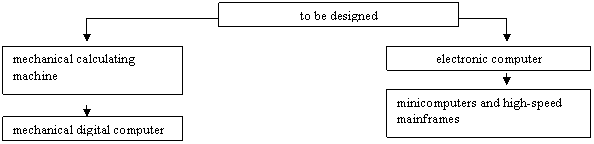
1. The inventions and ideas of many mathematicians and scientists led to the development of the computer. The first mechanical calculating machines were invented during the 1600's. One of the more notable of these devices was built in 1642 by the French mathematician and scientist Blaise Pascal.
2. During the 1830's, an English mathematician named Charles Babbage developed the idea of a mechanical digital computer. He tried to construct a machine called an analytical engine. The machine contained the basic elements of an automatic computer and was designed to perform complicated calculations according to a sequence of instructions. However, the technology of Babbage's time was not advanced enough to provide the precision parts needed to complete the machine.
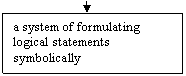
3. Another important contribution to the development of the computer was made in the mid-1800's by George Boole, an English logician and mathematician. Boole devised a system of formulating logical statements symbolically so that they could be written and proved in a way similar to that of ordinary algebra.
4. In 1930 the first reliable analog computer was built. This machine, called a differential analyzer, solved differential equations.
5. During the 1940's, John Von Neumann, an American mathematician, introduced an idea that improved computer design. He proposed that programs could be coded as numbers and stored with data in a computer's memory.
6. The invention of the transistor in 1947 and of related solid-state devices during the 1950's and 1960's resulted in the production of faster and more reliable electronic computers. The new machines also were smaller and less expensive than earlier models.
7. The continued miniaturization of electronic equipment during the late 1960's and 1970's led to further advances in computer technology. The development of the integrated circuit enabled engineers to design both minicomputers and high-speed mainframes with tremendous memory capacities.
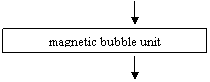
8. Researchers are seeking ways to improve memories and auxiliary storage equipment. They expect to produce an efficient magnetic bubble unit, which is faster and cheaper to operate than mechanical tape or disk units. A magnetic bubble unit is a semiconductorlike chip that stores data in tiny, cylindrically shaped areas called bubbles. Up to a million bits of information can be stored in one bubble unit.
9. Scientists are also working to increase computing speed by designing circuits that are even more densely packed and closer together. One proposed device, called a very large-scale integrated circuit (VLSI), contains hundreds of thousands of transistors and other parts. Projects also are being undertaken to devise hardware and software enabling a computer to understand ordinary speech.
III. Say whether the following statements are true or false:
1. Charles Babbage developed the idea of an electronic digital computer. 2. George Boole devised a system of formulating logical statements symbolically. 3. The invention of the transistor in 1947 resulted in the production of faster and more reliable electronic computers. 4. Scientists are also working to decrease computing speed.
IV. Answer the following questions on paragraphs 1 and 2:
1. What did the inventions and ideas of many mathematicians and scientists lead to? 2. When were the first mechanical calculating machines invented? 3. Who developed the idea of a mechanical digital computer? 4. The technology of Babbage's time was not advanced enough, was it?
V. Find the place in paragraph 3 containing the information about Boole's invention. Share this information with your group-mate.
VI. In paragraphs 5 and 6 find the English equivalents of the following words:
вводить; улучшать (усовершенствовать); конструкция (проект); предлагать; хранить; данные (информация); изобретение; устройство (прибор); кончаться, иметь (своим) результатом; производство; надежный; дорогой (дорогостоящий).
VII. Translate paragraphs 7 and 8 into Russian.
VIII. Read paragraph 9 and say how scientists are working to increase computing speed.
IX. Write out of the text the words and word combinations for describing advances in computer technology.
X. Fill in the boxes of the logical diagram with the Russian equivalents of the following words:
 |
 |  |
| |
 | |
XI. Divide text A into logical parts and find the topical sentences in each part.
XII. Speak about the development of computers using the topical sentences and words from the logical diagram.
LESSON THREE
I. Look through the list of English words and their Russian equivalents facilitating reading text B: to process (to handle) – обрабатывать; customer account – счет заказчика; to involve – включать; item – предмет, изделие; aid – средство; entertainment – развлечение; computerized games – компьютерные (машинные) игры; input device – устройство ввода; keyboard – клавиатура, клавишная панель; storage unit – запоминающее устройство; memory – память; control unit – устройство управления; to select – выбирать; to direct – управлять; arithmetic/logic unit – арифметическое/логическое устройство; output device – устройство вывода; meaningful – зд. понятный; to resemble – напоминать.
II. Skim through the text and say what it is about (you are given 5-10 minutes).
Text В
Computer is an electronic device that performs calculations and processes information. It can handle vast amounts of facts and figures1 and solve complicated problems at high speeds. The fastest computers are able to process millions of pieces of information in seconds.
A computer can process many kinds of information, from book titles and customer account numbers to chemical formulas and words from ancient Greek texts. It handles all such data in the form of numbers. A computer is able to solve problems involving words by changing them into problems dealing with numbers.
The ability of a computer to do so many tasks2 makes it useful for a wide variety of purposes. Industrial plants use computers to control machines that produce chemicals, steel products, and numerous other puters are used as a navigation aid on airplanes, ships, and spacecraft. They also enable scientists to analyze data returned by space puters can be used as teaching machines. They even provide entertainment in the form of computerized games.
Although a computer can do many things, it cannot think. A human operator has to instruct the computer exactly what to do with the data it receives. Such instructions are called a program. Also, the operator must frequently check the performance of the computer and in many cases, interpret the results of the performance.
Computers differ greatly in size. The biggest ones have enough equipment to fill a large room. The smallest computers can be held in a person's hand. No matter what their size, however, all computers have certain basic parts.
The typical computer has an input device, such as an electronic keyboard, through which the operator enters instructions and data. A storage unit, also called a memory, receives this information from the input device and holds it until it is needed. A control unit selects the instructions from the memory in their proper sequence and directs the operations of an arithmetic/logic unit. The arithmetic/logic unit processes the data by means of mathematical calculations and operations involving logic. An output device then translates the processed data into a form meaningful to the operator. Typical output equipment includes automatic typewriters, high-speed printers, and visual displays4 that resemble television screens.
Notes
1. handle (process) vast amounts of facts and figures – обрабатывать большое количество фактов и цифр
2. to do so many tasks – выполнять так много задач
3. to analyze data returned by space probes – анализировать данные космических зондов
4. includes automatic typewriters, high-speed printers and visual displays – включает в себя автоматические пишущие машинки, быстродействующие печатающие устройства и дисплеи
III. Answer the following questions on the contents of the text:
1. What is a computer? 2. What can a computer do? 3. A computer cannot think, can it?
4. What has a human operator to do? 5. Do computers differ in size?
IV. Speak about the basic parts of a computer.

|
Из за большого объема этот материал размещен на нескольких страницах:
1 2 3 4 5 6 7 8 9 10 11 12 13 14 15 16 17 18 19 20 21 22 23 24 25 |
