


Партнерка на США и Канаду по недвижимости, выплаты в крипто
- 30% recurring commission
- Выплаты в USDT
- Вывод каждую неделю
- Комиссия до 5 лет за каждого referral
LESSON FOUR
I. Look through the list of English words and their Russian equivalents facilitating reading text C:
general-purpose computer – вычислительная машина общего назначения; special-purpose computer – вычислительная машина специального назначения; to restrict – ограничивать; to represent – представлять; to compare – сравнивать; binary numeration system – двоичная система счисления; decimal – десятичный; switch – переключатель; to correspond – соответствовать; quantity – величина, значение.
II. Read the following text carefully and find the information about classifying computers:
Text С
Kinds of Computers
1. Computers are frequently divided into two groups according to the jobs they perform. These groups are general-purpose computers and special-purpose computers. A general-purpose computer can handle many kinds of jobs and is not restricted to any particular user. On the other hand, a special-purpose computer is designed to do one specific job for a particular user.
2. Computers differ in the way they work as well as in what they can do. On this basis, they can be classified into three general types: (1) digital computers, (2) analog computers, and (3) hybrid computers. Digital computers are by far the most common type.
3. Digital computers solve problems and do other tasks by counting, comparing, and rearranging digits in the arithmetic/logic unit. All the data, whether in the form of numbers, letters, or symbols, are represented by digits.
4. Digital computers use the digits of the binary numeration system. Unlike the familiar decimal number system, which uses 10 digits, the binary system uses only two digits: 0 and 1. These binary digits, called bits, can be easily represented by the thousands of tiny electronic circuits of a digital computer. The circuits operate much like an ordinary electric switch. When the switch is off, it corresponds to the binary digit 0. When the switch is on, it corresponds to the digit 1.
5. Analog computers work directly with a physical quantity, such as weight, voltage, or speed, rather than with digits that represent the quantity. The computers solve problems by measuring the quantity in terms of another quantity. In a problem involving water pressure and water flow, for example, electrical voltage might serve as an analogue (likeness) for the water pressure, and electric current for the water flow. Many familiar devices, including speedometers, thermometers, and thermostats, operate on the same basic principle as analog computers. For example, a thermometer measures temperature in terms of the length of a thin line of liquid in a tube. An analog computer presents output data in a continuous form, often as a position on a scale. In some cases, the data are displayed as electrical signals on an instrument called an oscilloscope.
6. Hybrid computers combine the features of analog and digital computers. They are as fast as analog computers in solving problems involving differential equations and as accurate as digital computers.
III. Say:
a) what numeration system digital computers use; b) in what form an analog computer presents output data.
IV. Find the information about general-purpose computers and special-purpose computers. Render it to your group-mate.
V. Explain how digital computers solve problems.
VI. Which paragraph contains the information dealing with analog computers.
VII. Find the information about hybrid computers in the text.
VIII. Summarize the general ideas developed in texts А, В and C.
IX. Imagine that you are to make a report about the development of computers. While preparing it use the information of texts А, В and С and the following plan:
1. The development of computers in the 1600's and the 1800's.
2. The further development of computers in connection with the invention of the transistor, related solid-state devices and the continued miniaturization.
3. The typical computer and its basic parts.
4. Digital computers.
5. Analog and hybrid computers.
UNIT NINE
• Grammar: Gerundial Construction (§ 15).
Functions of that, those (§ 21).
• Word-formation: Prefixes over-, en-.
• Individual Work: Lab Work "Gerundial Construction".
LESSON ONE
Pre-text Exercises
I. Practise the reading of the following words:
increasingly [In'kri:sINli], particularly [pq'tIkjqlqli], adjust [q'GAst], executive [ig'zekjqtIv], enormous [inO:mqs], launch [lO:ntS], vehicle ['vi: qkl], science ['saIqns], purpose ['pE:pqs], access ['xkses], scholar ['skPlq (r)], ancient ['einS(q)nt], guide [gaId], image ['ImIG].
II. Make sure if you can read these words correctly and say what words in the Russian language help you to guess their meaning:
control, product, operation, architectural, structure, biological, physical, social, model, system, chemist, physicist, laboratory, instrument, astronomer, telescope, photographic, process, planet, specialist, music, poem, generate, artist, style, literature, civilization.
III. Give the initial forms of the following words:
increasing, factories, turns, advanced, launching, deals, processed, giving, provides, transmitted, fields, purposes.
IV. State to what parts of speech the words in black type belong:
1. What is the number of the group your friend studies in? 2. We may group these substances according to their specific gravity. 3. The results of the experiment will be better if he changes the speed of the reaction. 4. Above certain critical temperature changes take place in the molecular structure of a metal. 5. Artificial satellites travel round the earth like planets. 6. In order to send up a manned spaceship it was necessary to solve the problem of the return travel. 7. Scientists may send any order to a radio-controlled rocket. 8. After manned spaceships return from the Moon, much valuable information will be added to that known about its composition and atmosphere. 9. Radio waves are like light waves. 10. We like working in our institute labs because we can always get help in case we need it.
V. a) Form verbs adding the prefixes a) over– and b) en– to the given words and translate them:
Example: a) to load – грузить b) large – большой
to overload – перегружать to enlarge – увеличивать
a) to heat, to estimate, to charge, to work, to fill, to fulfil, to cool, to grow, to balance, to hear, to supply, to simplify, to use, to develop, to value;
b) rich, sure, due, feeble, noble, close.
VI. Define the function of that (those) in the following sentences and translate them:
puters are devices that are capable of very rapid and accurate calculations. 2. The experimental technique was similar to that described previously. 3. You know that light waves pass through glass more easily than heat waves. 4. This control system is more efficient than that described in that journal. 5. The atoms and molecules that make up all the forms of matter are in constant thermal motion. 6. We know that automation ensures better working conditions in operation. 7. The masers can operate at other frequencies than those used in the microwave region. 8. On that day the radiotelegraphy was converted from an abstract theoretical problem into a real fact. 9. One positive charge is now called a proton and this charge is equal to that of one electron. 10. The first solar battery demonstrated in 1954 operated with semiconductor crystals similar to those used in transistors. 11. Since that time Maxwell wrote a great number of works which were the results of his experiments and calculations. 12. The antenna for the receiver is constructed in the same manner as that for the transmitter.
VII. Translate the following sentences into Russian paying attention to the Gerundial Construction:
1. I've heard of their experiment being successfully completed in the nearest future. 2. Mr. Smirnov's taking part in the design of the new data processing system was of great help to us. 3. We were told about their having studied a number of problems connected with the development of computing machinery. 4. Mankind is interested in atomic energy being used only for peaceful purposes. 5. Benjamin Franklin's having invented the first lightning conductor is a well established fact. 6. We all know of their designing a new type of computer. 7. He mentioned his having shown these slides at the conference. 8. Your having worked at the plant helped you to master technical subjects. 9. Kurchatov's having devoted all his life to nuclear physics is known to everybody. 10. I know of their being shown the new device. 11. We remembered having mentioned the works of this scientist. 12. We know of the Curies' having discovered some new radioactive elements. 13. We know of Rutherford's having investigated the nature of alpha-particles. 14. We insisted on the experiment being repeated. 15. There was no hope of their solving this complex engineering problem so soon.
VIII. Match up the words which are similar in meaning:
a) to turn on, enormous, calculation, a researcher, to work, information;
b) data, to operate, an investigator, tremendous, to switch on, computation.
IX. Try to memorize all word-groups:
■to play an important role – играть важную роль ■ developed countries – развитые страны ■ to adjust – регулировать ■ executive – служащий; сотрудник ■ advanced technological problems – передовые технологические проблемы (задачи) ■ with relative ease – с относительной легкостью ■ to be of tremendous help – оказывать большую помощь ■ information science – информатика ■ in various ways – различными способами ■ to solve (tackle) problems – решать задачи ■ in the form of mathematical equations – в виде (форме) математических уравнений ■ in many scientific fields – во многих научных областях ■ experimental data – экспериментальные данные ■ an efficient means – эффективное средство ■ in either case – в любом случае.
LESSON TWO
I. Before reading the text try to answer the following questions:
1. How do computers help in engineering? 2. What role do they play in the sciences? 3. How are computers used in the fine arts?
II. Study text A. Try to understand all details. Use a dictionary if necessary.
Text A
Uses of the Computer
puters play an increasingly important role in society, particularly in industrially developed countries.
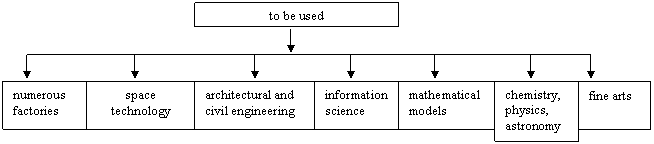
Numerous factories use computers to control machines that make products. A computer turns the machines on and off and adjust their operations when necessary. In most major industries, computers help researchers and executives make important decisions.
2. Without computers, it would be impossible for engineers to perform the enormous number of calculations needed to solve many advanced technological puters help in the building of spacecraft, and they assist flight engineers in launching, controlling, and tracking the puters also are used to develop equipment for exploring the moon and planets. They enable architectural and civil engineers to design complicated bridges and other structures with relative ease.
3. Computers have been of tremendous help to researchers in the biological, physical, and social sciences. They also have a major role in the field of information science. Information science deals with how information is collected, processed, and transmitted. It brings together knowledge from many fields of study2. Researchers' using computers helps them to solve problems in the biological and physical sciences. One method used for certain problems provides exact solution in the form of mathematical equations.
4. In many scientific fields, researchers use computers to construct mathematical models of devices, systems and theories. The models consist of equations that describe the possible relations between the parts or processes of a subject.
5. Chemists and physicists rely on computers3 to control and check sensitive laboratory instruments and to analyze experimental data. Astronomers use computers to guide telescopes and to process photographic images of planets and other objects in space.
puters provide an efficient means of storing and locating scientific research data for reference purposes4. Their storing records of thousands of articles and reports gives specialists quick access to the latest development in their field.
puters can be used to compose music, write poems, and produce drawings and paintings. A work generated by a computer may resemble that of a certain artist in both style and form, or it may appear abstract or random. In either case, however, any creativity in the work is basically that of the person who programmed the computer.
puters are also used in the study of the fine arts, particularly literature. They have also been programmed to help scholars identify paintings and sculptures from ancient civilizations.
Notes
puters help in tracking the vehicles – компьютеры помогают следить за полетом ракет
2. information science brings together – информатика объединяет
3. rely on computers – используют компьютеры
4. for reference purposes – для библиографических целей
III. Say whether the following statements are true or false:
puters play an important role in society. 2. Without computers it would be possible to perform the enormous number of calculations. 3. Researchers don't use computers to construct mathematical models of devices, systems and theories. puters provide an efficient means of storing and locating scientific research data for various purposes.
IV. Answer the following questions on paragraphs 1 and 2:
1. What can computers do in most major industries? puters enable engineers to design complicated structures, don't they?
V. Find the place in paragraph 3 containing the description of information science. Say this to your group-mate.
VI. In paragraphs 1 and 2 find the English equivalents of the following words:
многочисленный; управлять; включать, (выключать); регулировать; главный (основной); исследователь; служащий; решение; выполнять; огромный; вычисление; передовой (прогрессивный); помогать; запускать; летательный аппарат (ракета); следить; оборудование; исследовать.
VII. Translate paragraphs 4 and 5.
VIII. Write out of the text words and word combinations for describing the use of computers in engineering and the sciences.
IX. Find Russian equivalents to the words given in the boxes of the logical diagram.
 |
 |
X. Make an outline of the text.
XI. Speak about the application of the computer using your outline and the words from the logical diagram.
LESSON THREE
I. Look through the list of English words and their Russian equivalents. You '11 need them for better understanding of text B:
sequence – последовательность; to deliver – выдавать; to refer to – ссылаться на; software – программное обеспечение (средство) ; hardware – аппаратное обеспечение (средство); high-level language – язык высокого уровня; low-level language – язык низкого уровня; to require – требовать; to suit – подходить; to add – прибавлять, складывать; to subtract – вычитать; to represent – представлять; sign – знак; assembly language – (входной) язык ассемблера; compiler – компилятор, компилирующая программа; assembler – ассемблер, компонующая программа.
II. Skim through the text and try to formulate the main idea (you are given 10 minutes).
Text В
Programming a Digital Computer
Programming involves the preparation and writing of detailed instructions for a computer. These instructions tell a computer exactly what data to use and what sequence of operations to perform with the data. Without such programs, a computer could not solve problems or deliver any other desired result.
In most cases, computer scientists and other computer specialists called programmers write the instructions. They refer to programs as software because the instructions have no physical parts. The term hardware is applied to the computer itself, including its electronic circuits and peripheral equipment.
A programmer writes the instructions for a computer in a programming language. Such a language consists of letters, words, and symbols as well as rules for combining those elements. Some programming languages closely resemble the language of mathematics. Others enable programmers to write instructions in simple, everyday expressions, such as "READ", "ADD", and "STOP". Programming languages of this kind are called high-level languages.
The language that a programmer uses depends largely on the job to be done. If a task involves processing business data, the programmer would most likely use COBOL (COmmon Business Oriented Language)1. However, preparing a computer to solve complicated scientific problems might require the use of ALGOL (ALGOrithmic Language)2, which is a mathematically oriented programming language.
Some high-level languages can be used for business, technical, or scientific programming. Such languages include FORTRAN (FORmula TRANslation)3; APL (A Programming Language)4; and PL/1 (Programming Language One)5.
Another commonly used programming language is BASIC (Beginner's All-purpose Symbolic Instruction. Code)6. BASIC is well suited for writing relatively simple programs for minicomputers and microcomputers.
Some computer programs may be written in an assembly language. This kind of language is harder to use than a high-level language because it involves symbols as well as words. For example, an assembly language might use the symbols AD for add and S for subtract.
A computer cannot work directly with a program written in a high-level or assembly language. The instructions have to be translated into a machine language composed of binary digits that represent operation codes, memory addresses, and various symbols, such as plus and minus signs. Machine language is also known as low-level language. Special programs called compilers and assemblers translate high-level and assembly languages into machine language.
Notes
1. COBOL (COmmon Business Oriented Language) – КОБОЛ (язык, ориентированный на выполнение общих экономических расчетов)
2. ALGOL (ALGOrithmic Language) – АЛГОЛ (алгоритмический язык)
3. FORTRAN (FORmuia TRANslation) – ФОРТРАН (перевод формулы)
4. APL (A Programming Language) – АПЛ (язык программирования)
5. PL/l (Programming Language One) – ПЛ/1 (язык программирования/1)
6. BASIC (Beginner's All-purpose Symbolic Instruction Code) – БЭЙСИК (многоцелевой язык символических инструкций для начинающих)
III. Answer the following questions on the contents of the text:
1. What does programming involve? 2. Who writes the instructions? 3. What does a programming language consist of? 4. What programming languages do you know? 5. What is a machine language composed of?
IV. Give the main points of text В in some sentences.
V. Speak about high-level and low-level languages.
LESSON FOUR
I. Look through the list of English words and their Russian equivalents facilitating reading text C:
advantage – преимущество; weight – вес; load – груз; pay-load – платный груз; to apply – применять; response – ответ, реакция; blind landing – посадка по приборам; flight – полет; immediate – немедленный; vehicle – летательный аппарат, ракета; reliability – надежность; solid-state device – твердотельное устройство; square inch – квадратный дюйм; complicated patterns – сложные схемы, human brain – мозг человека; reason – причина; component – элемент; dimension – размер; cost – стоимость; to save – экономить.
II. Scan text C looking for answers to the following questions:
1. What are the advantages in making computers as small as one can? 2. What is the problem of further miniaturization of computers?
Text С
Miniaturization
1. There are several advantages in making computers as small as one can. Sometimes weight is particularly important. A modern aircraft, for example, carries quite a load of electronic apparatus. If it
2. is possible to make any of these smaller, and therefore lighter, the aircraft can carry a bigger pay-load. This kind of consideration applies to space satellites and to all kinds of computers that have to be carried.
3. But weight is not the only factor. The smaller the computer, the faster it can work.
This increase of operation is a real advantage. There are some applications in which computers could be used which require very fast response times. For example, automatic blind landing of aircraft requires continuous computer calculations which result in control of the aircraft flight. The more immediate the responses are, the more stable that control can be.
3. Another advantage is that less power is required to run the computer. In space vehicles and satellites this is an important matter.
Another advantage is reliability. Mini-computers have been made possible by the development of integrated circuits. And now that transistors and other solid-state devices are used instead of valves, printed circuits with their solid-state components have a very long life1 indeed. A computer can be built up of large numbers of similar units of this kind.
4. All these devices, small as they may be to the eye2 when hundreds of circuits can be packed on to one square inch, are still much larger than they need to be. So the problem is one of finding ways of making these complicated patterns automatically very precisely and yet smaller and smaller. The limit is a long way off yet3. Human brains have more than 100 million cells per cubic centimetre but there is no reason to think that we cannot pack solid-state devices more densely than this.
5. Computers could then easily be built up from these microminiaturized components to have data stores or memories as large as are needed for any job one could imagine. If they are large in information capacity, but small in physical dimensions, with present day techniques much time and cost can be saved.
Notes
l. have a very long life – являются очень долговечными
2. small as they may be to the eye – какими бы маленькими они ни казались для глаза
3. the limit is a long way off yet – однако до предела еще далеко
III.Say whether the following statements are true or false:
1. Weight is a very important factor in computers. 2. The increase of operation is a real advantage. 3. Another advantage is that more power is required to run the computer. 4. Reliability is not particularly important in computers.
IV. Give the reason for making electronic apparatus smaller in a modern aircraft.
V. Find the information about mini-computers.
VI. Explain why transistors and other solid-state devices are used instead of valves.
VII. Which paragraph contains the information about the advantage of computers to have large information capacity but small physical dimensions?
VIII. Summarize the general ideas developed in texts А, В and C. Use the following plan:
1. The use of computers in engineering.
2.The use of computers in the sciences and fine arts.
3. Programming a digital computer.
4.Using programming languages.
5. The advantage of making computers as small as possible.
UNIT TEN
• Grammar: Absolute Participial Construction (§ 14).
Functions of it (§ 20).
• Individual Work: Lab Work "Absolute Participial Construction".
LESSON ONE
Pre-text Exercises
I. Practise the reading of the following words:
generation ["Genq'reISn], branch [brRntS], modern ['mPdn], serve [sE:v], superconducting ["sju:pq'kPndAktIN], versatile ['vE:sqtaIl], vital ['vaItl], exploration [ˏeksplq'reISn], tiny ['taIni], scholar ['skPlq(r)], circuit ['sE:kIt], tackle ['txkl], package ['pxkIG].
II. Make sure if you can read these words correctly and say what words in the Russian language help you to guess their meaning:
dynamic, discrete, economy, industrialized, national, complex, element, microprocessor, monitor, miniature, series.
III. State to what parts of speech the words in black type belong:
means of electronic computers it is possible to translate from one language to another. 2. Electric typewriters and keyboard devices are the common means of input. 3. We usually measure volume in cubic centimetres. 4. A kilogram is a unit of weight measure in the metric system. 5. Certain types of equipment handle input information and also function as output devices. 6. The atmospheric pressure is the function of the altitude above the sea level.
IV. Make sure if you remember the meaning of the following verbs. Consult a dictionary if necessary:
to appear, to develop, to count, to contain, to serve, to use, to control, to prove, to require, to perform, to repeat, to start, to determine, to exist, to represent, to transform, to compose, to operate, to process, to bring.
V. Define the function of it in the following sentences and translate them:
1. A material which allows electricity to flow through it is called a conductor. 2. It took five years to develop the machine. 3. The computer doesn't really remember, information is stored in it. 4. It is necessary to protect the human eye when laser beams are being used. 5. In Russia it was Lodygin who invented the electric lamp. 6. It is hard to overestimate the role of radio-electronics in technical progress. 7. Electronics is a young science. It belongs to the twentieth century. 8. I find it necessary to continue the experiment. 9. Electronics makes it possible to raise industrial automation to a higher level. 10. At present mathematics is the language of science and it becomes the stimulator of discoveries. 11. It is the computer that makes a machine a robot.
VI. Translate the following sentences into Russian paying attention to the Absolute Participial Construction:
1. The experiments being demonstrated, all the students watched them with great attention. 2. There are two diagrams in this figure, one of them showing the relation between volume and temperature. 3. A new radio set having been shown to them, they began to examine its details. 4. Electrons leaving the surface, the metal becomes positively charged. 5. We defined the volume, all the measurements having been done with respect to the instruction. 6. The computer performing addition, two numbers to be added come from the memory. 7. Atoms consist of three kinds of particles — electrons, protons and neutrons, the number of particles determining the kind of element. 8. The workers increased the output of measuring instruments, new devices having been applied in all the shops of the plant. 9. The experiment having been carried out, the students left the lab. 10. I was writing the translation, my friend helping me. 11. Part of the energy being changed into heat, not all the chemical energy of the battery is transformed into electric energy.
VII. Choose the sentences with the Absolute Participial Construction from the ones given below. Translate them into Russian:
1. Speaking about the new method of work the engineer told us many interesting details. 2. The temperature of a conductor being raised, the motion of the electrons in the conductor increases. 3. Special instruments measuring cosmic radio signals are being installed in the observatory. 4. Transistors are very sensitive to light, some of them reacting even to star-light. 5. The first man-made satellite having been sent up, it became possible to investigate various types of radiation. 6. Obtaining new data engineers can improve their knowledge. 7. The resistance being very large, the current in the circuit was small. 8. When improving the design the constructor made many calculations. 9. A great variety of substances are semi-conductors, germanium and silicon being the most important of them. 10. A series of attempts having been made, Lodygin came to a successful solution of the problem.
VIII. Match up the words which are opposite in meaning:
a) young, joint, modern, simple, hardware, conducting;
b)complex, software, ancient, isolating, old, separate.
IX. Try to memorize all word-groups:
■ modern science and technology – современная наука и техника ■ ingenious – оригинальный, искусный, хитроумный ■ obsolete – вышедший из употребления, устарелый ■ the magnetic-core memory – запоминающее устройство на магнитных сердечниках ■ to retrieve – восстанавливать, извлекать ■ silicon – кремний ■ to coin a term – придумать термин ■ to encompass – включать
LESSON TWO
I. Read text A attentively. Try to understand all details. Use a dictionary if necessary.
Text A
The Generations of Computers
1. Computer technology is one of the youngest and most dynamic branches of modern science and technology. From the 1940s to the present, the technology used to build computers has gone through several revolutions. People sometimes speak about of different generations of computers.
2. The First Generation. First-generation computers prevailed in the 1940s and for much of the 1950s. They used electronic vacuum tubes for calculation, control, and sometimes for memory as well. First-generation machines used several other ingenious devices for memory. In one, for instance, information was stored as sound waves circulating in a column of mercury¹. All these first-generation memories are now obsolete.
3. The Second Generation. In the late 1950s, the transistor became available to replace the vacuum tube. A transistor, which is only slightly larger than a kernel of corn2, generates little heat and enjoys long life. At about the same time, the magnetic-core memory was introduced. Information could be stored in core memory or retrieved from it in about a millionth of a second. Core memory dominated the high-speed memory scene for much of the second and third generations.
4. The Third Generation. The early 1960s saw the introduction of integrated circuits, which incorporated hundreds of transistors on a single silicon chip. The chip itself was small enough to fit on the end of your finger. With integrated circuits, computers could be made even smaller, less expensive, and more reliable. Integrated circuits made possible minicomputers and tabletop computers.
5. The most recent jump in computer technology came with the introduction of large-scale integrated circuits3, often referred to simply as chips. Whereas the older integrated circuits contained hundreds of transistors, the new ones contain thousands or tens of thousands. It is the large-scale integrated circuits that make possible the microprocessors and microcomputers. They also make possible compact, inexpensive, high-speed, high-capacity integrated-circuit memory. All these recent developments have resulted in a microprocessor revolution, which began in the middle 1970s and for which there is no end in sight.
6. The Fourth Generation. In addition to the common applications of digital watches, pocket calculators, and personal computers, you can find microprocessors – the general-purpose processor-on-a-chip – in virtually every machine in the home or business – microwave ovens, cars, copy machines, TV sets, and so puters today are hundred times smaller than those of the first generation, and a single chip is far more powerful than any computer of the first generation.
7. The Fifth Generation. The term was coined by the Japanese to describe the powerful, intelligent computers they wanted to build by the mid-1990s. Since then it has become an umbrella term4, encompassing many research fields in the computer industry. Key areas of ongoing research are artificial intelligence (AI), expert systems, and natural language.
Notes
1. circulating in a column of mercury – циркулирующих в столбике ртути
2. a kernel of corn – ядрышко хлебного зерна
3. large-scale integrated circuits – интегральные схемы с большой степенью интеграции
4. an umbrella term – всеохватывающий термин
II. Say whether the following statements are true or false:
puter technology is one of the oldest branches of modern science and technology. 2. First-generation machines used not only vacuum tubes for memory. 3. All recent developments have resulted in a transistor. puters of today are hundred times smaller than those of the first generation.
III. Answer the following questions on paragraph 2:
1. When did the first generation of computers appear? 2. What did they use for calculations and control? 3. What were the disadvantages of the first-generation computers?
IV. Find the place in paragraph 3 containing the information about the transistor. Share this information with your group-mate.
V. In paragraphs 4 and 5 find the English equivalents of the following words and word-combinations. Use these words for describing large-scale integrated circuits:
схема; кремний; надежный, прочный; содержать, вмещать; иметь отношение, относиться; недавний, последний; скачок в компьютерной технологии; микропроцессор; память; сделать возможным.
VI. Translate paragraph 6.
VIII.Read paragraph 7 and say what key areas of ongoing research are.
IX. Describe the advances in developing computers.
X. Find Russian equivalents to the words in boxes of the logical diagram.

|
Из за большого объема этот материал размещен на нескольких страницах:
1 2 3 4 5 6 7 8 9 10 11 12 13 14 15 16 17 18 19 20 21 22 23 24 25 |
