


Партнерка на США и Канаду по недвижимости, выплаты в крипто
- 30% recurring commission
- Выплаты в USDT
- Вывод каждую неделю
- Комиссия до 5 лет за каждого referral

Notes
monly referred to as — на которую обычно ссылаются как на
2. its is a vital and powerful tool — это важное и мощное средство
3. oral communication — устное общение, коммуникация 4 engineering discipline — техническая дисциплина
5. job-related communication — деловое общение
6. personal communication — личное (персональное) общение
7. project team — проектная группа
8. a set of symbols — набор символов (знаков)
9. f ace-to-face communication — личное общение
10. in light of his own frame of reference — согласно его собственной компетенции
11 the message initiator — отправитель сообщения
12care must be taken — следует быть осторожным
13 not in light of one's personal value system – не в собственной интерпретации
II. Say whether the following statements are true or false:
munication is a process by which information is exchanged between individuals through a common system of symbols, signs, or be haviour. 2. Verbal communication is not considered to be a vital and powerful tool for the passage of information, the delivery of explanations and instructions. 3. The basic ingredients of a communications model do not include a source, encoder, message, channel, decoder, receiver, feedback and noise. 4. The presentation and discussion of the model of communication is intended to help the engineer understand why some of the messages sent are not received as originally intended, 5. The engineer should understand and appreciate the process of decoding as he does the encoding of the message for transmittal.
III. Find the place in paragraph 2 containing information about verbal communication,
IV. In paragraph 3 find the English equivalents of the following words and word combinations:
техническая дисциплина, модель, деловое общение, разрабатывать, теоретик, природа, область, понимать, ежедневно, иллюстрировать.
V. Answer the following questions on paragraph 4:
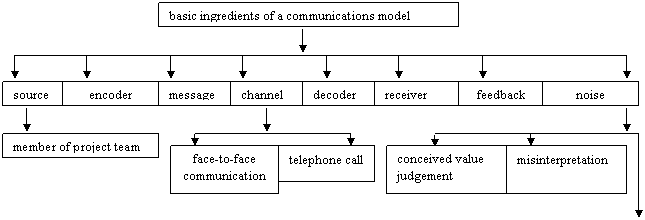
1. What are the basic ingredients of a communications model? 2. Where does communication originate? 3. The purpose of the source is expressed in the form of a message, isn't it? 4. How does the receiver decode and interpret the message?
VI. Read paragraph 5 and say:
a) what the presentation and discussion of the model of communication is intended for; b) whether care must be taken in encoding a message; c) how one should behave when one is sending a message; d) what language one should use in sending a message; e) how the engineer should treat the processes of decoding and encoding the message for transmittal.
VII. Write out of the text words, word combinations for describingthe procedure of encoding the message.
VIII. Describe the basic ingredients of a communications model to your partner.
IX. Divide text A into logical parts and find the topical sentences
in each part.
X. Fill in the boxes of the following logical diagram of the text
with Russian equivalents:
 | |
|
 XI. Speak about a communications model using topical sentences and words from the scheme.
XII. Read text A again. Concentrate on key fragments in black type. Rearrange the key fragments so as to make a logical plan of a would-be precis. Write the precis of the text. Try to make the number of the sentences in your precis equal to the number of paragraphs in the original.
LESSON THREE
I. Look through the list of the English words and their Russian equivalents facilitating reading text B:
medium (pi. media) — средство, способ, путь; среда; to evolve - развивать, разрабатывать; message — сообщение, послание; to revolutionize — революционизировать; information – информация; to remain — оставаться; facility — средство; to displace — вытеснять, смещать; mail — почта; to supply — поставлять; снабжать; to store – хранить; continuous – непрерывный; to exhibit – демонстрировать, показывать; feature – характерная черта, особенность.
II. Read the text and try to find the main information of it:
Text В
New Electronic Media
Over time, a wide range of communications media1 have been evolved to support human activities. In the process, new media have often assumed some (or all) of the functions of existing media. For example, Letters have been a personal communications medium for thousands of years. In the 19th century priority messages began to travel by telegraph, and since the end of that century, people have been able to talk to each other over the telephone. This development so revolutionized personal communications that writing letters is a dying art – the information they contain and the functions they perform are now included in a telephone call. Telegraph has also undergone change While it may still exist as a wire connection carrying low-speed data2 it has also developed into an automatic network serving commercial and industrial establishments. Even though the majority of message traffic has been diverted to Telephone, the telex network remains a vital communications facility in many nations. In other nations, Telegraph is being displaced by Data Communications4, and both Telegraph and Telephone are being replaced by Electronic Mail5, and other media.
Communications media may be differentiated on the basis of the functions they perform. Thus, Books, Magazines, Newspapers and Letters supply capsules of information which are of use over a limited time. For instance: many books will be of interest to someone for several years; on the average6, magazines evoke interest7 over a shorter period of time; and newspapers and letters hold the interest8 of the majority of readers for a matter of days, or less. Insofar as9 they all store information which can be retrieved10 as many times as the user desires, they can be called record media11.
In contrast, Telephone, Radio and Television deliver a continous stream of information12, as it is produced. They can be called real-time media. So can Data Communications, the medium which permits the exchange of information between machines. As for Telegraph it exhibits both real-time and record features.
Notes
l. a wide range of communications media – широкий набор средств связи
2. a wire connection carrying low speed data – проводная связь, передающая несрочную информацию
3. serving commercial and industrial establishments – обслуживающую торговые и промышленные учреждения
4. data communication — передача данных
5. electronic mail — электронная почта
6. on the average — в среднем
7. evoke interest — вызывают интерес
8.hold the interest — удерживают интерес
9. insofar as – поскольку
10. which can be retrieved — которую можно восстанавливать
11. record media — записывающие средства
12. a continuous stream of information – непрерывный поток информации
13 real-time media – средства передачи данных (или информации) в реальном масштабе времени
III. Answer the following questions to the text:
1. What kinds of communications media have been evolved over a time? 2. Has telephone undergone any change? 3. What is the basis for differentiating communications media? 4. What are record– and real-time media?
IV. Speak about the basis for differentiating communications media.
V. Give a short summary of text B.
LESSON FOUR
I. Look through the list of words facilitating reading text C:
forerunner — предшественник; ancestor — предок, прародитель; impulse — импульс, толчок; to detect — обнаруживать; click - щелканье, щелчок; to coin — создавать новые слова; wireless — беспроводной; to succeed in — добиваться успеха; particle — частица; amateur — любитель; broadcasting — передача радио– и телевизионных программ; service — служба.
II. Read the following text carefully. While reading it look for the
answers to the questions:
1. Who was the discoverer of electric telegraph? 2. Who made the telephone a practical instrument? 3. Who laid the foundations of electronics?
Text С
The Magnitude of Invention
1. The electric telegraph was the beginning of the whole vast telecommunications industry, the forerunner of the telephone, radio, television, communications satellites1 — in fact, a direct ancestor of everything now united under the convenient heading of "electronics".
2. But as with most other great inventions, the idea had been around for a long time. As early as 1747 electrical impulses had been transmitted along a wire laid across Westminster Bridge2, and detected at the other end by the crude but effective method of having someone hold on to the wire.
3. Strangely enough, the man who put most effort3 into developing the telegraph was a successful American painter and sculptor, Samuel Morse. On April 1, 1845, the world's first telegraph line between Baltimore and Washington has been opened for public use4, and after that the telegraph spread rapidly across Europe and America.
4. Joining the continents proved a much more difficult job5, but in 1856 the Atlantic Telegraph Company was organized to attempt the most demanding technical feat of the age and, in 1859, the Atlantic cable was completed.
5. But the inventors were already striving to transmit something more than the clicks of a Morse key. Wheatstone had coined the word" telephone in 1821, when he was only 19. Many others contributed ideas, but it was the energy and persistence of Alexander Graham Bell which made the telephone a practical instrument. Bell first realized how a telephone could be made to work in June 1875. After that progress was very rapid. The first permanent telephone line was opened in April 1876 in Boston.
6. Twenty years later, the invention of the wireless telegraph was to follow a very similar pattern. Guglielmo Marconi was only 21 years old when he succeeded in transmitting signals' by radio waves for nearly a mile.
7. A much more effective way of producing radio waves, and a more sensitive means of detecting them, were essential for progress, and were soon discovered. The invention of Edison, Fleming, and Lee de Forest were the beginning of electronics, exploiting the newly-made discovery that the electric current was actually a stream of particles, or electrons. They made wireless telephony8 possible, as distinct from 1919 there were a large number of amateur wireless enthusiasts and conditions were ripe for the beginning of broadcasting services.
Notes
munications satellites – спутники связи
2. Westminster Bridge – Вестминстерский мост
3. who put most effort — который внес наибольший вклад
4. for public use — для общественного пользования
5. proved a much more difficult job — оказалась намного более трудной задачей
6.had coined the word — создал (придумал) слово
7. succeeded in transmitting signals — добился успеха в передаче сигналов
8. wireless telephony — беспроводная телефонная связь
9. amateur wireless enthusiasts — радиолюбители
III. Find answers to the following questions:
1. When were electrical impulses transmitted? 2. Who put most effort into developing telegraph? 3. What did Guglielmo Marconi succceed in?
IV. Say what the forerunner of the whole telecommunications industry was.
V. Find the information about the person who contributed greatly into making the telephone a practical instrument.
VI. Say at what age Guglielmo Marconi succeeded in transmitting signals by radio waves.
VII.Which paragraph contains the information that the inventions of Edison, Fleming and Lee de Forest were the beginning of electronics.
VIII.Summarize the general ideas developed in texts А, В and C.
IX. Imagine that you are to make a report about the means of communication at a scientific conference. While preparing the report use the information of texts А, В, С and the following plan:
1. Communication is a process by which information is exchanged between individuals.
2. Modern means of communication rest upon a foundation laid by such scientists as Samuel Morse, Wheatstone, Graham Bell, Edison, Fleming and others.
3. New electronic media have been evolved to support human activities.
4. Telephone, radio, television and data communications are realtime media.
5. Books, magazines, newspapers, letters are record media.
UNIT FURTEEN
• Grammar: Noun as an Attribute (§ 19).
• Word-Formation: adj + n + - ed = adj.
n + - al = adj.
• Individual Work: Lab Work "Conditional Clauses".
LESSON ONE
Pre-text Exercises
I. Practise the reading of the following words:
efficient [I'fɪʃənt], capacityy [kə'pæsɪtɪ], fiber ['faɪbə], speed [spi:d], digital ['dIGItəl], voice ['vɔɪs], conversation [ˏkɔnvə'seɪʃn].
II. Check up if you can read the words correctly and say what words in the Russian language help you to guess their meaning:
decade, concept, second, system, type, telephone, cable, communication, electron, copper, diameter, interference, regeneration, resistance.
III. State to what parts of speech the following words belong:
information, install, speed, impressive, digital, television, conversation, conventional, protection, carrier, typically, inexpensive, versatility, data, travels, signals.
IV. Find the roots of the following words:
using, electrical, relatively, pulsing, easily, digital, alternately, conduction, construction, addition, equipment, operating, interference, carrier, resistance, regenerator.
V. Give the Russian equivalents of the following English compound adjectives with the suffix
-ed:
a fair-sized vessel, a great-faced clock, yellow-coloured walls, thick-lensed spectacles, high-priced equipment, light-flooded sky, good-humoured sarcasm, an ice-coated sign, a narrow-sheeted newspaper, a grey-roofed house, an oval-shaped vase, solid-headed lines.
VI. Form compound adjectives with the suffix -ed, corresponding to the following word combinations:
Example: a building of red brick – a red-bricked building
a machine-tool of medium size, an alphabet of Greek letters, a cover of soft leather, zigzags of a red pencil, mixture of thick oil, a box with thin walls, a house of small size, a clock with a dark face, a figure with sharp angles, a person of high culture, a man with narrow mind.
VII. Form adjectives by adding the suffix -al to the following nouns, making changes where necessary:
Example: form – форма
formal – формальный
optics, theory, electricity, digit, nation, idea, music, conversation, principle, structure, practice, notion, logics, vocation, profession.
VIII. Check up if you know the meaning of the following verbs. Consult a dictionary if necessary:
to transmit, to cost, to consider, to abridge, to undermine, to accommodate, to handle, to install, to compare, to eliminate, to require, to allow, to encounter, to travel, to carry.
IX. Read and translate the following word combinations paying attention to nouns as attributes:
light pulses, light wave communications system, transmission system, telecommunications network, glass fiber, voice signal, data signal, television signal, telephone conversation, telecommunications transmission, construction cost, underground duct, copper cable, signal regenerator, carrier system, device reliability, laser beam, laser beam wave, radio wave, radio wave speed.
X. Choose the sentences from the text containing word combinations with nouns as attributes. Translate these sentences into Russian.
XI.Match up the words which have a similar meaning:
a) concept, information, sophisticated, versatile, enormous, speed, to undermine, single, inexpensive, conventional, significant, to handle, to require, space.
b) important, to operate, to demand, room, idea, traditional, data, many-sided, cheap, the only, very large, destruct, rate, intricate.
XII. Try to memorize all the words and word-groups:
■ decade – десятилетие ■ light pulse – световой импульс ■ to transmit information – передавать информацию ■ lightwave communications system – система связи с использованием световых волн ■ hair-thin glass fiber – стекловолокно толщиной в человеческий волос ■ voice signal – речевой сигнал ■ capacity – мощность ■ contents – содержание ■ high-speed data signal – высокоскоростной сигнал данных ■ accommodate – включать, охватывать ■conventional – традиционный, обычный ■ copper wire – медная проволока ■ to substitute for – заменять, замещать ■ to install – устанавливать ■ electromagnetic interference – электромагнитная помеха (интерференция) ■ lightguide cable – световодный кабель ■ carrier system – многоканальная система связи ■ signal regenerator – регенератор сигнала ■ electrical digital carrier system – система электрической многоканальной цифровой связи ■ equipment оборудование ■ protection – защита
LESSON TWO
I. Read text A. Try to understand all details. Use a dictionary if necessary:
Text A
Modern Light-Wave Communications Technology
1. Some time ago, the concept of using light pulses instead of electrical signals1 to transmit information was only that – a concept. Today, lightwave communications systems are among the most sophisticated transmission systems in the telecommunications network. They are at once efficient, versatile and relatively inexpensive to install and maintain.
2. The efficiency of lightwave systems is perhaps their most renowned quality2. They carry enormous amounts of information over long distances at very high speeds. Consider, for example, the speed and capacity of the Bell System's long distance lightwave system. Light pulsing through a single, hair-thin glass fiber in this system can transmit the entire contents of Webster's unabridged dictionary4 – more than 2700 pages – over thousands of miles in only six seconds.
3. No less impressive than this tremendous speed and capacity is the versatility of light-wave systems. Because they are digital systems, they can transmit easily any of these types of information: voice signals, high-speed data signals, and television signals. Without undermining quality or efficiency, a single system can accommodate thousands of telephone conversations, and alternately handle data or video signals.
4. Finally, lightwave systems are inexpensive to install and operate compared to their wire-and-cable counterparts. Moreover, they allow considerable savings.
5. The reasons for such savings stem from the technology of lightwave communications. Conventional telecommunications transmission is based on the conduction of electrons through metal (usually copper wires). Lightwave systems, however, substitute protons for electrons and glass fibers for copper. These technological differences translate into big savings5, the most significant of which is in construction costs. Because lightguide cables are only a fraction of the diameter and weight6 of copper cables, they are easy to handle and take up far less space. They can be installed in existing underground ducts and rights-of-way7, sometimes right next to copper cables.
6. In addition, lightwave systems eliminate certain equipment and operating costs. They are immune to electromagnetic interference8, and therefore require no protection from it. Also, light can travel much farther through lightwave cables without regeneration than can electrons through copper carrier systems. This is because the light encounters little resistance from the very pure glass fibers through which it travels. Lightwave systems require significantly fewer signal regenerators than do electrical digital carrier systems: typically one every ten miles instead of one every mile.
Notes
1. the concept of using light pulses instead of electrical signals – идея использования световых импульсов вместо электрических сигналов
2. their most renowned quality – их самое известное свойство
3. over long distances – на большие расстояния
4. the entire contents of Webster's unabridged dictionary – полное содержание неадаптированного словаря Вебстера
5. translate into big savings – приводят к большой экономии
6. only a fraction of the diameter and weight – только частица в диаметре и по весу
7 right-of-way – полоса отчуждения
8. are immune to electromagnetic interference – невосприимчивы к электромагнитной интерференции
II. Say whether the following statements are true or false:
1. The concept of using light pulses instead of electrical signals to transmit information is not new. 2. The efficiency of lightwave systems is their most renowned quality. 3. Lightwave systems can transmit various types of information: voice signals, high-speed data signals, and television signals. 4. Conventional telecommunications transmission is not based on the conduction of electrons through metal.
III. Answer the following questions on paragraph 1:
1. Is the idea of using light pulses instead of electrical signals to transmit information new?
2. Do lightwave communications systems belong to the most sophisticated transmission systems?
3. What are the qualities of lightwave communications systems?
IV. Find the place in paragraph 2 containing information about the possibility to transmit the entire contents of Webster's dictionary over thousands of miles in only six seconds.
V. In paragraphs 3 and 4 find the English equivalents of the following words and word combinations:
огромная скорость, по сравнению с, разносторонность; система дискретной (цифровой) связи, речевой сигнал, сигнал данных, видеосигнал, устанавливать, качество, эффективность.
VI. Translate paragraph 5 into Russian.
VII. Read paragraph 6 and say:
a) whether lightwave systems eliminate certain equipment and operating costs; b) whether they are immune (невосприимчивы) to electromagnetic interference; c) whether light can travel much farther through lightguide cables without regeneration than electrons; d)whether lightwave systems require significantly fewer signal regenerators than electrical digital carrier systems.
VIII. Write out of the text words, word combinations for describing advantages of light wave systems. Use these words for describing these advantages to your group-mate.
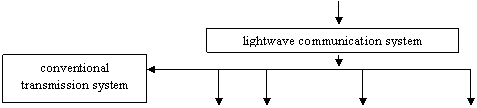
IX. Describe the technological differences between conventional telecommunications transmission and lightwave systems.
X. Divide text A into logical parts and find topical sentences in each part.
XI. Fill in the boxes of the following logical diagram of text A with Russian equivalents:
|
 |
 |
 |
|
|
| |||
XII. Read text A again. Make a list of key fragments picked out from each successive paragraph. Rearrange the key fragments, make a plan and then use it to write a précis. The number of sentences in your précis should be approximately the same as the number of paragraphs in the original.
LESSON THREE
I. Look through the list of the English words and their Russian equivalents facilitating reading text B:
fiber – волокно; strand – прядь, жила, нитка; breakthrough – достижение, открытие; transparent – прозрачный; call – телефонный разговор, заказ; вызов; immune – устойчивый, невосприимчивый; interference – помеха, вмешательство; интерференция; to affect – влиять, воздействовать; to sweep through – охватывать; to handle – обращаться, управлять; core – стержень, сердцевина; to reflect – отражать; ingredient – компонент, составная часть; to draw (drew, drawn) – тянуть, вытягивать; to coat – наносить покрытие; grain – крупица, зерно; application – применение.
П. Read text В and entitle pare your title with the one given by the author (see the key on page the author (see the key on page 169)
Text B
Optical fibres, hair-thin strands of pure glass carrying information as pulses of light1, have been described as "probably the biggest breakthrough in telecommunications since the invention of the telephone". All kinds of communications can be carried along the same optical fibre cable – speech, text, photos, drawings, music, computer data, etc. – at higher speeds than have been previously possible.
The fibres, made from glass so pure that a block of it 20 km thick would theoretically be as transparent as a window pane2, have many advantages over metal wires. Small, light and easy to handle, they are made from an abundant raw material, sand. They can carry the same number of telephone calls as metal cables ten times as thick – dozens of fibres, carrying around, 100,000 telephone calls, could all pass through the eye of a needle4, at the same time – and they are immune to electrical interference which affects the quality of calls. An optical fibre cable the thickness of a finger could bring a hundred TV channels to a receiver.
The tiny strands are playing a key role5 in the digital revolution which is sweeping through modern telecommunications. The telecommunications network developed for the telephone used a system which turned the air pressure waves created by speech into continuous and variable "analogues" of electrical waves and turned them back to speech at the receiver. Expensive conversion equipment or separate networks were needed to handle text, TV or computer data. In the digital world, however, all forms of information are translated into bits6, the standard international language of today's computers, and represented as pulses of light. Information in this form can be processed easily and sent anywhere in seconds in a single multi-purpose network. Optical fibres are ideal for digital working and open the door to a host of services not possible on an analogue system.
Each strand of fibre consists of an inner core7 to channel the light and an outer cladding8 to keep it in by reflecting it back along the core. To make the glass for the fibres, the ingredients are deposited as gases on the inside of a hollow silica tube9 at temperatures of around 2000°C. The tube is collapsed under intense heat to form a solid glass rod10 about I cm in diameter which already has the structure of the fibre which will be drawn from it. The rod is then loaded into a furnace, drawn into fibre and coated with resin to protect it and increase its flexibility. Tiny crystals the size of grain of salt are used to produce the light which carries information along the fibres. This passes through a lens into the fibre. At the other end a receiver reverses the process and turns each light pulse into an electrical sign. Optical fibres will have countless applications11 in tomorrow's "information society".
Notes
1) carrying information as pulses of light – несущие информацию в виде световых импульсов
2) as transparent as a window pane – прозрачный, как оконное стекло
3) from an abundant raw material – из имеющегося в большом количестве сырьевого материала
4) the eye of the needle – ушко иголки
5) are playing a key role – играют ведущую роль
6) all forms of information are translated into bits – все виды информации переводятся в биты (двоичные разряды)
7) inner core – внутренний стержень, провод
8) outer cladding – наружное покрытие
9) a hollow silica tube – полая кремниевая труба
10) glass rod – стеклянный стержень
1l) will have countless applications – найдут разностороннее применение
III. Answer the following questions to the text:
1. What has been described as "probably the biggest breakthrough in telecommunications"? 2. Can glass fibres carry the same number of telephone calls as metal cables? 3. Is the digital revolution sweeping through modern communications? 4. Will optical fibres have countless applications in "information society" of the future?
IV. Give the main points of text B.
V. Speak about the horizons of optical fibres application in communication systems of the future.
LESSON FOUR
I. Look through the list of the English words and their Russian equivalents facilitating reading text C:
interactive – интерактивный; traffic – нагрузка; processing – обработка; terminal – конечная станция; carrier – (многоканальная) система передачи информации с использованием несущей; to reject – отказываться; unwanted – нежелательный, ненужный.
П. Study the questions below and find out which of them the author answers in the text:
1. Is Very Large-Scale Integration (VLSI) revolution nearing its end? 2. What will one be able to do with intelligent network? 3. Many uses of the telephone will be replaced by an electronic in-basket, won't they? 4. Will the postal service undergo great changes in the third millennium? 5. To. what extent will the number of newspapers and magazines be decreased in the third millennium? 6. Can one give an exact date of introducing inexpensive graphics terminals in the home?
Text С
Information and Communication in the Third Millennium
1. By the beginning of the third millennium, the Very Large-Scale Integration (VLSI)1 revolution will at last be nearing its end. We will see some of the results below – intelligent networks with information as well as data processing2. In fact, much of the interactive multiterminal communication traffic will be routed through networks with delay and computation at the nodes. As one example of what we mean by information as opposed to data processing, one will be able to route a call or electronic message to a known person without necessarily having to know the equivalent of his "telephone number". One will be able to conduct a dialogue3 over the terminal with an intelligent network that will in effect give one the number or address.
2. Commercial video broadcasting4 over the air will be almost entirely replaced by scheduled, or even on demand, transmission into homes via fibre optics5.
3. Many uses of the telephone will be replaced by an electronic in-basket that provides message forwarding, editing, retrieval, and redirection services. The Bell System will still exist, but will only be one carrier of several, depending on the kind of service. In any case, most terminals will be procured separately from the carriers, which will be mainly transmission companies or information services, depending on what they feel like calling themselves.
4. Newspapers and magazines, particularly specialized ones, will still exist. However, by the beginning of the third millennium, a trend will have been set which will lead to their ultimate redefinition as electronic services6 instead of as pieces of paper. Inexpensive graphics terminals7 in the home will permit this new kind of publication. In some cases, hard copy will be available, although with local disk storage this will not be so necessary. The electronic in-basket and electronic newspapers will mean the end of the postal service as we wish we knew it. It will be restricted to packages. The problem of electronic junk mail can be solved by each individual programming his or her own terminal to reject unwanted communications as they see fit9.
Notes
1) VLSI (Very Large-Scale Integration )– сверхбольшая интегральная схема
2) data processing – обработка данных
3) to conduct a dialogue – вести разговор, беседу
4) video broadcasting– видеопередача
5) via fibre optics – через волоконную оптику
6) electronic services – электронные службы
7) graphics terminal – графический терминал
8) hard copy – копия на однократно используемом носителе
9) as they see fit – на их усмотрение
III. Say whether the following statements are true or false:
1. Very Large-Scale Integration revolution (VLSI) will be nearing its end by the beginning of the third millennium. 2. It will bring great disadvantages for communication system. 3. Terminals of the future will give out numbers or addresses for conducting dialogues. 4. Fibre optics will find most varied application in future intelligent communication network. 5. Application of fibre optics for communication will mean complete disappearance of the Bell System as well as the postal service. 6. Each individual will have a possibility to program his or her own terminal to reject unwanted communications.
IV. Say how one will be able to conduct a dialogue over the terminal with an intelligent network.

|
Из за большого объема этот материал размещен на нескольких страницах:
1 2 3 4 5 6 7 8 9 10 11 12 13 14 15 16 17 18 19 20 21 22 23 24 25 |
