


Партнерка на США и Канаду по недвижимости, выплаты в крипто
- 30% recurring commission
- Выплаты в USDT
- Вывод каждую неделю
- Комиссия до 5 лет за каждого referral
VI. Make sure if you remember the three forms of the following verbs. Translate the verbs into Russian:
be – was/were – been; bear – bore – born; begin – began – begun; buy – bought – bought; feed – fed – fed; find – found – found; get – got – got; give – gave – given; hold – held – held; hear heard – heard; know– knew – known; lie – lay – lain; make – made – made; meet – met – met; run – ran – run; say – said – said; send – sent – sent; sit – sat – sat; take – took – taken; understand – understood – understood.
VII. Define the tense-forms of the verbs in the following sentences. Translate the sentences into Russian:
1. Belarusian people are developing the economy of the country. 2. The output of the factory will be growing during the current five-year period. 3. Our scientists are using the energy of atom in various spheres of life. 4. The engineers were attaching the wires to the devices when I came in. 6. At present they are studying various aspects of this problem. 7. When we listen to a radio programme we are using the rays that are called radio waves. 8. The scientist was solving a new problem when we visited his laboratory last week. 9. What is she doing this week? 10. John was reading a book when I came to see him. 11. My friend is writing an article for the newspaper. 12. The student was carrying out this experiment for twenty minutes. 13. The plane was flying over the Ukraine. 14. I'm working too hard this year. 15. Molecules in a gas are constantly moving. 16. The electron is circling in an orbit around a nucleus.
VIII. Read the following sentences and say which of them are in the Active and which are in the Passive Voice. Translate them into Russian:
1. While the experiment was being carried out nobody left the laboratory. 2. A new type of computing equipment is being produced at our plant. 3. At present scientific work is being done mostly by large groups of researchers. 4. The apparatus will be working when you come. 5. The scientists who are carrying out research into nuclear physics deal with the most difficult problems. 6. For twenty minutes the air in the laboratory was being purified by two ventilators. 7. The solar battery is converting the energy of sun rays directly into electric energy. 8. This experiment was being carried out under low pressure.9. For a long time the electronic devices were being used for control. 10. An interesting research in the field of electronics is being done at our Institute. 11. Prospects of the usage of solar energy are already understood by everybody. 12. Now solar energy is being studied by a lot of research groups. 13. Our scientists and engineers are developing new types of electronic and cybernetic devices. 14. We were looking for a more simple method of solution but could not find it. 15. The engineers will discuss the advantages of this new system. 16. Our laboratory is housed in an old building.
IX. Translate the following word-groups. Pay attention to the tense forms of the predicates:
the problem occupied; the century began; they are obtaining; the scientists understood; the satellite was on its orbit; the property depended; the program is being broadcast; the physicist was searching; a new radio set was demonstrated; the elements constituted; the man thought; new results are being obtained; the chemist wrote; the discovery established; the particle became; the scientist was applying; the point of view differed; the engineer is measuring; the concept explains; the idea was supported; the particle will be divided; the phenomenon was explained; astronomy is studying; the telescope is built; the power plants were being controlled; the observation shows; the energy was converted; the data will be checked.
X. Analyse the functions of the verb to be. Translate the sentences into Russian:
The results of the experiment are of great importance for our further work. 2. There are no chemical plants in our town. 3. The substance that we are speaking about is water. 4. We are to translate technical literature in the second year. 5. It was the study of natural phenomena that made it possible to formulate various laws. 6. Probably the most important use of electricity in the modern house is producing light. 7. Technical progress is now impossible without high-quality materials. 8. Electronics is being used more and more throughout the industry. 9. The electron is a particle. 10. The machine is of five parts. 11. Our task is to finish the test by 7 o'clock. 12. Radio was invented by a talented Russian scientist A. S.Popov. 13. Words in a dictionary are in alphabetical order. 14. Smoking is dangerous. 15. The temperature is three degrees above zero. 16. My friends are mostly students. 17. It is the only positive solution. 18. The British are very proud of their sense of humour. 19. This scientific discovery was the result of six years' research. 20. Our aim is to accomplish this task as soon as possible. 21. He will be an engineer in two years. 22. Their house is in the middle of the village.
XI. Match up the words which are similar in meaning:
purpose, in the sphere of, to make, important, aim, proper, common, to work out, to vary, time, in the field of, significant, ray, to define, to operate, to develop, to differ, to show, method, to function, to demonstrate, technique, device, to determine, standard, to produce, suitable, beam, period, instrument.
XII. Try to memorize the words and word-groups:
■ probably – возможно, вероятно ■ exclamation – восклицание ■ to be related to – иметь отношение к ■ to have similar experience – иметь подобный опыт ■ to have nothing to do with – не иметь ничего общего с ■ to turn out – оказываться ■ after all – в конечном счете ■ to listen to a radio programme – слушать программу по радио ■ to refer to – ссылаться; называть ■ sun-tan lamp – лампа для загара ■ to guide – направлять, вести ■ bullet – пуля ■ cancer – рак, раковая опухоль ■ to resemble – иметь сходство; напоминать ■ complete – полный, законченный.
LESSON TWO
I. Read the title of the following text. Can you guess what the text might be about?
II. Study text A. Try to understand all details. Use a dictionary if necessary:
Text A
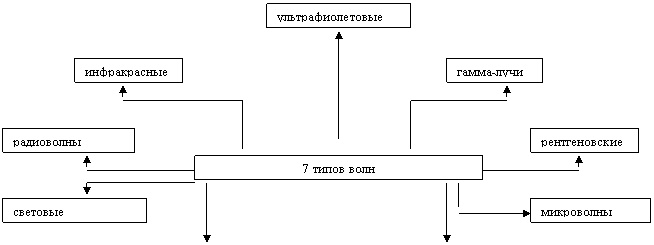
Seven Rays, One Family
1. "Isn't it a small world."1 You have probably heard this exclamation many times. People often say it when they find that acquaintances they had met at different times and places, and whom they never connected with each other, turn out to be related to each other. Scientists often have a similar experience with occurrences in nature. Things or events that at first seem to have nothing to do with3 each other turn out to be related after all. We shall repeat this experience with seven kinds of rays. We find them in different places, and use them in different ways, but they are close relatives. They are members of one family, the family of electromagnetic waves.
2. The kind of ray that mankind has known for the longest time is light. It helps us see the objects that surround us, when the objects reflect the light into our eyes. Because our eyes can detect light, we call it a visible ray. The other rays are invisible.
3. We find three types of invisible rays in use in our homes. When we listen to a radio programme, we are using the rays that are called radio waves. When we cook a meal on an electric cooker, we are using hurried rays, sometimes referred to as heat rays. When we sit under a suntan lamp, we are using ultraviolet rays. We meet the other three types of rays outside the home. Inside the hospital we shall find X-rays, produced by X-rays machines, and used for taking pictures of the insides of our bodies. At airports everywhere we shall find microwaves used with radar equipment to detect planes in the air, or guide them in to land. Also in hospitals we find gamma rays used as invisible bullets to kill cancer cells.
4. These seven types of rays resemble each other in that they are all electromagnetic waves. What makes them different from each other is their frequency or their wavelength. The distance that the wave moves during the time it takes for one complete cycle of vibration is called the wavelength of the wave. The frequency is the number of cycles in a second. Notice that radio waves are the longest of the electromagnetic waves and have the lowest frequency.
Notes
1. Isn't it a small world – Мир тесен.
2.occurrences in nature – явления в природе
3. things or events that at first seem to have nothing to do with... – предметы или события, которые, как кажется на первый взгляд, ничего не имеют общего...
III. Say whether the following statements are true or false:
1. These seven types of rays do not differ from each other. 2. Seven kinds of rays are close relatives. 3. We find three types of invisible rays in use in our homes. 4. We meet three types of rays outside the home. 5. These seven types of rays differ from each other in their frequency. 6. The frequency is the number of cycles in a second. 7. Radio waves have the highest frequency.
IV. Find the information explaining why we call light a visible ray. Read the information to your partner.
V. 1) Answer the questions on paragraph 3:
1. What rays do we deal with when we listen to a radio programme? 2. How are infrared rays referred to sometimes? 3. What rays do we use when we sit under a sun-tan lamp? 4. What kind of rays can we find inside the hospital? 5. Are microwaves used with radar equipment?
2) Name the types of invisible rays we find in use: a) in our homes-, b) outside the home.
VI. In paragraph 4 find the English equivalents to the following words:
луч, тип, частота, расстояние, напоминать, длина волны, период, полный (законченный), двигаться, называть, длинный, низкий, количество.
VII. Speak about the electromagnetic waves using English words from the logical diagram.
VIII. Fill in the boxes of the following logical diagram with English equivalents.
IX. Say briefly what each paragraph is about.
 | ||||||||||
 |  | |||||||||
|
| |||||||||
| ||||||||||
X. Read paragraph 4 again and say what makes the seven rays different from each other.
LESSON THREE
I. Look through the list of the English words and their Russian equivalents for better understanding text B:
subtle – тонкий, неуловимый; to occur – происходить; to convert – преобразовывать; receptive – восприимчивый; beyond – за пределами; wavelength – длина волны; to range – колебаться в пределах; frequency – частота; to approach – приближаться; beam – пучок; луч; to fan out – расходиться, распространяться.
II. Read text В. Find out the main information of the text.
Text В
Radio Waves
During the last few decades, a subtle change has occurred which none of our senses1 can register. Radio waves, bearing messages in many tongues2, flow ceaselessly around us, through us and above us. We can only hear and see them if we convert them to other waves to which our ears and eyes are receptive.
Radio waves are the longest members of the family of electromagnetic waves. In the spectrum, in which the waves are arranged in order of increasing wavelength3, they lie beyond the infrared waves. Their wavelengths range from about three hundredths of a centimetre to about 300 kilometers. Radio broadcasts today are made by two different methods known as AM (amplitude modulation) and FM (frequency modulation). The frequencies of the waves used are expressed in kilocycles or megacycles. The vibrating current is fed into an antenna from which the radio waves are broadcast into space.
Microwaves are the smallest radio waves. In the spectrum of electromagnetic waves they lie between infrared rays and the long radio waves. The shortest microwaves have a wavelength of about three hundredths of a centimetre and a frequency of one million megacycles. The longest microwaves have a wavelength of about three metres and a frequency of one hundred megacycles.
The first microwaves made by man were the two-foot waves produced by Heinrich Hertz. It is interesting that they were the last to be put to a practical use. Long waves were easier to produce and send out over long distances. Scientists had to return to the use of short waves in order to solve a problem4 that came up during World War II. The problem was "How can you detect an approaching enemy plane while it is still far away? " A possible answer to the problem was to send a beam of radio waves. Long radio waves could not be used for this purpose because they fan out too quickly from the broadcasting antenna. Very short waves were necessary to make the radar system work. So new transmitters and receivers were designed to make and use microwaves.
NOTES
1) none of our senses – ни одно из наших чувств
2) bearing messages in many tongues – несущие сообщения на многих языках
3) in order of increasing wavelength – в порядке увеличения длины волны
4) in order to solve a problem – чтобы решить проблему
III. Find answers to the following questions:
1. Can we hear and see radio waves? 2. What place do radio waves occupy in the spectrum of electromagnetic waves? 3. Who produced the first microwaves? 4. Were the microwaves the first to be put to a practical use? 5. What kind of problem came up during World War II?
IV. Speak about the characteristics of radio waves and microwaves.
LESSON FOUR
I. Look through the list of the English words and their Russian equivalents:
activity – деятельность; to support – поддерживать; to administer – управлять; responsible – ответственный; announcement – сообщение; to intend – намереваться; to remain – оставаться.
II. Before you read the text study the questions. Then read the text to yourself to find out which questions the author answers:
1. What is the name of the organization responsible for administering radio sport in Great Britain? 2. What word is the key one in radio sport? 3. Is radio sport supported by the government? 5. Do "foxes" identify themselves every five minutes? 6. Is the competitive spirit typical of Soviet electronics?
Text С
Radio Sport: a Serious Business
1. In Russian vocabulary the electronics enthusiasts are known as "radio sportsmen". Radio sport is a highly organized, serious activity supported and administered by the government. The organization responsible for administering radio sport is called the Radio Sports Federation. In radio sport, the key word is competition. The highest award, one held by a relatively few sportsmen, is "Master of Radio Sport". One particularly interesting form of radio competition is called "Fox Hunting". This is a contest in which teams of "hunters" (young people carrying portable direction finders ) race against time2 to find "foxes" (hidden transmitters). The rules call for3 the three "foxes" to take up positions one or two miles apart in a large wooded area. At the starting signal, the "foxes" begin identifying themselves by voice announcements4 at one-minute intervals, each "fox" therefore being on the air5 once every five minutes. The announcements, which are very brief, are made on amateur bands6 by means of low-powered transmitters, usually homemade. The winning "hunter" is the one who first locates all three "foxes" in sequence7. The kind of competitive spirit8 that characterizes radio sport is typical of electronics in general. Whether it be the technological state of the art, TV via communication satellite, or techniques for electronic training, the our people are fully aware of the importance9 of communications-electronics in the space age, and they intend to remain competitive in every possible way.
Notes
l) a portable direction finder – переносный радиопеленгатор
2) race against time – бегут на время
3) fthe rules call for – правила требуют
4) identify themselves by voice announcements – дают знать о себе голосом
5) on the air – в эфире
6) amateur band – радиолюбительский диапазон частот
7) in sequence – последовательно, одну за другой
8) competitive spirit – дух соревнования
9) are fully aware of the importance – вполне понимают значение
III. Say whether the following statements are true or false:
1. In radio sport the key word is competition. 2. One particularly interesting form of radio competition is called "Fox Hunting". 3. Each "fox" is on the air once every five minutes. 4. The announcements, which are very long, are made on amateur bands. 5. The winning "hunter" is the one who last locates all three "foxes" in sequence. 6. They are fully aware of the importance of communications-electronics in the space age.
IV. The text contains three main ideas. Divide the text into three logical parts and say briefly what each part is about.
V. Say how radio sport is characterized in the introductory part.
VI. a) What is the main principle of radio competition called "Fox Hunting"? b) Find the information in the text about the rules of "fox hunting" and answer the following questions:
1. What do the "foxes" do at the starting signal? 2. How often do "the foxes" identify themselves? 3. What devices do "the foxes" use to make voice announcements? 4. The winning "hunter" is the one who first locates all three "foxes" in sequence, isn't he?
VII. Can you say in what way the competitive spirit that characterizes radio sport shows itself in the development of electronics.
VII.Retell briefly the information you have learned from the text.
IX. Imagine that you are going to take part in a scientific conference. The theme of your report is "The Family of Electromagnetic Waves". While preparing the report use the information of texts А, В, С and the following plan:
1. Seven kinds of rays are close relatives.
2. The use of electromagnetic waves.
3. Characteristics of radio waves.
4. Short waves and their application in radio sport.
UNIT THREE
• Grammar: Perfect Tenses Active and Passive (§2, 3).
Perfect Continuous Active (§ 2, 2).
Functions of the verb to have(§ 9).
• Word-formation: suffixes -less, - ful.
• Individual Work: Lab Work "Functions of the verb to have".
LESSON ONE
Pre-text Exercises
I. Practise the reading of the following words:
knowledge ['nPlIG], record ['rekɔ:d], manual ['mxnjuəl], conversation [ˏkPnvə'seISn], drum [drAm], to shout [ʃaVt], pattern ['pætn], to reverse [rI'vE:s], to reproduce [ˏri:prq'dju:s], to wind [waInd], means [mi:nz], to store [stO:(r)], stereo ['steriqV], channel ['Cxnl].
II. Make sure if you can read these words correctly and say what words in the Russian language help you to guess their meaning:
modern, person, phonograph, code, signal, telegraph, symbol, method, diaphragm, experiment, poem, to reproduce, stereo, process, principle, line, microphone, original, music, laboratory, energy, apparatus, instrument, diameter, type..
III. Form adjectives adding the suffix -ful to the given nouns. Translate the nouns and adjectives into Russian:
Example: beauty – beautiful – красота – прекрасный
harm, power, use, fruit, skill, purpose, wonder, care, success, truth hope, taste, respect, meaning, art, change, peace, watch, help.
IV. Form adjectives adding the suffix -less to the given nouns. Translate the nouns and adjectives into Russian:
Example: hope – hopeless – надежда – безнадежный
wire, noise, help, motion, friend, aim, shape, branch, cause, character, sense, respect, object, ground, harm, change, power, colour, limit, meaning, voice, weight, life.
V. Read the words and say what suffixes they have and what parts of speech they belong to:
use, useful, usefulness; invent, inventor, invention; transmit, transmitter, transmission; work, worker; special, speciality, specialist; practice, practical; contain, container; lecture, lecturer; create, creative, creation; accelerate, acceleration, accelerator; determine, determination; proper, properly, property; science, scientific, scientist; discover, discovery, discoverer; important, importance; react, reaction, reactor, reactivity; arrange, arrangement; capable, capability; apply, application.
VI. Make sure if you remember the following verbs. Consult a dictionary:
to send, to cut, to represent, to notice, to sound, to happen, to find out, to consist of, to attach, to turn, to shout, to move, to hear, to store, to release, to repeat, to wear out, to transmit, to reproduce, to follow, to hit, to convert, to fit, to move, to represent, to wind, to claim, to damage, to link.
VII. Define the tense-forms of the verbs in the following sentences. Translate them into Russian:
1. I have just turned the radio on. 2. Have you listened to the news? 3. He understood the text after he had read it again. 4. I have read this book three times. 5. He has never been to the Carpathians. 6. He has seen this film. 7. Have you ever been to St. Petersburg? 8. He had finished his work by 5 o'clock yesterday. 9. The technician will have recorded the data before you come. 10. I have not seen him since he graduated from the University. 11. We shall have completed our experiments by the end of the week. 12. My friend had prepared his report before we spoke to you. 13. Electronics has made a rapid progress. 14. He had published his article by the end of the month. 15. We've played lots of matches this season, but we haven't won many. 16. She has spent a great deal of time in the Far East. 17. They'll have finished their work by lunchtime. 18. Have you read anything interesting lately? 19. They've probably forgotten the time. 20. They have accepted the scientist's suggestion. 21. Moscow Radio has been transmitting its programmes to other countries since the thirties. 22. We had been conducting this experiment for two hours before you came. 23. When she arrived, I had been waiting for two and a half hours. 24. It has been raining since two o'clock.
VIII. Translate the following sentences into Russian paying attention to the predicates in the Perfect Passive:
1. This theory has been used for analyzing the experimental data. 2. In my opinion this result has not been proved by anybody. 3. The apparatus used in our research has been described recently. 4. We must compare our data with those that have been obtained by other investigators. 5. Many difficulties had been overcome before the researcher succeeded in his work. 6. After the new device had been tested it was installed in our laboratory. 7. The construction of this television centre will have been completed by the end of the next year. 8. In our country great progress has been achieved in developing all branches of science and engineering. 9. Many different devices have been created in order to improve the performance of communications. 10. The information has been based on the data received from a computer. 11. Much research has been carried out in order to establish the causes of this phenomenon. 12. This question has already been discussed at the conference. the end of the year a large variety of semiconductor devices will have been produced. 14. This equipment had been repaired before you came. 15. This text has just been translated. 16. Mendeleyev's periodic law has been accepted as a universal law of nature.
IX. Translate the following word-groups into Russian, pay attention to the tense-forms of the verbs:
the scientist has suggested; the motion had been caused; the theory has advanced; the methods have been developed; he has been developing; the progress has been made; the suggestion has been applied; the observation has shown; the problem has been solved; the error will have been determined; the point of view has influenced; the chemist has written; the number has exceeded; the energy had been converted; the radio has been transmitting.
X. Compare the use of the Past Indefinite and the Present Perfect in the following sentences, translate them into Russian:
1. I have written several letters today. I wrote several letters yesterday. 2. They have made a new experiment this week. They made a new experiment last week. 3. She has been to the theatre this month. She went to the theatre last month. 4. Have you ever been to London? Yes, I've been there once. I went there in 19Have you ever seen "Hamlet"? Yes, I've seen "Hamlet" several times. I saw it at our theatre three years ago and at Moscow theatres in 1995 and 20He has graduated from the Moscow University. He graduated from the Moscow University in 19He has seen this film. He saw this film yesterday. 8. He has improved his device; you may use it. He improved his device a week ago. 9. He prepared his report ahead of time. Have you prepared your report? 10. The results of this research were published long ago. My friend has already published the results of his discovery.
XI. Define the functions of the verb to have in the following sentences. Translate them:
1. They have already passed the examination in electrical engineering. 2. Automated systems have a number of advantages. 3. Our district has now been transformed into a big construction site. 4. Gamma rays have no electric charge. 5. Cosmic television has a great future. 6. He had to work hard to complete his investigation in time. 7. The engineer will have to improve the accuracy of this machine-tool. 8. A new method has been used in order to investigate this problem. 9. I have to do this work now. 10. We had to repeat the experiment. 11. Our planet has powerful sources of energy. 12. You will have to go to the library to get this book. 13. I had to leave early because I didn't feel well. 14. We've got a new teacher. 15. She has a lot of character and energy. 16. Yesterday I had a bad headache. 17. She will have many new subjects next term. 18. The scientist had to stop the experiment. 19. Besides literature, we have to study history and philosophy. 20. The electron has almost the same mass as the proton.
XII. Define the functions of the word since in the following sentences. Translate them:
1. Colour television has been functioning in our country since 19More than a hundred years have passed since the day when A. S.Popov demonstrated his radio receiver. 3. Many expeditions have been here since. 4. I've known her since we were children. 5. Since you are here, I may go home. 6. There is no flow of electrons since the electric current is broken. 7. We've lived in three different towns since last year. 9. Since you weren't at the meeting, we took the decision without you. 9. How long is it since you left school? 10. London has been a capital since 10Telescopes are being used since their invention. 12. People wished to handle atom since ancient times. 13. It's ages since I saw you last. 14. He left for the Crimea and has been living there since. 15. Since your first letter, we haven't heard from you. 16. Since you have not got anything to read, let's talk.
XIII. Match up the words which are opposite in meaning:
to stop, frequently, high, charge, to start, important, first, part, common, rarely, low .complicated, discharge, the whole, quick, transmitter, to heat, unimportant, increase, receiver, to cool, light, decrease, simple, heavy, to begin, slow, special, last, to finish.
XIV. Try to memorize the words and word-groups:
■ to have a good knowledge of – иметь хорошие знания ■ to play records – проигрывать пластинки ■ in order to do this – чтобы сделать это ■ a strip of paper – полоска бумаги ■ to send messages – посылать сообщения ■ much more quickly – гораздо быстрее
■ to be a true scientist – быть настоящим ученым ■ a little more complicated – немного более сложный ■ speed – скорость
■ to devise – изобретать, придумывать ■ needle – игла; стрелка
■ tin – олово ■ foil – фольга ■ certain – определенный ■ to reverse – менять (направление) ■ to wind (wound) – вертеть, крутить ■ accident – случайность; случай ■ to hit (hit) – ударять.
LESSON TWO
I. Before reading the text answer the following questions:
I. What is the English for "проигрывать"? 2. Do you know that the original record-player was called a phonograph? 3. Who invented the phonograph? 4. Do you know the history of the invention of the first phonograph?
II. Find some information about a modern record-player in the text:
Text A
The Record-player. How Does It Work?
1. You may know a lot about music: you may have a good knowledge of modern records: but how much do you know about the machine that plays your records? How, for example, does it work? It will help you to understand how record-players work, if you go back to the person who invented the first phonograph, Thomas Edison.
2. He had been experimenting on ways of sending Morse Code1 signal more quickly by telegraph: in order to do this, he built a machine which cut out small marks, representing the Morse symbols, into a strip of running the paper2 through the transmitting machine at a very fast speed, he could send messages much more quickly than by the manual method. He noticed that the machine was making a noise which sounded like human voices3 in conversation. Edison was a true scientist: if something unusual happened he wanted to find out why: so he decided to fit a diaphragm to the machine, to see what this would do.
After a few experiments, Edison devised a machine which consisted of two diaphragms on either side4 of a drum of tinfoil. Each diaphragm was attached to a needle, which rested on the foil. Edison turned the drum by hand and shouted a poem into one of the diaphragms – the recording unit – which then cut a pattern into the tinfoil. This is because the diaphragm vibrations moved the needle in certain directions, which were recorded on the foil.
4. Edison then reversed the process so that the reproducing needle was at the start of the newly-cut needle path5 and started winding the drum again. He then heard his own voice repeating the poem: the needle, following the path in the foil, vibrated its diaphragm which then reproduced the sounds that the other diaphragm had recorded.
5. This all happened in 1877, more or less by accident. In a hundred years of development and experimentation, the phonograph has developed into what we know now as the record-player. The principle is still the same, however, sound waves hitting a microphone (diaphragm) are then converted onto a record by mechanical or electronic means. The sound is then stored, it is released as vibration when the needle follows the path that has been cut, and reproduces the original message. Stereo sound is a little more complicated. Two microphones, each attached to its own recording systems, record the sound that is produced from the loudspeakers. It appears very similar to the original sound. Nowadays, by "mixing" the sound, and by changing it from one channel to the other, you can make the sound travel from one loudspeaker to the next one.
Notes
1. Morse Code – алфавит Морзе
running the paper – посредством пропускания бумаги
3. like human voices – подобно человеческим голосам
4. on either side – с обеих сторон
5. the newly-cut needle path – только что прорезанная дорожка
III. Say whether the following statements are true or false:
1. Edison had been experimenting on ways of sending Morse Code signals more quickly. 2. The machine was making a noise which sounded like human voices in conversation. 3. Edison turned the drum by hand but couldn't shout a poem into the diaphragm. 4. The diaphragm vibrations moved the needle in certain directions. 5. The work of the modern record-player is based on other principles. 6. One can make the sound travel from one loudspeaker to the next one.

|
Из за большого объема этот материал размещен на нескольких страницах:
1 2 3 4 5 6 7 8 9 10 11 12 13 14 15 16 17 18 19 20 21 22 23 24 25 |
