


Партнерка на США и Канаду по недвижимости, выплаты в крипто
- 30% recurring commission
- Выплаты в USDT
- Вывод каждую неделю
- Комиссия до 5 лет за каждого referral
5. Communicative task
Draw your family tree. Use it to talk to your partner about your family. Then complete your partner's family tree by asking him/her questions. When you have finished, compare your versions
1) Would you recommend in your town? Think about the following, and then answer the questions below.
a factory a museum an airport observation
gallery university other
a. Is it open to the public?
b. Is it a place that visitors would travel to see? Why?
c Would it appeal to people interested in science or technology? Give reasons.
2) You are В; tell A what he/she needs.
A. Oh dear, it's raining. | B. You... |
A. The baby's thirsty. | B. She... |
A. he's very cold. | B. He... |
3) Work in pairs. Image that you are planning to invite some friends to a barbecue. You have already got the items listed below. Make a list of the things that you will need to buy.
- a small piece of cheese | - two tomatoes |
- five bottles of water | - half a bottle of milk |
- one sausage | - one bread roll |
Now prepare a conversation about the things you need to buy using the dialogue in 1 to help you. Act out your dialogue for the class.
4) Teacher or student picks a card and the others must guess which it is by asking questions based on a model given.
For example: (to practise the simple past)
T Guess what I did at six o'clock last night.
S Did you visit your sister?
T No, I didn't. '
S Did you go to the cinema? etc.
5) Class survey
Work in groups. Make a list of questions about talking risks, and then conduct a class survey.
Example:
Would you eat or drink something that you knew might be dangerous?
Which dangerous sports might you be prepared to try? Have you ever...?
6) Situation 1
Your company has made much larger profits than anyone expected. You have to decide how to spend this extra money. The basic choices are:
a. to improve the social facilities for the employees
b. to give all staff a three per cent bonus.
Situation 2
You want to try to raise money for charity and you are meeting to decide on the best way of doing this.
7) a. make sentences about the picture below following the pattern:
I saw __________________ - ing...
E. g. We saw a girl waving at the people outside.
a. I heard people shouting for help.
b. When the boy telephones the fire brigade to tell them there is fire, what questions will the fire brigade ask him?
c. Make up a dialogue, in pairs, between the boy and the fire brigade.
8) Imagine you are an estate agent. Work with your partner and try to 'sell' an unusual home to your partner. Your partner must think of all the objections.
Example: An island house is just what you need. It is private and really quiet.
Yes, but it's very expensive, and what happens when the sea is rough?
Five elements of a good speaking class
9) Expand the following:

Fred / holidays / July
Where / he / go?
How much / fare / cost?
10) Listen and answer either "yes I do' or 'yes please' as appropriate.
Do you like apples?
Would you like an apple?
Would you like a biscuit?
Do you like biscuits?
Do you like coffee?
Would you like some?
11) 'Ali goes to school every day'.
- yesterday
- shopping
- Mrs Moustapha
- to town
- every day etc.
12) Work in pairs. Read your roles, then listen to the second story again to check for any information you need. Take turns to be Student A.
Student A You are a reporter for a local newspaper and you are going to interview the man who survived the fall. Prepare four or five questions for your interview.
Student В You are the man who survived the fall. To prepare for the interview think about the kinds of question you might be asked, then answer the reporter's questions about your experiences.
13) Work in pairs. Look at me two pictures and discuss these questions.
a. What sort of people live in these rooms? What sort of characters do you think
they have?
b. Which of the two rooms would you feel more comfortable in? Why?
14) Work in pairs, but don't show each other your pictures.
Student A: Describe your room, saying exactly where your furniture and possessions are situated.
Student B: Draw a square to represent Student A's room. Mark where each item is situated according to his/her description.
Discuss the differences between your drawings.
15) Your friend's parents have gone away for a few days, leaving your friend in
charge of the house and family. You check that your friend has remembered to do
everything (sweep the yard, tidy up, do the shopping, feed the chickens). You ask
questions like, "Have you swept the yard?" etc. In an office situation, a boss might
check on the secretary in the same way.
16) Work in pairs. Can you think of any well-known legends about people or
places in your country? Talk about:
- who the person was
- if he or she really lived
- what he or she is famous for
- where the legend takes place
- what happened
17) (a) Make true statements comparing the things in the pictures, e. g., Cars are more expensive than bicycles.
(b) Say which you would rather have as a present, tell your neighbour why.
(c) Describes one of the objects to your neighbour (without naming it), until he/she guesses which it is.
The teacher …* should insist on learners` speaking English * should accept answers tactfully, even if they are wrong The learners…* need to be tolerant of each other * should not laugh at each other * should make an effort to speak English The atmosphere…* should be relaxed * should encourage everyone to participate Correction…* It is not necessary to correct every single mistake * The teacher should not correct the learners rudely * Learners can correct each other Activities…* should have lots of pair and group work * should include interesting discussion topics * should be varied | * the learners get a lot of input * the learners feel accepted and might contribute again in class * they might be shy or embarrassed if they scared of other learners *so that they will want to speak again *they will participate more * if the learners feel relaxed, they will contribute more * if everyone participates, more English is spoken * learners can sometimes be encouraged to speak fluently * learners are also people! They might feel less threatened if corrected by peers, if the teacher and fellow learners are supportive of this *so that everyone gets a chance to speak to motivate learners to prevent boredom |
Types of communicative activities
Non-communicative activity | Communicative drill | Communicative activity | |
A | В | С | |
The purpose of the activity is | To prepare Ls for later communication | -- ► -4- | To enable Ls to communicate intelligibly |
The focus is | More on language | -- ► <- | |
The Ls purpose is | |||
The teacher's role | All possible roles appropriate to the aim of the particular activity | • Initiator • Classroom manager • Source of guidance and help (preparation stage) • Reasonable monitor or co-communicator (production stage) | |
Criterion of the assessment | ---- ► — | Whether Ls convey meaning in accordance with a communicative task. |
I) Discuss it with your small group, c) Present your findings to the tutor.
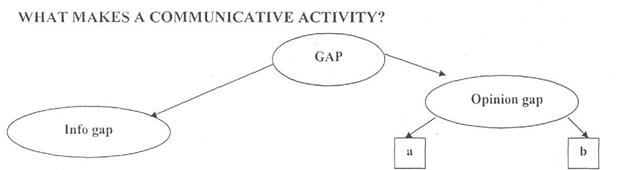
ls created by the activities | Is created by the activity, | Is created by activity, which |
when the Ls are forced to | which requires the Ls to | lets the Ls share their feelings |
exchange info in order to find | describe and perhaps express | about an experience they have |
a solution. | and defend their views on | in common. |
Examples: | controversial texts or ideas. | Examples: |
• Guessing games | Examples; | • Discussion games |
• Jigsaw tasks | § Ranking exercises | |
• Problem-solving activities | § Values clarification | |
§ Thinking strategies |
WHAT IS A COMMUNICATIVE ACTIVITY?
Task 1. Discuss the diagram below with your colleagues in small groups of£. Present your understanding of it to the whole group.
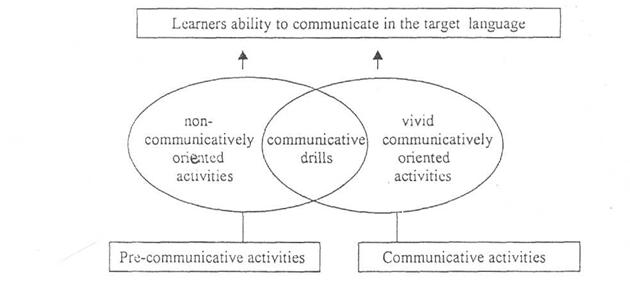
Task 2. a) Use the description of a pre-communicative and communicative activity and your own experience to complete the chart
Pre-communicative activity- is an activity in which the learner is a) to produce correct
language forms in an acceptable way; s/he is prompted to use these forms by the teacher's instructions (as in a drill) or b) to produce correct language for specific communicative purpose (e. g. through open or cued dialogues).
Communicative activity - is an activity in which the learner is to use the language
s/he has at her/his command, in order to communicate specific meanings for specific purposes.
 |
Successful oral fluency practice
Question
Of all the four skills (listening, speaking, reading and writing), speaking seems intuitively the most important: people who know a language are referred to as 'speakers' of that language, as if speaking included all other kinds of knowing; and many if not most foreign language learners are primarily interested in learning to speak.
Classroom activities that develop learners' ability to express themselves through speech would therefore seem an important component of a language course. Yet it is difficult to design and administer such activities; more so, in many ways, than to do so for listening, reading or writing. We shall come on to what the problems are presently, but first let us try to define what is meant by 'an effective speaking activity'.
Imagine or recall a successful speaking activity in the classroom that you have either organized as teacher or participated in as student. What are the characteristics of this activity that make you judge it 'successful'? Compare your ideas with those shown in Box 9.1.
BOX 9.1: CHARACTERISTICS OF A SUCCESSFUL SPEAKING ACTIVITY
1. Learners talk a lot. As much as possible of the period of time allotted to the
activity is in fact occupied by learner talk. This may seem obvious, but often most
time is taken up with teacher talk or pauses.
2. Participation is even. Classroom discussion is not dominated by a minority of
talkative participants: all get a chance to speak, and contributions are fairly evenly
distributed.
3. Motivation is high. Learners are eager to speak: because they are interested in
the topic and have something new to say about it, or because they want to
contribute to achieving a task objective.
4. Language is of an acceptable level. Learners express themselves in utterances
that are relevant, easily comprehensible to each other, and of an acceptable level
of language accuracy.
© Cambridge University Press 1996
 |
In practice, however, few classroom activities succeed in satisfying all the criteria shown in Box 9.1.
Successful oral fluency practice
Question What are some of the problems in getting learners to talk in the classroom? Perhaps think back to your experiences as either learner or teacher.
Now look at Box 9.2, and see if any of the problems I have come across in my teaching are the same as yours.
BOX 9.2: PROBLEMS WITH SPEAKING ACTIVITIES
1. Inhibition. Unlike reading, writing and listening activities, speaking requires some
degree of real-time exposure to an audience. Learners are often inhibited about
trying to say things in a foreign language in the classroom: worried about making
mistakes, fearful of criticism or losing face, or simply shy of the attention that
their speech attracts.
2. Nothing to say. Even if they are not inhibited, you often hear learners complain
that they cannot think of anything to say: they have no motive to express
themselves beyond the guilty feeling that they should be speaking.
3. Low or uneven participation. Only one participant can talk at a time if he or she
is to be heard; and in a large group this means that each one will have only very
little talking time. This problem is compounded by the tendency of some learners
to dominate, while others speak very little or not at all.
4. Mother-tongue use. In classes where all, or a number of, the learners share the
same mother tongue, they may tend to use it: because it is easier, because it
feels unnatural to speak to one another in a foreign language, and because they
feel less 'exposed' if they are speaking their mother tongue. If they are talking in
small groups it can be quite difficult to get some classes - particularly the less
disciplined or motivated ones - to keep to the target language.
© Cambridge University Press 1996
Follow-up Consider what you might do in the classroom in order to overcome each of discussion the problems described in Box 9.2. You may wish to supplement your ideas with those suggested below.
What the teacher can do to help to solve some of the problems
1. Use group work
This increases the sheer amount of learner talk going on in a limited period of time and also lowers the inhibitions of learners who are unwilling to speak in front of the full class. It is true that group work means the teacher cannot supervise all learner speech, so that not all utterances will be correct, and learners may occasionally slip into their native language; nevertheless, even taking into consideration occasional mistakes and mother-tongue use, the amount of time remaining for positive, useful oral practice is still likely to be far more than in the full-class set-up.
2. Base the activity on easy language
In general, the level of language needed for a discussion should be lower than that used in intensive language-learning activities in the same class: it should be easily recalled and produced by the participants, so that they can speak fluently
The functions of topic and task
BOX 9.3: TYPES OF ORAL FLUENCY ACTIVITIES
Activity 1
Discuss the following conflicting opinions.
Opinion 1. Children should be taught in heterogeneous classes: setting them into ability groupings puts a 'failure' label onto members of the lower groups, whereas putting more and less able learners together encourages the slower ones to progress faster, without penalizing the more able.
Opinion 2. Children should be divided into ability groupings for most subjects: this enables the less able ones to be taught at a pace suitable for them, while the better students do not need to wait for the slower ones to catch up.
Activity 2
A good schoolteacher should have the following qualities. Can your group agree together in what order of priority you would put them?
sense of humour enthusiasm for teaching
honesty pleasant appearance
love of children fairness
knowledge of subject ability to create interest
flexibility ability to keep order
clear speaking voice intelligence
© Cambridge University Press 1996
The results I usually get from this experiment are described under Which is better? overleaf.
Topic- and task-based activities
The main difference between the two activities in Box 9.3 is that the first is topic-based and the second task-based. In other words, the first simply asks participants to talk about a (controversial) subject, the main objective being clearly the discussion process itself; the second asks them actually to perform something, where the discussion process is a means to an end.
Topic. A good topic is one to which learners can relate using ideas from their own experience and knowledge; the 'ability-grouping' topic is therefore appropriate for most schoolchildren, schoolteachers or young people whose school memories are fresh. It should also represent a genuine controversy, in which participants are likely to be fairly evenly divided (as my own classes tend to be on this one). Some questions or suggested lines of thought can help to stimulate discussion, but not too many arguments for and against should be 'fed' to the class in advance: leave room for their own initiative and originality. A topic-centred discussion can be done as a formal debate, where a motion is proposed and opposed by prepared speakers, discussed further by members of the group, and finally voted on by all. (This technique is used in the task of Unit Six below.)
Task. A task is essentially goal-oriented: it requires the group, or pair, to achieve an objective that is usually expressed by an observable result, such as brief notes or lists, a rearrangement of jumbled items, a drawing, a spoken
Writing
Lecture session
The lecture is to cover the following issues:
•What writing is
•What kind of process writing is.
•Why is it important to teach writing in a foreign language.
•What basic principles of writing are.
•What approaches and techniques bring to better results in teaching writing skills.
•How to design tasks for writing.
•How to assess written works.
Everybody will agree that writing is a part of our everyday routine, and it is also a part of our professional life.
Activity 1
But what is writing? What does your experience tell you about writing? Work in groups of four, think it over and write your definition of writing.
(Writing is one of the means of communication having some purpose, organization and addressed to somebody.)
Activity 2 (Handout 1)
Task: Analyze what you were doing while writing the definition ranging the sequence of your actions.
First I was thinking about….. then…..
1. | Accurate use of words | |
2 | Accurate use of grammar | |
3. | Punctuation | |
4. | Content | |
5. | Organization of the text | |
6. | Good ideas | |
7. | Communicative value of the definition | |
8. | Cohesive devices | |
8. | Spelling | |
10. | How the reader will be effected by this definition | |
11. | The purpose of my piece of writing | |
12. | How the reader(s) might understand my message | |
13. | ||
14. |
 |
|
|

|
Из за большого объема этот материал размещен на нескольких страницах:
1 2 3 4 5 6 7 8 9 10 11 12 13 14 15 16 |
