


Партнерка на США и Канаду по недвижимости, выплаты в крипто
- 30% recurring commission
- Выплаты в USDT
- Вывод каждую неделю
- Комиссия до 5 лет за каждого referral
To understand this chart better you should bear in mind the difference between the terms “approach”, “method” and “methodology”.
· Approach - a theory of teaching (how to teach)
· Method – procedures and techniques characteristics of teaching(a way of teaching)
· Methodology – a system of methods
Analyzing the chart we can come to a conclusion that there have been a lot of approaches within the recent years. The most popular among them, nevertheless, were grammar-translation, audio-lingual, Communicative Language Teaching. And I’d like to draw your attention to the description of these 3 approaches.
1) Grammar-translation as the most commonly used way of learning languages for hundreds of years. Analyzing the grammar and finding equivalents between the students’ language and the language to be studied, the students studied how the foreign language is constructed. A concentration on grammar-translation stopped the students from getting the kind of natural language input and it often fails to give them opportunities to activate their language knowledge. The problem with grammar-translation is that it teaches people about the language and doesn’t really help them learn the language itself.
2) Audio-lingual. This is a language teaching methodology based on behaviourist theories of learning. These theories suggested that much learning is the result of habit formation (Pavlov’s method). As a result, audio-lingual classes concentrated on long repetition – drill stages, in which the teacher hoped that the students would acquire good language habits. Methodologists later on understood that in this approach students were not exposed to real or realistic language. However, drilling is still popular, especially for low – level students.
Communicative Approach: basic principles
Aims: by the end of the session the students will be able to point out basic principles of Communicative Approach, the nature of communication.
Communicative Language Teaching
What is the goal of this teaching method in your opinion? Compare your idea with the definition from the glossary.
CLT has two main strands (points):
1) Language is not just bits of grammar; it also involves language functions (inviting, agreeing, suggesting, giving advice, etc.)
2) The focus of communicative language teaching is activation and then study for students should use the language appropriately for the given social context. And the three basic building blocks for successful language teaching and learning are:
§ Engage
§ Study
§ Activate
And the order in which they can be presented at a lesson can be different.
Communicative Approach
1) Communicative Competence:
Linguistic forms, meanings, functions
used appropriately to a given social and
cultural context
1) Teaching / learning process ü activities: information gap, choice of linguistic forms, feedback ü authentic materials ü student-centred | 2) Emphasized areas: ü function over forms ü cohesion and coherence ü work on four skills |
3) Role of a teacher: ü initiator ü advisor ü co-communicator ü manager | 4) Students’ feelings ü cooperative interactions ü emotional security ü express their individuality ü more motivated |
5) Evaluation:
ü accuracy and fluency
ü communicative tests
ü errors of form are tolerated
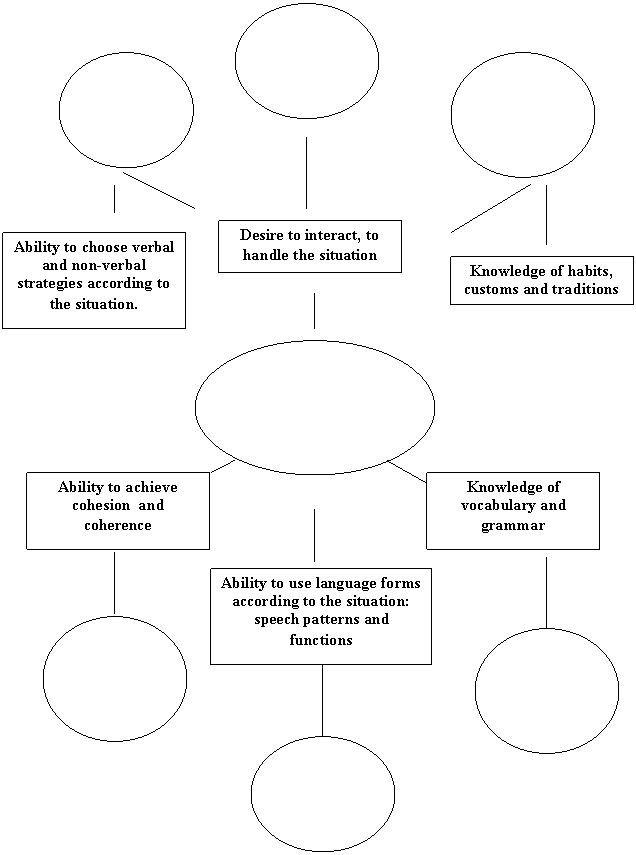
Activity: Define the competence. Choose from the given below:
Strategic, social, linguistic, socio-cultural, socio-linguistic, discourse competence.
|
Communicative competence is a measure of a learner’s ability to achieve successful communication in the language he is learning.
The most difficult element of communicative competence is discourse competence.
According to Webster Encyclopedic Unabridged Dictionary “Discourse is communication of thought by words”. The Cobuild Essential Dictionary gives the following definition: “Written or spoken communication between people”. In other words discourse is language used in real situation for real purposes, i. e. language as social behaviour. Such a use of language involves interaction (e. g. between participants in a conversation; between reader and writer in a newspaper article; between lectures and listeners) and the combining and relating of utterances. Utterance is any complete unit of language used for communicative purpose. An utterance can be either written or spoken. Interaction is communication between people involving the use of language (e. g. between two people having a conversation; between writer and readers; between speaker and listeners).
Coherence is a state or a situation in which all the parts or ideas fit together well so that they form a united whole.
Cohesion markers are textual means, signs which make a text a united whole, with the help of which all parts of a text fit together well. For example: parallel grammar structures, ellipses.
Let’s discuss the second basic principle: teaching / learning process. The first thing includes information gap or opinion gap activities. Let’s try to answer he question: what makes a communicative activity?



 Opinion gap
Info gap
А Б
Info gap is created by the activities when the learners are forced to exchange info in order to find a solution.
Examples: guessing games
Jigsaw tasks
Problem-solving activities
Opinion gap A is created by the activity, which requires the learners to describe and perhaps express and defend their views on controversial texts or ideas.
Examples: Ranking exercises
Values clarification
Thinking strategies
Opinion gap B is created by the activity which lets the learners share their feelings about an experience they have in common.
Example: Discussion games
Activity: identify Info gap, opinion gap A and opinion gap B.
Feedback is evaluation and suggestions for improving.
Authentic materials
Materials such as newspaper articles, brochures, train tickets, letters, advertisements, recordings of the news, airport announcements, which were originally used in real situations and were not designed for use in language teaching. Such materials are used in the classroom to expose the learners to language in real use.
The third basic principle is about emphasized areas; i. e. functions are taught more than forms. Function is a language category; it is some kind of communicative act: it is the use of language to achieve a purpose usually involving interaction between at least two people. Ex: suggestions, promising, apologizing, greeting. Very often functions are binary. The performance of one implies a certain response which is already a different function. Ex: invitations are followed by acceptance or rejection. “Unitary” functions may occur on their own: informing, for example.
The other language category is a notion. It is a concept or idea; it may be quite specific – in this case it is close to the concept “topic». It may be general, and then it is close to the concept VOCABULARY.
Activity: Have a look at the items. Can you sort them into separate lists of notions and functions?
Notions and functions
location | apology | the future | request |
obligation | probability | crime | food |
advise | offer | the body | instruction |
threat | promise | expression of opinion | remind |
As for the 4th basic principle, role of a teacher, let’s do the following activity.
Activity: Match the role of a teacher with the stages of the lesson:
1. initiator | a. Engage |
2. advisor | b. Study |
3. co-communicator | c. Activity |
4. manager |
There may be more than one possibility.
Activity: Match the roles of a teacher with their explanations:
1. initiator | a. The teacher takes part in the discussion if necessary, expresses his/her opinion on the subject |
2. advisor | b. The teacher engages students with a topic, arouses students’ interest |
3. co-communicator | c. The teacher helps students with their language problems, organizes their work on language difficulties |
4. manager | d. The teacher organizes an activation stage thus staying an observer and a helper if something starts going wrong |
Students’ feelings are also very important for Communicate Approach in Language teaching. Cooperative interaction means a spirit of group solidarity, in which everyone contributes to the process of learning, regardless of linguistic ability. Learners work with one another, not in competition with one another. Collaborative work gives students emotional security. They have to pay attention to what other students say and so they can teach and correct each other. Students have their own ideas, opinions, experiences. All of this is important to them. Students can express themselves and their municative Language teaching focuses on encouraging learners to express their ideas freely. All activities, even grammar practice, are based on the “here and now” of the learners. Apart from their individual interests learners bring their native language and culture to the classroom. Students who feel most warmly about a language and who want to integrate into the culture of its speakers are more highly motivated than those who are only learning language because they don’t have anything else to do. But whatever kind of motivation students have, it is clear that highly motivated students do better than ones without any motivation at all.
As for the 6th basic principle: Evaluation. It includes accuracy and fluency.
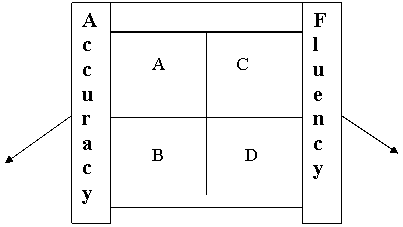
Let’s look at the Box “Interaction Pattern”. Activities can be controlled, semi-controlled and free. Look the terms “accuracy” and “fluency” in the glossary and say whether the types of activities refer to controlled, semi-controlled or free.
 |
|
Activity: fill in the gaps with the following words: organizer, monitor, conductor, stimulator, consultant, manager.
A
· accuracy activities controlled by the teacher
· Most traditional language games belong here. They are easy to do with the whole class as they are usually intended to provide practice of the language. The teacher controls the activity because he/she wants to check what’s going on.
· teacher’s role is of a …
B
· accuracy activities directed by the learners and done in pairs or groups
· Mini-dialogues practice belongs here. The students work in pairs using a model provided by the teacher. The dialogue is intended to provide practice in grammar and vocabulary
· teacher is an …
C
· fluency activities controlled by the teacher and done with the whole class
· what is important is how the teacher interacts with the class or gets the students to interact with the another
· teacher is a …
D
· fluency activities directed by the learners and done in groups or pairs
· any activity which encourages the students to use language freely
· Teacher is … and ….
Activity: work in groups and think of two ways of progression of skills from accuracy to fluency.
Patterns of classroom interaction
The most common type of classroom interaction is known as ‘IRF’ Initiation – Response-Feedback.
1) the teacher initiates an exchange, usually in the form of a question
2) one of the students answers
3) the teacher gives feedback (assessment correction)
4) initiates the next question
There are alternative patterns: the initiative doesn’t always have to be in the hands of the teacher; and interaction may be between students.
Activity
Look at the various patterns of interaction and note for each one how active the teacher and the students are in their participation. | Individual work |
TT – teacher very active, students only receptive
T – Teacher active, students mainly receptive
TS – Teacher and students fairly equally active
S – Students active, teacher mainly receptive
SS – students very active, teacher only receptive
Classroom management
Aims: The students will be able to differentiate between patterns of interaction, to define suitable patterns of seating arrangement according to the pattern.
The teacher’s physical presence plays a large part in the management of the classroom environment. And it's not just appearance either. However “good” or “bad” the students are, the teacher needs to manage the classroom, both in terms of his / her own presence and in the way the classroom is physically organised.
The question how teachers should use their physical presence in class is under our consideration before we go on to talk about patterns of interaction and seating arrangement.
There are a number of issues which influence the students’ perception of us, teachers.
Proximity. Teachers should consider how close they want to be to the students they are working with. Some student’s can’t stand it if the distance between them and the teacher is too small. For others distance is a sign of coldness. Teachers should be conscious of their proximity and assess their students’ reactions to what is happening in the classroom and take it into account.
Appropriacy. Deciding how closely you should work with students is a matter of appropriacy. So in general teachers sit or stand. Many teachers create an extremely friendly atmosphere when they work with students in pairs. However, some students find this informality worrying. Some teachers abroad even sit on the floor. And sometimes it may lead to a situation where students are put off from concentrating. All the positions teacher take-sitting on the edge of tables, standing behind a lectern – make strong statements about the kind of person the teacher is. It is important to consider what kind of effect such physical behaviour has so that we can behave in a way which is appropriate to the students we have and the relationship we wish to create with them.
Movement. Some teachers spend most of their class time in one place – at the front of the class or to the side, or in the middle. Others spend a great deal of time walking from side to side. Although this is a matter of personal preference, it is worth remembering that motionless teachers can bore students, while teachers who constantly more can turn their students into tennis-match spectators, their heads moving from side to side until they become exhausted. Most successful teachers move around the classroom to some extent and it depends not only on her / his personal style, but on the type of the activity as well.
Contact. How can teachers make contact with students? In order to manage a class successfully, the teacher has to be aware of what students are doing and, where possible, how they are feeling. This means watching and listening just as carefully as teaching. It means being able to move around the class, getting the level of proximity right, making eye contact with students, listening what they have said and responding appropriately.
The teacher’s physical approach and personality in the class is one aspect of class management. Another is one of the teacher’s chief tools: the voice.
There are 3 issues to bear in mind:
1. Audibility. Teachers need to be audible. They must be sure that the students at the back of the class can hear them just as well as those at front. But a shout is always unpleasant. In fact, in most classrooms there’s a danger of the teacher’s voice being too loud. Good teachers try to get this balance between audibility and volume.
2. Variety. It is important for teachers to vary the quality of their voices and the volume they speak at depending on the type of the lesson and the type of the activity. In one particular situation, teachers often use very loud voices, and that is when they want students to be quiet and stop doing something. But it is worth pointing out that speaking quietly is often just as effective a way of getting the students’ attention since, when they realise that you are talking, they will want to stop and listen in case you are saying something important or interesting. However, for teachers who almost never raise their voices, the occasional shout may have an extremely dramatic effect.
3. Conversation. Just like opera singers, teachers have to take great care of their voices. It is important that they breathe correctly so that they don’t strain their larynxes. Teachers should avoid shouting wherever possible, so that they can conserve their vocal energy.
What’s the best seating arrangement for a class?
In order to manage a class successfully, the teacher has to choose the seating arrangement appropriate to a certain activity.
Orderly rows. When the students sit in rows, there are obvious advantages. The teacher has a clear view of all the students and the students can all see the teacher. It makes lecturing easy. It makes discipline easier since it is more difficult to be disruptive when you are sitting in a row. If there are aisles in the classroom, the teacher can easily walk up and down making more personal contact with students Many teachers use it to keep their students guessing. Especially where teachers need to ask individual students questions, it is important that they should not do so in order, students after student, line by line. The students know when they are going to be asked. It is much better to ask students from all parts of the room in random order. It keeps everyone on their toes!
Circles and horseshoes. In smaller classes, many teachers prefer circles or horseshoes. In a horseshoe the teacher will probably be at the open end. In a circle, the teacher’s position – where the board is situated – is less dominating. With all the people in the room sitting in a circle, there is a feeling of equality. This may not be quite so true of the horseshoe shape where the teacher is often located in a central position. There is one more advantage: all the students can see each other.
Separate tables. A more informal pattern of seating arrangement is when students are seated in small groups at individual table. In such classrooms you might see the teacher walking around checking the students’ work and helping, prompting or explaining something. The atmosphere in such a class is much less hierarchical than in other arrangements. It feels less like teacher and students and more like responsible adults getting in with the business of learning. However, this arrangement is not without its own problems. First, students have their preferences and they don’t always like sitting with the same group mates. Secondly, it makes ‘whole-class’ teaching more difficult.
Whatever the seating arrangements in a classroom, students can be organised in different ways: they can work as a whole class, in groups, in pairs, or individually.
Whole class. As you know there are many occasions when a teacher working with the class as a whole is the best type of classroom organization. This doesn’t mean that the class should sit in orderly rows; whatever the seating arrangement, the teacher can have the students focus on him or her and the task.
Group work and pair work. Group work is a cooperative activity. In groups students tend to participate more equally, and they are also more able to use the language than they are in a whole – class arrangement.
Pair work has many of the same advantages. The moment students get into pairs and start working or talking about something, many more of them will be doing the activity than if the teacher was working with the whole class. Both pair work and group work give the students chances for greater independence because they are working together without the teacher controlling every move. Decisions are made in cooperation, responsibilities are shared.
The other great advantage of group work and pair work is that they give the teacher the opportunity to work with individual students. While groups A and C are doing one task, the teacher can spend some time with group B who need special attention.
Neither group work nor pair work are without problems. Students may not like the people they are grouped or paired with. In any one group or pair, one student may dominate while the others stay silent. In difficult classes, group work may encourage students to be more disruptive, especially in a class where students are at Starter or Elementary level, they can use their first language.
Solo work. This can have many advantages: it allows students to work at their own speed, allows them thinking time. Students can relax and consider their own individual needs and progress.
Good teachers are able to use different class groupings for different activities and successfully use the advantages of group work – cooperation, involvement, autonomy as well as the advantages of the whole – class grouping – clarity, dramatic potential and teacher control.
Activity
Match the following types of activities to the most suitable seating arrangement. There can be more than one possibility. | |
1. orderly rows 2. circle 3. horseshoe 4. separate tables | a. group work (e. g. discussion) b. individual work c. role-play d. debate e. brainstorming f. watching a video g. explaining grammar h. predicting i. problem-solving j. phonetic drill k. listening to a text l. making a project m. dramatizing a dialogue n. doing a test o. answering teacher’s questions p. writing a dictation |
Activity
What’s the best grouping for these activities? Put W = whole class, P = pair work, G = group work, S = solo work |
 Students design a poster for a school event.
 Students listen to a tape recording of a conversation.
 Students practice saying sentences with the Present Perfect.
Students prepare a talk on a subject of their choosing.
Students repeat words and phrases to make sure they can say them correctly.
Students work out the answers to a reading comprehension.
Students write a dialogue between a traveller and an immigration official.
 Students write a paragraph about themselves.
 The teacher explains the rule for the pronunciation of‘s’ plurals.
Students choose one of three alternatives when faced with an imaginary moral dilemma.
Activity
What do you think is the best seating arrangement for the following situations? Explain your reasons. |
a. You want to have a game in teams with a class of forty students.
b. In your class of 15 students you want them to discuss a topic with you.
c. In your class of thirty students you want them to work in pairs.
d. You have some reading tasks in a class of ten students.
e. Students are designing an advertisement in groups.
f. The students are going to listen to a tape.
g. You want to explain a grammar point.
Activity
Do you agree or disagree with the following statements? Give your reasons.
a) Classes where students sit in straight rows are easier to control.
b) Classes where students sit in straight rows are old fashioned and stop people learning.
c) Having students in straight row is the best way to teach a large class.
d) It is important for students for students to face the teacher.
e) Students participate more fully in a class where students sit in straight rows.
f) Students understand things better when they sit in straight rows.
Stages of the lesson
Aims: By the end of the lesson the students will be able to distinguish between 3 sequences of a good lesson: ESA (“Straight Arrow Sequence”), EAS (A) (“Boomerang Sequence”) and “Patchwork”, to define the three stages of a lesson and to produce their own activities for an ESA lesson.
Activity. Read the information about the three elements of successful language learning, highlight or underline the aims of each stage and types of activities.
What elements are necessary for successful language learning in classrooms?
Classroom students don’t usually get the same kind of exposure or encouragement as those who – at whatever age – are ‘picking up’ the language. But that does not mean they cannot learn a language if the right conditions apply. Like language learners outside schools, they will need to be motivated, be exposed to language, and given chances to use it. We can therefore way what elements need to be present in a language classroom to help students learn effectively. We will call these elements ‘ESA’, three elements which will be present in all – or almost all – classes. They are:

|
Из за большого объема этот материал размещен на нескольких страницах:
1 2 3 4 5 6 7 8 9 10 11 12 13 14 15 16 |
