


Партнерка на США и Канаду по недвижимости, выплаты в крипто
- 30% recurring commission
- Выплаты в USDT
- Вывод каждую неделю
- Комиссия до 5 лет за каждого referral
Activity 3 Handout 2.
Task: Read a number of quotations about writing, examine them and single out the key issues concerning writing.
А. "Письменная речь - это вид речевой деятельности, который имеет целью передачу информации в письменной форме в соответствии с ситуацией общения." {Методика преподавания русского языка как иностранного/ Под редакцией - М., 1990, стр. 133)
В. "Письменная речь представляет собой коммуникативное умение сочетать слова в письменной форме для выражения своих мыслей в соответствии с потребностями общения." (Методика! Под редакцией - М., 1988, стр. 142).
С. " any piece of writing is an attempt to communicate something: that the writer has a goal or purpose in mind, that he has to establish and maintain contact with his reader; that he has to organize his material and that he does this through the use of certain logical and grammatical devices." (Byrne, D., Teaching Writing Skills; Longman, 1988, p.14)
D. "Effective writing involves conveying a message in such a way as to affect the audience as the writer intends." (Parrott, M., Tasks for Language Teachers; CUP, 1993, p/211)
E. "... effective writing requires... a high degree of organization in the development of ideas and information; a high degree of accuracy so that there is no ambiguity of meaning; the use of complex grammatical devices for focus and emphasis; and a careful choice of vocabulary, grammatical patterns and sentence structures to create a style which is appropriate to the subject matter and the eventual readers." (Hedge, Т., Writing; OUP, 1995, p. 5)
 The main features of writing are:

The main features of writing are:
In the last few decades writing is being paid more and more attention to which leads closer inspection of the methods of teaching this skill. Several things should be taken into consideration when we think about teaching writing.
1). Firstly, teaching writing involves both a teacher and a student in a partnership, where the participants are equal. Treating any peace of writing only for correcting language errors and mistakes on the teacher's side misses the aim of this creative process on the student's side.
2). Secondly, it is a myth that all it takes to write is to sit down in front a blank page to begin at the beginning and write through to the end, without planning, drafting, revising, editing or discussing. The following diagram shows the complex process of writing.
Activity 4
Task: In groups of four discuss and come to a conclusion why most of the arrows on the diagram are the two-ways ones.
II Process of Writing
Examine the diagram "A Model of Writing"
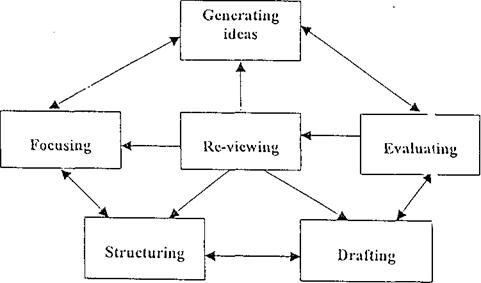
(White. R. and Anult. V., Process tt iling; Longman. 1992, p.4)
Give a brief outline of the processes that go on at each of the stages.
3).Thirdly, for the reader to understand the message of the text, the writer should deal with a number of issues shown in the following scheme.
1. Generating ideas – brainstorming, producing ideas, selecting ideas, reading from the book.
2. Reviewing - analyzing ideas, searching for ways to make them better.
3. Focusing – choosing the idea, concentrating on the idea.
4. Structuring – organizing the text, choosing the form paragraphing.
5. Drafting – writing process, re-writing the draft for many times.
6. Evaluating – rereading the text and trying to improve it.
4). Finally, writing is a task which is often imposed on us, that's why we should develop positive attitude to writing trying to overcome some psychological, linguistic and cognitive problems.
In conclusion it should be mentioned that though the situation is complex and there is no one set of answers, still writing is a skill worth developing. Our problem, as teachers, how to do this in such a way that the students see the purpose of learning this skill.
Activity 5
Task: Mark the following statements true (T) or false (F):
1. We usually write a text once for ever without any change.
2. The teacher and the students are both participants in the process of writing who have complementary roles and similar status.
3. The teacher should concentrate on the accuracy of using the language when checking students’ written works.
4. The writer should take into consideration all aspects of language and the process of writing to create a clear, fluent, effective and meaningful text.
5. Writing is a long process of going back and forward, of revising and reviewing, of evaluating and restructuring.
Activity 6
Task: Analyze the mind-map and be ready to speak about things necessary for producing a good piece of writing.
Producing a Piece of Writing.
Sentence structure, sentence boundaries Relevance, clarity, originality, logic, etc.

 stylistic choices
 Rules for verbs, agreement,
|
 articles, pronounce, etc. getting ideas, getting started,
 drafting, revising.

 Handwriting, spelling, the reader(s)
punctuation, etc.


Paragraphs topic and support
 cohesion and unity the reason for
Vocabulary, idiom,
tone, register, etc.
The process of writing is divided into 3 stages. What are they?
- pre-writing
- while-writing
- editing
Since writing is about organizing info and communicating the meaning; generating, collecting and putting down ideas is a crucial point of the writing process. Getting started is usually the most difficult and inhibiting step in writing.
Activity 7
Task: Work in groups, recollect your experience at writing sessions and make a list of activities for a pre-writing stage.
- gathering info
- pyramid planning
- discussion
- making mind maps
- using a diagram of ideas
- brainstorming
- organizing points
- using questionnaires
- observing
- note-taking
- conducting a survey
The main goal of writing is to help students learn how to create a clear, meaningful, fluent text which will pass your ideas, feelings, thoughts in such a way that the reader gets your message as you have intended him\her to understand. That's why the task of writing session is to concentrate on techniques to get students to go beyond those sentence exercises, so that they write:
- to communicate with a reader
- to express ideas without the pressure of face-to face communication
- to explore a subject
- to record experience
- to become familiar with the conventions of Written English discourse(a text)
What are the three purposes of writing in real life?
-to inform
-to persuade
-to clarify
Activity 8
Types and kinds of written texts
Task: Read the following paragraphs and decide what was each of them written for, that is determine the purpose of each paragraph: to inform (which implies that the audience has imperfect knowledge of a subject), to persuade ( which implies the audience to be persuaded/ be given reasons why they should think о do in a certain way) or to clarify (which includes not only the audience but tin writer who 'puts pen to paper to test whether his or her own ideas are coheren and clear' [Brooks, a. and Grundy, P. Writing for Study Purposes: CUP, 1990, p 14])

Text one
Niagara Falls is one of the most beautiful wonders in North America. The 2000,000 tons of water that plummet 160 feet into the bed of the Niagara River each minute provide a continuous visual spectacle for tourists. The greater part of the deluge rushes over a craggy ledge of limestone on the, Canadian side creating Horseshoe Falls. The lesser flow sends the sparkling liquid down even farther forming the American Falls. The two falls known commonly as Niagara Falls were first observed by European explorers in 1678. At night, white and coloured lights dance across the water like millions of tiny diamonds transforming the sight into a colour wheel.

Text two
It is one matter to make New Year's resolutions and quite another to keep them. There are several suggestions one may follow to make the undertaking a bit easier. In the first place, be serious. Don't make a resolution simply because it seems the Thing to do at the moment. You should really have every intention of keeping Resolutions when they are made. Secondly, don't make too many resolutions. It is not reasonable to expect to alter one's life in an evening resolve. Make one or two resolutions, no more. And finally, make your pledge to the future in the presence of witnesses. Granted it is possible to hold to resolutions made in private, but making them public provides the additional motivation to keep them. Most people don't like the idea of breaking a promise, especially when it is on the public record. So, if you take in what has been said above, you might really have a chance to make your wish come true.

Text three
LOVE is a strong feeling of fondness for another person, especially between members of a family or close friends. This notion also includes fondness combined with sexual attraction and, definitely, warm interest and enjoyment. Alternatively, the word LOVE may mean the object of such interest and attraction. In addition, LOVE or LUV (informal) is a friendly form of addressing to somebody, especially to or by a woman.

Activity 9
Task: Kinds of written text are looked at from the point of view of the purpose. Think what may be the purpose of the following kinds of texts.
Kinds of written texts | Purpose |
Static description | |
Process and procedure description | |
Narrative | |
Formal letters | |
Informal letters | |
Argumentative essays | |
Articles | |
Reports | |
Reviews | |
Discursive essays | |
Classifications | |
Definitions | |
Advertisements | |
Notes | |
Others | |
Activity 10
Task: Study the table of the types of written texts depending on the addressee (audience, readers). Tick those kinds and types of texts you are going to teach at school.
Types of writing
Personal writing | Public writing | Creative writing |
diaries shopping lists | Letters of-enquiry | Poems |
journals packing lists | complaint | stories |
addresses recipes | request | rhymes |
reminders for oneself | form filling | drama |
applications (for member- | songs | |
ships) | autobiographies | |
Social writing | Study writing | Institutional writing |
letters | making notes while reading | Agendas posters |
invitations | taking notes from lectures | Minutes instructions |
notes of - condolence | making a card index | Memoranda speeches |
- thanks | reports of - experiments | Reports applications |
- congratulations | - workshops | Reviews contracts |
cablegrams | curriculum vitae specifications | |
telephone messages | summaries reviews | business-letters note-making |
instructions - to friends | synopses essays | public notices (doctors and |
- to family | bibliographies- | advertisements other profess- |
ionals) |
Activity 11
The task and its components
Task: Read the definitions of "task" and decide which one fits better teaching a foreign language. What are the most important components of the "task"?
A. "[a task is] a piece of work undertaken for oneself or for others, freely or for
some reward... In other words, by 'task' is meant the hundred and one thongs
people do in everyday life, at work, at play, and in between" (Long, M, A Role for
Instruction in Second Language Acquisition; 1985, p. 89).
B. "[a task is] an activity or action which is carried as the result of processing or
understanding language (i. e. as a response). . . A task usually requires the teacher
to specify what will be regarded as successful completion of the task. The use of a
variety of different kinds of tasks in language teaching is said to make language
teaching more communicative. . . since it provides a purpose for a classroom
activity which goes beyond the practice of language for its own sake." (Richards,
J., Platt, j. and Weber, H.: Longman Dictionary of Applied Linguistics; Longman,
1986, p. 289).
C. ". . . any structured language learning endeavour which has a particular
objective, appropriate content, a specified working procedure, and a range of
outcomes for those who undertake the task. 'Task' is therefore assumed to refer to
a range of work plans which have the overall purpose of facilitating language
learning - from a simple and brief exercise type, to more complex and length activities such as group problem-solving or simulations and decision making (Breed, M, Learner Contributions to Task Design, 1987, p. 23)
Task design
Activity 12
Task: Think of the components of the task
setting Patterns of interaction
 |  |
 input TASK goal

 Activities (step by step)
Learner role
If a teacher wants a student to have some progress, his\her written works should be graded\marked\tested\evaluated\assessed\examined.
(The most important components of the tasks are:
- particular objective
- appropriate content
- a specified working procedure
- a certain range of activities)
Activity 13
Task: Put the following steps of students" writing process and of the teacher's interference to help during this process of writing into the scheme and explain why it is appropriate to intervene at various points of process of creating a written paper.
student writes draft 1 | student writes draft 2 | student writes draft 3 or proofreads edits | student reads draft 2 with guidelines or checklist: makes changes | |||
student makes outline of draft one | preparation for writing/ prewriting activities | selection of topic by teacher and/ or by student(s) | teacher evaluates progress from draft 1 to 3 | |||
teacher reads notes, lists, outlines, etc. and makes suggestions | teacher reads draft 2; indicates good points and areas for improvement | teacher assigns follow-up tasks to help in weak areas of the language, style, etc. | T. and sts read draft: add comments and suggestions about content |
Activity 14

|
Из за большого объема этот материал размещен на нескольких страницах:
1 2 3 4 5 6 7 8 9 10 11 12 13 14 15 16 |
