


Партнерка на США и Канаду по недвижимости, выплаты в крипто
- 30% recurring commission
- Выплаты в USDT
- Вывод каждую неделю
- Комиссия до 5 лет за каждого referral
Task: In groups of four make rules\establish some basic principles for intervening at various points in the writing process.
1). Never take a pan before reading students" work up to the end.
2). Students should know symbols for error correction. What are they?
Sp
Wo
Or
Voc
P
Ww
Can you think of some more symbols?
Activity 15
Task: Consider the scheme "The process of writing" and write down the areas that should be assessed.
>content
>style (word choice)
Organization of the text
>vocabulary>
>grammar
Activity 16 (Handout 11)
Task: Read what J Hammer thinks about correcting writing. Underline the main issues.
How should
teachers correct
writing?
Most students find it very dispiriting if they get a piece of written work back and it is covered in red ink, underlinings and crossings-out. It is a powerful visual statement of the fact that their written English is terrible.
Of course, some pieces of written work are completely full of mistakes, but even in these cases, over-correction can have a very demotivating effect. As with all types of correction, the teacher has to achieve a balance between being accurate and truthful on the one hand and treating students sensitively and sympathetically on the other.
One way of avoiding the 'over-correction' problem is for teachers to tell their students that for a particular piece of work they are only going to correct mistakes of punctuation, or spelling, or grammar etc. This has two advantages: it makes students concentrate on that particular aspect, and it cuts down on the correction.
Another technique which many teachers use is to agree on a list of written symbols (S = spelling, WO = word order etc). When they come across a mistake they underline it discreetly and write the symbol in the margin. This makes correction look less damaging.
However many mistakes you may want to identify, it is always worth writing a comment at the end of a piece of written work - anything from 'Well done' to 'This is a good story, but you must look again at your use of past tenses - see X grammar book page 00'.
Two last points: correcting is important, but it can be time-consuming and frustrating, especially when it is difficult to know what the mistake is because it is unclear what the student is trying to mon sense and talking to students about it are the only solutions here. The other really important point is that correction is worthless if students just put their corrected writing away and never look at it again. Teachers have to ensure that they understand the problem and then redraft the passage correctly.
Activity 17
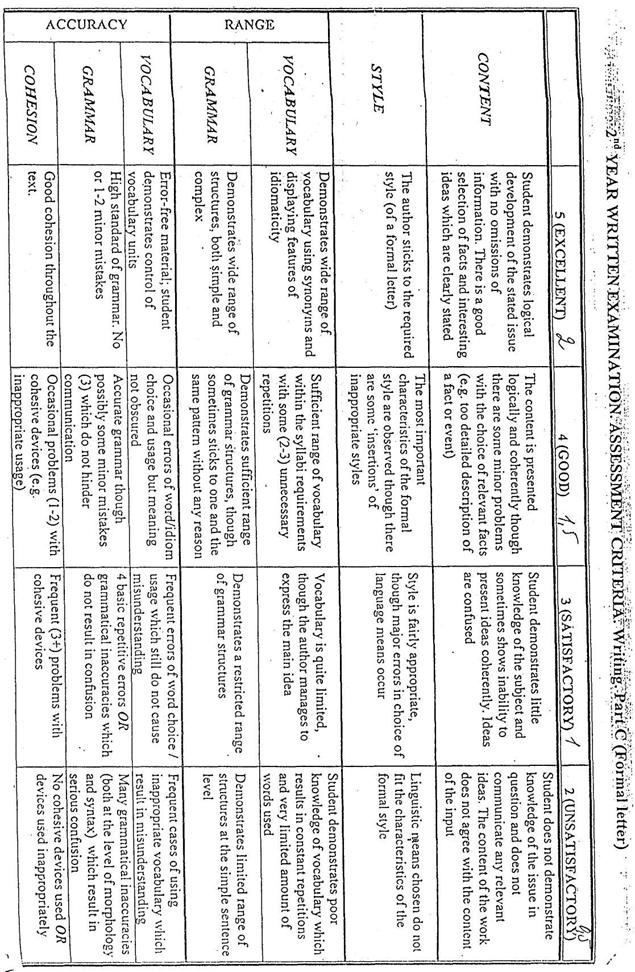
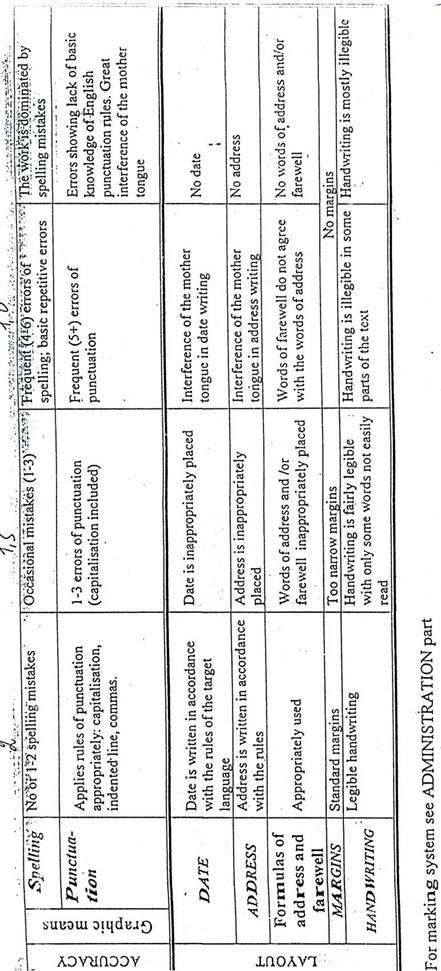
Task: Study the assessment scale and explain each criterion
Register (linguistics) the range of vocabulary, grammar, etc., used by speakers in particular social circumstances or professional contexts.
|
Activity 18
Task: What can be done about handwriting?
J. Harmer. Read the paragraph and find out what J. Harmer suggest doing.
What can be
done about
handwriting?
Handwriting is a very personal matter. It is supposed to reflect character. Different nationalities certainly have recognizable handwriting traits. Some people have easily readable writing. Some produce written work which is indecipherable, whether beautiful or messy and ugly.
Many nationalities do not use the same kind of script as English, so for students from those cultures writing in English is doubly difficult: they are fighting their expressive limitations as well as trying to work out a completely new writing system at the same time. And now that word processors are becoming more and more common, people have less motivation for good handwriting. Teachers are not in a position to ask students to change their handwriting style, but they can insist on neatness and legibility. Especially when students are heading towards an exam, such things are crucial. With students who are having problems with English script, special classes or group sessions may have to be arranged to help them. In these classes they can be shown many examples of certain letters, and the teacher can demonstrate the strokes necessary for making those shapes - and where the letter starts (writing from left to right is difficult for some students). They can be asked to write 'in the air' to give them confidence or they can be asked to imitate letters on lined paper which demonstrates the position and height of letters, e. g.
Activity 19
Task: Read the paragraph and present your findings. How does writing fit into ESA?
How does
writing fit
into ESA
The four writing examples in this chapter approach the ESA procedure from a number of different angles. In the case of the postcard the teacher to students about postcards and/or holidays in such a way as to Engage them. They then Study the postcard looking for typical 'postcard features' and finally they Activate that knowledge by writing their own version.
In the 'altering dictations' activity, the students are, hopefully, Engaged by the dictation and topic of the sentence they write down. When they alter the sentence they are Activating the knowledge of English which they have. After the discussion {Activate) which this will provoke, the teacher will give feedback on the language used, making corrections where appropriate [Stud]).
A different kind of boomerang procedure is evident in the newspaper-writing activity. Students are first Engaged with the topic of newspapers before doing the matching task [Activate). They then Study headlines before going on to a creative writing stage {Activate).
In report writing, a number of stages are gone through, giving the whole sequence a patchwork feel. Students need to be Engaged with the topic, they need to Study the language which they will need, knowledge which is Activated in the collection of results before students come back to study the structure of reports in order to produce a final piece of work (Activation).
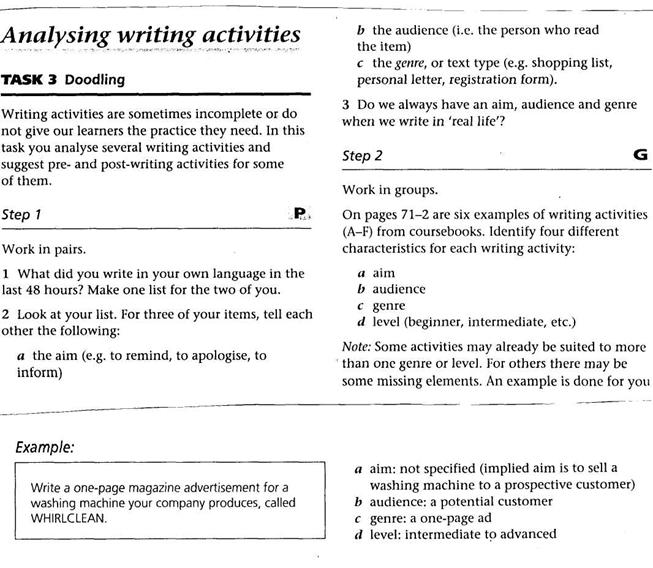
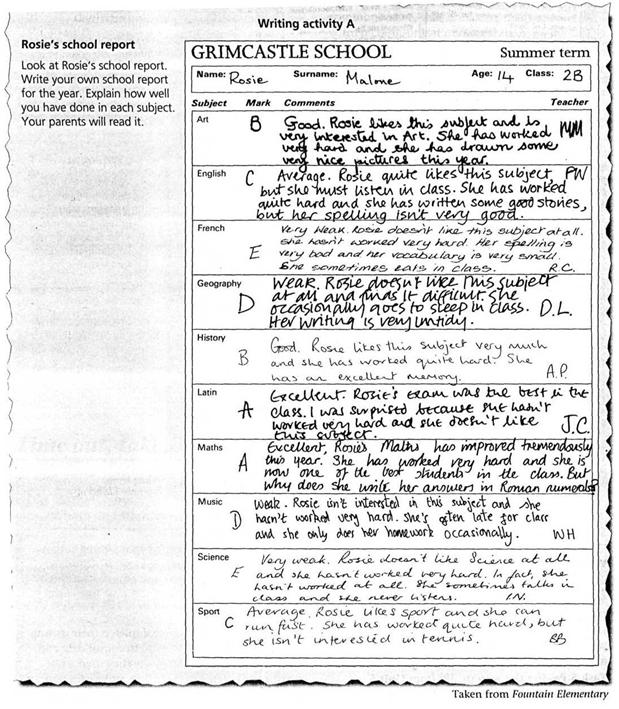
Activity 20
|
 |
 |
 |
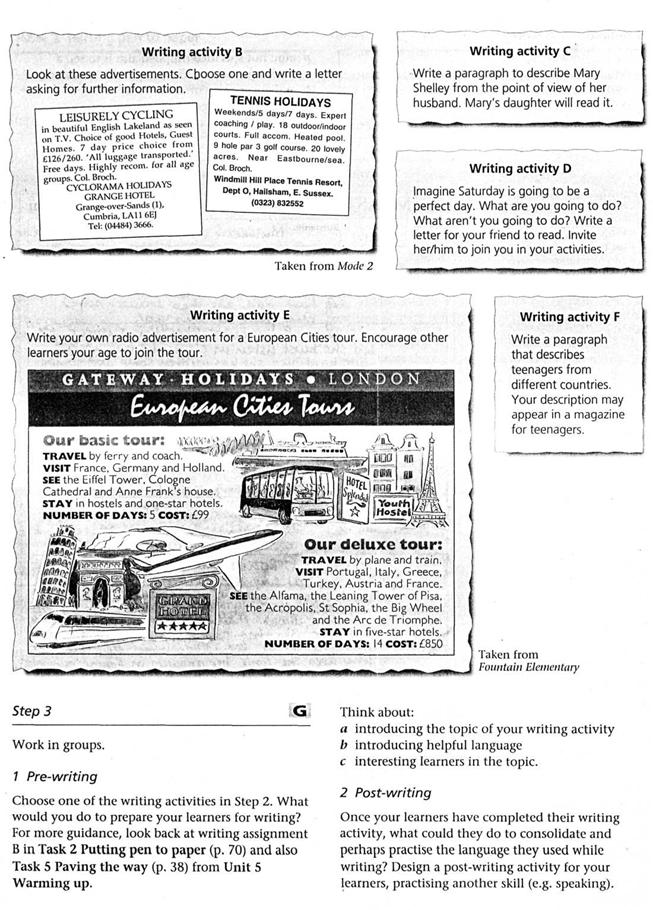
More writing suggestions
Students write letters to a newspaper in response to a controversial article, (intermediate/advanced)
Students expand a variety of headlines into newspaper articles, (intermediate/advanced)
Students write/design their own menus, (beginner/lower intermediate)
Students design posters for a party/play/concert etc. (beginner/lower intermediate)
Students write a radio news bulletin, (elementary/intermediate)
Pre-writing: planning the pieces of writing:
a) analyze the situation;
b) make a plan;
c) gather information;
d) organize your notes;
Drafting: getting ideas clown on paper in a rough form:
a)write a quick draft;
b)your draft need not be perfect;
c) keep your audience, purpose and voice in mind as you write;
d)keep yourself open to new ideas
e) allow yourself enough time to write. Do not try to do all your writing at the last minute;
f) write as many drafts as you need to write.
Revising: changing and improving the rough draft:
a) rework a written draft to enhance its content and organization;
b) use the checklist for revision to identify ways to improve your paper;
Proofreading: correcting any errors in spelling, grammar, vocabulary, punctuation, capitalization:
a) Use the checklist for proofreading checking for errors in grammar and usage of the words, spelling, punctuation, capitalization and manuscript form;
Publishing: letting others read and share the writing:
a) share your writing with friends, groupmates or room-mates;
b)read your paper aloud to a discussion group or to the whole class;
c) trade papers with other students of your class or other classes;
d)create a publication that contains writing by all students in your class.
Module 4. Assessment
Aim: By the end of the session the students will be able to design a classroom test on their own.
Stages in designing a test.
Stage 1: Preparation
Prepare your test. It is a good idea to list in writing all the material that you want your test to cover: you can then refer back to the list during and after the test-writing to see if you have included all you intended.
Your notes: ____________________________________________________________________________________________________________________________________________________________________________________________________________________________________________________________________________
Stage 2. Performance /Pre-testing/
If possible, administer your test to a class of learners; if not, ask colleagues to try doing it themselves.
Your notes:____________________________________________________________________________________________________________________________________________________________________________________________________________________________________________________________________
Stage 3. Feedback /Validating the test/
Look at how your test was done, and ask the testees how they felt about it.
Your notes:__________________________________________________________________________________________________________________________________________________________________________________________________
Guidelines for test preparation.
While preparing a test you should take into consideration these six factors. What for? Discuss in pairs and write your explanation.
Validity - /example/. Check that your items really test what they are meant to!
______________________________________________________________________________________________________________________________________________________________________________________________________
Clarity:________________________________________________________________________________________________________________________________________________________________________________________________
Do-ability:___________________________________________________________________________________________________________________________________________________________________________________________________________________________________________________________________
Marking:_____________________________________________________________________________________________________________________________
Interest:________________________________________________________________________________________________________________________________________________________________________________________________
Heterogeneity___________________________________________________________________________________________________________________________________________________________________________________________
Some useful tips:
· Students are not required to use knowledge of the world for giving correct answers.
· Students are not required to demonstrate specific knowledge.
· Test should reflect what students have been doing in class, i. e. should accurately reflect the syllabus and design of the course in terms of content and format.
· Test format should be well-known for students.
Test types
group test divergent
objective test interactive
short answer classificatory
graduated or graded invigilated
pencil and paper capability
convergent criterion-referenced
standardized performance
categorical
computerized / automated
readiness
norm-referenced
individual
subjective type
extended answer
pass / fail
Test types
Group test | Individual |
Objective test | Subjective type |
Short answer | Extended answer |
Graduated or graded | Pass / fail |
Pencil and paper | Performance |
Convergent | Divergent |
Standardized | Interactive |
Categorical | Classificatory |
Computerized/automated | Invigilated |
Readiness | Capability |
Norm-referenced | Criterion-referenced |
Module 5. Materials evaluation
IN FAVOUR OF USING A COURSEBOOK
1. Framework
A coursebook provides a clear framework: teacher and learners know where they are going and what is coming next, so that there is a sense of structure and progress.
2. Syllabus
In many places the coursebook serves as a syllabus: if it is followed systematically, a carefully planned and balanced selection of language content will be covered.
3. Ready-made texts and tasks
The coursebook provides texts and learning tasks which are likely to be of an appropriate level for most of the class. This of course saves time for the teacher who would otherwise have to prepare his or her own.
4. Economy
A book is the cheapest way of providing learning material for each learner;
alternatives, such as kits, sets of photocopied papers or computer software, are
likely to be more expensive relative to the amount of material provided.
5. Convenience
A book is a convenient package. It is bound, so that its components stick together and stay in order; it is light and small enough to carry around easily; it is of a shape that is easily packed and stacked; it does not depend for its use on hardware or a supply of electricity.
6. Guidance
For teachers who are inexperienced or occasionally unsure of their knowledge of the language, the coursebook can provide useful guidance and support.
7. Autonomy
The learner can use the coursebook to learn new material, review and monitor progress with some degree of autonomy. A learner without a coursebook is more teacher-dependent.
© Cambridge University Press 1996
AGAINST USING A COURSEBOOK
1. Inadequacy
Every class - in fact, every learner - has their own learning needs: no one coursebook can possibly supply these satisfactorily.
2. Irrelevance, lack of interest
The topics dealt with in the coursebook may not necessarily be relevant or interesting for your class.
3. Limitation
A coursebook is confining: its set structure and sequence may inhibit a teacher's initiative and creativity, and lead to boredom and lack of motivation on the part of the learners.
4. Homogeneity
Coursebooks have their own rationale and chosen teaching/learning approach They do not usually cater for the variety of levels of ability and knowledge or of learning styles and strategies that exist in most classes.
5. Over-easiness
Teachers find it too easy to follow the coursebook uncritically instead of using their initiative; they may find themselves functioning merely as mediators of its content instead of as teachers in their own right.
© Cambridge University Press 1996
area |
questions to consider |
1 price |
How expensive is the textbook? Can the students afford it? Will they have to buy an accompanying workbook? Can they afford both? What about the teacher; can he or she pay for the teacher's book and tapes?
2. availability |
Is the course available? Are all its components (students' book, teacher's book, workbook etc.) in the shops now? What about the next level (for the next term/semester)? Has it been published? Is it available? What about tapes, videos etc.?
33.layout design |
Is the book attractive? Does the teacher feel comfortable with it?
Do the students like it? How user-friendly is the design? Does it get in the way of
what the book is trying to do or does it enhance it?
4 methodology |
What kind of teaching and learning does the book promote? Can teachers and students build appropriate ESA sequences from it? Is there a good balance between Study and Activation?
Does the book cover the four skills (reading, writing, listening and speaking) adequately? Is there a decent balance between the skills? Are there opportunities for both Study and Activation in the skills work? Is the language of the reading and listening texts appropriate? Are the speaking and writing tasks likely to Engage the students' interest?
5 skills |
6 syllabus |
Is the syllabus of the book appropriate for your students? Does it cover the language points you would expect? Are they in the right order? Do the reading and listening texts increase in difficulty as the book progresses?
7 topic |
Does the book contain a variety of topics? Are they likely to engage the students' interest? Does the teacher respond to them well? Are they culturally appropriate for the students? Are they too adult or too childish?
8 stereotyping |
Does the book represent people and situations in a fair and equal way? Are various categories of people treated equally? Is there stereotyping of certain nationalities? Does the book display conscious or unconscious racism or sexism?
9. teacher's guide |
 Is there a good teacher's guide? Is it easy to use? Does it have all the answers the teacher might need? Does it offer alternatives to lesson procedures? Does it contain a statement of intention which the teacher and students feel happy with?
COURSEBOOK COVERAGE
- some entertaining or fun activities
pronunciation practice
- introduction of new vocabulary and practice
- grammar explanations and practice
- recordings for listening practice
- listening and speaking communicative tasks
- reading and writing communicative tasks
- mixed-skills communicative tasks
- short and long reading texts
- dictionary work
- review of previously learnt material
© Cambridge University Press 1996
PACKAGES OF SUPPLEMENTARY MATERIALS
Package 1: A set of computers for learners' use, with accompanying language-learning programs on floppy disk.
Package 2: A set of reference books for the teachers, including: grammars, dictionaries; various specialized textbooks; handbooks of activities; and a subscription to a teachers' journal of your choice.
Package 3: A number of overhead projectors and slide projectors, with all necessary film, slides and markers.
Package 4: Video equipment, with assorted cassettes, including language-learning material and films in the target language.
Package 5: Computers and printers for teachers' use; each computer has a hard disk with the latest word processor and various programs that enable you to compose your own computer tasks for learners.
Package 6: Several cassette recorders with accompanying earphones (so that several learners can listen quietly to one machine); a selection of accompanying cassettes for language learning.
Package 7: A wide variety of posters and sets of coloured pictures, plus board and card games for language learning.
Package 8: A library of simplified readers in the target language, ranging from very simple to advanced. There would be enough books in this library to enable all students to borrow freely.
© Cambridge University Press 1996
6. Module Syllabus design
Учебная программа (syllabus), стандарт (curriculum), цели (aims), задачи (objectives), содержание обучения (content).
Русский термин «программа» имел широкое значение и фактически соответствовал английскому термину National Curriculum в значении «государственный стандарт»
Этот термин приобрел новое значение, которое соответствует английскому syllabus и означает разработку программ по какому-то предмету применительно к конкретным условиям обучения.
Появление многочисленных учебных программ привело к необходимости? вновь вернуться к разработке единых государственных стандартов
Необходимость создания таких стандартов очевидна, так как они позволяют унифицировать требования, предъявляемые к учащимся по окончании учебного заведения того или иного типа, а также определить уровень владения языком на каждом этапе обучения.
Стандарты должны включать единые и обязательные для всех школ данного типа требования к уровню обученности учащихся, общие направления обучения, предлагать рекомендации по их реализации, должны сопровождаться инструктивно-методическими документами.
В отечественной методике проблемы разработки учебных программ, как у правило, рассматриваются в связи с отбором содержания обучения и отражены в теоретической литературе в разделе «Цели, задачи и содержание обучения иностранным языкам»,
В отечественной лингводидактике и методике хорошо разработаны проблемы целеполагания и кроме практических целей обучения выделены воспитательные и общеобразовательные
Разработка учебных программ связана с трудностями выбора типа программы и ее компонентов.
General concepts - Основные понятия
Сurriculum
1. Учебный план — «документ, определяющий состав учебных предметов, изучаемых в данном учебном заведении, их распределение по годам обучения, количество времени, отводимое на каждый учебный предмет, и в связи с этим структуру учебного года» Учебный план отражает общее направление, стратегию подготовки специалистов или учащихся в том или ином учебном заведении. Учебные планы составляются в соответствии с государственным образовательным стандартом
2. Стандарт, образовательная программа - документ, отражающий основную концепцию образования применительно к конкретному предмету (иностранный язык). Стандарт определяет конечные требования к уровню владения иностранным языком в том или ином виде речевой деятельности (attainment),
Стандарты отражают:
1)цели и задачи обучения, конечные требования к уровню владение языком;
2)общая характеристика содержания обучения;
3)характеристика используемого материала;
4)характеристика упражнений, заданий и приемов;
5)контроль результатов обучения и их оценка учащимися.
National Curriculum
Государственный образовательный стандарт — утвержденный государством нормативный документ, определяющий обязательный минимум требований к образованию и содержанию обучения; описывает цели и задачи обучения, включает в себя перечень умений и навыков, на достижение которых направлено образование, устанавливает максимальный объем учебной нагрузки обучающихся.
На основании Госстандарта разрабатываются региональные стандарты.
Государственный образовательный стандарт служит также ориентиром при написании учебников разработке экзаменационных материалов, контрольных заданий и тестов.
Британский стандарт по иностранным языкам формулирует цели и задачи обучения, требования к уровню владения языком; особо оговариваются требования к уровню владения восточными языками. Указанные требования разбиты на восемь групп, соответствующих восьми уровням обученности (level), предусмотрен также наивысший уровень.
Course
1. Курс по предмету — учебная дисциплина, включенная в программу обучения как обязательная или факультативная
2. Курсы — организационная форма обучения тому или иному предмету
3. Курс обучения — система занятий, разработанная и организованная в соответствии с учебным планом для различных типов учебных заведений
По окончании курса выдается диплом, свидетельство или сертификат
Programme
Программа обучения Теаcher Тгаining Соursе / Рrogramme (курс или программа подготовки учителей), Еnglish Language Course / Programme (курс английского языка) и т. д. Программа обучения больше по объему, чем курс, рассчитана на длительный период обучения и большее, чем курс, количество часов.
Подготовка преподавателей английского как иностранного в Великобритании и США осуществляется как в рамках высшего образования, когда специализированная магистерская программа обучения в университете составляет один-два года, так и на различных краткосрочных курсах продолжительностью в несколько недель. В университетах предлагаются следующие программы по подготовке преподавателей английского языка: МА, ВА, Diploma, Сertificate Course / Programmes in TEFL, TESL, TESOL.
Выделяются также специализированные курсы подготовки и повышениям Квалификации преподавателей английского языка: PRESETT, INSETT в рамках которых готовят преподавателей английского языка для работы с определенной группой учащихся: ESP Teacher Development Course. Teacher Business English (преподавание делового английского), Teaching English to Young Learners (раннее обучение иностранным языкам) и другие.
Course design / Programme design
Разработка курса — планирование курса обучения, которое предполагает решение следующих вопросов: метод, который будет лежать в основе обучения,•умения и навыки, подлежащие формированию, используемые материалы и приемы обучения, время, отведенное на каждый раздел курса, средства поэтапного и итогового контроля, способы оценки учащимися итогов каждого этапа и всего курса обучения.
Course design и syllable design используются в качестве синонимов в том случае, если syllable design трактуется в широком смысле.
Syllabus
Учебная программа — рабочий документ, которым пользуется учебное заведение
Учебная программа может изменяться или корректироваться в зависимости от нужд и типа конкретного учебного заведения, изменения условий обучения.
В отличие от учебного плана, программа посвящена вопросам преподавания одного предмета: содержание курса, приемы обучения и контроля, предусматривает определенные организационные формы обучения и дает характеристику используемых материалов.
Учебная программа, как правило, имеет определенные временные рамки.
Типы программ Type of syllabus.
Любая учебная программа реализует теоретические положения
три уровня программ:
1) basic level — базисный, или теоретический, уровень,
2) policy level — стратегический уровень, или уровень разработки
3) practical action level — уровень практического применение
Типовая учебная программа состоит из нескольких разделов, которые строятся в произвольной форме. Программа сопровождается объяснительной запиской, в которой описываются условия обучения, методические принципы подход или метод, лежащий в основе программы, дается теоретическое обоснование и определяются принципы отбора содержания обучения и организации процесса обучения.
В настоящее время нет единого мнения по вопросу о том, какие компоненту должны включаться в учебную программу
Многие зарубежные методисты сходятся во мнении, что программа должна включать в себя следующие разделы:
· цели и задачи обучения;
· содержание, языковой и речевой материал, который может быть представлен по-разному в зависимости от подхода и принципов обучения;
· упражнения, задания и приемы обучения и учения, которые используются учителем и учащимися;
· требования к уровню владения видами речевой деятельности на разных этапах обучения;
· различные виды и формы контроля и оценки уровня обученности, включая самооценку и самоконтроль;

|
Из за большого объема этот материал размещен на нескольких страницах:
1 2 3 4 5 6 7 8 9 10 11 12 13 14 15 16 |
