


Партнерка на США и Канаду по недвижимости, выплаты в крипто
- 30% recurring commission
- Выплаты в USDT
- Вывод каждую неделю
- Комиссия до 5 лет за каждого referral
The chapter devoted to teaching pronunciation consists of activities dealing with
· individual sounds
· word stress
· compound word stress
· rhythm and stress
One of the items for practising pronunciation is a minimal pair.
Activity 2
Listen to the sentences and write them down. 1. Please sit in this seat. 2. These shoes should fit your feet. 3. Do you still steal? 4. They ship sheep. Complete the definition: A minimal pair is a pair of words which ……………………………………. |
Activity 3
Work in groups; make a list of activities to do with minimal pairs. Possible answers: · filling in the chart with 2 columns · transcription · listen and complete the sentence · dictations |
One more resource book which I would recommend to you as future teachers of English pronunciation to children is “Young learners” by Sarah Phillips. Chapter 7 is called “Music and chants” and is devoted to music and rhythm as an essential part of language learners. Music and rhythm make it much easier to imitate and remember language.
Activity 4
A chant. What is a chant? A chant is like a song without music or a poem with a very marked rhythm. Some songs and chants are good for singing, others for doing actions to the music. You can use songs and chants to teach children the sounds and rhythm of English. What are action songs? (the children do actions as they listen to and sing songs) There are some general guidelines for doing action songs. Work in groups and work out the guidelines for action songs. Compare them with the ones suggested by the author. 1. Play or sing the song once or twice the children just listening, so that they begin to absorb the tune and rhythm. 2. Now play or sing the song again and get them to clap the rhythm and/or hum the tune to the music. 3. Get them to join in the actions with you. 4. Ask them if they can tell you what the song means from the actions. Explain anything they don’t understand. 5. Play the song again. The children join in with the actions, and sing along with the words if they wish. You can give older children the words of the song? Perhaps with gaps to fill in, or to illustrate. It is a good idea to get the children to make an ongoing song book to which they add new songs as they learn them. |
There are also poems, rhymes and chants to sat and some general guidelines how to practice them. You would probably not do them all in one lesson!
1. Say the poem yourself, and demonstrate the actions.
2. See if the children can guess what it means.
3. Practice saying it with all the class, keeping up a good rhythm and listening out for pronunciation problems.
4. Teach the children the actions and get them to do them as you say the poem. It is not important if they do not all say the words at this stage.
5. (Optional) Write all or some of the poem on the board and explain any difficult words, or even translate it if you think necessary.
6. (Optional) Ask the children to look at the words on the board again, and rub out one or two words (you could substitute pictures). Get them to recite the poem, ‘reading’ the invisible words.
Then rub out some more words and get them to recite it again. Go on like this until they are ‘’reading the invisible poem.
Activity 5
Work in groups of 3 and practice the chant, the action song and the rhyme. Five little elephants (adapted from Of Frogs and Snails) Words ActionsFive little elephants Five children stand in a row, using Standing in a row their arms as ‘trunks’ Five little trunks Waving hello The children wave hello with their trunks ‘Oh’ said an elephant ‘Time to go’Four little elephants The first child looks at his or her watch, Standing in a row. makes a surprised gesture, and hurries Continue with: away Four little elephantsThree little elephantsTwo little elephants And so on untilOne little elephantStanding in row |
Activity 6
At the end of the module read questions for discussion on the teaching pronunciation, discuss them in groups of 4. Questions for discussion on the teaching of pronunciation1. Does pronunciation need to be deliberately taught? Won’t it just be ‘picked up’? if it does need to be deliberately taught, then should this be in the shape of specific pronunciation exercises, or casually, in the course of other oral activities? 2. What accent of the target language should serve as a model? (For English, for example, should you use British? American? Other? Local accent?) Is it permissible to present mixed accents (e. g. a teacher who has a ‘mid-Atlantic’ i. e. a mixed British and American accent)? 3. Can/ Should the non-native teacher serve as a model for target language pronunciation? 4. What difference does the learner’s age making learning? 5. How important is it to teach intonation, rhythm and stress? * Cambridge University Press 1996 |
Activity 7
Read the text and fill in the gaps with the appropriate words from the list: articulate, allophones, different, foreign, intonation, consonants, phonetics, prominence, phonology, pitch, received, syllables, spelling, stress, sound, vocal, vowels, voice, suprasegmentally. …Most of us have an image of such a normal or standard English in pronunciation, and very commonly in Great Britain this is 1. “______________ Pronunciation”, often associated with the public schools, Oxford, and the BBC. Indeed, a pronunciation within this range has great prestige throughout the world, and for English taught as a 2._______________ language it is more usually the ideal than any other pronunciation… …We make language manifest through pronunciation and 3._____________ that is t say, through spoken and written utterance. …We filter out all kinds of phonetic differences and so perceive not the sounds as such but the phonemes they present. The same principle of selective attention applies to written language as well. …The 4.________________ shapes that the sounds and letters take are perceived as tokens of the same type of form. With regard to speech, these variant tokens are called 5.______________________ of the same phoneme. … The study of allophonic manifestations, how the sounds of speech are actually made, s the business of 6. __________________ . The study of phonemes and their relations in sound system is the business of 7._____________________. |
Module 3.Teaching skills
3.1 TEACHING LISTENING
Aims: By the end of the module the students will be able to identify what listening is, how listening in real life and in the classroom are different, what types of listening activities are presented by different methodologists (P. Ur, J. Harmer, Green and Tanner, how to deal with problems in Listening).
We are starting a new module which is devoted to one of the four skills in teaching English.
What are these four skills?
How many groups are they divided into? What are their names? Receptive (perceptive) are those skills requiring the ability to receive communication but not to produce it.
Listening and reading refer to receptive skills.
Let’s compare listening in the real world and listening in the classroom.
Activity 1 Course book p.43, Green and Tanner
Work in groups, complete the listening mind map, it compares listening to language 1 outside the classroom with listening to English inside the classroom. See page 101.
Activity 2
Work in pairs and fill in the chart.
Listening in real life | Listening in the classroom |
1. Usually not tape-recorded: language is fleeting. | |
2. Purpose for listening is clear. | |
3. Listening happens in a context | |
4. We listen because we want to. | |
5. Language is not simplified. | |
6. We usually see the speaker when we listen (apart from radio and telephone). | |
7. We usually respond as the discourse is going on. | |
8. Environmental clues: provide info about the situation, speakers and general atmosphere | |
9. Shortness of the chunks: usual pattern: a short period of listening > listener response > further short spell of listening > further response. Formal speech is less interrupted. | |
10. Informal speech most of the discourse we hear is quite informal, being both spontaneous and colloquial in character. |
Learner difficulties and problems in listening P. Ur recognizes six learner difficulties in listening.
1) Learners find it difficult to catch particular sounds. It is more a matter of teaching pronunciation, than listening. But still special techniques do exist, for ex. In the book ‘Self-Access’ by Susan Sheerin. She offers ‘minimal pairs’ as a kind of practice in discrimination between individual sounds.
2) Learners have to understand every word and if they don’t, they feel worried and stressed. Teachers are advised to teach learners selective ignoring of heard info – smth they do naturally in their mother tongue.
3) Learners can’t understand fast, natural native speech. And the temptation of any teacher is to slow down and speak clearly, but learners should try to cope with everyday informal speech.
4) Students need to hear things more than once. But the fact is that in real life they will have to cope with ‘one-off’ listening. One of the ways out suggested by P. Ur includes using texts with the essential info presented more than once and giving learners the opportunity to ask for clarification or repetition during the listening.
5) Learners cannot keep up with incoming info. The solution to this problem is to learn to pick out what is important and ignore the rest.
6) Long lasting passages can be broken into shorter ones through pauses, listener response.
What do we listen for in classroom?
Purposes:
Work in groups, work out purposes for listening in the classroom:
· general info – main points
· specific info – particular items
· cultural interest
· people’s attitudes and opinions
· organization of ideas
· sequence of events
· lexical items – words, expressions
· structural items – use and meaning
· functional items – forms and use.
How do we listen?
Strategies:
· listening for gist (for the main idea)
· listening for the main points
· listening for specific info
And now a question:
? What makes up the overall skill of listening comprehension? What is ‘comprehension’? What does it involve?
(understanding)
? What does it depend on?
It depends on the level of the development of the so-called sub-skills which can be involved in effective comprehension.
~ Inferring the context of the discourse
~ recognizing attitudes and opinions
~ distinguishing main ideas from supporting details
~ predicting the context or the development of the discourse
~ recognizing familiar words
~ interring info which isn’t explicitly stated (is implied)
~ recognizing the speaker’s attitude towards the listener / topic
~ using the context to understand the meaning of unfamiliar words
Activity 3
Work in two groups and make a list of personal factors which may facilitate or inhibit effective listening comprehension.
inhibit | facilitate |
Ö cultural gap Ö generation gap Ö fear (inhibition) Ö poor knowledge of the second language Ö experience in listening Ö bad memory | Ö eye-contact Ö knowledge of the subject Ö good ear Ö familiar topic Ö similar cultural background Ö learning styles |
Six basic principles of teaching listening (J. Harmer)
Principle 1. The tape-recorder should be of very good quality and the recording must be heard all round the classroom.
Principle 2. Preparation is very important: students should be engaged with the topic so that they really want to listen.
Principle 3. The teacher shouldn’t play a tape only once, but listening to it twice or more than 3 times can also be boring.
Principle 4. Students should be encouraged to respond to the problem raised in the recording, not just to the language. The author considers questions like ‘Do you agree?’ just as important as question about the used language.
Principle 5. ‘Different listening stages demand different listening tasks’. For the first listening the task is general and for later listening – more detailed listening.
Principle 6. A listening text should be fully exploited.
Guidelines for listening texts (P. Ur)
1) Informal talk. It means that listening texts should be improvised or at least be a fair imitation of it.
2) Speaker visibility: direct speaker – listener interaction. P. Ur advises the teacher to improvise some of the listening text in the presence of the learners.
3) Single exposure. Students should be encouraged to extract the info ‘from a single hearing’.
Guidelines for listening tasks
1. Expectations. The author thinks it would be more useful to know exactly what they’re going to listen about.
2. Purpose. No vague purpose can make listening successful. Learners should listen selectively for important info.
3. Ongoing listener response. It’s difficult to prepare a task where students can respond during the listening, not after it.
Activity 4
Work in groups and design a spidergram of what you need to organize teaching listening effectively.
 feedback students
|
cassette teacher’s instructions
a set of activities time
recordings
All kinds of listening activities may be divided into two categories:
listening for perception listening for comprehension
Activity 5
Read the definition and define the type:
For perception:
The main aim is to give the learner practice in identifying correctly different sounds, sound combinations, stress and intonation.
For comprehension:
The main aim is to be only the preliminary to or basis for more sophisticate activities involving other language skills and imaginative or logical thought.
Activity 6
Read the following types of listening activities and say whether they refer to perception or comprehension.
Types of listening Activities
A Listen and repeat
A Listen and say if the sound is English or not
A Listen and say how often you heard the phrase
A Listen and identify the right word
A Listen and write the word
A Listen and mark the intonation
A Listen and mark stress and unstress
A Listen and write down the dictation
| * * * B Listen and follow the text B Listen to the song (to the poem, to the tale) B Listen and look at the pictures B Listen to me (to the teacher) B Listen to the TV programme | |
| * * * B Listen and do (physical movement) B Listen and draw pictures B Listen and tick … B Listen and find 3 mistakes in the picture B Listen and number the pictures in the correct order B Listen and name the objects on the map B Listen and fill in the chart B Listen to the recipe and complete the list of ingredients B Listen and draw a family tree |
 Listening and making no response
 Listening and making short responses
There are different classifications of types of listening activities. One of them is given by P. Ur. She chose to do her classification according the amount and complexity of response demanded of the learner. It is as following:
Read and underline the main idea:
1) No overt response
The learners do not have to say anything in response, but the expressions of their faces and body language can show if they are following or not.
- stories. Teachers are offered to tell a joke or a real-life anecdote; or play a recording of a story. If the story is amusing, learners will enjoy it.
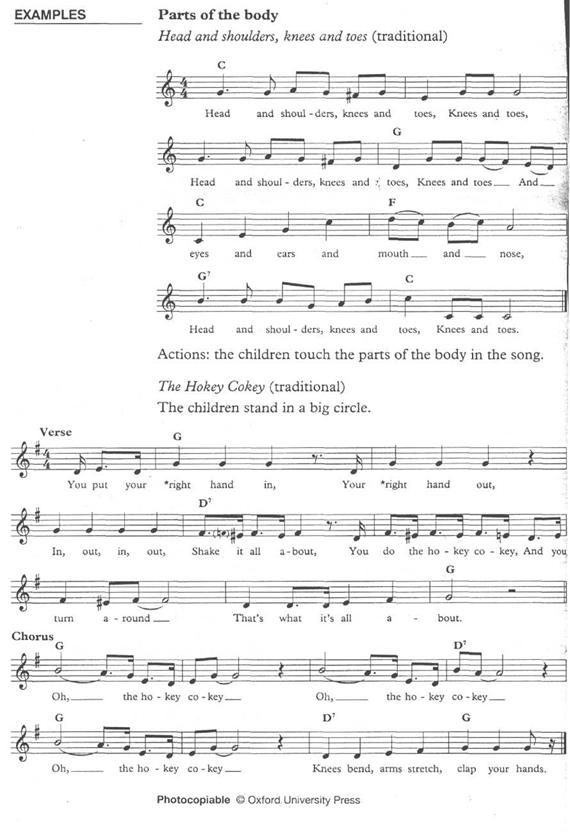
- songs. Teachers are offered to sing by themselves.
- entertainment: films, theatre, video. The content should be really entertaining and then learners will be motivated to make an attempt to understand without any further tasks.
2) Short responses
- obeying instructions. Learners draw pictures or perform actions in response to instructions
- ticking off items
- True / false. Learners can put ticks or crosses or make brief responses or they may keep silent if the statements are true and say ‘No’ if they are wrong
- detecting mistakes. The teacher tells a story making a number of deliberate mistakes. Listeners react by raising their hands or calling out when they hear smth wrong
- Cloze. The listening text has occasional brief gaps represented by silence or some kind of buzz. Learners are to write down what they think is missing. It is easier to speak the text than to listen to a recording because then you can easily adapt the pace of your speech to the speed of learner responses
- guessing definitions. The teacher gives oral definitions of a person, place or thing, learners write down what they think it is.
- Skimming and scanning. Improvised or recorded a not too-long listening text for learners to identify the main idea (skimming) or certain info (scanning)
3) Longer responses
- answering questions. Several questions (in a written form) are given in advance and the text provides the answers.
- Note-talking. Learners take notes from a talk
- paraphrasing and translating. Learners rewrite the listening text in different words: either in the same language (paraphrase) or in another (translate)
- summarizing. Learners write a brief summary of the content of the listening passage
- Long gap-filling. A long gap is left, at the beginning, middle or end of a text, learners guess and write down what they think might be missing
4) Extended responses
Here, the listening is integrated with other skills: reading, speaking and writing.
- Problem-solving. A problem is described; learners discuss how to deal with it and write down or present orally a suggested solution
- Interpretation. An extract (a piece of dialogue or monologue) is provided, with no previous info, the listeners try to guess what is going on
Activity 7
Types of listening activities (P. Ur)
1) Read the types of listening activities and classify them in accordance with the amount and complexity of response.
2) Define the learner level:
Starter 5 – 6
Elementary 7 – 8
Pre-intermediate 9 – 11
Box 8.3.1: LISTENING ACTIVITY 1Instructions1. Listen to the recording of someone giving instructions. What are they talking about? 2. Look at the words below. Use a dictionary to check the meaning of any you are not sure about. Nouns: switch, slot, disk, handle, key, arrow, screen Verbs: lock, type Adjectives: bent, capital 3. Listen to the cassette again, and use the words to complete these notes: Turn it on, here is the __________ at the side. Then you’ll see some words and numbers on the _____________ and finally a __________ C. Take your ______________ and put it in the _________, and ______________ it in; you have to close this __________. Now _____________ in ‘A’ and press the _________ with the sort of ______________ ___________ at the side. The listening textFirst you turn it on, here’s the switch at the side. Then you’ll see some words and numbers on the screen, and finally a capital C and a sort of V sideways on. OK, now take your disk, this one, and put it in the slot – it’s called a ‘drive’- and lock it in, you have to close this little handle here. Now type ‘A’ and press the key with the sort of bent arrow at the side. |

 BOX 8.3.2: LISTENING ACTIVITY 2
Instructions to student
Your worksheet shows a map of a zoo; write in the names of the animals in the appropriate cages as your teacher tells you.
Instructions to teacher
Using your filled-in map of the zoo, describe to the class where each animal lives; they may ask you to repeat or explain anything they did not catch or understand.
Student's map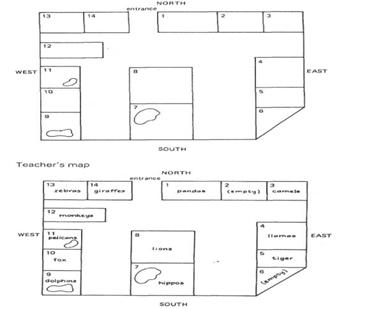
(Adapted from Penny Ur, Teaching Listening Comprehension, | Cambridge University |
Press. 1984, pp. 109-10 © Cambridge University Press 1984) |
Box 8.3.3: LISTENING ACTIVITY 3InstructionsListen to the following recorded talk, and then answer the multiple-choice questions below. The listening textCrash! was perhaps the most famous pop group of that time. It consisted of three female singers, with no band. They came originally from Manchester, and began singing in local clubs, but their fame soon spread throughout the British Isles and then all over the world. Their hairstyle and clothes were imitated by a whole generation of teenagers, and thousands came to hear them sing, bought recordings of their songs or went to see their films.The questions 1.Crash! was a) notorious b) well-known c) unpopular d) local 2. The group was composed of: a) three boys b) two girls and a boy c) two boys and a girl d) three girls 3. The group was from: a) Britain b) France c) Brazil d) Egypt 4. A lot of young people wanted to a) sing like them b) look like them c) live in Manchester d) all of these |
Activity 8 Green and Tanner p.44-46
Five principles of designing a listening task:
1. Immediate response (students react after while-listening activities)
2. Motivation
3. Success (students should be put in a situation of success at their own level)
4. Simplicity (appropriate to the students’ level of the language)
5. Feedback (immediate feedback after while-listening task)
Activity 9
Designing listening material for the classroom
1) Read about the procedure which has become standard practice when dealing with a listening text in class and underline the main points.
2) Read the following steps in a lesson and say what your opinion about this approach is.
3) Evaluate different approaches to developing listening skills, say to which stage they can refer and whether they are effective or not.
Designing Listening Materials for the classroom
The following procedure has become standard practice
when dealing with a listening text in class:
1.Pre-listening. Various activities are used to help students to become familiar with the topic, to exposed to some language features of the text or to its overall structure, and to activate any relevant prior knowledge they have.
The teacher’s role is to create interest, reasons for listening, and the confidence to listening.
2. While-listening. Before setting the students to do the task, the teacher makes sure that they have all understood what it involves.
The students carry out the task independently without intervention from the teacher. Although the listening itself is done individually, student can be encouraged o check their responses in pairs or groups as soon as they are ready.
As a feedback the teacher and students check and discuss the responses to the while-listening task. The teacher’s role is to help students see how successful they have been in doing the task.
3.Post-listening. Follow-up activities can be of various kinds. The teacher may wish to focus on features of the text, or on listening process to assist further development of effective listening, or on integration with other skills.
(from Teaching and Learning in the Language Classroom by Tricia Hedge, Oxford, 2001.)
The following are some familiar steps in a lesson in which the teacher’s objective is to develop the students’ listening skills (pre-, while, post-listening activities):
 |
· Do a ‘warm-up’ on the topic of the listening passage
· Get some gist questions for the students to answer
· Play the tape once, ask the students to answer
· Check (correct, repeat if necessary)
· Get some tasks to listen for details
· Play the tape again, probably with stops
· Check
· Use the topic or the language of the listening text as an input for an ‘extension’ or ‘transfer’ activity in which students use other skills
 |
What is your opinion about this approach?
Is it perfect? Do any features trouble you?
_______________________________________________________________________________________________________________________________________________________________________________________________________________
Perhaps the most vital element in learning to listen effectively in a foreign language is confidence, and confidence comes with practice and with achieving success from an early stage. The role of the teacher is to provide as much positive practice as possible.
Tricia Hedge
Developing Listening Skills
 |
1.Evaluate different approaches to developing listening skills
Look at the following list of measures teachers might employ to develop listening skills. Indicate which measures you think are effective by writing E and ineffective by writing I. In some cases a measure may be considered as either effective depending on the circumstances.
Example: The teacher instructs the class to listen carefully to every word. – I
(Qualification: In most cases, effective listening involves paying attention selectively. However, listening carefully to every word might be effective - and indeed ‘appropriate’ – if, for example, the task involved dictation of an address.)

|
Из за большого объема этот материал размещен на нескольких страницах:
1 2 3 4 5 6 7 8 9 10 11 12 13 14 15 16 |
