


Партнерка на США и Канаду по недвижимости, выплаты в крипто
- 30% recurring commission
- Выплаты в USDT
- Вывод каждую неделю
- Комиссия до 5 лет за каждого referral
a) The teacher encourages the class to listen to herself or to other speakers of English
b) The teacher arouses interest in the material before the class listens
c) The teacher uses materials which incorporate features of natural spoken English (false starts, hesitation, repetition, ungrammatical, unfinished sentences, etc.)
d) The teacher sets tasks which focus specially on these features
e) The teacher sets clear, realistic tasks which encourage the students to listen only for certain information
f) The teacher makes it clear to students that they will have the opportunity to discuss their answers in groups before speaking to the whole class
g) The teacher encourages discussion of the process of listening
h) The teacher devises tasks to infer information which is only implied in the discourse
i) The teacher encourages the students to guess how the discourse will develop
j) The teacher encourages the students to use their knowledge of grammar and context to guess the next word.
k) When focusing on new language, the teacher gives realistic models, taking care to draw attention to the weakening and elision of syllables in a continuous stream of speech
l) The teacher always takes care to speak slowly
m) The teacher always uses good quality tapes and ensures that there is no distraction by the presence of background noise
n) The teacher tries to use materials which provide good models of ‘standard English’
o) The teacher always takes care to find out and record how many questions each student answered correctly
p) The teacher teaches the students ways of interrupting a speaker to ask for clarification
Material Selection__________________________________________________
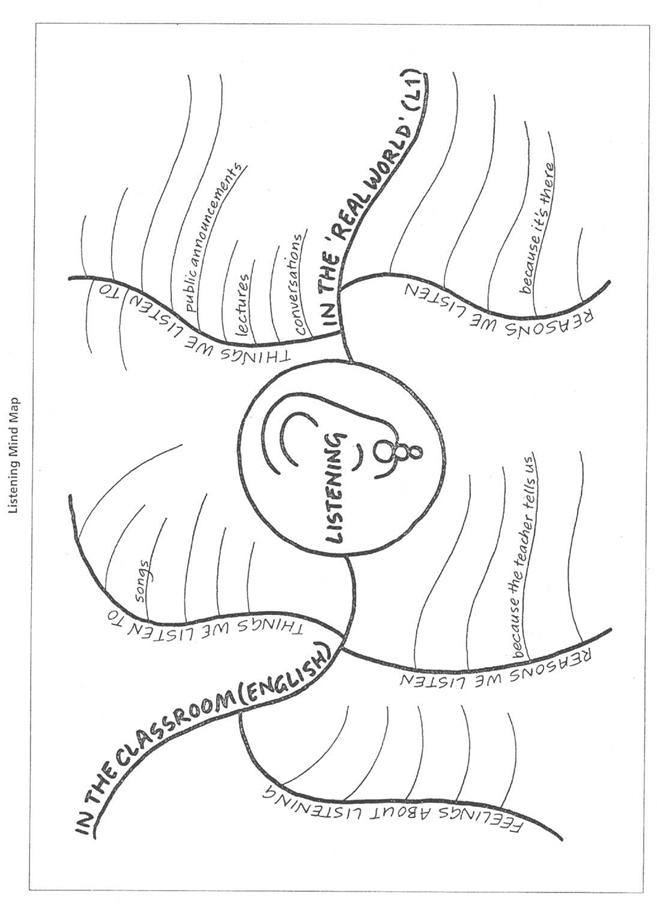
· The use of recordings of authentic unrehearsed discourse. Think about advantages and drawbacks of using it.
· The use of recordings which are approximation to authenticity (semi-authentic). Do they have any value? Why?
· The use of video. How important is it in developing listening skills?
· Listening material presented ‘live’. Can a teacher improvise listening material in the classroom? Can students design and present their own listening materials?
Discuss in groups and make a conclusion:
______________________________________________________________________________________________________________________________________
___________________________________________________________________
Activity 10
Go through the list of types of listening activities, marking activity types that seem to you particular useful, or even essential. Divide them into 3 stages: pre-, while - , and post - listening
· Following a written text
· Listening to a familiar text
· Listening aided by visuals
· Describing pictures
· Maps, plans, grids, family trees
· Informal teacher-talk
· Entertainment (songs, stories)
· Films and TV programmes
· Obeying instructions
-physical movement
-constructing models
-picture dictation
· Ticking off items
· True/False
· Detecting mistakes
· Aural cloze (with/without a text)
· Guessing definitions
· Noting specific information
· Identifying and ordering
· Naming features (maps)
· Alterations
· Ground-plans
· Graphs
· Repetition and dictation
· Paraphrase
· Translation
· Answering questions
· Predictions
· Filling gaps
· Summarizing
· Problem-solving
· Jigsaw
· Complementary texts
· Interpretative listening
· Evaluative stylistic analysis
· Interview
· Comedy
· Drama
· Advertising
· Rhetoric
· Poetry
· Conversation
Activity 11
Study the chart and add activities from the previous task (Activity 10)
Stages and activities for a listening lesson
Stages | Activities |
Pre-Listening While-listening Post-listening | · Brainstorming (express ideas about the topic/content of the text based on background knowledge and experience) · Elicitation (eliciting something associated with the topic) · Discussion (encouraging students to exchange ideas/opinions) · Games (for warming-up relaxation) · Introducing the task (giving instructions) · Ticking off items · Filling in gaps · Sequencing · Matching · Comparing · Information transfer (maps, plans, grids, forms, pictures, etc.) · Multiple-choice questions · True/false, etc · Speaking as follow-up activities (e. g. debate, interview discussion, role play, summarizing, problem-solving, etc.) · Writing as follow-up activities (letters, telegrammes, messages, etc.) · Answering questions to show comprehension |
Listening and Speaking Skills for the Cambr .Proficiency Exam2 V. Evans, S Scott
Listening tasks
Step 1
 TASK 2 Using an ear trumpet
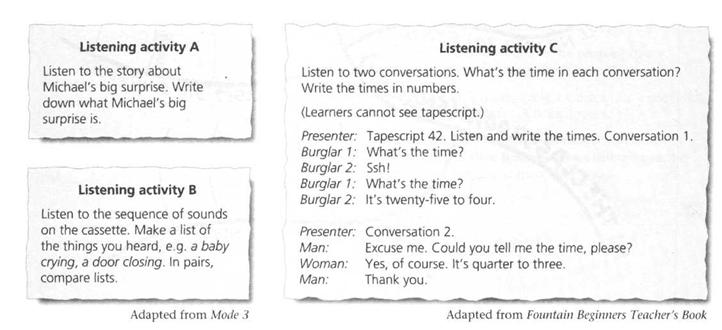
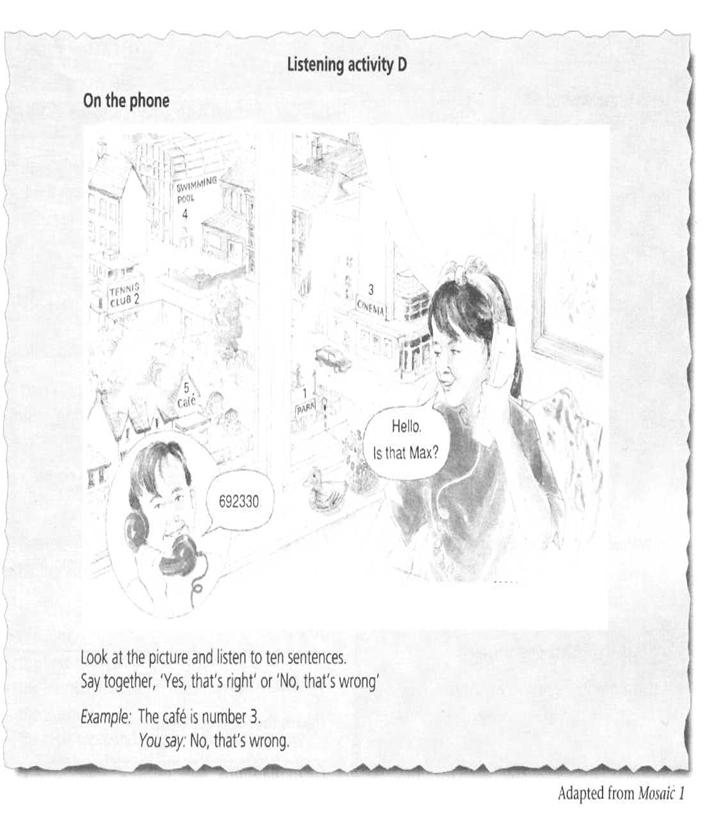
 In this task you examine and evaluate ten listening activities and decide on their aims.
Work in pairs.
Match each of the Listening aims (1-10) in the table below with the instructions to the learner in Listening activities A-J (pp. 44-46), by writing the letter of one or more activities (A-J) in the right-hand column. Some aims apply to more than one activity. One example has been done for you.
Listening aims | Listening activity |
1 Listening for the main ideas / gist | |
2 Listening for specific information | |
3 Listening to check if your answers are right or not | |
4 Listening to check for mistakes | |
5 Listening for dictation | |
6 Listening to re-order a jumbled dialogue | |
7 Listening to take notes | |
8 Listening to complete a picture | |
9 Listening to other learners | |
10 Listening to match pictures with descriptions |
|

 '
'
Listening activity E
Answer these questions about Susan's room. As you listen, note down either Yes, she has or No, she hasn't.
1 Has Susan got a big bookcase? Yes, she has.
2 Has she got a picture of a kangaroo on the wall?
No, she hasn't.
3 Has she got an easel?
4 Has she got two pianos?
5 Has she got a cassette player?
Adapted from Fountain Beginners
Listening activity G
Show your project to your teacher and your friends. Look at your friends' projects and talk about them.

Listening activity F
1. Here is a dialogue between Anna and Mr Baker.
Read it to yourself and put it in the right order.
Mr Baker; Five pencils, two exercise books, a rubber, and... how many envelopes?
Anna: Can I have a newspaper, please?
Mr Baker: Hello, Anna. I'm fine thanks. And you?
Anna: Hello, Mr Baker, How are you?
Mr Baker: Yes, certainly. Here you are.
Anna: Thank you. And can I have ... let's see... five pencils, two exercise books, a rubber and, er, ten envelopes.
Mr Baker: Good.
Anna: Ten, please.
Anna: I'm OK, thanks.
Mr Baker: Right. Here you are. Anything else?
2. Now listen to the dialogue. Did you have the
right order?
Taken from Mosaic 1
Adapted from Mosaic 1
3.2 Teaching Reading
Aim: By the end of the session the students will get a clear idea of effective ways of developing reading skills.
The following issues will be considered:
· texts types for reading at school;
· purpose for reading;
· reading skills and strategies;
· criteria and guidelines for selecting texts for classroom studying;
· types of activities;
· methods of testing reading.
1. Texts for Reading
One can name more than 50 texts types people read in real life. They are:
· Novels, short stories, tales: other literary texts and passages(e. g. essays, diaries, anecdotes, biographies)
· Plays
· Poems, limericks, nursery rhymes
· Letters, postcards, telegrammes, notes
· Newspaper and magazines (headlines, articles, editorials, letters to the editor, stop press, classified ads., weather forecast, radio/TV/theatre programmes)
· Specialized articles, reports, review, essays, business letters, summaries, precis, accounts, pamphlets (political and other)
· Handbooks, textbooks, guidebooks
· Recipes
· Advertisements, travel brochures, catalogues
· Puzzles, problems, rules for games
· Instructions (e. g. warnings), directions (e. g. How to use...), notices, rules and regulations, posters, signs (e. g. road signs), forms (e. g. application forms, landing cards) graffiti menus, price lists, tickets
· Comic strips, cartoons and caricatures, legends (of maps, pictures)
· Statistics, diagrams, flow/pie charts, time-tables, maps
· Telephone directories, dictionaries, phrasebooks
Task 1. Please, read the list and pick the text types that pupils read at school.
Teacher’s question: How many items have you got? What are these text types? Is there any great difference between these two lists? Can you see here any problems? Should we give our students the texts of all types?
2. Purpose for Reading
Here we come to the questions:
· What do we read for in real life? and
· What is the aim of learning reading and teaching reading at school?
Task 2. Working in groups of four define the purposes of reading in real life.
In real life people read for:
· pleasure
· information
· surviving
In general we read because we want to get the message from the writing: it might be facts, ideas, enjoyment, feelings, etc.
So, reading is communication or interaction through conveying a message.
Different people understand the meaning of one and the same message differently. Understanding depends on attitudes, values shared by people brought up in the same society. Understanding also depends on what we have experienced and how our minds have organized the knowledge we have got from our experiences.
We all get something different from a text. Whose understanding is better, closer to the writer’s message?
Understanding a written text means extracting the required information from it as efficiently as possible.
Task 3. Working in the groups of four state the aims of teaching reading at school.
The aim of teaching reading at school is: to enable students to read without help unfamiliar texts at appropriate speed silently with adequate understanding.
Task 4. Working in a group of four compare the aims and explain the difference. Share your ideas with the whole group.
If our students reach that aim they become competent readers.
3. Reading Skills and Strategies
Competent readers should possess some specific skills. Reading involves a variety of skills. The main are as follows:
· Recognizing the script of a language
· Deducing the meaning and use of unfamiliar lexical items
· Understanding explicitly stated information
· Understanding information when not explicitly stated
· Understanding conceptual meaning
· Understanding the communicative value (function) of sentences and utterances
· Understanding relations within the sentence
· Understanding relations between the parts of a text through lexical cohesion devices
· Understanding cohesion between parts of a text through grammatical cohesion devices
· Interpreting text by going outside it
· Recognizing indicators in discourse
· Identifying the main point or important information in a piece of discourse
· Distinguishing the main idea from supporting details
· Extracting salient points to summarize (the text, an idea etc.)
· Selective attraction of relevant points from a text
· Basic reference skills
· Skimming
· Scanning to locate specifically required information
· Transcoding information to diagrammatic display
Competent readers first take into consideration what they are going to read and then they choose the way of reading:
ü Skimming: quickly running one's eyes over a text to get the gist of it.
ü Scanning: quickly going through a text to find out a particular piece of information.
ü Extensive reading: reading longer texts, usually for one's own pleasure. This is a fluency activity, mainly involving global understanding.
ü Intensive reading: reading shorter texts, to extract specific information. This is more an accuracy activity involving reading for detail.
These different ways of reading are not mutually exclusive. For instance, one often skims through the passage to see what it its about before deciding whether it is worth scanning a particular paragraph for the information one is looking for.
In real life, reading purposes constantly vary and we should vary the questions and the activities according to the type of text studied and the purpose in reading it. When working on a page of classified ads., for instance, it would be artificial to propose exercises requiring the detailed comprehension of every single advertisement.
Task 5. Working in groups of four discuss the reading skills and pick out the skills you have been teaching and would like to teach your students. Share your ideas with the whole group of participants.
Task 6. Working with partner fill in the chart for reading strategies. Discuss your ideas with the whole group of participants.
Text is the area for the skills and strategies implementation
Teacher’s question: What kind of texts should be used in a reading lesson: texts that teach language or texts that have been written just to inform, to entertain, to persuade?
4. Criteria and guidelines for selecting texts for classroom studying
Task 7. In a group of four make a list of criteria which are most important in choosing a text for reading in the classroom. Discuss the criteria with the whole group.
Task 8. Range the criteria in order of importance.
Criteria for evaluating texts for reading development
ü Suitability of content
ü Exploitability
ü Readability
ü Authenticity
ü Presentation
Guidelines for choosing texts for classroom study
Take a critical look at texts you currently use for comprehension work: do they fulfill these criteria?
1. Will the text do one or more of these things?
a) tell the students things they don't already know.
b) introduce them to new and relevant ideas, make them think about things they haven't thought of before.
c) help them understand the way others feel or think (e. g. people with different backgrounds, problems or attitudes from their own).
d) make them want to read for themselves (to continue a story, find out more about a subject, and so on).
2. Does the text challenge the students' intelligence without making unreasonable demands on their knowledge of the language?
3. Is the language natural, or has it been distorted by the desire to include numerous examples of a particular teaching item (e. g. a tense)?
4. Does the language reflect written or spoken usage? (the spoken language presented to beginners is often limited to describing the obvious - e. g. a picture; this may carry over into coursebook texts.)
5. If there are new lexical items, are they worth learning at this stage, and not too numerous? Can the meaning of some of them be worked out without the help of a dictionary? Can some be replace by simpler words.
5. Types of Activities
The idea that there are three main types of reading activity: pre-, while - and post-, is now a common feature of discourse about reading.
Pre-reading activities can consist of questions to which the reader is required to find the answer from the text. Other pre-reading tasks tend to focus on preparing the reader for linguistic difficulties in a text; more recently attention has shifted to cultural or conceptual difficulties.
The aim of while-reading activities is to encourage learners to be flexible, active and reflective readers. Many while reading tasks, with the aim of active and reflective reading, attempt to promote the kind of dialogue between reader and writer. Different genres offer opportunities for different activities of this kind. For example discursive texts typically present a problem to which there are a number of potential solutions. One can interrupt such texts at points which appear especially to invite a reader contribution. The writer might signal such, natural breaks' in his or her text in a number of ways, most obviously by means of a question.
Texts in other genres such as narrative fiction may be divided into sections with intervening questions to encourage learners to predict the continuing events of the story. What such activities attempt to do is to replicate the process which occurs quite spontaneously in mature readers, we continually use the evidence of what has preceded to predict the continuation of a text.
Other while-reading tasks require students to transfer information from a continuous text to some kind of grid or matrix or while reading activities may be designed to offer prompts for readers in the case of difficult texts. A major problem with while reading tasks of this kind is that they can be very time consuming to prepare.
Post-reading activities can serve the purpose of heightening the reader’s awareness of other ways in which the topic could have been written about. Post-reading activity needs to be motivated by the genre, the context of learning and likely learner purpose.
Task 9. Read and identify activities for different stages of a reading lesson.
Activities for a Reading Lesson
Stages | Activities | Explanation / Demonstration |
PRE - READING | Warm-up exercises: | |
elicitation / discussion about the topic (perhaps based on visuals, title) | a. to elicit something associated with the topic b. to encourage students to exchange ideas / opinions about the topic | |
brainstorming | a. word - star: ask students to predict the words and expressions likely to appear in the passage. Teacher writes them on the blackboard. b. expressing hypotheses about the content of the passage, based on previous knowledge, by writing notes down | |
games | a. for warming-up relaxation b. for training in basic reading | |
guiding questions | teacher asks / writes questions that help students exploit passages | |
WHILE - READING | comparing | to compare passage with prediction in pre-reading |
obeying instructions | students are given instructions and show comprehension by physical movement, finishing a task, etc. | |
filling in gaps | e. g., students read utterances of only one of the participants and are asked to reconstruct those of the others | |
detecting differences or mistakes | students read passages, responding only when they come across something different or wrong | |
ticking off items (bingo) | students read a list of words and tick off or categorize them as they read them | |
information transfer | maps, plans, gifts, forms, lists, pictures, etc. | |
paraphrase | students are asked to focus on certain sentences and paraphrase them | |
sequencing | e. g., students are asked to give the right order for a series of pictures | |
information search | students read a passage and take notes on the segments that answer a particular question | |
filling in blanks | students are given a passage with some words missing and must fill in the blanks while reading | |
matching | e. g., students are asked to match items that have the same meaning as those they read | |
POST - READING | answering to show comprehension of messages | e. g., multiple choice or true / false questions, open-ended questions, short questions |
problem solving | students read the information relevant to a particular problem and then set themselves to solve it | |
summarizing | students are given several possible summary – sentence and asked to say which of them fits a text | |
jigsaw reading | different groups of students read different but connected passages, each of which supplies some part of what they need to know. Then they come together to exchange information in order to complete a story or perform a task | |
writing as a follow-up to reading activities | e. g., letters, telegrams, postcards, messages, etc. related to passages | |
speaking as follow-up to reading activities | e. g., debate, interview, discussion, role-play, dramatization | |
translation | ||
projects |
6. Methods of testing Reading

|
Из за большого объема этот материал размещен на нескольких страницах:
1 2 3 4 5 6 7 8 9 10 11 12 13 14 15 16 |
