


Партнерка на США и Канаду по недвижимости, выплаты в крипто
- 30% recurring commission
- Выплаты в USDT
- Вывод каждую неделю
- Комиссия до 5 лет за каждого referral
Immediately the rhetoric was carefully managed in terms of carefully chosen words to try to shape perception of the event. The murderer, who has not been named yet, is characterised as ‘acting alone’ and that this was an ‘isolated incident’ (in spite of plenty of evidence to the contrary, such as the massacre of 19 civilians in Eastern Afghanistan in 2007 by US troops after a roadside bomb wounded one soldier). There have been promises by Defence Secretary Leon Panetta that the military would bring ‘appropriate charges’, given the track record to date this is very doubtful. This is especially so given the unfolding excuses and narratives, such as the soldier suffering from mental stress. The event is variously described as being a ‘tragedy’, a ‘massacre’, a ‘bloody rampage’. However, no mention at all of the obvious descriptions for what it really is, such as an atrocity or a war crime.
The ‘lone’ narrative is a central theme of the public messages. A good example of this was Obama’s reaction to the comparison made with the US atrocity in My Lai in Vietnam in 1968. This was discounted because he is characterised as acting as a lone gunman (http://www. /intl/cms/s/0/86c8adaa-6c72-11e1-bd0c-00144feab49a. html#axzz1p2VtpsLK). There seem to be significant problems with this statement though. There have been a number of accounts by Afghans that this was not the work of a lone gunman. The contradictions come from people who had survived the attack and increasingly other Afghans that increasing doubt the value and sincerity of what American political and military officials state publicly (http://www. /_8/afghans-express-skepticism-over-shooting-account/ and http://www. dailymail. co. uk/news/article/US-soldier-fallen-blind-rage-rampage-killed-16-Afghan-civilians. html).
Questions that are critical to understanding this latest atrocity have still not been asked by the mainstream mass media. The simple question, how could a senior non-commissioned officer leave a military base alone at 0300 without anyone noticing him? No sentries challenged or reported his departure? US military personnel in Afghanistan are not meant to travel alone while of base as a security measure. This story has many unanswered questions and suspect aspects that imply that there is more to this story than what has been told in the mass media.
Another story, which illustrates a set of double standards on a larger scale, involves the story of the 14 year old Pakistani girl, Malala Yousafzai. She was shot by Taliban owing to her public stance on women’s education. The story featured heavily in Western media, which was meant to highlight the superiority of Western values and action over those of the other (extremist Islamic), especially when the girl was offered medical treatment that went beyond the ‘normal’ procedure and access for the average citizen. This act has rightly been widely condemned around the world. Yet, while this particular act focuses world attention on the plight of one girl, US drones are killing hundreds of her fellow countrymen, women and children each and every day along the North Western parts of the country. These people are summarily executed without question, dismissed as being ‘suspected militants’, without any political outcry. This indiscriminate use of military firepower on civilian infrastructure clearly contradicts those earlier expressed values of freedom, democracy, rule of law and human rights, and probably the rules of war.
Myopic policy and living the grey zone
Foreign policy and implementation is increasingly myopic, short term, often poorly defined goals, and serve a narrow set of interests. A certain red thread exists that can be seen in the programme of regime change, the short term nature of the goals and some dubious assumptions that have been made along the way. The premise of the goals of regime change seem to be that by removing the previous regime (by whatever means), the local population shall be grateful and indebted to their ‘liberators’. And that they shall seek to construct a society that models itself on Western variants. Neocons have even gone as far as to justify the illegal Iraq invasion as sparking the Arab Spring and a ‘democratic awakening’ in the Arab world. This contrasting against the varying positions of Bush on the aspects of legitimacy of the invasion from an act of self-defence against the Hussein regime’s possession of Weapons of Mass Destruction and links to terrorism to ‘at least we got rid of a bad man’ argument.
Working with the notion of gratitude by those who have been liberated, if such was true, then Osama bin Laden should have been a close friend of the US. He was not, yet this type of thinking and assumption remains. The more recent result was the death of the US ambassador in Libya, which is yet again, hardly an overwhelming sign of gratitude. Recent media reports suggest that the US is reluctant to supply more powerful weapons to the Syrian insurgents owing to the radical and terrorist elements that are firmly entrenched in their ranks. Yet they continue to keep the conflict boiling.
Turkey is an interesting case with regards to their interference in Syria. Actively helping the armed insurrection against al Assad, in spite of growing public opinion against Turkey being involved (some polls put public opinion at 75 per cent against). They know full well the costs of being involved and it is against the national interest. One excuse being put forward is the rise of Neo-Ottoman diplomacy. However, the Ottoman’s were skilled diplomats as they were a fighting force, in their time. If regime change fails to be achieved, Turkey will be hosting a large number of radicalised and heavily armed insurgents on their soil, and a hostile neighbour to the south. If regime change succeeds, then there is the possible question of the Kurdish state. They are still dealing with the results from the Iraq war on this particular issue. Syria is likely to implode and become heavily radicalised, thereby providing Turkey with a security nightmare along the complete southern borders. When Syria responds to Turkey’s hostile acts (such as flying the photo-reconnaissance plane into Syria airspace, and the above), this is decried and judged as being unacceptable by the international community. Turkey on the other hand, is able to give itself the right to invade Syria at any time with NATO’s blessing. The asymmetry and hypocrisy in what is deemed as acceptable and not has reached new depths with this move. Not long ago (25 July 2012), a report was released by the Royal United Services Institute, the Syria Crisis Briefing, which repeated the mantra on a number of occasions that the West does not want to go to war with Syria, but sometimes wars just happen to find the West. Thereby attempting to wash their hands of any responsibility for deliberate human decisions, writing them off as being a product of fate!
Syria as the Latest in the Line of Manufactured Wars
Syria is portrayed as being the latest of a string of revolts against authoritarian dictatorships, where the given scenario is painted as being a justified and righteous democratic movement that seeks to rid itself of decades of corruption and repression. These budding democratic movements are miraculously appearing, heralded in some corners (such as the Hawks in the United States), as being justification for the dubious US-led invasion and occupation of Iraq that has brought in to play some kind of democratic domino-effect.
Global mass media assets in the Anglo-Saxon world have been giving glowing reports of the Arab Spring, the dominant narrative is that it is a democratic awakening in the Arab world that has started at the grassroots level in the region (Simons, 2012). As if some kind of force has been mysteriously stirred from within, this is a familiar story to some people as the Colour Revolutions of the early 2000s. The general framing of these conflicts is that of democracy versus authoritarianism, good versus bad and freedom versus oppression. This simplistic and emotional coverage glosses over and omits many worrying and disconcerting facts. As history has shown, it can be very difficult to maintain control of the situation after unstable political forces have been unleashed. What was unleashed in the Soviet Union by Mikhail Gorbachev’s Perestroika provides an excellent case in point.
One of the implied and sometimes explicit themes, which is related to the notion of a sense of justification for such types of civil conflict is that the outcome is to be better than the original state before the conflict. This is repeatedly stated as being the case, but there is very little hard evidence or justification for stating so. Very little time has gone by and the press has hailed the Arab Spring as a great success for democracy and the Arab World. Any contradictory evidence has been omitted or glossed over. For instance, the elections in Libya are a demonstration of success. The seizure of the lawyers from the International Criminal Court and the various massacres perpetrated by the victors, not to mention the recent events in Mali are either downplayed or brushed aside. This would interrupt the good news narrative.
Tunisia, Egypt, Libya and Syria have been deemed as belonging to the Arab Spring club. Like a contagion the ‘democratic’ movements have been overthrowing decades old authoritarian regimes. The process is still ongoing in Syria. However, some revolutions and insurgencies have been left out from this club, interestingly enough. The insurgency in Yemen and its former dictator President Saleh were excluded as was Bahrain and the massacre of unarmed protesters that occurred there.
Yet these ‘legitimate’ Arab Springs are far from being spontaneous and without any foreign assistance. The Libyan war provided a much more open demonstration of the open use and abuse of foreign military intervention in a ‘humanitarian crisis’. In Syria, there is no direct foreign military intervention yet, but a lot of assistance to the anti-Assad forces. Turkey is providing safe havens for the insurgent forces as well as anti-tank and anti-air weapons, other Arab states proving weapons, CIA on the ground ‘liaising’ with the insurgents. The United Kingdom hosts NGO, the so-called Syrian Human Rights Observatory, which makes up much of the material that is quoted by Western mass media outlets.
Western support of ‘liberation movements’ has been a problem in the past, where a mix of ideology and short-term, myopic thinking has seen the move backfire in the future. The support of the anti-Soviet forces in Afghanistan, including Osama bin Laden. This decision, with various factors that came to affect what was to come, ultimately came back to haunt the US and the Western world. Similarly the decision to offer Adolf Hitler the position of Chancellor, perhaps under the misguided notion that he could be controlled, came to be regretted.
The rebels/insurgents are often described as being ‘regular’ people in extraordinary circumstances and are cleared of conducting any wrongdoing in the current bloody civil war. When acts of terrorism are committed by them, they are not called acts of terrorism, rather as decisive blows against a bloody and brutal regime of Assad. However, one or two cracks in the mass media narrative have begun to appear. Reuters recently hinted at some possible problems in the future. And acknowledged some current ‘problems’, such as the presence of foreign radicals that were targeting non-military objects, including schools, yet these actions are not condemned (http://www. /article/2012/08/08/us-syria-crisis-insight-idUSBRE87701T). The New York Times produced an even more disturbing article, radical elements that include Al Qaeda and the use of suicide terrorism, hardly the picture of democracy (http://www. /2012/07/25/world/middleeast/al-qaeda-insinuating-its-way-into-syrias-conflict. html).
These articles are a taste of what is being mostly hidden from public view. There may be the belief that by supporting fundamentalist elements in overthrowing the last vestiges of the Axis of Evil that they shall be somehow grateful and fall in to the Western sphere of influence is a pipe dream that is likely to be confirmed by events in the near future. Libya is in the process of unravelling, but away from the gaze of the international press. The Syrian scenario is one that has a much more dismal outcome for many concerned, the people of Syria, and the wider region. An irony in the Global War On Terror, whilst fighting extremist elements in Afghanistan and Iraq, the West is assisting extremist forces in seizing political power in Libya and now Syria. This is currently a war that is being fought by deception and perception. If or when Assad falls from power what follows is likely to be replaced by a situation that is far worse, and to create fertile conditions for bringing in to existence the next bin Laden.
Conclusion
What does the future hold? There is an ancient (allegedly) Chinese curse – “may you live in interesting times.” Indeed we are living in interesting times, but this is of the West’s own making, based upon poorly conceived and short term policy objectives that have a tendency to erode rather than contribute to any sense of national security. There seems to be little desire or demand for long term strategy based upon solid concepts and policy for contributing to a sustainable engagement with the region that shall work towards peace and cooperation rather than war and disruption. There is a distinct tendency, under the guise of humanitarian diplomacy, wage wars of convenience (rather than out of necessity). On the surface, these seem to be done with good intentions and for humanitarian purposes. However, the way these wars are wages demonstrates very much the contrary.
The naming of the European Union as the recipient of the 2012 peace prize, and the war time President Barak Obama earlier, merely demonstrates the level of deceit involved in this very cynical process. Poorly conceived, executed and in general counter-productive policy shall result in further crisis and problems in the future. The West, and in particular the US, may wonder why the world does not ‘like’ them, the answer is not very difficult to understand with some hindsight or at least self-reflection. One cannot make ‘friends’ with terrorists, especially when fighting similar people and groups in one country and helping them come to power in another.
However, it is not going to be only the West that feels the eventual effects of the current age of humanitarian diplomacy in artificially created and sustained armed conflict. As can be seen with Syria, it is beginning to engulf a much wider region, leaving instability and devastation in its wake. Interestingly enough, the US does not want to supply its ‘freedom fighters’ there with any heavy weapons, yet at the same time, keep supplying them with small arms, money, intelligence, safe havens... etc, which keeps the war going. The same situation has happened with countries that are neighbouring Afghanistan, Iraq and Libya. Yet there are more wars are likely to be in the making in the near future!
References
Bennett, W. L., Lawrence, R. G. & Livingstone, S., When the Press Fails: Political Power and the News Media From Iraq to Katrina, Chicago, The University of Chicago Press, 2007
Creel, G., How We Advertised America: The First Telling of the Amazing Story of the Committee on Public Information That Carried the Gospel of Americanism to Every Corner of the Globe, Lexington (KY), Forgotten Books, 2010 (original in 1920)
DiMaggio, A. R., Mass Media, Mass Propaganda: Examining America’s News in the “War on Terror”, Lanham (MD), Lexington Books, 2009
Herman, E. S. & Chomsky, N., Manufacturing Consent: The Political Economy of the Mass Media, New York, Pantheon Books, 2002
Shabo, M. E., Techniques of Propaganda and Persuasion, Clayton (DE), Prestwick House, 2008
Simons, G., Propaganda and the Information war Against Syria: The Latest War for Peace, http://e-journal. spa. *****/images/File/2012/33/Simons. pdf, Государственное управление. Электронный вестник, Выпуск № 33. Август 2012 г
Simons, G., El uso del 'ius ad bellum' para fabricar una causa de guerra contra Libia, CIP-Ecosocial, http://www. fuhem. es/cip-ecosocial/articulos. aspx? v=8996&n=0, 2011 (a)
Simons, G., SMI i Borba za Obshchestvennoe Mnenie v Globalnoi Voine s Terrorismom: Opit Iraka, in Bikov, A. U. (editor), Sovremenniye Zarubezhniye SMI v Usloviyakh Globalizatsii, St Petersburg, 2011 (b), pp. 24-41
Simons G., Selling conflict in the 21st century: PR or advertising the way of public consent? In Topical Issues of Advertising: Theory and Practice: collection of Papers. Vol. II. / Editor-in-Chief A. V. Prokhorov. Tambov: The Publishing House of TSU named after G. R. Derzhavin, 2010, pp. 45-53
Snow, N., Information War: American Propaganda, Free Speech and Opinion Control Since 9-11, New York, Seven Stories Press, 2003
Thussu, D. & Freedman, D. (editors), War and the Media: Reporting Conflict 24/7, Sage, London, 2003
Zelizer, B. & Allan, S. (editors), Journalism After September 11, Routledge, New York, 2002
Sharyn Steel
Peace and Compassion in the Media
I think the challenge in the media is to make peace and compassion as interesting and exciting as war and disasters. That is just as much challenge for me today as it was when I started in journalism over 40 years ago.
My original purpose is moving into journalism, from studying physics and chemistry at university, was to learn about the world from the bottom up, and avoid specialization. I wanted to be a generalist, and find out about everything, not confined to a laboratory in a white coat. Over the intervening years, I have worked as a sports, political, diplomatic and business journalist in newspapers and magazines, before again deciding that I didn’t want to specialize.
I am now a news editor at Radio New Zealand, and a writer, with one book published, ‘Struggling to Fly’, about my first two decades in what was then male dominated news journalism. I also have two other books in progress. But I am not writing about them now. Anyone wanting more information on that can look at my website www. As an editor, selecting stories for radio news, I am constantly confronted by the desire to make the news more positive, while the world in general often seems to become more negative with conflicts, power struggles, murders and crashes. I may struggle to find positive stories but I try to balance them with those of crimes and disasters.
Initially, as a 20 year old, I was curious and naïve. I am still curious, but I have become somewhat disillusioned with power, having often seen it associated with control, and incompetence. I am now more focused on increasing the amount of peace and compassion in the world. I believe the media has a role to play in that. Sometimes the media acts by putting a situation or person under the spotlight, publicizing the particular person or issue, positively or negatively. The media can also help work out crisis situations. I tried to do that as a diplomatic journalist for a newspaper – I would interview the protagonist, the opposition and then a neutral person about a particular world situation. As a diplomatic journalist, I had access to the ambassadors of countries, and my neutral person would mostly be a New Zealand Foreign Service analyst in that the time I had interviewed at least three people, the difference between the propaganda and what was real would be obvious. I could then write a story based on that, showing the propaganda as such, and the real possibilities for future change. Although my stories didn’t change world crises, they had the potential to change people’s views about the particular situation. Changing even one person’s view can be positive, as you never know how that can spread.
In some ways, writing about wars and disasters is necessary, as a record of the present and past. But it is limited by being a record of what has happened. To make a particular article a possibility for the future, there must be a way to move forward. In many ways writing, about wars and disasters is easier as they have more factual definition than peace and compassion, which tend to be amorphous. But writing about ideas, solutions, and possibilities can also be made exciting and engaging.
Something that always brings a story to life is focusing on the personal experience of someone in a particular situation. For example, instead of focusing on a disaster, write about the experience of someone experiencing that disaster and also how they are coping with their situation. Personalize the story as well as writing about the generalized situation. Then a story can become one of hope and survival rather than struggle and destruction.
Peace and compassion can be brought to life with the suggestions of solutions or options for progress. Disasters, in contrast, have their own adrenaline and drama. But the excitement of a story could be a positive outcome, raising the conscious level of the reader by creating possibilities rather than leaving them mixing with antagonists.
In general, the world media follows war much more than peace. But I believe it is important to get the message of peace out and aid organizations have a role to play in that. While journalists get imbedded with military groups in conflicts, they don’t usually work alongside aid groups and there is surely scope to do more along those lines. In some cases, all it would take would be an invitation for a journalist to join a particular group and their employer might pay the costs for the possibility of an inside story.
I believe people in general often have a suspicion about working with the media, which they may judge harshly. But the media is just as diverse as society itself with journalists coming from varied backgrounds. They all, however, have in common the desire to find good stories. Some can be blinkered with judgments and criticisms, but most are curious and non-judgmental. You can always find appropriate media by examining the media outcome, the newspaper, magazine, television or radio program, and approach the editor, who can assign the reporter most suitable for the exercise.
Publicity through the media, in stories or features, can be far more effective than paid advertising. Media promotion can be as easy a sending an email to the particular news organization with the story idea or person to interview and the name and phone number of a contact person; that person must be available to take any calls in response, or at least respond promptly to messages. As news organizations are usually busy, they will not repeatedly call someone who doesn’t respond to their requests for an interview.
Media should not be seen as the enemy. Even if an individual in the media is negative, there is usually someone else more positive who can be approached.
As well as being a writer/journalist, I am an avatar master, in the avatar personal development program, not the movie. Avatar is a powerful, pure self-development program that is raising human consciousness one person at a time to create an enlightened planetary civilization. More information can be obtained from www. or from me.
; Jeffrey Kleinpeter
«Развитие гуманитарной дипломатии в различных средах и формирование виртуальных гуманитарных кластеров»
Гуманитарная дипломатия развивается в определенной международной институциональной и правовой среде, позволяющей ее основному субъекту , в том числе Российскому Красному Кресту, ставить и решать основные задачи в области реализации международного гуманитарного права, решения различных гуманитарных проблем и удовлетворения основных гуманитарных потребностей уязвимого населения.
Одной из постоянных задач гуманитарной дипломатии МККК (Международный Комитет Красного Креста) является ведение систематического диалога со всеми, кто может повлиять на ситуацию в зонах вооруженного конфликта.
Этот диалог направлен на то, чтобы обеспечить доступ к жертвам и побудить участников диалога изменить некоторые свои действия, которые они совершают в нарушение гуманитарного права и норм права прав человека.
В Стратегии 2020 Российского Красного Креста (утверждена XV Съездом Общероссийской общественной организации «Российский Красный Крест», 25 августа 2011 года), заявлена разработка принципов, механизмов и общей стратегии гуманитарной дипломатии РКК в целях развития сотрудничества и партнерских связей.
В этом отношении, важно заметить, что заявленные в Стратегии цели гуманитарной дипломатии РКК не позволяют ей полностью реализовывать возможности развития гуманитарного взаимодействия между системами дипломатического и демократического реагирования.
А вместе с тем, взаимодействие этих систем должно находиться в центре внимания гуманитарной дипломатии РКК.
В настоящее время, в рамках поддержки системы демократического реагирования, партнерами ООН издан Справочник для дипломата, готовится к выходу, в начале 2013 года, Справочник для военных*, задачей которых является обеспечение с их стороны быстрого демократического реагирования в странах «молодых демократий» и в странах, готовых к демократическим преобразованиям.
Несомненно, что Справочник для военных нуждается в гуманитарной экспертизе, как мере реагирования со стороны РКК и гуманитарном дипломатическом реагировании.
Несмотря на то, что для РКК сфера гуманитарной дипломатии сравнительно новая область деятельности, важно уже сейчас обратить внимание на то, что развитие гуманитарной дипломатии должно происходить в определенной стимулирующей среде, в том числе, кластерной среде, способствующей становлению системы дипломатического реагирования во взаимосвязи с демократическим реагированием, как составной части национальной системы гуманитарного реагирования.
Будущему гуманитарному дипломату РКК необходимо заранее развивать свои компетенции в следующих направлениях:
- совершенствовать свои навыки коммуникативного общения, как в ситуации гуманитарных переговоров, так и с помощью современных сетей коммуникаций, используемых для развития гуманитарного сотрудничества и гуманитарного взаимодействия;
- развивать пространственное мышление и овладевать технологиями картирования, в том числе, гуманитарного и когнитивного;
- формировать медиаторские способности для участия в быстром демократическом реагировании в зонах постконфликтного восстановления и зонах деятельности «гуманитарных баз».
Если анализировать опыт деятельности международного дипломатического сообщества в рамках ООН, то можно видеть, что международная гуманитарная дипломатия вписана в так называемый кластер ООН, выделенный в ходе гуманитарной реформы ООН и включающий в себя 11 глобальных кластеров:
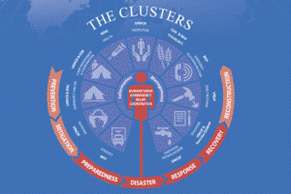
В то же время, созданный кластер ООН, не имеет четких характеристик гуманитарного кластера.
Скорее всего, в характеристике кластера ООН доминируют признаки экономического кластера и бизнес-кластера, построение которых происходит с учетом особенностей глобальной и национальной социальной среды.
К гуманитарным кластерам, например, можно отнести:
1.Созданный ООН Глобальный кластер здравоохранения.
В этот кластер входят 32 гуманитарных партнерских учреждений, организаций и институтов.
По определению ВОЗ, «целью кластерного подхода является усиление готовности и технического потенциала всей системы ООН для принятия ответных мер на чрезвычайные ситуации путем четкого определения лидерства и улучшения отчетности и прозрачности этих действий».
Одной из главных задач Глобального кластера здравоохранения является усиление гуманитарной готовности в пределах всей системы путем обеспечения достаточного потенциала в области управления информацией;
2. Организованный Международной Федерацией МККК Глобальный кластер по предоставлению временного убежища в чрезвычайных ситуациях. http://www. ifrc. org/PageFiles/86597/RUSSIAN%20Disaster%20Laws%20discussion%20paper%20FINAL. pdf
Создание ООН кластерной среды способствует улучшению отчетности и лидерства у основных участников кластера.
В этом отношении, важно, чтобы РКК использовал возможности своего участия в глобальных гуманитарных кластерах для развития своего лидерства на глобальном уровне, а не только на национальном, среди некоммерческих российских организаций.
Гуманитарная дипломатия РКК должна являться ядром кластерной политики на глобальном уровне.
Моделирование такой ситуации возможно при переносе глобальных кластеров ООН в виртуальную среду и создания виртуальных гуманитарных кластеров.
Такая среда создана партнером международной конференции «Гуманитарная дипломатия, сотрудничество, взаимодействие», Jeffrey Kleinpeter, в рамках развития инициативного проекта «Virtual Cluster Initiative»(Германия):
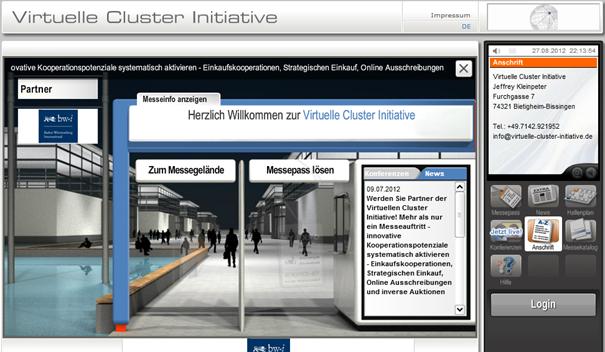
Данный проект позволяет создавать гуманитарные ситуации и сценарии гуманитарного взаимодействия, проводить соответствующее он-лайн обучение и веб-семинары, а также виртуальные выставки и конференции.
В проекте, лидирующие предприятия и партнеры виртуального гуманитарного кластера могут быть представлены через виртуальные информационные стенды и информационные каталоги, созданные на основе краудсорсинга, визуализации и инфографики.
На основе информации полученной от этих стендов и каталогов, формируются потенциальные ядра и вектора создаваемых гуманитарных кластеров.
Например, такого гуманитарного кластера, как «чрезвычайный кров», или «временное убежище при ЧС», или «Тревожный чемоданчик», «Человек как биокластер», и т. д..
Внутри такого кластера образуются производственные, стоимостные, логистические цепочки взаимосвязанных областей гуманитарного взаимодействия (услуги, бенефициары, сквозные сервисы), направленные на достижение минимальных гуманитарных стандартов, корпоративных стандартов, других стандартов существующих в качестве внешней среды создаваемого кластера.
В виртуальной среде гуманитарный кластер возникает как структурированный и систематизированный трехмерный образ, созданный на основе взаимодействия информационных ресурсов потенциальных участников кластера с открытыми ресурсами и открытыми системами.
При формировании виртуального гуманитарного кластера РКК и моделирования развития гуманитарной дипломатии, как ядра этого кластера, определяющего кластерную политику, были приняты следующие векторы развития:
- развитие взаимодействия краснокрестного сообщества с мировым, дипломатическим, научным, образовательным, инновационным, местным сообществом;
- развитие взаимодействия между системами социального, гуманитарного, дипломатического, демократического реагирования и системами предупреждения;
- определение лидерства в сфере гуманитарного развития и содействия международному развитию.
Вокруг этих векторов структурируются новые области гуманитарного взаимодействия, образующие виртуальный гуманитарный кластер и способствующие наращиванию не только потенциала реагирования, но и потенциала предупреждения в реальном времени.
Операции ООН по поддержанию мира –
действенный и эффективный механизм поддержания мира?
Поддержание мира является первостепенной задачей ООН. На протяжении многих лет эта международная организация продолжает играть важную роль в предотвращении международных кризисов и в урегулировании затяжных конфликтов, посредством проведения миротворческих операций и оказанием гуманитарной помощи.
Однако, современный геополитический процесс характеризуется возникновением новых угроз и конфликтов, которые в условиях глобализации перерастают в региональные конфликты и подрывают мир, безопасность и стабильность целых регионов и групп стран.
Предпринимаемые ООН меры и инициативы не всегда приводят к желаемым результатам в деле сохранения и поддержания мира. Поэтому в международной правовой практике была создана еще одна форма поддержания мира – миротворческие операции и, как следствие, международно-правовой институт миротворческих операций – Департамент операций по поддержанию мира ООН.
В Уставе ООН нет положений, прямо регулирующих порядок осуществления миротворческих операций. Правовым основанием для таких операций являются резолюции Генеральной Ассамблеи ООН. Однако, следует отметить, что в целом ряде ситуаций ООН не смогла применить миротворческие силы из-за противодействия отдельных государств и проблем с финансированием таких операций.
Кратко рассмотрим этапы возникновения и развития миротворческих операций ООН. Общее количество операций ООН по поддержанию мира с момента их начала до настоящего времени – 67; из них 54 были проведены после 1988 года. За этот период представители более 120 стран принимали участие в миротворческих операциях.
В истории миротворческих операций ООН эксперты выделяют три основных этапа.
Первый этап: начало миротворческой деятельности ООН (1948 – 1991).
Миротворческая деятельность ООН, начатая в период «холодной войны», который характеризовался непримиримостью сторон, ограничива-лась лишь мерами по обеспечению соблюдения соглашений о прекращении огня, стабилизацией обстановки на местах и созданием предпосылок для политических усилий по мирному урегулированию конфликтов. Первые миссий ООН были укомплектованы невооруженными военными наблюдателями и легко - вооруженными военнослужащими, которые выполняли функции по наблюдению, предоставлению отчетности и осуществлению мер по укреплению доверия. Первыми двумя операциями ООН стали: Орган ООН по наблюдению за выполнением условий перемирия (UNTSO) на Ближнем Востоке в 1948 году и Группа военных наблюдателей ООН в Индии и Пакистане (UNMOGIP) в 1949 году. Обе миссии, действующие до сих пор, могут служить примером осуществления операций по наблюдению и контролю. В 1956 году в связи с Суэцким кризисом, была проведена первая миротворческая операция с участием вооруженных контингентов и были созданы Первые чрезвычайные вооруженные силы ООН (UNEF I). Развернутая в 1960 году Операция ООН в Конго (ONUC), стала первой крупномасштабной миссией ООН. В составе ее воинского контингента находились почтивоеннослужащих. В ходе проведения ONUC впервые стал очевиден риск, связанный с деятельностью по стабилизации ситуации в пострадавших от войны районах — 245 миротворцев и 5 международных гражданских сотрудников ООН, среди которых был Генеральный секретарь Даг Хаммаршельд, погибли при исполнении обязанностей.
В гг. краткосрочные миссии ООН работали в Доминиканской Республике — Миссия Представителя Генерального секретаря в Доминиканской Республике (DOMREP); в западной части Новой Гвинеи (Западный Ириан) — Cилы безопасности ООН в Западной Новой Гвинее (UNSF); в Йемене — Миссия ООН по наблюдению в Йемене (UNYOM). Также, ООН осуществляла развертывание операций, рассчитанных на более длительный период, включая операции на Кипре — Вооруженные силы на Кипре (UNFICYP) и на Ближнем Востоке — Вторые чрезвычайные силы ООН (UNEF II), Силы ООН по наблюдению за разъединением (UNDOF) и Временные силы ООН в Ливане (UNIFIL). Усилия миротворцев по реализации принципов ООН получили высокую оценку и в 1988 году миротворцы ООН были удостоены Нобелевской премии мира. Данный факт стал подтверждением значимости и важной роли ООН в мировых делах, а также проявлением доверия к этой международной организации.

|
Из за большого объема этот материал размещен на нескольких страницах:
1 2 3 4 5 6 7 8 9 10 11 12 |
