


Партнерка на США и Канаду по недвижимости, выплаты в крипто
- 30% recurring commission
- Выплаты в USDT
- Вывод каждую неделю
- Комиссия до 5 лет за каждого referral
3. The role of a logistics manager is to balance the cost of possession
of stocks with their transportation costs. He has the advisory role of
moderating the (often conflicting) demands of the company's financial,
commercial and marketing operations. A company's logistical strategy
should be based on four basic factors:
There is no problem in getting any product to any client at any time. The problem is how to do it at the most efficient cost to the company and the client. A logistical system can improve just-in-time delivery: delivery on a guaranteed date for a fixed price.
By Zsuzsanna Ardo, "English for Practical Management"
9
3. Now read the text carefully, looking up any new items in a dictionary or
reference book. Then answer the following questions:
1. What is transport today?
2. What does the term "logistics" illustrate?
3. What is the role of the logistics manager?
4. What basic factors is logistical strategy based on?
5. What does just-in-time delivery mean?
4. Read the text and write a summary in English.
Transport, energy, and the environment
This article is about transport using water-based vehicles. Ship transport is the process of moving people, goods, barge, boat, ship or sailboat over a sea, ocean, lake, canal or river. This is frequently undertaken for purposes of commerce, recreation or military objectives.
A hybrid of ship transport and road transport is the historic horse-drawn boat. Hybrids of ship transport and air transport are kite surfing and parasailing. The first craft were probably types of canoes cut out from tree trunks. The colonization of Australia by Indigenous Australians provides indirect but conclusive evidence for the latest date for the invention of ocean-going craft; land bridges linked southeast Asia through most of the Malay Archipelago but a strait had to be crossed to arrive at New Guinea, which was then linked to Australia. Ocean-going craft were required for the colonization to happen.
Early sea transport was accomplished with ships that were either rowed or used the wind for propulsion, and often, in earlier times with smaller vessels, a combination of the two. Also there have been horse-powered boats, with horses on the deck providing power. Ship transport was frequently used as a mechanism for conducting warfare. Military use of the seas and waterways is covered in greater detail under navy.
Recreational or educational craft still use wind power, while some smaller craft use internal combustion engines to drive one or more propellers, or in the case of jet boats, an inboard water jet. In shallow draft areas, such as the Everglades, some craft, such as the hovercraft, are propelled by large pusher-prop fans.
Although relatively slow, modern sea transport is a highly effective method of transporting large quantities of non-perishable goods. Transport by water is significantly less costly than transport by air for transcontinental shipping. In the context of sea transport, a road is an anchorage.
Microsoft Encarta 2006.
III. Materials handling equipment (Грузо-обрабатывающее оборудование)
1. Translate the following expressions into Russian.
Handling, to move, quantity, retail store, production facility, concern, speed, cost, equipment, size, shape, volume, weight, truck, conveyor, crane, forklift truck, aid, assists, heavy, slow, fatiguing, hand-powered platform, towing tractor, capacity, aisle, to power, manually, bulky, route, gravity-feed, power-feed, hand, steam, internal-combustion engine, electric motor, jib, derrick, bridge.
2. Read the text and translate.
Materials handling equipment
1. Product, or materials, handling is moving small quantities of goods
over short distances. It is an activity that takes place in warehouses,
production facilities, and retail stores, and also between transportation
modes. The concern is to move the goods with speed and low cost. A
variety of mechanical equipment is available for handling a wide range of
product sizes, shapes, volumes, and weights. The more popular types of
materials handling equipment are (I) trucks, (2) conveyors, and (3) cranes.
2. The forklift truck is the most popular of the mechanical materials-
handling aids. Trucks are mechanical assists for moving materials that if
moved by hand would be too heavy, too slow, or too fatiguing. These trucks
range from hand-powered platforms to towing tractors. Normal variations of
the forklift truck include (1) its lifting capacity, (2) its lifting height, (3)
whether it can operate in narrow aisles, (4) how it is powered (manually or
by mechanical power), and (5) the speed with which it moves.
3. Next in popularity is the conveyor for small, bulky items.
Conveyors are particularly useful for moving high-volume items along a
fixed route. There are two main types of conveyors: Gravity-feed and
power-feed. Crane is a machine for moving heavy objects both vertically
and horizontally. Cranes range in capacity from a few hundred pounds to
several hundred tons. Motive power may be furnished by hand, by steam or
internal-combustion engines, or by electric motors. In form, cranes are
classified as jib, derrick, or bridge.
3. Answer the questions:
1. What is product handling?
2. What is the concern of materials handling?
3. What are the popular types of materials handling?
10
11
4. What is truck?
5. What variations of trucks do you know?
6. What are conveyors used for?
7. What is crane?
8. How are they classified?
4. Read and translate the following word combinations.
Capacity, pound, motive power, steam, internal-combustion engine, jib, derrick, bridge, beam, pillar, to rotate, trolley, cantilever, mast, to counterweight, to brace, to run, to mount, gantry crane, elevated tracks.
5. Read the text, make up an annotation and note down the types of
cranes mentioned.
1. The most prominent component of derrick cranes is the jib, or
boom. It is a long beam that is structurally reinforced so that it will not
bend. A traveling jib crane is a crane in which the pulley system is
suspended from a trolley, or wheeled carriage, moving along the length of
the jib. Such traveling cranes usually have lifting capacities of from 5 to 250
tons. A potentially more powerful derrick is the floating crane. It is built on
a barge for such purposes as constructing bridges or salvaging sunken
objects.
2. The cantilever crane used in the construction of ships and tall
buildings has a horizontal boom. This boom rests upon and can rotate about
a vertical mast. A cantilever crane is commonly used in shipyards.
3. Bridge crane is another important class of cranes. The pulley
system is suspended from a trolley. It moves on tracks along one or two
horizontal beams. These beams are called the bridge and are supported at
both ends. The bridge itself can move along a pair of parallel rails. The
crane can serve a large rectangular area. A circular space can be served by a
rotary bridge crane. The overhead traveling crane is a bridge crane for
which the rails are mounted above the level of the ground or floor.
Overhead traveling cranes are commonly used indoors. If the construction
of overhead rails is impracticable, the ends of the bridge can be attached to
upright towers. These towers move on rails at the ground level. Such cranes
are called gantry, or goliath, cranes.
5. A commonly used type of small movable crane is the truck crane. This is a crane mounted on a heavy, modified truck. Such cranes frequently use unsupported telescoping booms. Truck cranes make up in mobility and ease of transport but they lack in hoisting capacity.
6. Look at the pictures of the cranes and define their types.
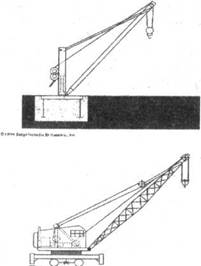
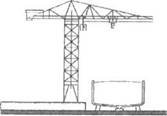
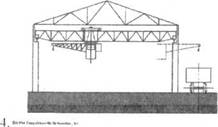
12
13

 7. Read the text A) think of the most suitable heading, B) write a summary
of the text.
A forklift truck (often just called forklift) is a powered industrial truck used to lift and transport materials by means of steel forks inserted under the load. Forklifts are most commonly used to move loads stored on pallets.
A pallet is a flat transport structure made of wood or plastic (and in a few cases metal and paper) which can support a variety of goods in a stable fashion while being lifted by any mobile forklift or other jacking device. The goods are placed on top of the pallet, and can be secured to it by straps or stretch-wrapped plastic film. A pallet is sometimes colloquially called a skid, by back-formation from skid loader.
The forklift was developed in the 1920s by various companies including the transmission manufacturing company Clark (today known as Clark Material Handling Company) and the hoist company Yale & Towne Manufacturing (Today known as Yale Materials Handling Corporation. It has since become an indispensable piece of equipment in many manufacturing and warehousing operations.
8. Write a summary of the text and think of the suitable heading.
Развитие мировой экономики на современном этапе характеризуется интенсивными интеграционными процессами. Логистика учеными и специалистами рассматривается как развивающаяся сфера экономики и новое научное направление.
При построении Логистики системный подход находит свое выражение в объединении процессов снабжения, производства, транспорта, распределения и потребления. Техническая база логистики - это современная информатика и вычислительная техника. В реализации принципов логистики скрыты огромные потенциальные возможности повышения эффективности экономики и транспорта. Существенным элементом логистики, от которого зависит надежное функционирование всей логистической системы, является транспортная логистика. Движение материальных потоков обеспечивает объединение процессов снабжения, производства и потребления в единую систему.
Объектом изучения новой научной дисциплины «логистики» являются материальные и связанные с ними информационные и финансовые потоковые процессы. Широкое применение логистики в практике хозяйственной деятельности объясняется необходимостью сокращения временных интервалов между приобретением сырья и поставкой товаров конечному потребителю. Логистика позволяет
минимизировать товарные запасы, а в ряде случаев вообще отказаться от их использования, позволяет существенной сократить время доставки товаров, ускоряет процесс получения информации, повышает уровень сервиса.
IV. Warehouses (Склады)
/. Translate the following expressions into Russian.
Storage, owning, renting, leasing, storing in transit, private, public, requirements, commodity, bulk, liquid, low, temperature, household, articles, merchandise, facilities, receipt, the bill of lading, inventory, report, to store, to own, terms and conditions, contract, negotiable, nonnegotiable, to issue, endorsement, carrier, upon receipt, to file a claim, item, basis.
2. Read the text and translate § 2.
1. Any organization in need of storage space has a number of options.
These choices are (I) owning, (2) renting, (3) leasing, and (4) storing in
transit. Each offers a different level of cost, risk and managerial
involvement. Warehouses are generally classified into private or public. The
private warehouse is often built to specialized user needs. The public
warehouse must of necessity serve a wide range of user requirements.
2. Public warehouses can be classified into five basic types.
Commodity warehouses limit their services to certain commodity
groupings (as lumber, cotton, tobacco, and grain).
Bulk-storage warehouses offer storage and handling of products in bulk, such as liquid chemicals, oil, highway salts, and syrups. Mixing products and breaking bulk may also be part of the service.
Cold-storage warehouses are controlled low-temperature warehouses (perishables such as fruits, vegetables, and frozen foods, as well as some chemicals and drugs).
In Household-goods warehouses storage, handling of household articles, furniture are the specialty of these warehouses.
General-merchandise warehouses handle a broad range of merchandise, which usually does not require the special facilities or special handling noted in the four previous types of warehouses. In practice, a public warehouse may not strictly be one of these types.
3. Answer the questions:
1. What are the choices of the organization in need of storage space?
2. How are warehouses classified into?
3. What is the private warehouse built for?
4. What is the public warehouse built for?
14
5. How can public warehouses be classified?
4. Read the text, think of the suitable heading and answer the questions:
1. What are the principal documents of a public warehouse?
2. What does the warehouse receipt identify?
3. What warehouse receipt do you know?
4. When is nonnegotiable receipt issued?
5. How can the negotiable receipt be passed?
6. What is the bill of lading?
7. When is the over, short and damage report issued?
8. What does the inventory - status report show?
Several types of documentation become important to the smooth operation of a public warehouse. The principal documents are (1) the warehouse receipt; (2) the bill of lading; (3) the over, short, and damage report; and (4) the inventory-status report. The warehouse receipt is the primary document. It identifies what is being stored, where the goods are stored, who owns the goods, to whom they are to be delivered, and the terms and conditions of the storage contract. Warehouse receipts may be negotiable or nonnegotiable. A nonnegotiable receipt is issued to a designated person or company. The negotiable receipt may simply pass from one person to another by endorsement of the receipt. The bill of lading is the contract document used in the movement of goods. It spells out the terms and conditions under which a carrier moves goods. The over, short, and damage (O. S. &D.) report is issued upon receipt of the goods at the warehouse, and only if the goods do not arrive in good condition or as stated on the bill of lading. The O. S.&D. report serves as a basis for filing a claim with a carrier. The inventory-status report shows the inventory position in the warehouse at the end of the month in terms of item, quantity, and weight. It may also be used as the basis for computing the monthly storage charges.
5. Read the text from exercise 4, note down the principal documents in the
operation of a public warehouse and translate them.
6. Write a summary of the text and think of the suitable heading.
Склад существует, главным образом, как хранилище, где в безопасных условиях находятся грузы, не требуемые в данный момент, но которые понадобятся в будущем. Они, таким образом, сглаживают колебания в потребности и наличии грузов.
16
Склады существуют во многих пунктах на пути потоков распределения грузов. По назначению склады подразделяются на производственные, сельскохозяйственные, торговые и транспортные.
Транспортные склады размещаются на грузовых ж/д станциях, в морских, речных и воздушных портах. Такие склады предназначены для краткосрочного хранения грузов. В отдельных случаях перевалочные склады используют для накопления, сортировки и формирования партий грузов.
Характерной особенностью складов речных и морских портов является большая номенклатура грузов. Склады портов классифицируются по следующим признакам: месту расположения на территории порта, конструкции и типу здания, виду грузов и характеру их хранения, материалу, из которого построен склад.
17
_________ ЧАСТЬ 3. КОНТРОЛЬНАЯ РАБОТА №3_______
Чтобы правильно выполнить контрольную работу №3, необходимо усвоить следующие разделы курса.
1. Глагол. Формы времени и залога. Модальные глаголы.
2. Видо-временные формы глагола страдательного залога.
3. Простое распространенное предложение (прямой порядок
слов повествовательного и побудительного предложений в
утвердительной и отрицательной форме). Порядок слов
вопросительного предложения.
Вариант 1
 1.Образуйте формы инфинитива страдательного залога и переведите их.
Образец: to do - to be done - быть сделанным
To bring, to translate, to send, to offer, to make, to speak, to tell, to say, to build, to use, to advise, to break, to give.
2. Преобразуйте предложения, употребив модальные глаголы,
переведите предложения, обращая внимание на употребление
модальных глаголов в конструкциях страдательного залога.
Образец: Cargo is protected from contact with water (should). Cargo should be protected from contact with water. Груз должен быть защищен от контакта с водой.

|
Из за большого объема этот материал размещен на нескольких страницах:
1 2 3 4 5 6 7 8 9 10 11 12 13 14 15 16 17 18 |
