


Партнерка на США и Канаду по недвижимости, выплаты в крипто
- 30% recurring commission
- Выплаты в USDT
- Вывод каждую неделю
- Комиссия до 5 лет за каждого referral
The early 19th-century steamboat experiments were aimed primarily at building and operating passenger ships. Endowed with the Mississippi-Ohio-Missouri river system, the St. Lawrence-Great Lakes system, the Columbia and its tributaries, and the Colorado system, North America had virtually ideal conditions for the creation of an extensive, integrated network of inland navigation by shallow-draft steamboats. There was a strong geographic expansion under way in Canada and the United States that would be more quickly advanced by steamboats than by land transportation. North American transportation before the late 1850s was by river in most regions. This was not a unique situation: most areas subject to 19th-century colonization by Europeans such as Siberia, South America, Africa, India, and Australia had a heavy dependence on river transport.
There were some mechanical improvements that encouraged this use of steamboats. Higher-pressure steam made craft more efficient, as did double - and triple-expansion engines. Improved hulls were designed. It was, however, the general level of settlement and economic productivity that tended to bring steamboat use to an end in inland transport. A demand for shipments of coal finally made the railroad the most economical form of transport and removed steamboats from many streams
Oceanic navigation
The first Atlantic crossings It was on the North Atlantic that most of the advances in steam shipping took place. Because river line and narrow-seas steaming was first to gain commercial importance, and shallow-water propulsion was easily accomplished with paddle wheels turning beside or behind the hull, that method of driving a ship was also the first to be used at sea.
Oceanic steam navigation was initiated by an American coastal packet first intended entirely for sails but refitted during construction with an auxiliary engine. Built in the port of New York for the Savannah Steam Ship Company in 1818, the Savannah was 98.5 feet long with a 25.8-foot
42
43
beam, a depth of 14.2 feet, and a displacement of 320 tons. Owing to a depression in trade, the owners sold the boat in Europe where economically constructed American ships were the least expensive on the market and were widely seen as the most advanced in design. Unable to secure either passengers or cargo, the Savannah became the first ship to employ steam in crossing an ocean. At 5:00 in the morning on May 24, 1819, it set sail from Savannah. After taking on coal at Kinsale in Ireland, it reached Liverpool on July 20, after 27 days and 11 hours; the engine was used to power the paddle wheels for 85 hours. Subsequently the voyage continued to Stockholm and St. Petersburg, but at neither place was a buyer found; it thus returned to Savannah, under sail because coal was so costly, using steam only to navigate the lower river to reach the dock at Savannah itself.
The next voyage across the Atlantic under steam power was made by a Canadian ship, the Royal William, which was built as a steamer with only minor auxiliary sails, to be used in the navigation of the Gulf of St. Lawrence. The owners, among them the Quaker merchant Samuel Cunard, of Halifax, N. S., decided to sell the ship in England. The voyage from Quebec to the Isle of Wight took 17 days. Soon thereafter, the Royal William was sold to the Spanish government. The ability to navigate the North Atlantic was demonstrated by this voyage, but the inability to carry any load beyond fuel still left the Atlantic challenge unmet. CopyrightEncyclopedia Britannica, Inc.
Machine-powered transportation
Oceanic navigation
The "Atlantic Ferry"
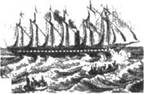 At this point the contributions of Isambard Kingdom Brunei to sea transportation began. Brunei was the chief engineer of the Great Western Railway between Bristol and London, which was nearing completion in the late 1830s. A man who thrived on challenges, Brunei could see no reason his company should stop in Bristol
just because the land gave out there. The Great Western Railway Company set up a Great Western Steamship Company in 1836, and the ship designed by Brunei, the Great Western, set sail for New York City on April 8, 1838. Thus began a flow of shipping that earned in the second half of the 19th century the sobriquet "4he Atlantic Ferry" because of its scale and great continuity.
The Great Britain (1843), the first steamship with an iron hull. The Great Western Steamship Company, though the first major company organized, did not earn the pride of place one might have expected. Its next ship, the Great Britain of 1843 (see photograph), was the first with an all-iron hull; it has survived, now in the dry dock in which it was constructed in Bristol's Floating Dock, to this day. It was Cunard's steamboat company, however, that won the British government contract to establish a mail line across the North Atlantic. In 1840 the Cunard Line launched four paddle steamers with auxiliary sails - the Britannia, Acadia, Columbia, and Caledonia - which with their long line of successors became the leaders in a drive for speed and safety on the North Atlantic. From 1840 until the outbreak of the American Civil War the competition lay largely between the British lines and the American lines. During the war American shipping was greatly reduced as Confederate raiders, mostly constructed in Britain, either sank Union ships or drove them to operate under other registries. For a short period in the 1860s the United States went from being the world's largest merchant marine power to merely an importing shipping nation.
By the mid-1860s Britain had abandoned the paddle steamer for the Atlantic run, but the recently organized Compagnie Generale Transatlantique (known as the French Line in the United States) in 1865 launched the Napoleon III, which was the last paddle steamer built for the Atlantic Ferry. Early in the history of steam navigation the Swedish engineer John Ericsson had attempted unsuccessfully to interest the British Admiralty in the screw propeller he had invented. The U. S. Navy did adopt the propeller, however, and Ericsson moved to the United States. While there he also did pioneering work on the ironclad warship, which was introduced by the Union navy during the Civil War.
During the last third of the 19th century, competition was fierce on the North Atlantic passenger run. Steamship companies built longer ships carrying more powerful engines. Given the relatively large space available on a ship, the steam could be pressed to do more work through the use of double - and triple-expansion engines. That speed appealed greatly to the first-class passengers, who were willing to pay premium fares for a fast voyage. At the same time, the enlarged ships had increased space in the steerage, which the German lines in particular saw as a saleable item. Central Europeans were anxious to emigrate to avoid the repression that took place after the collapse of the liberal revolutions of 1848, the establishment of the Russian pogroms, and conscription in militarized Germany, Austria, and Russia. Because steamships were becoming increasingly fast, it was possible to sell little more than bed space in the
44
45
steerage, leaving emigrants to carry their own food, bedding, and other necessities. Without appreciating this fact, it is hard to explain why a speed race led as well to a great rise in the capacity for immigration to the United States and Canada.
Steamship transportation was dominated by Britain in the latter half of the 19th century. The early efforts there had been subsidized by mail contracts such as that given to Cunard in 1840. Efforts by Americans to start a steamship line across the Atlantic were not notably successful. One exception was the Collins Line, which in 1847 owned the four finest ships then afloat - the Arctic, Atlantic, Baltic, and Pacific - and in 1851 the Blue Riband (always a metaphorical rank rather than an actual trophy) given for the speediest crossing of the New York-Liverpool route passed from Cunard's Acadia to the Collins Pacific, with the winning speed averaging 13 knots. The Collins Line, however, did not survive for long. Collision removed the Arctic from the line in 1854, and other losses followed. The contest was then mostly among British companies
Most ships on the Atlantic were still wooden-hulled, so that the newer side-lever steam engines were too powerful for the bottoms in which they were installed, making maintenance a constant problem. Eventually the solution was found in iron-hulled ships. The size of ships was rapidly increased, especially those of Brunei. Under his aegis in 1858 a gigantic increase was made with the launching of the Great Eastern, with an overall length of 692 feet, displacing 32,160 tons, and driven by a propeller and two paddle wheels, as well as auxiliary sails. Its iron hull set a standard for most subsequent liners, but its size was too great to be successful in the shipping market of the l860s. German ships of this period tended to be moderately slow and mostly carried both passengers and freight. In the late 1890s the directors of the North German Lloyd Steamship Company entered the high-class passenger trade by construction of a Blue Riband-class liner. Two ships were ordered - the 1,749-passenger Kaiser Wilhelm der Grosse (655 feet long overall; displacement 23,760 tons), with twin screws, and the Kaiser Friedrich, which was returned to the builders having failed to meet speed requirements. When the Kaiser Wilhelm der Grosse won the Blue Riband on the eastbound leg of its third voyage in the fall of 1897, a real race broke out. North German Lloyd handled 28 percent of the passengers landed in New York City in 1898, so Cunard ordered two superliners, which represented the first steamers to be longer than the Great Eastern.
Passenger liners in the 20th century
The upper limits of speed possible with piston-engined ships had been reached, and failure in the machinery was likely to cause severe damage to the engine. In 1894 Charles A. Parsons designed the yacht Turbinia, using a steam turbine engine with only rotating parts in place of reciprocating engines. It proved a success, and in the late 1890s, when competition intensified in the Atlantic Ferry, the question arose as to whether reciprocating or turbine engines were the best for speedy operation. Before Cunard's giant ships were built, two others of identical size at 650 feet (Caronia and Carmania) were fitted, respectively, with quadruple-expansion piston engines and a steam-turbine engine so that a test comparison could be made; the turbine-powered Carmania was nearly a knot faster. Cunard's giant ships, the Lusitania and the Mauretania, were launched in 1906. The Lusitania was sunk by a German submarine in 1915 with a great loss of life. The Mauretania won the Blue Riband in 1907 and held it until 1929. It was perhaps the most popular ship ever launched until it was finally withdrawn in 1934.The British White Star Line, which competed directly with Cunard, also had commissioned two giant liners. The Olympic of 1911, displacing 45,324 tons, was then the largest ship ever built. The Titanic of 1912 displaced 46,329 tons, so vast as to seem unsinkable. The Titanic operated at only 21 knots, compared with the Mauretania's 27 knots, but its maiden voyage in 1912 was much anticipated. The ship collided with an iceberg off the Newfoundland coast and sank within hours, with a loss of about 1,500 lives.
World War I completely disorganized the Atlantic Ferry and in 1918 removed German competition. At that time Germany had three superliners, but all were taken as war reparations. The Vaterland became the U. S. Line's Leviathan; the Imperator became the Cunard Line's Barengaria; and the Bismarck became the White Star Line's Majestic. That war severely cut traffic, although ships were used for troop eliminating German competition and seizing their great ships, the Western Allies returned to competing among themselves.
During the prosperous years of the 1920s, tourist travel grew rapidly, calling forth a new wave of construction, beginning with the French Line's lle de France in 1927 and gaining fiercer competition when the Germans returned to the race with the launching on successive days in 1928 of the Europa and the Bremen. But by the end of 1929 the Great Depression had begun; it made transatlantic passage a luxury that fewer and fewer could afford and rendered immigration to the United States impractical
46
47
Because the international competition in transatlantic shipping reached full stride only with the return of German ships in 1928, major decisions as to construction were made just as the Great Depression was beginning. Since the beginning of the century the "1,000-foot" ship had been discussed among shipowners and builders. A new Oceanic was planned in the late 1920s but abandoned in 1929 because its engines seemed impractical. In 1930 the French Line planned a quadruple-screw liner of 981.5 feet, which would represent another and, as it turned out, the final -ratchet in the expansion of the passenger liner. What came of that undertaking was the most interesting, and by wide agreement the most beautiful, large ship ever built. The Normandie was the first large ship to be built according to the 1929 Convention for Safety of Life at Sea and was designed so the forward end of the promenade deck served as a breakwater, permitting it to maintain a high speed even in rough weather. The French Line had established a policy with the lle de France of encouraging tourist travel through luxurious accommodations (changing from third class, which was little more than steerage with private cabins, to tourist class, which was simple but comfortable). The Normandie offered seven accommodation classes in a total of 1,975 berths; the crew numbered 1,345. The ship popularized a design style, Moderne, that emulated the new, nonhistorical art and architecture. The bow was designed with the U-shape favoured by the designer Vladimir Yourkevitch. Turboelectric propelling machines of 160,000 shaft horsepower allowed a speed of 32.1 knots in trials in 1935. In 1937 it was fitted with four-bladed propellers, permitting a 3-day, 22-hour and 7-minute crossing, which won the Blue Riband from the Europa.
To compete with the Normandie, in 1930 Cunard built the Queen Mary, which was launched in 1934. At 975 feet, it was Britain's first entry in the 1,000-foot category. The ship was never so elegant as its French rival and was a bit slower, but its luck was much better. The Normandie burned at the dock in New York in February 1942 while being refitted as a troopship. The Queen Mary was the epitome of the Atlantic liner before being retired to Long Beach, Calif., to serve as a hotel.
During World War II civilian transportation by sea was largely suspended, whereas military transport was vastly expanded. Great numbers of "Liberty"' and "Victory" ships were constructed, and at the close of the war surplus ships were returned to peacetime purposes. A sister ship of the Queen Mary, the Queen Elizabeth (at 83,673 tons the largest passenger ship ever built), was launched in 1938, but the interior had not been fitted out before the war came in 1939. First used as a troopship during the war, it was completed as a luxury liner after 1945 and operated with the Queen Mary
until the 1960s, when the jet airplane stole most of the trade from the Atlantic Ferry
Experience with the two Cunard liners in the years immediately after 1945 suggested the value in having two giant ships, of approximately the same size and with a speed that allowed a transatlantic run of four days or less, so that one ship might sail from New York and another from Europe weekly. This competition began when U. S. Lines launched the 53,329-ton United States. Though lighter than the Queen Elizabeth, greater use of aluminum in the superstructure and more efficient steam turbine engines allowed it to carry essentially the same number of passengers. The great advantage lay in its speed of 35.59 knots, which captured the Blue Riband from the Queen Mary in 1952, an honour the latter had held for 14 years.
Cargo ships
The history of other merchant marine activities parallels that of the great passenger liners. Freighter navigation, tanker navigation, naval ships, and the more recent near replacement of bulk cargo by container transport must be understood as a similar ever-improving technology. Iron followed wood as a construction material and was followed in turn by steel. Until very recently steam was a source of power, though the diesel engine was used for some ships as early as the Vandal of 1903. After 1900 there was a general division between the use of steam turbines in passenger liners and diesel engines in freighters. Europeans, particularly the Scandinavians, favoured the diesel internal-combustion engine, with its more economical fuel consumption, whereas American shipping companies tended to favour steam turbines because their labour costs were usually lower. The rapid rise in the cost of petroleum fuel after 1973 led to increased diesel-engine construction.
CARGO HANDLING
A commercial ship is usually a link in a "trade route" between distant points. Goods flowing in the route must be transferred to and from the sea link; they must also be given care while aboard the ship, and in turn they must not be a hazard to the ship and its crew.
Ship-shore transfer
Ancient cargo handling consisted almost exclusively of manually carrying cargo in single man-loads. For example, grain would be packed into sacks, each of a size that a man could carry on or off the ship on his shoulders. During the many centuries of dominance by sailing vessels, this process might be supplemented by hoisting with the ship's running rigging.
48
49
A line reeved through a block on the end of a yard might be led to a capstan by which a group of men might develop the force needed to lift an object far heavier than a single man-load.
Steam propulsion brought the steam winch and rigging that was intended solely for lifting cargo. The near-universal practice as it developed into the 20th century was to fit at least one pair of booms to serve each cargo hatchway, with each boom supported by rigging from a "king post," a short, stout mast whose sole function was boom support. Winches were mounted at the base of the king post. In action, the head of one boom would be rigged in fixed position over the hatchway; the head of the other would be rigged over the cargo-handling space on the pier alongside. A single lifting hook would be used, but a line would lead from the hook to each of the two boom-heads ("married falls") and thence each to its individual cooperative tensioning and slackening of the two lines, the winch operators could cause the hook to move vertically directly beneath either boom-head or horizontally between them. Cargo was thereby moved between cargo hold and pier with no gear movement save that of the hook and its two supporting lines. This scheme is known as burton ing
Burtoning was gradually replaced by systems better adapted to special cargoes. It remained in favour only for handling very heavy objects, so that the few ships that were built during the late 20th century for this type of cargo were usually fitted with at least one set of massive burtoning gear. The first cargo to require a unique handling system was petroleum. When first carried by sea, petroleum products were packaged in barrels that were handled in the traditional way, but the great volume to be moved quickly soon made this method of packaging and handling woefully inadequate. Since the late 19th century crude oil and its many products have been transported in bulk - i. e., without packaging. The hulls of tankers (as described above; see Types of ships: Tankers) are subdivided into a number of cells, or tanks, into which the liquid cargo is pumped through hoses by pumps mounted on the shore. Unloading is effected in the reverse manner by pumps mounted within the ship. Usually the only external cargo-handling gear is a pair of cranes or boom-post winch sets (one for each side of the ship) for handling the rather massive hoses that connect ship to shore facility.
The handling of many other commodities is more economical if done without packaging and with at least some of the continuous-flow features of pumping. For example, the loading of "dry bulk" commodities such as coal, ore, and grain is nearly always done from special shore facilities that pour them from a high elevation directly into the cargo holds of the ship.
Although the ship may be designed for the commodity, almost any cargo-carrying ship except the tanker can accept dry-bulk cargoes in this fashion.

|
Из за большого объема этот материал размещен на нескольких страницах:
1 2 3 4 5 6 7 8 9 10 11 12 13 14 15 16 17 18 |
