

Партнерка на США и Канаду по недвижимости, выплаты в крипто
- 30% recurring commission
- Выплаты в USDT
- Вывод каждую неделю
- Комиссия до 5 лет за каждого referral
9. Study the map below. Which of these could be the elevation of point X?
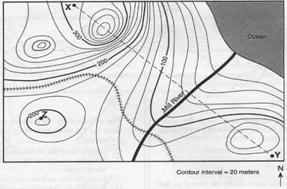
A 315 feet
B 330 feet
C 350 feet
D 355 feet
Earth Science SOL Review Sheet #3 : Atmosphere and Meteorology
Essential Knowledge and Skills
· The early atmosphere contained little oxygen and more carbon dioxide than the modern atmosphere.
· Early photosynthetic life such as cyanobacteria (blue-green algae) consumed carbon dioxide and generated oxygen.
· It was only after early photosynthetic life generated oxygen that animal life became possible.
· Earth’s atmosphere is 21 percent oxygen, 78 percent nitrogen, and 1 percent trace gases.
· The atmosphere of Venus is mostly carbon dioxide and very dense.
· The atmosphere of Mars is very thin and mostly carbon dioxide.
§ Human activities have increased the carbon dioxide content of the atmosphere.
§ Man-made chemicals have decreased the ozone concentration in the upper atmosphere.
§ Volcanic activity and meteorite impacts can inject large quantities of dust and gases into the atmosphere.
§ The ability of Earth’s atmosphere to absorb and retain heat is affected by the presence of gases like water vapor and carbon dioxide.
· Explain how volcanic activity or meteor impacts could affect the atmosphere and life on Earth.
· Explain how biologic activity, including human activities, may influence global temperature and climate.
Important Words You Need to Know:
Weather: day-to-day changes in atmospheric conditions
Climate: typical weather patterns for a certain location over many years; climate is affected by latitude, elevation, how close the area is to a major body of water and whether or not it is close to mountains
Cyanobacteria - blue green algae; a simple photosynthetic life form that helped introduce oxygen into Earth’s ancient atmosphere
Troposphere - the layer of the atmosphere closest to the earth’s surface
Isobar - line on a weather map that connects locations with the same air pressure
Convection - transfer of heat energy in a fluid (gas or liquid) by means of currents
Ozone - gas in Earth’s atmosphere formed when three atoms of oxygen combine, absorbs ultraviolet radiation
Greenhouse effect - process in which carbon dioxide and other gases in the atmosphere absorb infrared radiation from the sun, forming a “heat blanket” around Earth
Radiation - energy transmitted as rays or waves without the need of a substance to conduct the energy
Barometer - an instrument used to measure air pressure
Dew point - the temperature at which condensation develops
Humidity - the amount of water vapor in the air
Carbon dioxide - CO2; a gas that is naturally found in the air, also comes from burning wood, from running vehicles on gasoline, and from exhaling
Precipitation - any form of water that returns from the atmosphere to Earth’s surface including: rain, snow, sleet, and hail
Condensation nuclei - any particle onto which water vapor condenses
Now You Try It!
Practice Questions: Circle the correct answer!
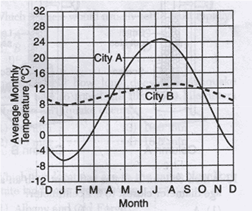 1. Which statement best explains the difference in the average yearly temperature range for the two cities?
A City B is located in a different global wind belt.
B City B receives less yearly precipitation.
C City B has a greater yearly duration of insolation.
D City B is located near a large body of water.
2. Which of these has the LEAST affect on the composition of our atmosphere?
A Human activity
B Biological activity
C Geologic activity
D Tidal activity
3. Clouds usually form when–
A air temperature reaches the dew point
B evaporation has warmed the air
C relative humidity is 0%
D condensation nuclei have been removed from the air
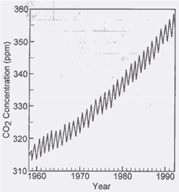 4. The most likely cause of the overall change in the level of carbon dioxide from 1960 to 1990 is an increase in the–
A number of violent storms
B number of volcanic eruptions
C use of nuclear power
D use of fossil fuels
5. Which region is the probable source of the air mass labeled cP on the map?
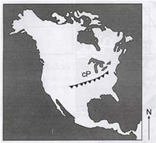
A central Canada
B southwestern United States
C North Atlantic Ocean
D Gulf of Mexico
6. The following symbol is often seen on weather maps. What does it represent?

A Cold front
B Low pressure area
C Warm front
D Stationary front
7. Over the course of a year, compared to location B, location A will have-
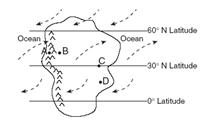
A less precipitation and a smaller temperature range
B less precipitation and a greater temperature range
C more precipitation and a smaller temperature range
D more precipitation and a greater temperature range
8. The cross section below shows how prevailing winds have caused different climates on the windward and leeward sides of a mountain range.
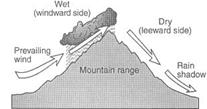
Why does the windward side of this mountain have a wet climate?
A Rising air compresses and cools, causing the water droplets to evaporate.
B Rising air compresses and warms, causing the water vapor to condense.
C Rising air expands and cools, causing the water vapor to condense.
D Rising air expands and warms, causing the water droplets to evaporate.
9. Which letter represents the area that would record the warmest temperatures?
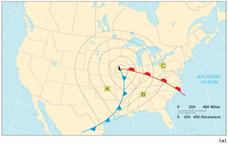
A Letter A
B Letter B
C Letter C
D Letter D
Earth Science SOL Review Sheet #4 : Astronomy
Essential Knowledge and Skills
· The Earth revolves around the sun, tilted on its axis, causing the seasons.
· The moon revolves around the Earth creating the moon phases and eclipses.
· The solar system consists of the sun, the 8 classic planets, dwarf planets, comets, and asteroids.
· The sun is made of mostly hydrogen gas and its energy comes from nuclear fusion reactions.
· Mercury, Venus, Earth and Mars are terrestrial planets. Jupiter, Saturn, Uranus and Neptune are gas giants. The asteroid belt is located between Mars and Jupiter.
· Made of ice and frozen gases, comets also orbit the sun
· The Big Bang theory is the most current model for the origin of the universe. It states that the universe began billions of years ago in a very hot, dense state that suddenly expanded. This material eventually formed today’s stars and galaxies.
· The Solar Nebular Theory is our most current explanation how the planets formed. Material in a solar condensed and formed planets.
· Our solar system is located in the Milky Way galaxy.
· Stars change over time. The mass of a star controls how it evolves, how long it exists and its ultimate fate
Important Words You Need to Know:
Solstices - the longest and shortest days of the year
Equinoxes - times of the year when the sun is located directly above the equator so that day and night are of equal length around the world (March 21 and September 22 – 23)
Apollo 11 - the 1st manned landing on the moon
Galaxy - billions of stars grouped together
Stellar evolution - the stages of development and duration of stars, some of which appear on the H – R diagram
H-R Diagram - a diagram that shows the relationships between a star's color, its absolute magnitude, and its temperature
Nebula - a huge cloud of dust and gases; condense to form stars
Revolution - the circling of one object about another, the motion of the planets around the sun and satellites (moons) around the planets
Meteor - streaks of light produced by a meteoroid as it burns up in Earth’s atmosphere
Solar eclipse - occurs when the moon blocks sunlight from Earth’s surface
Light year - the distance that light can travel in a year; approximately 6 trillion miles (~ 9 trillion kilometers)
Now You Try It!
Practice Questions: Circle the correct answer!
1. Label the phases of the moon.

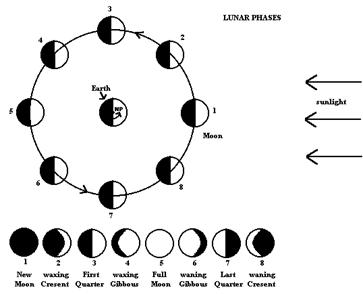
2. On this day, which location has the greatest number of hours of daylight?
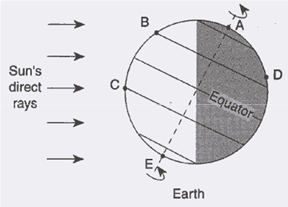
A Location E
B Location B
C Location C
D Location D
3. How does the sun produce energy?
A Fusion of Hydrogen into helium

|
Из за большого объема этот материал размещен на нескольких страницах:
1 2 3 4 5 6 7 |
