

Партнерка на США и Канаду по недвижимости, выплаты в крипто
- 30% recurring commission
- Выплаты в USDT
- Вывод каждую неделю
- Комиссия до 5 лет за каждого referral
4. Primary waves from an earthquake at X would reach which city last?
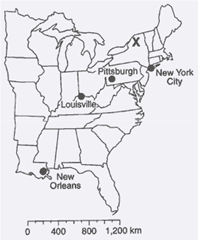
A Louisville
B New Orleans
C Pittsburgh
D New York City
5. The diagram below shows land features that have been disrupted by an earthquake.
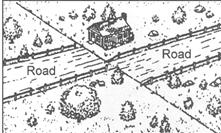
Which type of crustal movement most likely caused the displacement of features in this area?
A vertical lifting of surface rock
B folding of surface rock
C down-warping of the crust
D movement along a transform fault
Base your answers to the next two questions, on the map below of Iceland, a country located on the Mid - Atlantic Ridge.
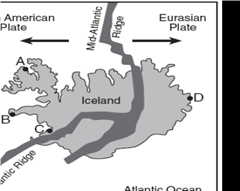
6. The fine-grained texture of most of the igneous rock formed on the surface of Iceland is due to -
A rapid cooling of the molten rock
B high density of the molten rock
C numerous faults in the island’s bedrock
D high pressure under the island
7. The youngest bedrock is most likely found at which location?
A Location A
B Location B
C Location C
D Location D
8. The diagram below shows the bedrock age as measured by radioactive dating and the present location of part of the Hawaiian Island chain. These volcanic islands have formed as the Pacific Plate moved over a mantle hot spot. This diagram provides evidence that the Pacific Plate was moving toward the-
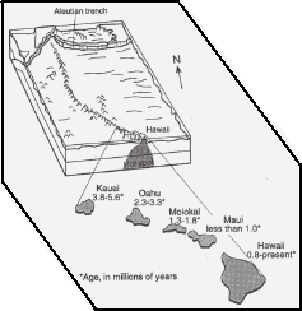
A south
B east
C southwest
D northwest
Earth Science SOL Review Sheet #10: Virginia Province Essential Knowledge and Skills
· The five physiographic provinces are Coastal Plain, Piedmont, Blue Ridge, Valley and Ridge, and Appalachian Plateau.
· The Coastal Plain is a flat area underlain by young, unconsolidated sediments. These layers of sediment were produced by erosion of the Appalachian Mountains and then deposited on the Coastal Plain.
· The Piedmont is an area of rolling hills underlain by mostly ancient igneous and metamorphic rocks. The igneous rocks are the roots of volcanoes formed during an ancient episode of subduction that occurred before the formation of the Appalachian Mountains.
· The Blue Ridge is a high ridge separating the Piedmont from the Valley and Ridge Province. The billion-year old igneous and metamorphic rocks of the Blue Ridge are the oldest in the state. Some metamorphism of these rocks occurred during the formation of the Appalachian Mountains.
· The Valley and Ridge province is an area with long parallel ridges and valleys underlain by ancient folded and faulted sedimentary rocks. The folding and faulting of the sedimentary rocks occurred during a collision between Africa and North America. The collision, which occurred in the late Paleozoic era, produced the Appalachian Mountains.
· The Appalachian Plateau as an area with rugged, irregular topography and underlain by ancient, flat-lying sedimentary rocks. The area is actually a series of plateaus separated by faults. Most of Virginia’s coal resources are found in the Plateau Province.
· Label a map and recognize the major features of the physiographic provinces of Virginia.
Important Words You Need to Know:
Appalachian Plateau – Virginia province which lies to the northwest of the Valley and Ridge; source of coal (Virginia’s most valuable mineral resource)
Blue Ridge – mountains of folded and faulted igneous rock formed when Africa and North America collided
Coal – a sedimentary or sometimes metamorphic rock formed by the compaction of ancient plants and animals over a period of millions of years; a fossil fuel found in the Appalachian Plateau
Coastal Plain – the youngest province in Virginia; the land from the fall line eastward to the Atlantic Ocean; a landform that is broad, flat area along a coastline; also called a lowland
Fall line – the boundary between the Coastal Plain and the Piedmont; an abrupt change in elevation causes rapids and small waterfalls to be common
fold – bend in rock with an anticline (up-fold) and syncline (down-fold)
Piedmont – the largest physiographic province in Virginia; bounded on the east by the fall zone and on the west by the mountains of the Blue Ridge; rolling hills of igneous and some sedimentary rock
Valley & Ridge – long parallel ridges and valleys to the west of the Blue Ridge mountains which are part of the major landform feature of North America; the Great Valley which stretches from New York to Alabama, a region of Karst topography
Now You Try It!
Practice Questions: Circle the correct answer!
Use this map of Virginia as a reference for several of the following questions:
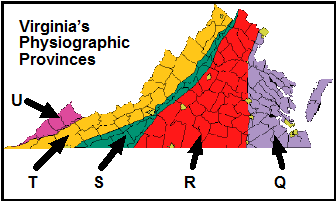
1. The fall line is located between which two provinces?
A provinces U and T
B provinces T and S
C provinces S and R
D provinces R and Q
2. Letter S points to which province?
A Valley and Ridge
B Blue Ridge
C Piedmont
D Appalachian Plateau
3. Which of the following Virginia provinces has the most karst topography?
A province U
B province T
C province S
D province R
4. Letter R points to which province?
A Valley and Ridge
B Blue Ridge
C Piedmont
D Coastal Plain
5. Letter T points to which province?
A Valley and Ridge
B Blue Ridge
C Piedmont
D Appalachian Plateau
6. This is famous building is called the Rotunda. It is located on the grounds of the University of Virginia in Charlottesville. Charlottesville is located in an area that has many low rolling hills. In which province is it located?

A Valley and Ridge
B Blue Ridge
C Piedmont
D Appalachian Plateau
7. Luray Caverns, Endless Caverns, Skyline Caverns, Grand Caverns, Shenandoah Caverns and several more, are located in which province?
A Valley and Ridge
B Blue Ridge
C Piedmont
D Appalachian Plateau
8. Which province are you most likely to find a fossil fuel, nonrenewable resource?
A Valley and Ridge
B Blue Ridge
C Piedmont
D Appalachian Plateau
9. What is the fossil fuel mentioned above?
A Coal
B Uranium
C Oil
D Limestone
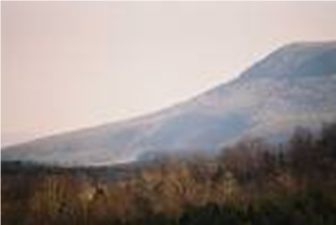
10. This is a picture of the end of Massanutten Mountain. It is one of several long, narrow mountains that have river valleys (like the Shenandoah River) between them. In which province is it located?
A Valley and Ridge
B Blue Ridge
C Piedmont
D Appalachian Plateau
11. Imagine that you were on a trip driving from Hampton to West Virginia. The first time you felt your ears pop, you were MOST LIKELY in which province?
A Valley and Ridge
B Blue Ridge
C Piedmont
D Coastal Plain
12. On the same trip mentioned above, you noticed that the road was very flat with hardly any hills or mountains. You were MOST LIKELY in which province?
A Valley and Ridge
B Blue Ridge
C Piedmont
D Coastal Plain
Earth Science SOL Review Sheet #11: Paleontology Essential Knowledge and Skills
· A fossil is the remains, impressions, or other evidence of the former existence of life preserved in rock.
· Some ways in which fossils can be preserved are molds, casts, and original bone or shell.
· Nearly all fossils are found in sedimentary rocks.
· In Virginia, fossils are found mainly in the Coastal Plain, Valley and Ridge, and Appalachian Plateau provinces.
· Most Virginia fossils are of marine organisms. This indicates that large areas of the state have been periodically covered by seawater.
· Paleozoic, Mesozoic, and Cenozoic fossils are found in Virginia.
· Relative time places events in a sequence without assigning any numerical ages.
· Fossils, superposition, and cross-cutting relations are used to determine the relative ages of rocks.
· Absolute time places a numerical age on an event.
· Radioactive decay is used to determine the absolute age of rocks.
· Describe how life has changed and become more complex over geologic time.
· Interpret a simple geologic history diagram using superposition and cross-cutting relations.
Important Words You Need to Know:
absolute dating – calculating age in years
carbon 14 – parent material used in radiometric dating of organic remains
cast – a model of an organism formed when a mold fills with sediment
Cenozoic – current era; Age of Mammals
extinct – when a species no longer exists
fossil – any direct evidence of life that lived before recorded history
index fossil – a fossil used to determine the age of other fossils or rocks
Law of Cross cutting Relationships – when interpreting a geologic column, if one event cuts through or affects another, it must be younger than the one it cut through
Law of Superposition – in a series of undisturbed strata, the oldest layer is on the bottom and the youngest is on the top

|
Из за большого объема этот материал размещен на нескольких страницах:
1 2 3 4 5 6 7 |
