

Партнерка на США и Канаду по недвижимости, выплаты в крипто
- 30% recurring commission
- Выплаты в USDT
- Вывод каждую неделю
- Комиссия до 5 лет за каждого referral
Igneous rocks: rock formed from the cooling and hardening of magma or lava
Extrusive igneous rocks: formed from lava;
they cool fast, so they have small or no crystals
examples include: basalt, pumice, obsidian
Intrusive igneous rocks: formed from magma;
they cool slow so they have visible mineral
crystals and coarse texture. Example: granite
magma: – molten rock beneath the earth’s surface
Metamorphic rocks: rock that has undergone physical and chemical changes due to extreme heat or pressure
Foliated rock: metamorphic rock that shows
parallel banding Example: gneiss and schist
Nonfoliated rock: metamorphic rock that has
been recrystalized; does not show banding
Sedimentary rocks: rock formed by rock
fragments or organic matter being bound together or by chemical precipitation
Clastic rocks: sedimentary rocks made from
fragments of other rocks. Example: sandstone
Non-clastic rocks: sedimentary rocks made
from chemical processes. Example: limestone
Texture: how large the mineral crystals are
Rock cycle - a diagram showing how the formation of igneous, sedimentary, and metamorphic rocks are interrelated
Now You Try It!
Practice Questions: Circle the correct answer!
1. Which rock is metamorphic and shows evidence of foliation?
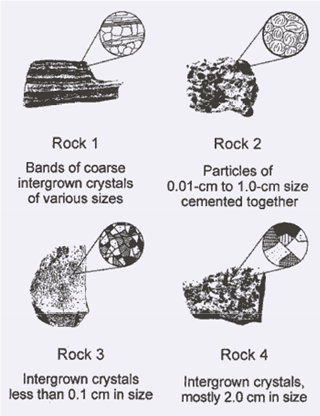
A Rock 1
B Rock 2
C Rock 3
D Rock 4
2. The diagrams below show the crystals of four different rocks viewed through the same hand lens. Which crystals most likely formed from molten material that cooled and solidified most rapidly?


A B


C D
3. Which of the following rocks is NOT igneous?
A Granite
B Gneiss
C Obsidian
D Basalt
4. The "weathering" position in the rock cycle would be found–
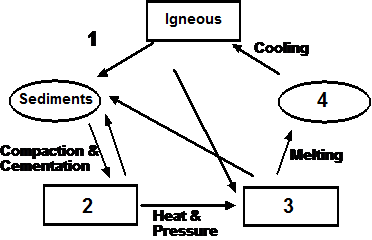
A At position 1
B At position 2
C At position 3
D At position 4
5. During metamorphism, shale becomes–
A Marble
B Quartzite
C Slate
D Gneiss
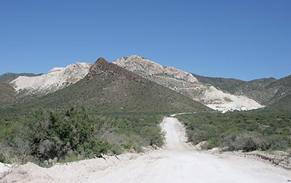
6. This picture shows a section of the Rocky Mts.. The rocks are mainly limestone. The dark horizontal stripe is a sill. Barely noticeable, above and below the sill is a white band of metamorphic rock. What kind of rock should it be?
A Marble
B Quartzite
C Slate
D Basalt
7. The two types of metamorphic rock are–
A Foliated & nonfoliated
B Clastic & nonclastic
C Intrusive & extrusive
D Clastic & recrystalized
8. Which of these best describes intrusive igneous rock?
A solidifies from lava, cools quickly, large crystals
B solidifies from lava, cools slowly, small crystals
C solidifies from magma, cools quickly, large crystals
D solidifies from magma, cools slowly, large crystals
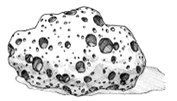 9. Pumice is an igneous rock that can float on water. Which of these is most likely pumice?
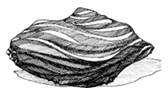
A B
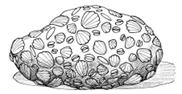
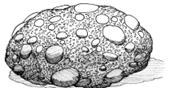
C D
Earth Science SOL Review Sheet #7 : Natural Resources
Essential Knowledge and Skills
· Renewable resources can be replaced by nature at a rate close to the rate at which they are used. Renewable resources include vegetation, sunlight, and surface water.
· Non-renewable resources are renewed very slowly or not at all. Non-renewable resources include coal, oil, and minerals.
· Fossil fuels are non-renewable and may cause pollution, but they are relatively cheap and easy to use.
· In Virginia, major rock and mineral resources include coal for energy, gravel and crushed stone for road construction, and limestone for making concrete.
· Analyze the advantages and disadvantages of various energy sources.
Important Words You Need to Know:
coal: a sedimentary rock composed of combustible matter derived from the partial decomposition of plant material
environment: the sum of all the external conditions that affect an organism or community
fossil fuels: fuels formed hundreds of millions of years ago from the remains of dead plants and animals; coal, oil, or natural gas
nonrenewable resource: any resource that cannot be replaced by nature, such as fossil fuels and minerals
oil: a liquid formed as ancient plants and animals decayed; burned as a fossil fuel and used to make lubricants and plastics
pollution: release into the environment of substances that change the environment for the worse
renewable resource: any resource that can be replaced by nature, such as water, soil, and living resources
solar energy: energy from the sun
Now You Try It!
Practice Questions: Circle the correct answer!
1. Which of the following is NOT one of Virginia's rock and mineral resources?
A Coal
B Limestone
C Trees
D Granite
2. Which of the following Virginia natural resources is used as fuel for making electricity?
AX Coal
B Limestone
C Sand and gravel
D Arable land
3. Plants will not grow in soil that contains oil. Why is it a BAD idea to pour oil along fence lines to stop weed growth?
AX The oil will seep into the ground and pollute the ground water
B All of the weeds would die_
C The oil would damage the fence
D The oil could be used to kill weeds in a garden instead
4. The device shown in this picture produces electricity from what natural resource?
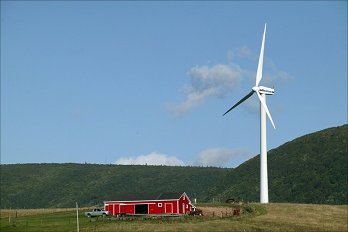
AX Oil
B Wind
C Sun
D Water
5. Which of these is a reason why the use of paper products is good for the environment?
A They are inorganic and do not break down easily
BX They are made from a renewable resource
C They are not recyclable
D They are made from fossil fuels
6. Resources that are used faster than nature can replace them are referred to as–
A Renewable resources
B Fossil fuels
C Pollution
D X Nonrenewable resources
7. Which of the following is NOT a fossil fuel?
A Coal
B Wood
C Petroleum
D Natural gas
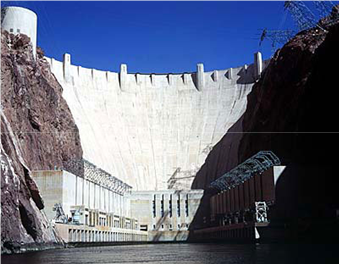
8. This is the Hoover Dam. It generates electricity using turbines to capture the energy from falling water. What is this type of energy called?
A Geothermal
B Nuclear
C Solar
D Hydroelectric
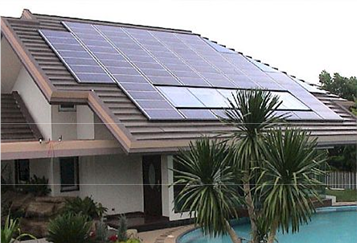
9. This house has a device on its roof that transforms sunlight into electricity. What is this type of energy called?
A Geothermal
B Nuclear
C Solar
D Hydroelectric
10. You overheard part of a conversation… ”It is a nonrenewable resource. We are partially dependent on foreign countries to supply this to us. Using it creates air pollution.” Which type of energy resource was being discussed?
A Wind
B Fossil fuels
C Solar
D Hydroelectric
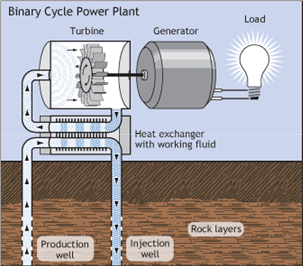
11. This diagram illustrates how heat from inside the Earth can be used to create electricity. What is this type of energy called?
A Geothermal
B Nuclear
C Solar
D Hydroelectric
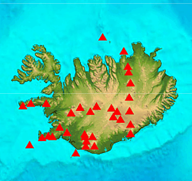
12. This is a map of Iceland that shows the locations of active volcanoes. With this information, which type of energy resource might be possible there?
A Geothermal
B Nuclear
C Solar
D Hydroelectric
Earth Science SOL Review Sheet #8 : Weathering and Erosion
Essential Knowledge and Skills
· Weathering is the process by which rocks are broken down chemically and physically by the action of water, air, and organisms.
· Erosion is the process by which Earth materials are transported by moving water, ice, or wind.
· Deposition is the process by which Earth materials carried by wind, water, or ice settle out and are deposited.
· Soil is loose rock fragments and clay derived from weathered rock mixed with organic material.
· Karst topography includes features like caves and sinkholes.
· Karst topography forms when limestone is slowly dissolved away by slightly acidic groundwater.
· Where limestone is abundant in the Valley and Ridge province of Virginia, karst topography is common.

|
Из за большого объема этот материал размещен на нескольких страницах:
1 2 3 4 5 6 7 |
